
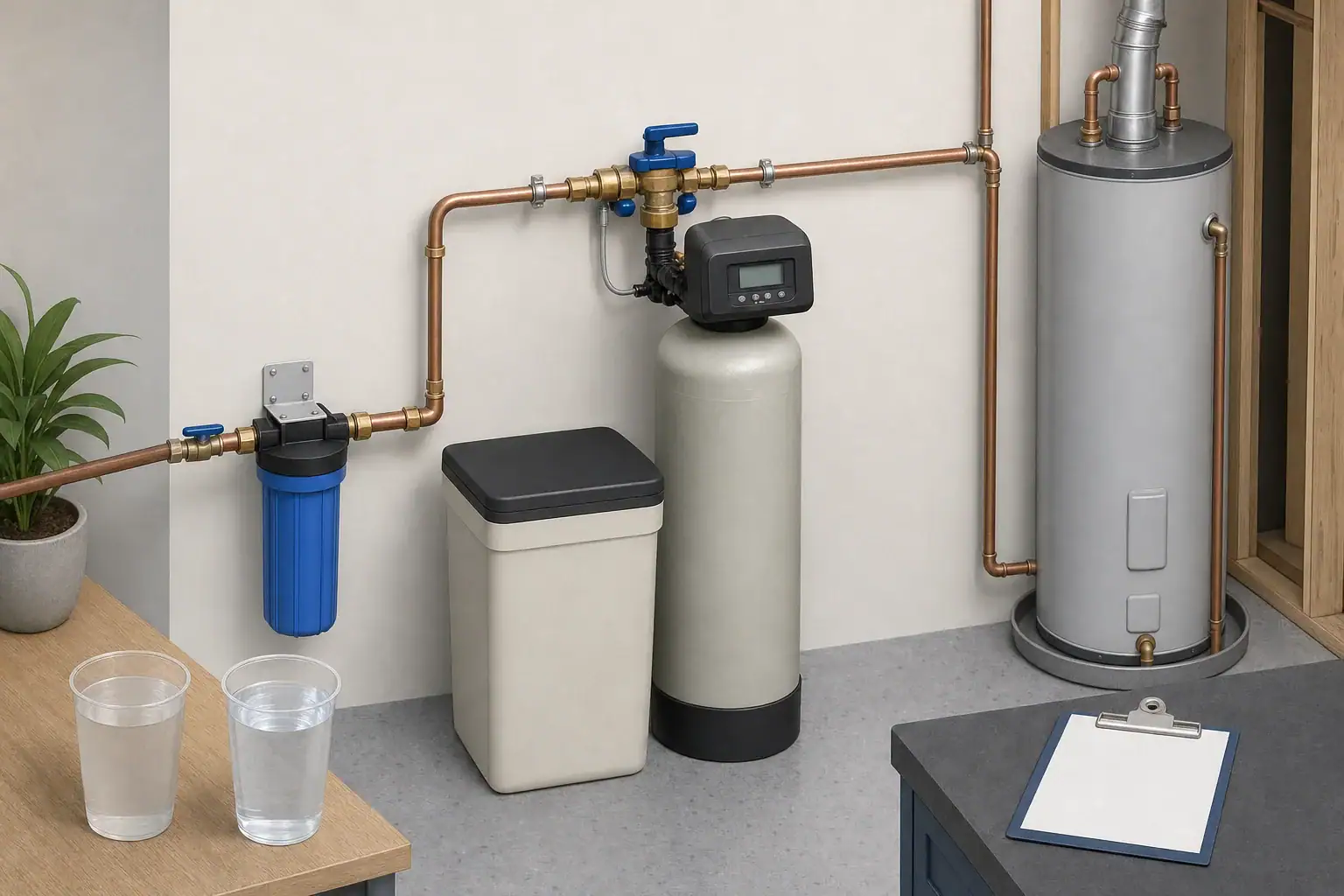
Quick answer: First, compare untreated water with a cold-water sample confirmed to be downstream of the softener. If both test similarly hard, check the bypass, regeneration history, salt condition, programming, and recent demand. If only hot water or one fixture tests hard, investigate stored water or a plumbing branch before blaming the softener.
Water still hard after softening? Test before changing settings
Spots, scale, taste, how water feels, and a total dissolved solids (TDS) reading do not measure hardness directly. Hardness primarily comes from dissolved calcium and magnesium compounds, according to the U.S. Geological Survey’s explanation of water hardness. Use a total-hardness test that provides a numerical result or a clearly defined result band.
Do not start by changing controller settings, running repeated regeneration cycles, or assuming the resin needs replacement. The useful first question is simpler: is hard water actually reaching an outlet that is known to be supplied by the softener?
1. Compare untreated and softened cold-water samples
Collect two samples close together in time. Use the same test method, range, units, sample volume, timing, and interpretation instructions for both.
- Untreated sample: Collect from a point known to be upstream of the softener or intentionally left unsoftened.
- Treated cold-water sample: Collect from a cold-only outlet confirmed to be downstream of the softener. Avoid a faucet or appliance that may combine softened and unsoftened water.
Sample location matters. The GE GXSF27E/GXSF31E manual specifically cautions that a test faucet may not be plumbed exclusively to soft water and tells users to choose a faucet that does not mix hard and soft supplies. Its plumbing and service instructions are model-specific, but the sampling caution is broadly useful. See the GE GXSF27E/GXSF31E owner’s manual.
For guidance on the testing step itself, see how to test water hardness at home. A hardness result addresses hardness only; it does not answer unrelated water-quality questions.
| What you observe | What it may indicate | Practical next step |
|---|---|---|
| Untreated water is hard and treated cold water is similarly hard | Water may be bypassing the softener, or the unit may not be regenerating or operating as intended. | Check the bypass, cycle status, salt condition, programming, and recent demand. |
| Treated cold water is softer, but one fixture remains hard | That fixture may be on an unsoftened branch or may mix supplies. | Test another confirmed softened outlet and verify the plumbing route. |
| Treated cold water is softer, but hot water remains hard | The water heater may contain water from before the softener returned to service. | Review recent operation and follow the heater and softener manuals. |
| Hardness is noticed after unusually heavy simultaneous use | Demand or capacity between regenerations may be involved. | Compare the usage pattern with the exact model’s performance data. |
| Untreated water does not test hard with the selected method | The original symptom may not be caused by hardness. | Confirm the test range and investigate the symptom separately. |
2. Confirm the bypass is in its service position
A bypass routes water around the treatment tank. Check every relevant valve against the service position shown on the equipment label or in the exact owner’s manual. Do not use a generic rule about a handle pointing with or across a pipe; bypass designs vary.
If a valve is difficult to move, leaks, has no clear label, or the flow path is uncertain, do not force it. A qualified plumber or authorized service provider can identify the configuration without risking damage to a valve or pressurized plumbing.
3. Verify that regeneration finished normally
Before initiating another cycle, review the display and operating history. Look for:
- Loss of power or an incorrect clock
- An error code or an interrupted cycle
- A regeneration that is still active
- A schedule or demand calculation that did not trigger as expected
- Unusually high household use near the regeneration period
Avoid using a sample collected during regeneration as the basis for diagnosing normal service. The Whirlpool WHES48 manual lists interrupted operation, incorrect settings, excessive water use, bypass position, salt bridging, changing incoming hardness, and hot-water use during regeneration among possible causes of hard-water symptoms. Those are useful troubleshooting categories, but the manual’s settings and button procedures apply only to that model. See the Whirlpool WHES48 operating manual.
For a model-specific discussion of household water use during the cycle, read can you use water while a water softener regenerates?
4. Inspect whether salt is available for brine preparation
Seeing salt in the tank does not, by itself, confirm that the softener prepared brine correctly. Without dismantling equipment, compare the salt level and physical condition with the owner’s manual. Note whether the level changes over normal operation and whether salt appears suspended above an empty space, which may suggest bridging.
Use only the inspection or correction procedure authorized for the exact model. Do not insert sharp tools into the tank, add chemicals, or alter brine settings based on generic instructions. If salt does not appear to be used and the manual’s external checks do not explain why, record that observation for service.
5. Review programming against the current untreated-water result
Compare the current untreated-water hardness result with the value entered in the controller. Confirm that the test and controller use the units specified in the manual. Also check the displayed clock, regeneration mode, configured capacity, reserve behavior, and any source-water adjustments the manufacturer specifically calls for.
Do not copy another household’s settings or convert values from memory. There is no universal hardness setting, capacity setting, reserve setting, or salt dose that fits every softener and water supply. If incoming hardness has changed, use the exact manual or consult a qualified provider before editing the controller.
6. Compare peak demand with model-specific performance data
Write down what was running when hard water was noticed: showers, faucets, washing machines, irrigation branches connected to softened water, or other high-use fixtures. Include known leaks and unusually high recent consumption, which can use capacity sooner than expected.
Then compare that pattern with the exact unit’s published service flow and capacity rather than a generic household threshold. For example, the WHES48 manual publishes performance data for that model and warns that continuous use above its rated service flow can affect capacity and efficiency. That value is not transferable to another softener. For context on why system capacity and use patterns matter, see water filter capacity claims: gallons, months, and real-world usage.
Why only hot water may still test hard
A water heater stores water, so its contents can reflect conditions before the softener returned to service. It may also have received hard water while the softener was bypassed or regenerating. Whirlpool’s WHES48 troubleshooting guidance specifically notes that a heater can fill with hard water during regeneration. See the WHES48 manual.
Test a confirmed treated cold-water outlet first. If that sample shows lower hardness than the untreated sample, consult both the water-heater and softener manuals for their normal operating and service instructions. Do not drain, flush, or alter a water heater unless its manufacturer provides an appropriate procedure for that equipment.
Measurement and manual-reading checklist
- Softener manufacturer, model, and serial number
- Exact owner’s manual and model performance sheet
- Hardness-test type, range, units, and expiration status
- Date, time, sample temperature, and reported result for each test
- Confirmed untreated sample point and result
- Confirmed downstream cold-water sample point and result
- Hot-water and single-fixture results, when relevant
- Bypass position as defined by the label or manual
- Display status, clock, error codes, and last completed cycle
- Salt level, physical condition, and whether it appears to change over time
- Programmed hardness, capacity, reserve, and displayed units
- Recent high use, simultaneous fixtures, and known leaks
- Rated service flow and capacity from the exact model documentation
When professional service is appropriate
Arrange service if a valid downstream cold-water sample remains about as hard as the untreated sample after the manual’s external checks. Also seek service for a persistent error, continuous flow to drain, leaking valves, suspected internal bypass leakage, apparent failure to draw brine, damaged controls, or any diagnosis that requires opening pressurized valve components.
A hard-water result alone does not establish that resin needs replacement. Give the technician the paired test results, sample locations, programmed values, cycle history, salt observations, and recent demand notes. These details can help separate a plumbing or setup issue from an internal equipment fault.
FAQ
Can a TDS meter confirm that a water softener is working?
No. A TDS reading is not a direct hardness measurement and should not replace a total-hardness comparison between untreated water and a confirmed treated cold-water outlet. See TDS vs. hardness: what’s the difference?
Does NSF/ANSI 44 prove that every water softener will solve a hard-water problem?
No. Certification and claims are model-specific. The official NSF/ANSI 44 product directory lists individual products and their claims. A reference to the standard alone does not confirm certification for every model or diagnose an installation problem.
Until the cause is identified, avoid unsupported setting changes and repeated regeneration. A controlled comparison of untreated and downstream cold water is the clearest starting point for separating a softener issue from stored hot water or household plumbing.
- NSF/ANSI standards explained (42/53/401/58)
- Clear trade-offs: pitcher vs faucet vs under-sink vs RO
- Maintenance planning: cost per gallon and replacement cadence