
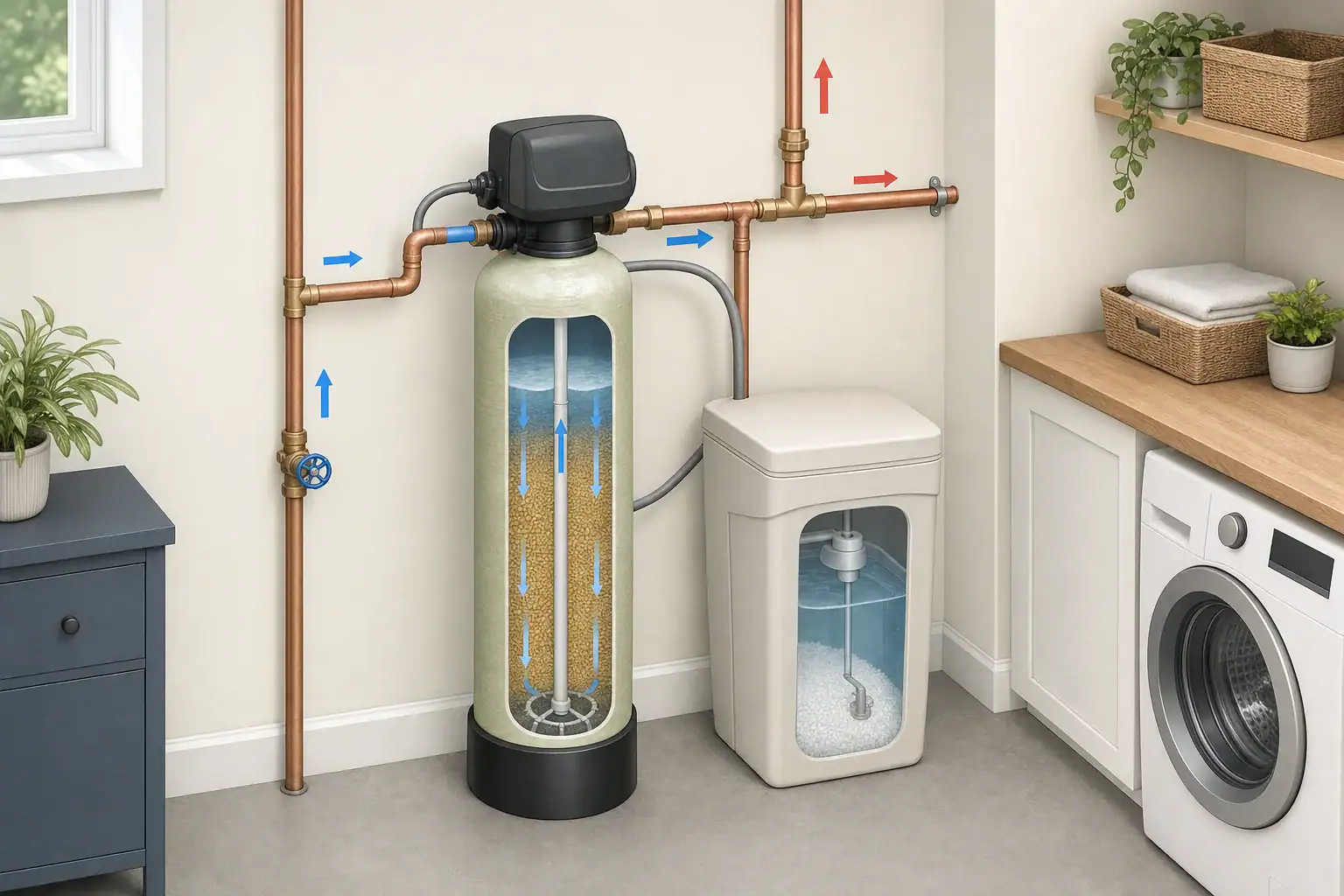
Quick answer: Often, household water remains available while a water softener regenerates, but it may be untreated hard water on bypass-style models. Alternating twin-tank softeners can continue supplying softened water. Check your exact manual; if the design is unknown, delay optional hot-water use, laundry, and dishwashing until service resumes.
Can you use water while a water softener regenerates?
Whether you can use water during regeneration depends on what your softener’s control valve supplies during the cycle. Regeneration restores the capacity of ion-exchange resin by displacing collected hardness ions and rinsing the resin. The cycle may include backwash, regenerant application, dilution, and rinsing, although the sequence varies by system.
Some units send untreated water to household fixtures while the resin tank regenerates. Other systems use two alternating resin tanks, allowing one tank to treat water while the other regenerates. Do not assume that two tanks visible in a utility room means you have a twin-tank softener: one may simply be the brine tank.
| What your manual documents | Likely household supply during regeneration | Practical approach |
|---|---|---|
| Hard-water bypass or similar wording | Water may remain available, but it is not softened | Follow the manual; postpone hot-water-heavy and soft-water-dependent tasks |
| Alternating twin resin tanks that maintain service | The second tank continues treating water | Normal use may be appropriate within the manual’s stated limits |
| Model or service arrangement is unknown | Treatment status is unknown | Wait for the controller to return to service before optional high-use tasks |
Why the softener design changes the answer
Single-tank or bypass-water arrangements
A bypass arrangement can keep water flowing to fixtures while the resin is unavailable for normal softening. This does not mean every single-tank softener works the same way. For example, the Whirlpool WHES40/WHES44 installation and operation manual says to avoid hot-water use during regeneration because the water heater can refill with bypass hard water. That instruction applies to the identified Whirlpool models, not automatically to all softeners.
Alternating twin-resin-tank systems
Some twin-tank designs automatically switch household service to a second resin tank. The Kinetico Signature Series 735/935 owner’s manual describes one tank providing treated water while the other regenerates. This is a design-specific capability, so confirm it in the documentation for your own model.
A separate salt or brine tank stores brine for regeneration; it is not, by itself, a second softening tank. Use the complete model number and control-valve information—not tank count or brand alone—to identify the service arrangement.
What household uses should wait?
If the manual says the unit bypasses hard water during regeneration, or if you cannot verify what it does, wait to start uses that draw a large amount of warm or hot water:
- Showers and baths
- Warm or hot laundry loads
- Dishwasher cycles
- Extended hot-water use at sinks
This is particularly important when the manufacturer warns that bypass hard water can enter the water heater. Rheem’s guidance for its equipment permits brief cold-water use during recharge but advises against hot water, bathing, and laundry. Treat this as model-specific guidance rather than a rule for every brand.
A toilet flush or brief cold-water draw may be allowed by a particular manual, but the water may be unsoftened. Do not change valve positions or try to stop a normal cycle solely to run an optional appliance unless the manufacturer instructs you to do so.
Does temporary hard water mean the water is unsafe?
No conclusion about drinking-water safety follows from hardness alone. Hardness primarily reflects dissolved calcium and magnesium. The U.S. Geological Survey’s overview of water hardness describes effects such as soap scum and scale, especially when hard water is heated.
A temporary return of hard water may affect cleaning results or contribute to scale, but it does not by itself show that water is unsafe or safe. Water-safety decisions depend on the source water and relevant contaminants. Do not use taste, odor, clarity, or TDS readings alone as evidence of potability. Follow applicable utility notices, and use appropriate testing guidance for private wells.
How to schedule regeneration around water use
Choose a low-demand period that your controller and manual allow. There is no universal best start time or regeneration duration. EPA’s WaterSense guide to water-efficient softeners advises that non-demand regeneration schedules account for softener capacity, incoming hardness, and household treated-water use. Regenerating more often than needed can waste salt and water.
Check whether your controller distinguishes between an immediate command and a delayed command such as “tonight.” After a power outage, verify the clock if your manual requires it; an incorrect clock can move a scheduled cycle into a high-use period.
Manual-reading checklist before you run water
- Identify the full model: Record the manufacturer, complete softener model, and control-valve number.
- Find the service wording: Search the manual for “bypass,” “hard water,” “recharge,” “regeneration,” “continuous soft water,” or “alternating tanks.”
- Read the current display: Note the cycle stage, remaining time if shown, and the indicator for return to normal service.
- Check appliance warnings: Look specifically for instructions about hot water, bathing, laundry, dishwashers, and water heaters.
- Review available capacity information: If the controller displays remaining gallons, reserve, or capacity, use it to plan—not to alter settings without instructions.
- Leave plumbing controls as documented: Do not reposition an external bypass valve unless the manual directs you to do so.
Related guides: Whole house filters vs. water softeners · Water softener salt pellets vs. crystals · Managing hard-water residue and shower scale
The safest default when the design is unknown
Wait until the controller shows normal service or the cycle has completed before starting a shower, dishwasher, laundry load, or other optional high-demand task. This conservative approach avoids assuming that an unfamiliar softener continues to supply softened water during regeneration.
Frequently asked questions
Can I flush the toilet while my water softener regenerates?
Many installations continue to supply water during regeneration, but the water may be unsoftened on a bypass-style model. Check the manual for your equipment. If its behavior is unknown, a necessary flush is different from starting an optional high-volume task.
Can I drink water while my softener is regenerating?
A regeneration cycle does not, by itself, determine whether source water is safe to drink. If your system supplies bypass water during the cycle, it may be harder than normal. Follow any local drinking-water notice and the instructions for your specific treatment equipment.
- NSF/ANSI standards explained (42/53/401/58)
- Clear trade-offs: pitcher vs faucet vs under-sink vs RO
- Maintenance planning: cost per gallon and replacement cadence