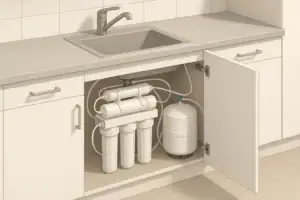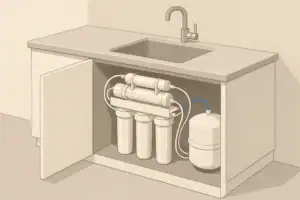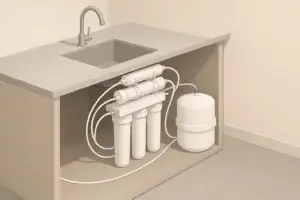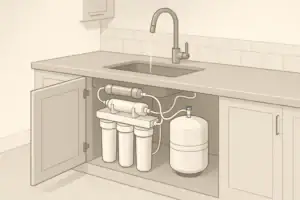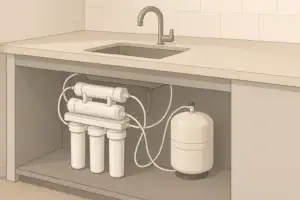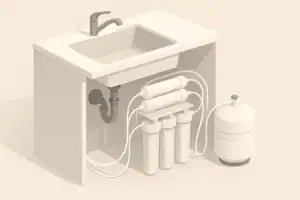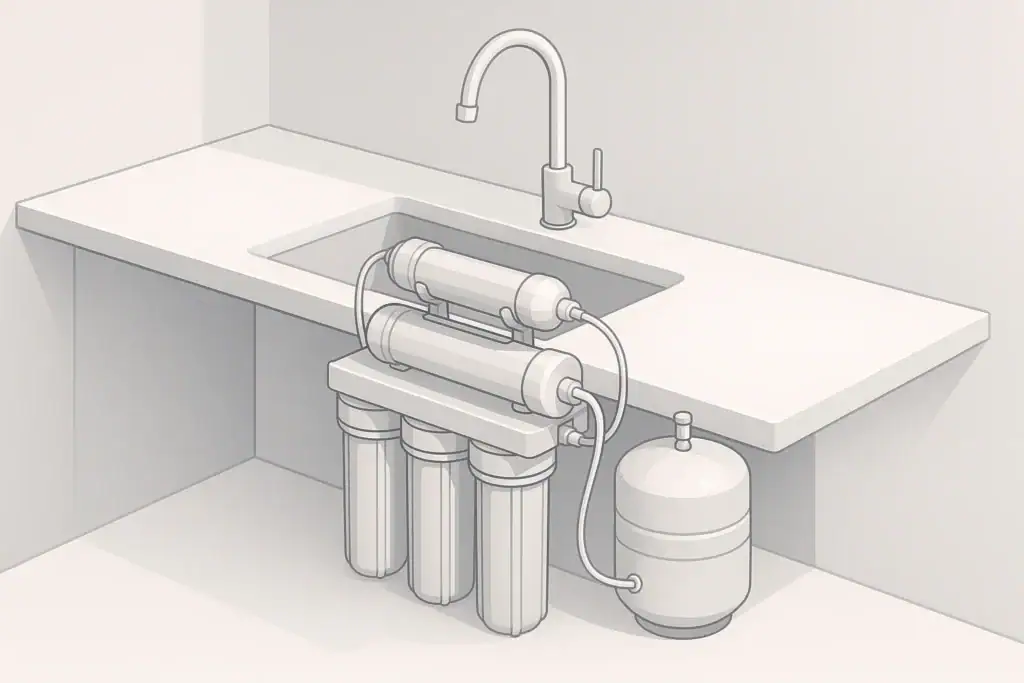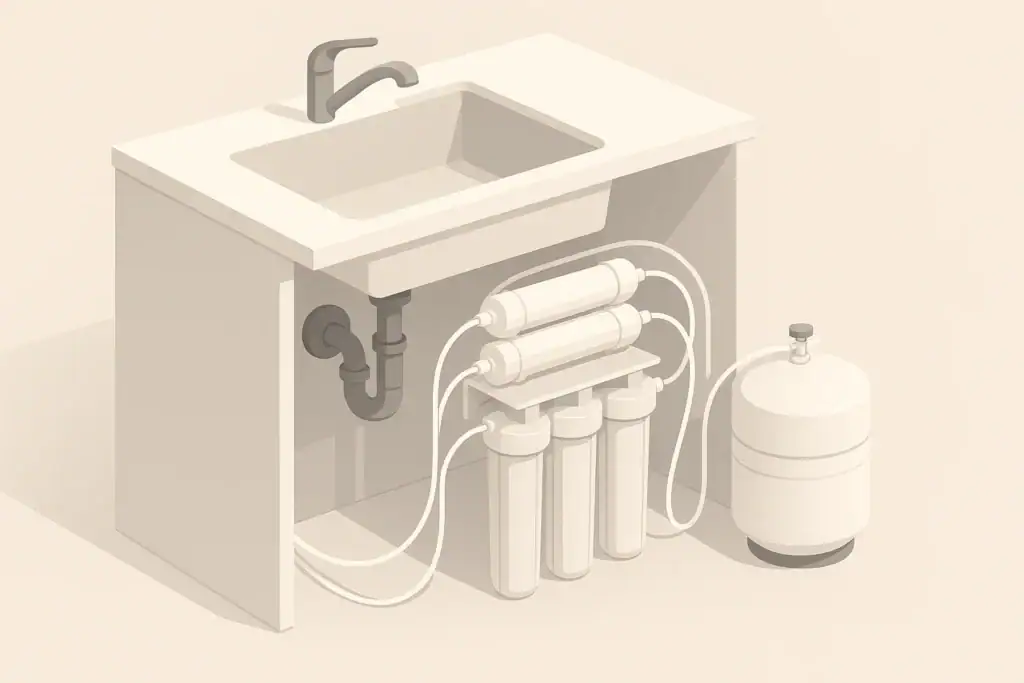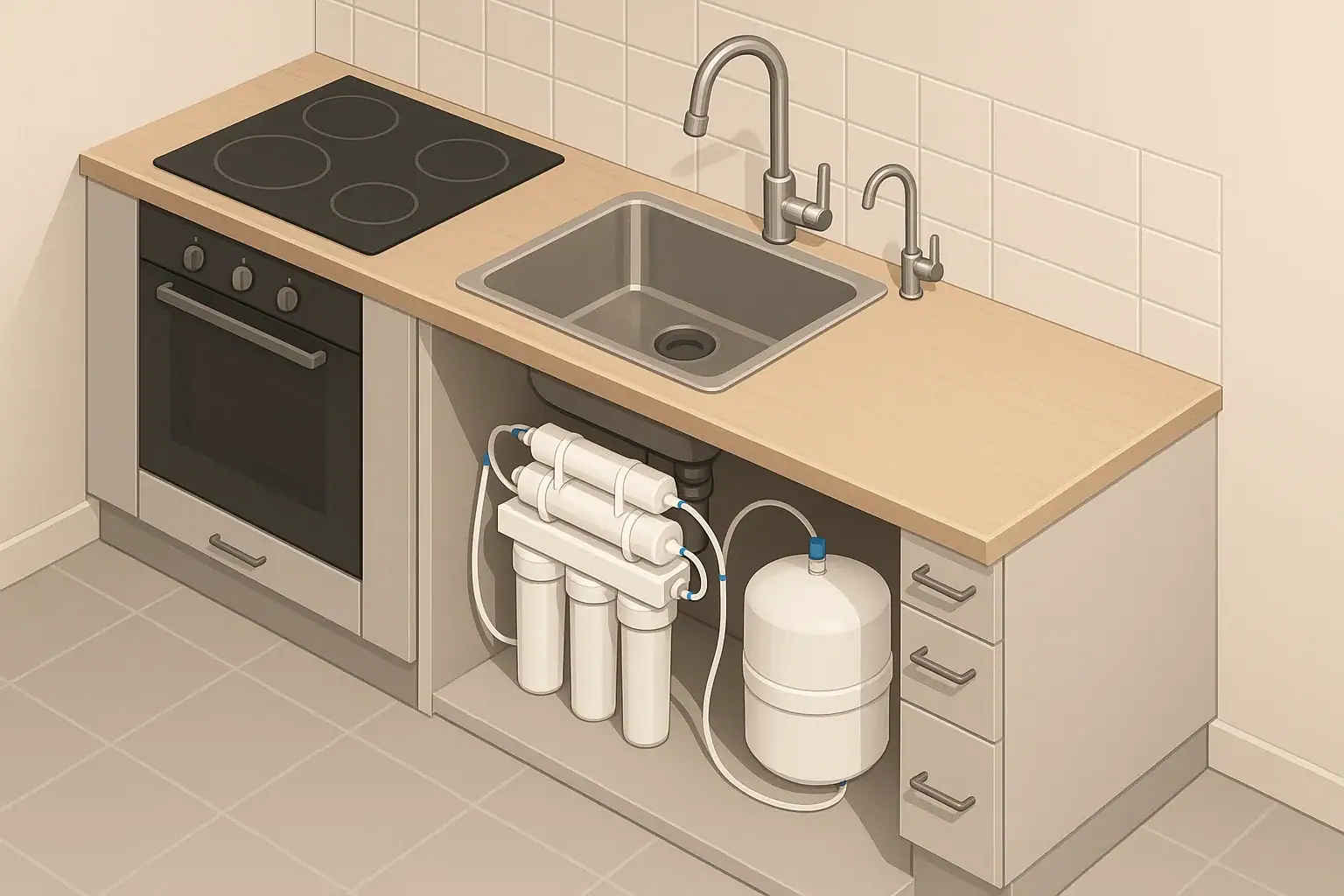
Reverse osmosis (RO) is a point-of-use filtration method that pushes water through a semi-permeable membrane to reduce dissolved solids and many other impurities. For families, RO is most often installed under the kitchen sink to provide better-tasting water for drinking and cooking.
RO systems typically use several stages:
- Sediment pre-filter to capture rust, sand, and other particles
- Carbon pre-filters to reduce chlorine or chloramine and improve taste and odor
- RO membrane to reduce total dissolved solids (TDS) and many contaminants
- Post-filter (often carbon) to polish taste before the water reaches the faucet
Both tank and tankless RO systems use these same basic stages. The main difference is how they store and deliver the purified water.
How Reverse Osmosis Works in a Family Home
Reverse osmosis (RO) is a point-of-use filtration method that pushes water through a semi-permeable membrane to reduce dissolved solids and many other impurities. For families, RO is most often installed under the kitchen sink to provide better-tasting water for drinking and cooking.
RO systems typically use several stages:
- Sediment pre-filter to capture rust, sand, and other particles
- Carbon pre-filters to reduce chlorine or chloramine and improve taste and odor
- RO membrane to reduce total dissolved solids (TDS) and many contaminants
- Post-filter (often carbon) to polish taste before the water reaches the faucet
Both tank and tankless RO systems use these same basic stages. The main difference is how they store and deliver the purified water.
Tank vs Tankless RO: What Is the Core Difference?
In a traditional tank-style RO system, purified water fills a pressurized storage tank under the sink. When you open the RO faucet, water flows from the tank rather than directly from the membrane, which helps maintain a steady flow even though RO purification itself is relatively slow.
In a tankless RO system, there is no storage tank. Instead, the unit uses higher membrane capacity, a pump, or both to produce filtered water on demand. The system is more compact, but the flow rate and performance depend heavily on feed water pressure and system design.
For families, the tank vs tankless decision usually comes down to a few practical questions:
- How much space is available under the sink?
- How many people will use the system daily?
- How important is high flow rate during busy times?
- How hands-on are you willing to be with maintenance?
- How much can you invest upfront versus over time?
| Aspect | Tank RO | Tankless RO |
|---|---|---|
| Under-sink space use | Tank plus filter housings; more bulky | Compact unit; frees up storage space |
| Flow experience at faucet | Draws from pressurized tank; typically steadier | On-demand; may vary with household pressure |
| Typical family size fit | Well suited for 3–6 people with moderate use | Can handle higher daily use if sized correctly |
| Installation complexity | More parts (tank, tubing) but widely familiar | Fewer bulky parts; may need power outlet |
| Wastewater ratio (example only) | Often higher waste to pure water ratio | Some designs aim for lower waste ratio |
| Upfront system cost | Commonly lower | Often higher due to integrated design |
| Long-term flexibility | Easier to swap individual components | More integrated; parts may be system-specific |
Space and Installation Considerations for Families
Under-sink space is limited in many homes, especially in smaller kitchens or condos. The presence or absence of a storage tank has a noticeable impact on usability of the cabinet.
How Much Space Does a Tank RO Use?
Tank-style systems usually include:
- A vertical or horizontal RO tank, often comparable to a small wastebasket in size
- One or more filter housings mounted to the side or back wall
- A dedicated RO faucet on the sink or countertop
For families that store cleaning supplies or bins under the sink, the tank may reduce usable storage. However, the layout is simple, and many installers are familiar with this configuration, which can make installation more straightforward.
How Compact Are Tankless RO Systems?
Tankless systems typically integrate filters and the RO membrane in a single rectangular or vertical module. This can free up floor space inside the cabinet for other items.
However, families should check for:
- Electrical outlet needs, since many tankless units use a pump and require power
- Clearance for filter changes, including pull-out or twist-off cartridges
- Access to cold-water line and drain without sharp bends in tubing
If your kitchen plumbing is tight, or you are adding other under-sink equipment such as a garbage disposal or hot water dispenser, a tankless system may simplify the layout.
Water Quality, TDS, and Taste Differences
Both tank and tankless RO systems rely on membrane performance and pre/post-filtration, so their water quality potential is similar when designed and maintained correctly.
TDS Reduction and Membrane Performance
Reverse osmosis membranes are selected by their nominal rating and tested under specific conditions. Whether the system has a tank or not, factors that influence actual TDS reduction include:
- Feed water TDS and hardness
- Water pressure and temperature
- Age and condition of pre-filters and the membrane
- Adherence to maintenance schedules
Some tankless systems emphasize consistent TDS output due to more controlled flow and pressure. Tank systems, if used heavily in bursts, sometimes show small variations in TDS as the tank empties and refills. For most families, these differences are minor when filters are replaced on time.
Taste, Odor, and Stale Water Concerns
A common question is whether water stored in an RO tank becomes “stale.” Properly functioning systems include a post-filter and food-grade tank components. If the system is used regularly and maintained according to manufacturer guidance, tank water is routinely refreshed.
Tankless RO avoids longer-term storage altogether by producing water on demand. Families that are very sensitive to taste may prefer this, but most households find taste differences small as long as:
- Carbon filters are replaced at recommended intervals
- The system is flushed after long periods of non-use (such as vacations)
- Any tank sanitization procedures are followed during membrane replacement or major service
Flow Rate, Family Size, and Daily Use
Flow rate is a major factor for multi-person households that fill bottles, cook large meals, or brew coffee and tea regularly.
How Tank RO Handles Peak Demand
RO purification is relatively slow, but a full storage tank can deliver water at a comfortable rate until the tank empties. For a typical family:
- The tank may comfortably supply several glasses, cooking pots, and small appliances in a row.
- Once the tank is drawn down, it refills gradually over time, depending on input water pressure and membrane capacity.
If your family often draws large volumes back-to-back—for example, filling multiple large jugs—you may notice a drop in flow and will need to wait for the tank to refill.
How Tankless RO Manages On-Demand Flow
Tankless systems rely on the membrane output and any booster pump. Under good conditions, they can deliver continuous flow without waiting for a tank to refill. However:
- Flow may be lower if household water pressure is marginal.
- Flow can vary when other fixtures (showers, laundry) are in use.
- Some systems are designed to prioritize efficiency over maximum flow.
Families with high simultaneous demand might prefer tankless if they have solid water pressure and want steady on-demand output, or they might choose a larger tank-style system for more stored capacity.
Water Waste, Efficiency, and Environmental Considerations
All RO systems produce a concentrated wastewater stream that carries away rejected dissolved solids and other impurities. The ratio of wastewater to purified water varies by design and conditions.
Typical Waste Ratios (Illustrative Only)
As an example, some residential RO systems might send several liters of wastewater down the drain for every liter of purified water, while others—especially more recent designs—aim to reduce this ratio. Tank or tankless format alone does not determine efficiency. Influencing factors include:
- Presence of a booster pump to maintain optimal membrane pressure
- Membrane size and configuration
- Wastewater control valves and flow restrictors
- Feed water pressure, temperature, and TDS
Some tankless systems are marketed around improved efficiency, but families should always check the claimed waste ratio in context and understand that actual performance can differ from ideal test conditions.
Household Strategies to Use RO Water Wisely
Regardless of system type, families can reduce overall impact by:
- Using RO water primarily for drinking, cooking, and beverage prep, not for tasks like dishwashing
- Considering ways to reuse wastewater where allowed and practical, such as certain cleaning tasks (if local plumbing codes permit and if wastewater routing is set up safely)
- Checking that any integrated booster pump is properly adjusted to maintain efficiency
Maintenance, Filter Changes, and Costs Over Time
Both tank and tankless RO systems require ongoing maintenance. For families, the ease of remembering and performing filter changes can be as important as the technical differences between formats.
Typical Maintenance Tasks
Common maintenance items include:
- Pre-filters (sediment and carbon): usually replaced every several months to a year, depending on usage and water quality
- RO membrane: often replaced every few years, based on TDS performance and manufacturer guidance
- Post-filter: generally changed on a similar schedule to pre-filters or as specified
- Tank sanitization (tank systems): performed during membrane changes or when recommended
- Leak checks: quick visual inspections around fittings, tubing, and the drain saddle
Maintenance Differences: Tank vs Tankless
Tank systems often use separate filter housings with individual cartridges. Tankless units may use integrated cartridges or multi-stage modules. Practical differences for families include:
- Filter access: Tankless units may place filters behind a front panel or in an easily accessible bay, while tank systems might require clearance under the cabinet for wrench-operated housings.
- Tank care: Tank-style systems add the step of occasional tank sanitization and checks on tank pressure.
- Reminder methods: Some tankless models include indicator lights or timers; tank systems often rely on calendar reminders or TDS meter checks.
For budgeting, families can estimate annual filter costs by adding up the expected replacement price of pre-filters and post-filters, then spreading membrane cost over its expected life. Cost per gallon is generally modest compared with bottled water, but it varies by system, local water quality, and usage.
| Component / Task | Typical interval (example only) | Cues to check | Planning method |
|---|---|---|---|
| Sediment pre-filter | Every 6–12 months | Noticeable drop in flow; visible discoloration | Mark replacement dates on a calendar or app |
| Carbon pre-filter | Every 6–12 months | Return of chlorine smell or taste | Change together with sediment filter when possible |
| RO membrane | Every 2–5 years | Rising TDS readings at faucet; slower production | Check TDS annually and log readings |
| Post carbon filter | Every 6–12 months | Flat or off taste despite good TDS | Replace with pre-filters for simplicity |
| Tank sanitization (tank systems) | During membrane change or as recommended | Service event; not usually cue-based | Combine with major service to reduce downtime |
| Leak inspection | Monthly quick check | Moisture around fittings, cabinet floor | Align with other routine kitchen checks |
Certifications, Standards, and What to Verify Before Choosing
Whether you choose tank or tankless RO, independent certifications can help you understand what the system is designed to do. In the United States, many drinking water treatment units refer to NSF/ANSI standards. For RO systems, NSF/ANSI 58 is the most directly relevant, but other standards can apply to specific components.
Key points for families when reviewing specifications include:
- Which standards the complete system (not just individual parts) is certified to
- Which contaminant claims are covered under those certifications
- Any operating conditions tied to test results, such as pressure and temperature ranges
Verifying certifications typically involves checking markings on the product literature and, when possible, confirming listings with the certifying body. This helps ensure that performance claims have been evaluated under standardized test conditions.
Which Is Better for Your Family: Tank or Tankless RO?
Neither tank nor tankless RO is universally “better.” The right fit depends on your household’s patterns and constraints.
A tank-style RO may suit your family if you:
- Have enough under-sink space for a storage tank
- Prefer a familiar design with wide availability of replacement parts
- Want a steadier faucet flow during short bursts of use
- Are comfortable with occasional tank maintenance
A tankless RO may be a better match if you:
- Have limited cabinet space and want a compact footprint
- Have adequate water pressure (or built-in boosting) to support on-demand flow
- Prefer simpler cabinet organization without a separate tank
- Like the idea of minimizing stored water and relying on real-time production
For many families, both systems can provide similar water quality when maintained properly. Focusing on space, flow expectations, maintenance style, and verified certifications will help guide a practical, long-lasting choice.
Frequently asked questions
How do tank and tankless RO systems differ in daily water availability for a family?
Tank systems store pressurized purified water and can deliver a steady flow for short bursts until the tank empties, which is helpful for filling multiple containers quickly. Tankless systems produce water on demand and can provide continuous flow if the membrane capacity and feed water pressure are sufficient, but their performance may drop if pressure is low or many fixtures run simultaneously.
Which system typically wastes less water: tank or tankless RO?
The tank vs tankless format by itself does not determine wastewater; waste ratios depend on factors such as membrane size, presence of a booster pump, flow restrictors, and feed water conditions. Some modern tankless designs aim to reduce waste, but actual efficiency varies and should be evaluated using manufacturer data and real-world conditions.
How much under-sink space should I reserve for a tank-style RO system?
Expect a tank-style RO to occupy space roughly comparable to a small wastebasket plus room for filter housings and tubing, which can reduce usable cabinet storage. Measure your cabinet and compare with the tank and housing dimensions before purchasing to ensure a proper fit.
Are there taste or sanitation differences between stored tank water and on-demand tankless water?
When maintained properly, both formats deliver similar taste because of post-filtration and food-grade components; stored tank water is routinely refreshed during use. Tankless systems avoid storage entirely, which may appeal to users sensitive to storage, but differences are minimal if filters and tank sanitization (for tank units) are performed as recommended.
What maintenance tasks are unique to tank systems compared to tankless units?
Both system types require routine pre-filter, post-filter, and membrane changes, but tank systems add occasional tank sanitization and periodic checks of tank air pressure. Tankless units may use integrated cartridges and can include indicator lights or timers to simplify reminders, while tank systems often rely on calendar planning or TDS checks.
Recommended next:
- Reverse Osmosis 101: What RO Removes (and What It Doesn’t)
- NSF/ANSI 58 Explained: What It Means for RO Systems
- RO vs Carbon Under-Sink: Taste, TDS, and Maintenance Compared
- RO System Installation Guide: Space-Saving Layout Under the Sink
- RO Waste Water Ratio: What’s Normal and How to Reduce It
- RO Filter Replacement Schedule: Prefilters vs Membrane
- More in Reverse Osmosis (RO) →
- NSF/ANSI standards explained (42/53/401/58)
- Clear trade-offs: pitcher vs faucet vs under-sink vs RO
- Maintenance planning: cost per gallon and replacement cadence