
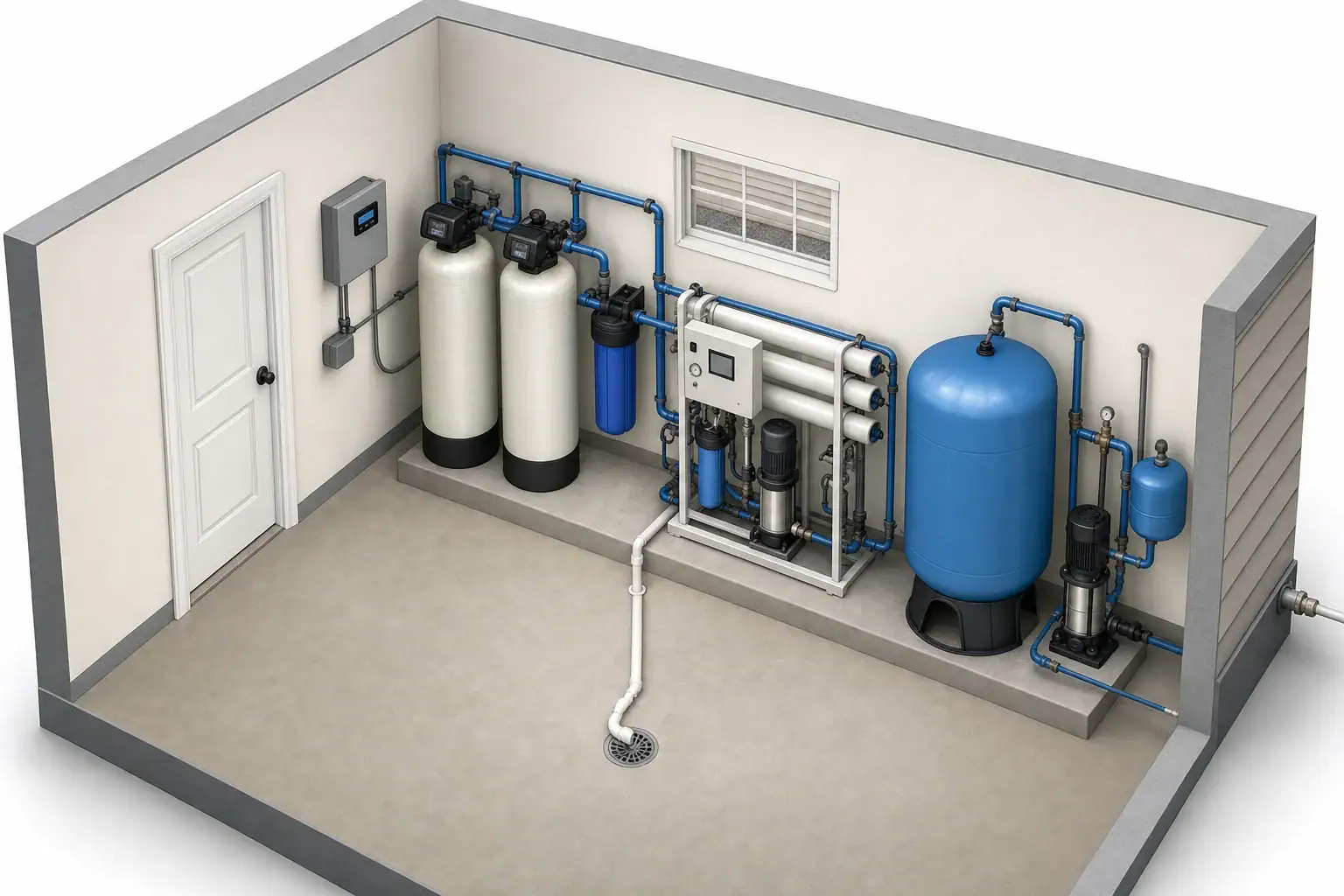
Quick answer: A whole house reverse osmosis system can make sense when testing confirms a dissolved-water problem that affects uses across the home and the proposed equipment documents an applicable claim. It needs a complete design for pretreatment, production, storage, delivery pressure, drainage, monitoring, and service—not just an RO membrane.
When does a whole house reverse osmosis system make sense?
A whole house reverse osmosis system is a specialized point-of-entry treatment design, not a default upgrade. Start with a defined water-quality objective: identify what is in the water, its measured concentration, and whether treatment is needed throughout the building rather than only at a drinking-water tap.
The EPA WaterSense guide to selecting home water-treatment systems advises using a Consumer Confidence Report or laboratory results to identify a treatment need and considering where treated water is needed. It notes that uses such as toilet flushing and clothes washing may not need additional treatment. The CDC’s home water-treatment guidance similarly advises testing first, selecting treatment for the chemicals or germs identified, and checking the product label for the specific claim.
Neither source establishes a universal TDS result or contaminant concentration at which every household needs whole-home RO. The decision should follow the test result, the treatment objective, and a site-specific design.
What test results support an RO design evaluation?
A useful analysis identifies the constituents relevant to the treatment goal and the feed-water characteristics needed to assess the proposed membrane and pretreatment. A single total dissolved solids reading is not enough to identify individual dissolved substances or determine potability.
- Confirmed dissolved-water concern: The exact proposed system has documentation relevant to the identified constituent and operating conditions.
- Broad salinity concern: Dissolved salts affect a large enough share of indoor uses that treatment at one tap would not meet the practical goal.
- Multiple verified dissolved constituents: A complete treatment train, rather than separate point treatments, is justified by the documented need and design.
- Defined process need: A specific appliance or building use requires lower-mineral water in a defined part of the plumbing system.
TDS is a measure of dissolved material, not a contaminant identification or safety verdict. The USGS overview of salinity uses dissolved-salt classifications to describe water, but those classifications are not health determinations or automatic thresholds for whole-home RO.
Taste, odor, clarity, and a low TDS reading also do not establish that water is safe. If testing identifies a microbial issue, follow the laboratory report and applicable public-health guidance; do not assume a general RO claim replaces source correction or validated disinfection.
Whole-home RO or treatment at one tap?
| Verified situation | Reasonable starting point | Key question |
|---|---|---|
| Concern is limited to drinking and cooking water | Point-of-use treatment matched to the test result | Why produce treated water for showers, toilets, laundry, or outdoor use? |
| Hardness or scale is the main concern | Evaluate hardness-specific treatment | Is broad dissolved-material reduction actually needed? |
| Taste, odor, or disinfectant is the concern | Evaluate contaminant-specific filtration | What substance is causing the concern, and where is treatment needed? |
| Verified salinity or dissolved-water concern affects most indoor uses | Consider a whole-home RO design evaluation | Can the design meet both the treatment objective and household demand? |
| Water quality is unknown or a microbial result is present | Obtain qualified guidance and address the source or validated treatment need | What do the laboratory report and local authority recommend? |
Point-of-use treatment is not automatically a lesser choice. When only ingestion water needs treatment, it can avoid the additional production, storage, pumping, drainage, and maintenance required to distribute RO water through a home. For a broader comparison, see whole-house versus point-of-use filters.
Why daily RO production is not household peak flow
Whole-house planning must reconcile two different measurements:
- Membrane production is commonly stated in gallons per day under specified test conditions.
- Household delivery demand is expressed in gallons per minute and can increase sharply when several fixtures operate at once.
An RO membrane generally produces water gradually. Storage provides a reserve, while a delivery pump supplies pressure and short-term flow to fixtures. A membrane rating alone does not establish that the home will have adequate flow during simultaneous use.
Illustrative production-and-storage example
Assume, only for illustration, that a proposed membrane is expected to produce 500 gallons per day at the site’s stated design conditions. Its average production rate is:
500 gallons ÷ 24 hours = about 20.8 gallons per hour
Now assume a simultaneous-use event needs 10 gallons per minute for 10 minutes:
10 gallons per minute × 10 minutes = 100 gallons
The average membrane-production rate cannot directly provide 10 gallons per minute during that event. Usable stored volume and the delivery pump would need to bridge the difference. This is not a sizing recommendation: actual design depends on expected daily use, fixture-demand assumptions, usable tank volume, refill time, feed-water conditions, and the pump curve at the required pressure. A whole-house flow sizing worksheet can help document fixture-demand assumptions.
Production ratings are condition-dependent. For example, the Crystal Quest Thunder 200/300/400 manual states that colder water and higher TDS can reduce output. That warning applies to the named equipment; it is not a universal derating formula for all residential RO systems.
What belongs in a complete treatment train?
A quote should describe a complete system, not merely a membrane. The components depend on the water analysis, plumbing arrangement, treatment objective, and the exact equipment instructions.
Source-specific pretreatment
Feed water outside an RO system’s operating limits can contribute to fouling, plugging, or scale. Ask the designer to compare the water analysis with the exact manual’s limits for applicable factors such as hardness, turbidity, disinfectant residual, iron, manganese, silica, pressure, temperature, and TDS.
Every pretreatment component should have a stated purpose connected to a test result or manufacturer limit. The cited Thunder manual instructs users to evaluate feed chemistry and use pretreatment or adjust recovery as needed to manage scaling and fouling; its requirements are model-specific.
Product-water storage and controls
Many point-of-entry designs use an atmospheric product-water tank. Level controls can start and stop production as stored water changes. Request the tank’s nominal capacity, usable operating volume, reserve basis, refill assumptions, overflow route, low-level protection, sanitation procedure, and service clearance.
Repressurization
Water held in an atmospheric tank is not stored at household delivery pressure. A pump and controls are used to supply the home. Select the pump from its performance curve at the required flow and pressure, rather than from a maximum-flow label alone. One manufacturer’s atmospheric-tank manual describes tank kits using a delivery pump for approximately 40–60 psi; that range is specific to that product line, not a universal household target.
Finished-water assessment
Ask the designer to assess finished-water pH, alkalinity, stability, taste objectives, and compatibility with downstream plumbing and fixtures. Post-treatment may be appropriate in some designs, but remineralization should not be automatically added or omitted. Request the rationale, target conditions, monitoring approach, and replacement requirements for any post-treatment stage.
Plan drainage, space, power, and fault handling
RO produces treated water and a concentrate stream. The quote should state projected product and concentrate volumes under the proposed feed temperature, pressure, chemistry, and operating settings. Do not apply a universal reject-water ratio from unrelated equipment.
The concentrate route must comply with the equipment instructions and applicable plumbing requirements. The cited Thunder manual requires concentrate to flow freely to an open drain without backpressure. Ask the installer to identify the concentrate destination, atmospheric-tank overflow destination, drain-capacity assumptions, and applicable backflow protections on the plan.
Confirm the footprint and service access for pretreatment, membrane equipment, storage, pumps, controls, post-treatment, and replacement work. Electrical requirements, including any dedicated circuit or backup arrangement, should be specified and reviewed by qualified trades.
A bypass plan also needs clear documentation. It should not silently deliver untreated source water as though it were treated water when that would conflict with the system’s intended use. Ask how the system indicates bypass, low tank level, pump failure, overflow, or another fault condition.
How to verify RO certifications and performance claims
A standard number alone does not establish every contaminant claim. NSF’s overview of NSF/ANSI 58 describes the standard as applying to point-of-use RO drinking-water systems. It explains that TDS reduction is required while claims for contaminants such as arsenic, nitrate/nitrite, lead, fluoride, and VOCs are optional.
Therefore, point-of-use NSF/ANSI 58 certification should not be represented as certification of an entire point-of-entry installation. Verify the exact model in the certifier’s current listing and read the scope, rated conditions, replacement components, and named contaminant claims. NSF’s guidance on product labels and literature claims explains why the exact model, validated claim, rated flow, installation conditions, and maintenance requirements matter. See also what NSF/ANSI 58 means for RO systems.
Whole-house RO quote and manual checklist
- Water analysis: Laboratory name, sampling date, source, analytes, concentrations, reporting limits, and treatment operating during sampling.
- Treatment objective: The exact result to be addressed and why treatment is needed throughout the building.
- Exact equipment: Manufacturer and model numbers for RO equipment, pretreatment, tank, pumps, controls, and post-treatment.
- Claim support: Current certification listing or applicable performance documentation tied to the exact model and named constituent.
- Design conditions: Feed temperature, pressure, chemistry, expected daily demand, and assumptions used to estimate production.
- Peak delivery: Simultaneous-fixture demand in gallons per minute and the pump curve at the required pressure.
- Storage: Nominal and usable volume, reserve basis, refill calculation, level controls, overflow protection, and sanitation access.
- Pretreatment: Each component’s purpose, the supporting test result or manual limit, and its service requirements.
- Concentrate and overflow: Projected volumes, destinations, drain requirements, and applicable backflow protection.
- Finished water: Assessment of pH, stability, plumbing compatibility, and the rationale for any post-treatment.
- Monitoring: Pressure, flow, conductivity or TDS trend, sampling points, alarms, and fault indications.
- Maintenance: Model-specific inspection, cleaning, sanitizing, cartridge, membrane, pump, and post-treatment tasks without assuming universal intervals.
- Verification: Startup checks and follow-up laboratory testing when the treatment objective involves a health-related constituent.
Frequently asked questions
Can TDS alone tell me whether I need whole-house RO?
No. TDS indicates the overall amount of dissolved material but does not identify the substances present or establish potability. Use a water analysis and the documented objective for treatment rather than a universal TDS cutoff.
Does a whole-house RO system need a storage tank?
Many point-of-entry designs use product-water storage because membrane production is gradual while household demand can be high for short periods. Whether a particular design needs storage, and how much usable volume it needs, depends on its production rate, demand assumptions, controls, and equipment instructions.
Does NSF/ANSI 58 certify a whole-house RO installation?
No. NSF describes NSF/ANSI 58 as a point-of-use RO drinking-water standard. Check the exact product listing and named claims; do not treat a point-of-use certification as validation of an entire point-of-entry installation.
Make the decision from the complete design
A suitable proposal connects the water analysis to a defined treatment objective, then shows how pretreatment, membrane production, usable storage, peak flow, delivery pressure, drainage, controls, and maintenance work together. If the concern applies only to drinking and cooking water, or the proposal cannot document these design assumptions and model-specific requirements, whole-home RO may not be the appropriate starting point.
- NSF/ANSI standards explained (42/53/401/58)
- Clear trade-offs: pitcher vs faucet vs under-sink vs RO
- Maintenance planning: cost per gallon and replacement cadence