Choosing the right water filtration setup depends on what you value most in your home water. Some homeowners prioritize drinking-water taste and targeted contaminant removal at a single faucet, while others focus on protecting plumbing, appliances, and every tap from sediment, chlorine, or common distribution issues. Cost, maintenance, space for installation, and local water quality all factor into the decision. This article compares the two main approaches—whole house (point-of-entry) systems and under-sink (point-of-use) filters—so you can quickly see typical strengths, common use cases, and certification considerations. It also outlines practical concerns like flow, pressure, and replacement intervals, and suggests when using both types together may make sense. If you have a recent water quality report or notice unusual taste, staining, or odors, those specifics can guide whether to start with a whole-home barrier or a kitchen-focused solution. Read on for a concise guide to matching filtration strategies to household priorities.
Whole House vs Under-Sink Filters: The Core Tradeoff
When people compare whole house and under-sink water filters, they are usually weighing two different priorities:
- Taste and drinking quality at the tap (under-sink)
- Protection for the entire plumbing system and fixtures (whole house)
Both filter types can improve water, but they are designed to do different jobs:
- Under-sink filters focus on water you drink and cook with. They aim to improve taste, smell, and specific contaminants at one faucet, usually the kitchen sink.
- Whole house filters treat all incoming water before it reaches any tap, shower, or appliance. They are often chosen to reduce sediment, chlorine, or other broad issues that affect pipes, fixtures, and laundry.
Understanding these roles helps you decide whether you need better-tasting drinking water, broader household coverage, or a combination of both.
How Each System Works in Your Home
Whole house and under-sink systems sit in different locations and treat water in different ways. That affects what they can reasonably filter, how much they cost to run, and how often you need to maintain them.
Whole House Filters: Point-of-Entry Protection
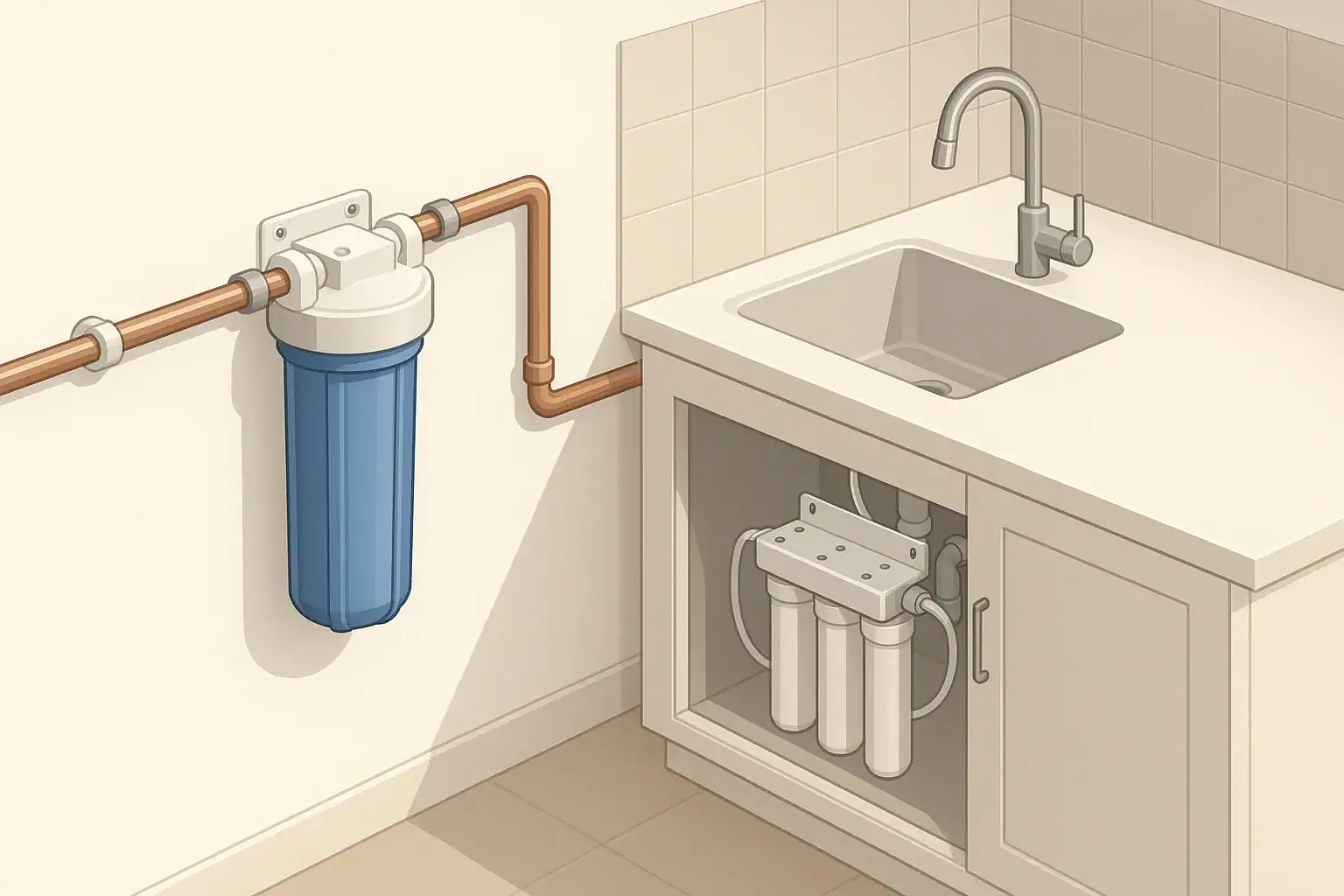
A whole house filter is typically installed on the main water line where it enters the home (point of entry). Every tap, shower, and appliance uses this treated water.
Common goals for whole house filtration include:
- Reducing sediment, sand, and rust that can clog fixtures
- Reducing chlorine taste and odor in all taps and showers
- Providing a first stage of treatment before other devices (such as under-sink systems or appliances)
Because all household water passes through a whole house system, it must handle higher flow rates and larger volumes than a drinking-water-only filter. As a result, these systems often focus on broad, higher-capacity filtration rather than very fine or specialized contaminant removal.
Under-Sink Filters: Point-of-Use Taste and Odor Improvement
Under-sink filters sit in the cabinet beneath a sink and treat only the water going to that faucet (point of use). Some connect to the main kitchen faucet; others use a dedicated filtered-water tap.
Common goals for under-sink filtration include:
- Improving taste and odor for drinking and cooking
- Targeting specific contaminants such as lead, certain volatile organic compounds (VOCs), or select emerging contaminants, depending on the cartridge type and certifications
- Providing a final polishing stage after broader whole house treatment
Because they handle much lower flow and volume than a whole house filter, under-sink systems can often use finer media or multi-stage cartridges aimed at taste-sensitive and health-relevant contaminants, while still maintaining a usable flow at the sink.
Example values for illustration.
| Aspect | Whole house filter | Under-sink filter |
|---|---|---|
| Location | Main water line (point of entry) | Cabinet under a sink (point of use) |
| Water treated | All taps, showers, appliances | One faucet (drinking and cooking) |
| Primary goal | Whole-home protection and general quality | Taste, odor, and targeted contaminant reduction |
| Flow demand | High (multiple fixtures at once) | Low to moderate (one faucet) |
| Typical installation | On main line, often near water heater | Under kitchen sink with simple tubing |
| Best for | House-wide chlorine, sediment, basic taste issues | Drinking water quality and flavor at a key tap |
What Each Filter Type Typically Handles
Neither whole house nor under-sink filters automatically remove everything. What they handle depends on the specific media, design, and verified performance claims. However, there are common patterns in how they are used.
Common Contaminants and Water Quality Issues
In many U.S. homes, people consider filtration for issues such as:
- Chlorine and chloramine (taste and smell from municipal disinfection)
- Sediment and rust (from aging pipes, wells, or mains)
- Lead (from older plumbing or fixtures)
- PFAS and other emerging contaminants (where of concern)
- VOCs (from some industrial or household chemical sources)
- Microplastics and visible particles
- Turbidity (cloudiness from suspended solids)
Water metrics such as TDS (total dissolved solids), hardness, pH, and pressure also influence which system works best and where it should be installed in the plumbing layout.
Typical Strengths of Whole House Filters
Whole house filters are often used for broad, high-volume issues rather than very fine polishing. Depending on design, they commonly focus on:
- Sediment and turbidity: Cartridges with relatively large pore sizes capture sand, silt, and rust before they reach fixtures.
- Basic chlorine taste and odor: Large beds of granular activated carbon (GAC) or similar media can reduce free chlorine for all taps.
- Support for downstream systems: Removing coarse material first can help under-sink or appliance filters last longer.
Because they must supply showers, toilets, washing machines, and dishwashers at once, whole house filters are usually not the place for very slow or restrictive media unless the system is designed with that in mind and plumbing flow is sized appropriately.
Typical Strengths of Under-Sink Filters
Under-sink filters treat a much smaller volume, which allows for more specialized approaches. Depending on the cartridges or modules used, under-sink systems often focus on:
- Taste and odor polishing: Fine activated carbon blocks and similar media can noticeably improve flavor and smell at the tap.
- Targeted contaminants: Some cartridges are designed and certified to reduce substances such as lead, certain pesticides, or some PFAS compounds, within defined conditions.
- Fine particulate removal: Smaller pore sizes can help reduce very fine particles and some microplastics.
Some under-sink systems use multi-stage filtration, and some may incorporate reverse osmosis (RO) modules; however, RO is a separate technology with its own design and certification considerations.
NSF/ANSI Standards: How to Compare Claims
Whole house and under-sink products often reference NSF/ANSI standards. These standards help you understand what type of performance was independently tested. They do not guarantee that any specific system is right for your water, but they provide a common framework to read claims.
Common Standards for Carbon and Mechanical Filtration
For many non-RO filters in this category, the most commonly referenced standards include:
- NSF/ANSI 42: Aesthetic effects, such as chlorine taste and odor and some particulate classes.
- NSF/ANSI 53: Certain contaminants of health concern, such as lead and some VOCs, under specified conditions.
- NSF/ANSI 401: Select emerging contaminants, including some pharmaceuticals and chemicals, within test parameters.
Reverse osmosis systems are often evaluated under NSF/ANSI 58, which focuses on RO performance and may include criteria for total dissolved solids reduction and certain contaminants. When an under-sink system includes RO, it may reference both 58 and other relevant standards for the full configuration.
Why Certification Matters for Both System Types
Certification can be helpful for both whole house and under-sink filters, but what you look for may differ:
- For whole house filters, many people look for verified claims about chlorine reduction, particulate removal, and structural integrity at household pressures.
- For under-sink filters, the focus is often on specific contaminant reduction claims that match local water reports or private test results.
On any system, it is useful to confirm:
- Which exact standards the filter is certified to
- Which specific contaminants or performance attributes were tested
- The capacity or service life used in testing (for example, a certain number of gallons)
Flow, Pressure, and Everyday Use
Water flow and pressure are everyday concerns that can tilt a decision between whole house and under-sink filtration, or influence how they are configured together.
Whole House: Impact on Showers and Appliances
A whole house filter sits in the main line, so any restriction affects every fixture. Key considerations include:
- Flow rate: A typical household may use several gallons per minute when multiple taps, showers, or appliances run at once.
- Pressure drop: Filter cartridges introduce some resistance to flow. Over time, buildup of sediment can increase pressure drop further.
- Filter sizing: Choosing housings, cartridges, and plumbing that match household demand can help maintain comfortable showers and appliance performance.
In many cases, a simple sediment or basic carbon filter with appropriate capacity can supply a typical home without noticeable pressure issues when properly maintained.
Under-Sink: Flow at the Faucet
Under-sink systems usually serve one faucet, so the main concern is how the filter affects that specific tap. Considerations include:
- Filtered flow rate: Some cartridges allow near-normal faucet flow, while finer media may slow water to a modest stream.
- Separate faucet vs. main faucet: A dedicated filtered-water faucet can keep normal flow for rinsing dishes on the main tap, while using slower flow only for drinking water.
- House pressure: Lower incoming pressure may make restrictive filters feel slower, especially in multi-stage systems.
Household expectations matter here: some people are comfortable waiting slightly longer for a glass of water in exchange for more intensive filtration at the sink.
Maintenance, Replacement, and Cost per Gallon
Both whole house and under-sink systems depend on timely filter changes. Neglecting replacements can reduce effectiveness and affect flow.
Filter Life and Capacity
Manufacturers typically specify a filter life using one or more of these approaches:
- A time period (for example, several months or roughly one year, under typical use)
- A capacity (an approximate number of gallons of water treated)
- Whichever comes first (time or capacity)
Whole house filters generally have higher rated capacities than under-sink cartridges, but they also treat a much larger portion of household water, including toilet flushing and laundry. Under-sink cartridges may treat many fewer gallons but at a higher level of refinement.
Cost per Gallon: Broad vs Focused Treatment
One way to think about long-term cost is approximate cost per gallon of filtered water used for its intended purpose. As an example only:
- A whole house cartridge might cost more per replacement but treat a large volume of water at a modest level of filtration.
- An under-sink cartridge might cost less per replacement but treat far fewer gallons at a more intensive level.
If you drink and cook with only a small fraction of your total household water, intensive filtration at the point of use can be efficient for taste-focused improvements. If you want all water in the home to be free of sediment or basic chlorine odor, a whole house filter spreads that benefit across every tap.
Maintenance Practicalities
Routine tasks differ slightly between system types:
- Whole house: Replacing larger cartridges on the main line, often involving a shutoff valve and filter wrench. Some homeowners prefer to schedule this along with other periodic tasks.
- Under-sink: Replacing smaller cartridges in a cabinet, sometimes with quick-connect fittings. Access space under the sink can be the main constraint.
In both cases, planning replacements based on actual usage, visible flow changes, and any manufacturer guidance helps maintain consistent performance.
Choosing Between Taste and Whole-Home Protection
Deciding between whole house and under-sink filtration often comes down to which problems you are trying to solve first.
When a Whole House Filter Fits Best
A whole house filter may be most useful when:
- You see visible sediment or rust at multiple fixtures.
- You notice chlorine smell in showers as well as at the sink.
- You want to protect appliances and plumbing from particulate buildup.
- You plan to add point-of-use filters later and want a first line of treatment for the entire home.
This approach is often about broad water quality and system protection rather than fine-tuned drinking water optimization alone.
When an Under-Sink Filter Fits Best
An under-sink filter may be the better starting point when:
- Your main concern is the taste and smell of drinking water.
- You want to target specific contaminants identified in a local report or test, and can match them with a certified under-sink system.
- You prefer a simpler installation focused on one tap, without modifying the main water line.
- You want to control ongoing costs by treating only the water you drink and cook with.
This approach centers on flavor, kitchen use, and focused contaminant reduction where it matters most for consumption.
Using Both: Layered Filtration
Some households choose both a whole house and an under-sink filter, using them for different tasks:
- The whole house filter manages sediment, basic chlorine reduction, and general plumbing protection.
- The under-sink filter provides more refined treatment for drinking water at a key tap.
This layered approach can spread out workload and extend filter life for each stage, while giving you both broader home coverage and better-tasting water at the sink.
NSF/ANSI Certification Cheat Sheet for These Systems
When comparing whole house and under-sink products, it is useful to have a quick reference to what the common NSF/ANSI standards typically address.
Example values for illustration.
| Standard | Common use | What to verify on a product |
|---|---|---|
| NSF/ANSI 42 | Aesthetic effects (taste, odor, particulates) | Chlorine taste and odor reduction claims and particulate class |
| NSF/ANSI 53 | Selected contaminants of health concern | Which specific contaminants (for example, lead or certain VOCs) |
| NSF/ANSI 401 | Emerging contaminants | List of tested emerging compounds and any usage limits |
| NSF/ANSI 58 | Reverse osmosis systems | That the complete RO system, not just parts, is certified |
| Structural and material safety provisions | Applies within each standard | Maximum working pressure, temperature, and material safety notes |
| Capacity and service life | Included in test conditions | Rated gallon capacity and replacement interval used for testing |
Bringing It Together for Your Home
Choosing between a whole house filter and an under-sink system starts with identifying your main concerns: taste at the tap, whole-home coverage, specific contaminants, or plumbing protection. Matching those priorities to the typical strengths of each system, and confirming performance claims against recognized standards, can help you build a filtration setup that fits how you actually use water every day.
Frequently asked questions
Can a whole house filter remove lead, or should I rely on an under-sink filter for lead removal?
Some whole house systems can reduce lead if they use media and cartridges certified to the appropriate NSF/ANSI standard for lead reduction and are installed where they treat water that contacts lead sources. For drinking water, point-of-use under-sink filters certified for lead are often preferred because they target the tap and can use finer media specifically tested for that contaminant; always check a product’s certified contaminant list and tested capacity.
Will a whole house filter improve drinking water taste as much as an under-sink system?
Whole house carbon filters can reduce chlorine taste and odor across all taps, improving overall household water quality. However, under-sink units with fine carbon blocks or reverse osmosis provide stronger polishing at the kitchen tap and are more likely to produce the most noticeable improvement in drinking water flavor.
Will installing a whole house filter reduce my water pressure or flow?
Any filter introduces some resistance, so a poorly sized or heavily fouled whole house unit can cause a noticeable pressure drop when multiple fixtures are used. Properly sizing the system for household flow, maintaining cartridges on schedule, and using housings rated for the home’s demand will minimize pressure or flow issues.
Is it worth installing both a whole house and an under-sink filter?
A layered approach is common and can be cost-effective: a whole house filter handles sediment and bulk chlorine to protect plumbing and appliances, while an under-sink filter polishes drinking water and targets specific contaminants. This arrangement can extend the life of each stage and provide both broad protection and high-quality tap water, though initial installation and combined maintenance costs are higher than a single system.
How often should I replace cartridges in whole house and under-sink systems?
Replacement intervals depend on the manufacturer’s rated capacity, local water quality, and household usage; typical guidance is based on a time period, a gallon capacity, or whichever comes first. Monitor flow, taste, and any visible sediment, and follow certified service-life information—heavy sediment or high usage will shorten cartridge life.
Recommended next:
- NSF/ANSI standards explained (42/53/401/58)
- Clear trade-offs: pitcher vs faucet vs under-sink vs RO
- Maintenance planning: cost per gallon and replacement cadence