
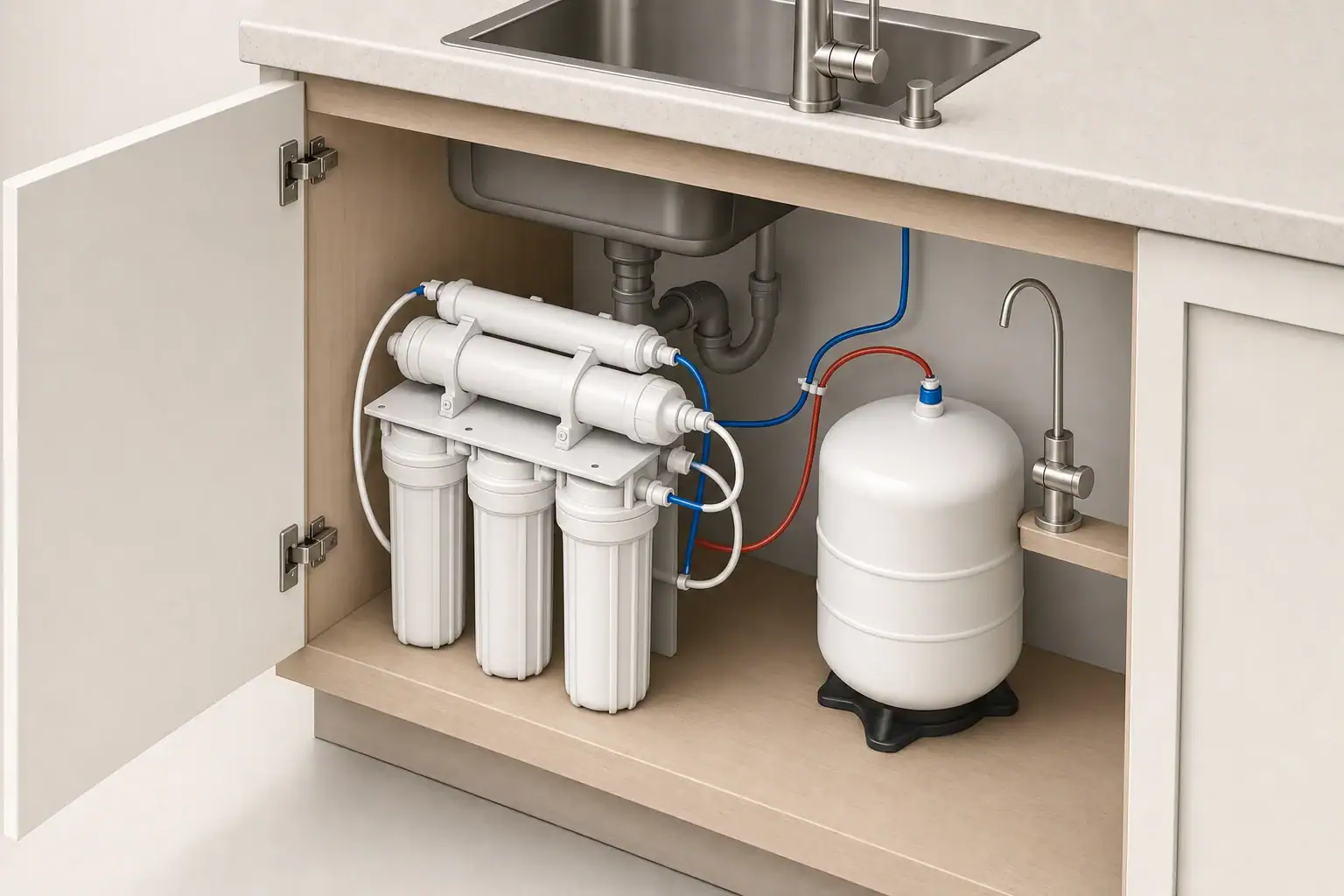
Choose 3/8-inch tubing when maximizing delivery flow is important and every connected fitting supports that size. Choose 1/4-inch tubing when compatibility, compact routing, and standard replacement parts matter more. For many conventional under-sink and reverse osmosis systems, 1/4-inch tubing is adequate because the filter, membrane, faucet, or storage tank—not the tubing—is the main flow restriction.
Moving to 3/8-inch tubing can reduce pressure loss, especially on longer runs or the line from a reverse osmosis storage tank to the faucet. It will not automatically improve performance if water still passes through 1/4-inch ports, restrictive cartridges, narrow faucet passages, or undersized adapters.
What the tubing measurements mean
Under-sink water-filter tubing is commonly identified by its outside diameter, or OD. A tube sold as 1/4-inch generally has a 1/4-inch outside diameter, while 3/8-inch tubing has a 3/8-inch outside diameter.
The inside diameter is smaller and depends on wall thickness. Two tubes with the same outside diameter can therefore have slightly different internal passages. This is one reason tubing should be selected by system specifications and fitting compatibility rather than appearance alone.
Before ordering tubing or connectors, verify:
- Whether the listed size refers to outside or inside diameter
- The size of every filter head, valve, tank, faucet, and connector in the run
- The tubing material and its pressure and temperature ratings
- Whether inserts, ferrules, sleeves, or locking clips are required
- Whether the tubing is intended for potable-water plumbing
Flow differences between 1/4-inch and 3/8-inch tubing
All else being equal, a wider internal passage creates less resistance to flow. That gives 3/8-inch tubing an advantage when water must travel farther or move quickly from a pressurized storage tank to a faucet.
The practical difference depends on the entire water path. Tubing size is only one part of a system that may also include:
- A feed-water valve
- Sediment and carbon cartridges
- A reverse osmosis membrane
- A storage tank and tank valve
- A postfilter
- Elbows, tees, check valves, and reducers
- A dispensing faucet with a relatively narrow internal passage
If one of these components is substantially more restrictive than the tubing, enlarging the tubing may produce little noticeable change. A 3/8-inch tube connected through a 1/4-inch port also retains that narrow point.
| Decision factor | 1/4-inch tubing | 3/8-inch tubing |
|---|---|---|
| Flow resistance | Higher over the same run | Lower over the same run |
| Typical routing | Easier in tight cabinets | Needs more bend clearance |
| Fitting compatibility | Common on many filtration components | Requires matching larger ports or adapters |
| Best use | Short runs and modest faucet demand | Longer delivery lines and higher-flow dispensing |
| Upgrade value | Often sufficient as specified | Useful only when other restrictions permit |
Where tubing size matters most in a reverse osmosis system
Reverse osmosis systems may use multiple tubing runs that perform different jobs. They should not all be resized as though they were interchangeable.
Feed-water line
The feed line supplies untreated water to the filtration system. Many residential units use a 1/4-inch connection, although designs vary. A larger feed tube offers limited benefit when the feed valve, inlet port, prefilters, or membrane controls the rate.
Use the size specified for the feed connection. Improvised reducers and mismatched valves can add restrictions and create extra potential leak points.
Storage-tank line
The line between a reverse osmosis storage tank and the rest of the system can affect short-term dispensing flow. Water leaves the tank under pressure, so reducing resistance in this path may help the faucet deliver water more readily.
Some systems use 3/8-inch tubing for part or all of this path, while others are designed around 1/4-inch components. The benefit of a larger tube is reduced if the tank valve, postfilter, or system manifold still has a narrow passage.
Faucet delivery line
A longer run from the filtration system to a drinking-water faucet is one of the stronger reasons to consider 3/8-inch tubing. The improvement is most likely when the faucet inlet and upstream ports are also 3/8-inch or have similarly unrestricted internal passages.
For a short route inside one sink cabinet, 1/4-inch tubing may provide acceptable flow while being easier to route. Faucet design and tank pressure can have a greater effect than changing a short piece of tubing.
Drain or reject-water line
Do not resize a reverse osmosis drain line simply to increase faucet flow. Drain routing may interact with a flow-control component, an air-gap faucet, or other system-specific parts. Changing it without following the system documentation can affect operation or drainage.
Air-gap faucets can also have several tubes with different purposes and diameters. Record where each tube connects before disassembly, and replace each one with the specified size.
Fit can be more important than nominal size
A reliable connection requires more than matching a number printed on a tube. The tubing must be compatible with the connector type and inserted or assembled correctly.
Push-to-connect fittings
Push-to-connect fittings generally grip the tube by its outside diameter. The end should be cut square, remain round, and be inserted to the required depth. Scratches, deep tool marks, or an angled cut near the sealing area can prevent a dependable seal.
Do not force 1/4-inch tubing into a 3/8-inch fitting or attempt to make up the difference with tape. Use a correctly sized reducer or replace the fitting with one intended for the tubing.
Compression fittings
Compression connections may require a nut, ferrule, sleeve, or internal tube insert. The required pieces vary by fitting and tubing material. Reusing a deformed ferrule or omitting a specified insert can result in leaks or damaged tubing.
Bend radius and cabinet space
Three-eighths-inch tubing is less convenient in crowded cabinets because it generally needs broader turns. A sharp bend can kink the line and erase the flow advantage of its larger diameter.
Plan a route that avoids hot pipes, moving drawers, cabinet hinges, cleaning-product storage, and edges that could abrade the tube. Leave enough slack for cartridge changes, but not so much that the line can snag or fold.
When changing to 3/8-inch tubing is likely to help
A larger delivery line is most reasonable when several conditions apply:
- The current tubing run is relatively long
- Flow starts adequately but seems restricted by the delivery path
- The tank, manifold, postfilter, and faucet can accept 3/8-inch connections
- The existing 1/4-inch tube is kinked or routed through several restrictive elbows
- The system was designed to support an optional larger faucet line
As an example, a storage tank located in an adjacent cabinet may benefit more from a 3/8-inch delivery line than a tank positioned directly beside the faucet. This is a planning example, not a guarantee of a specific flow increase.
When larger tubing will probably not solve low flow
Low faucet flow does not always indicate undersized tubing. Before changing line sizes, check for more common restrictions:
- A cartridge that is overdue for replacement
- A kinked or pinched tube
- A valve that is not fully open
- Low incoming water pressure
- Incorrect reverse osmosis tank air pressure
- A nearly empty storage tank
- A fouled membrane or postfilter
- Debris in a faucet aerator or narrow connector
Changing tubing cannot increase the production rate of a membrane or restore capacity to a clogged filter. It mainly reduces resistance between components.
Common sizing mistakes
- Assuming all tubing is measured the same way: Confirm whether the specification is based on outside diameter.
- Upsizing only the visible section: A short 3/8-inch segment offers little advantage if the rest of the path remains 1/4-inch.
- Adding several adapters: Extra transitions can restrict flow and create additional joints to inspect.
- Ignoring the faucet connection: Some drinking-water faucets accept only one tubing size or require a specific adapter.
- Using unsuitable tubing: Select tubing intended for potable water and compatible with the system’s pressure and temperature conditions.
- Confusing delivery and drain lines: A reverse osmosis drain circuit should remain configured as specified for the system.
Related guides: Under-sink filter flow rate explained • Troubleshooting low RO flow • RO tank pressure
A practical way to choose
Start with the connection sizes specified by the filter system, tank, and faucet. If all ports are 1/4-inch and the run is short, matching 1/4-inch tubing is usually the simplest choice. If the system provides 3/8-inch ports, the delivery run is long, or higher dispensing flow is a design priority, 3/8-inch tubing can reduce avoidable pressure loss.
After installation or service, restore water pressure gradually and inspect every connection for leaks. Recheck the fittings after the system has remained pressurized. The best tubing size is the one that supports the needed flow without sacrificing compatible fittings, safe routing, or dependable seals.
Frequently asked questions
Is 3/8-inch tubing better than 1/4-inch tubing for an under-sink filter?
Three-eighths-inch tubing has lower flow resistance, but it is only better when the connected ports, fittings, and faucet support that size. For short runs on systems designed for 1/4-inch tubing, 1/4-inch is often adequate.
Will changing from 1/4-inch to 3/8-inch tubing increase reverse osmosis faucet flow?
It can help on a long delivery run or tank-to-faucet line, especially when the rest of the water path is similarly sized. It will have limited effect if a cartridge, tank valve, postfilter, faucet, or 1/4-inch port is the main restriction.
Are 1/4-inch and 3/8-inch filter tubing measurements based on inside diameter?
Under-sink filter tubing is commonly sized by outside diameter. Check the product specification because wall thickness affects the inside diameter and fittings must match the tube outside diameter.
Can I connect 1/4-inch tubing to a 3/8-inch fitting?
Use a properly sized reducer or a fitting designed for the tubing size. Do not force smaller tubing into a larger push-to-connect fitting or use tape to make up the difference.
Should I increase the size of a reverse osmosis drain line?
No. Keep the drain or reject-water line configured according to the system documentation. Its size and routing may work with a flow restrictor, air-gap faucet, or other components that affect system operation.
- NSF/ANSI standards explained (42/53/401/58)
- Clear trade-offs: pitcher vs faucet vs under-sink vs RO
- Maintenance planning: cost per gallon and replacement cadence