
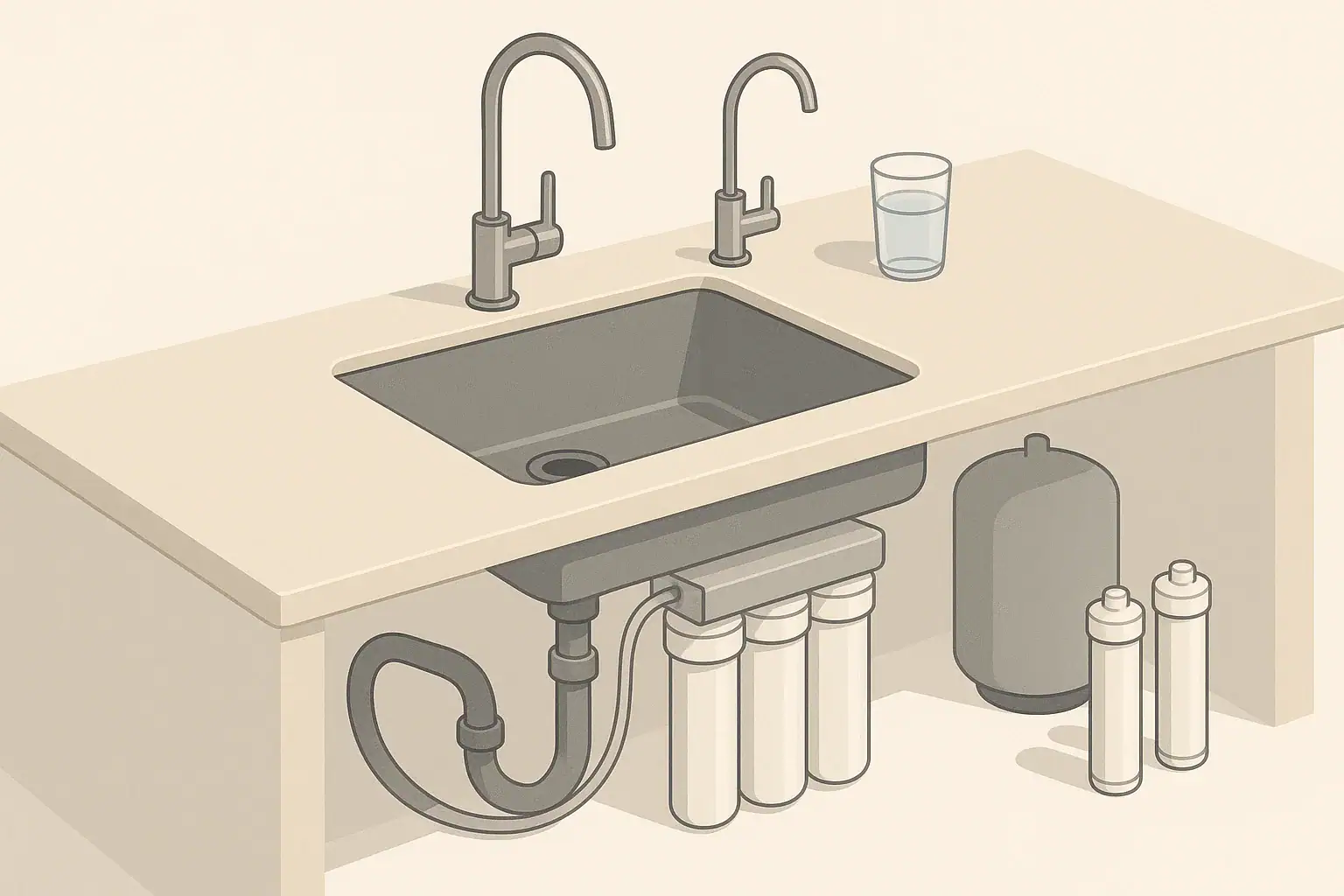
Why RO faucets have two different designs
A reverse osmosis system usually sends filtered water to a small dedicated faucet at the kitchen sink. That faucet may look simple from above the counter, but the drain connection below the sink changes the design. Some RO faucets are made with an air gap. Others are non-air-gap faucets.
The difference matters because a reverse osmosis system produces two water streams. One stream is treated water that goes to the faucet. The other is concentrate, sometimes called reject water or brine, that carries the flushed-away dissolved minerals and other substances to the drain.
An air gap faucet includes a small physical break in the drain path before the RO waste line connects to the household drain. A non-air-gap faucet does not include that break at the faucet. Instead, the RO drain line runs more directly to a drain saddle or similar approved drain connection.
Both designs are common in homes. The better choice depends on local plumbing rules, the sink layout, the homeowner’s tolerance for drain noise, and how much protection is required against drain water moving backward toward the RO system.
The core difference: drain-line protection
An air gap is a plumbing safety concept, not a filtration stage. It creates a physical separation between the RO system’s drain discharge and the household drain. If the sink drain backs up, the air gap helps reduce the chance of contaminated drain water being pulled or pushed into the RO drain tubing.
In an air gap RO faucet, the waste line from the RO membrane usually runs up to the faucet body first. Inside the faucet assembly, water passes through an open break and then exits through a second tube that goes down to the drain connection. The small holes or slots near the faucet base are part of this design. If the downstream drain path is blocked, water may come out near the faucet base rather than silently forcing its way back into the RO tubing.
A non-air-gap RO faucet skips that built-in break. It has fewer drain-related parts in the faucet body, so it is often quieter and simpler to install. However, backflow protection must be addressed by the overall plumbing arrangement and any applicable local code requirements.
For many homeowners, this is the main tradeoff:
- Air gap faucet: more visible and audible drain protection, but more parts and possible gurgling.
- Non-air-gap faucet: simpler and quieter, but it lacks the faucet-based air gap.
Example values for illustration.
| Feature | Air gap RO faucet | Non-air-gap RO faucet |
|---|---|---|
| Drain protection method | Physical break at the faucet | No faucet-based air break |
| Typical drain tubing | Usually two drain tubes at the faucet | Usually one drain tube to the drain connection |
| Noise during production | May gurgle or trickle audibly | Often quieter |
| Leak symptom if drain blocks | Water may appear at faucet base or air gap opening | Drain issue may be less obvious at the faucet |
| Installation complexity | More tubing and routing | Simpler faucet connection |
| Code acceptance | Often preferred or required in some areas | Depends on local plumbing requirements |
| Best fit | Homes prioritizing built-in drain separation | Homes prioritizing quiet operation where allowed |
How an air gap RO faucet works
An air gap RO faucet has a more involved drain path than a standard drinking water faucet. The clean water path is still separate from the drain path, but the faucet body also handles RO concentrate water on its way to the sink drain.
Typical flow path
In a common under-sink RO setup, tap water passes through prefilters, then the RO membrane, and then into a storage tank or directly toward the faucet in a tankless system. Concentrate water from the membrane flows to the drain. With an air gap faucet, that drain flow usually travels upward to the faucet first, passes across the air gap, and then travels down to the drain connection.
This creates a break between the RO system and the drain plumbing. The air gap does not improve taste, reduce total dissolved solids, or add a polishing stage. Its purpose is related to plumbing protection.
Why air gap faucets can make noise
Air gap faucets may make a trickling, gurgling, or dripping sound while the RO system is producing water. This is usually the drain water moving through the air gap and into the drain line. The sound may be more noticeable after someone draws water from the RO faucet and the system refills the tank.
Some noise is normal. Loud sputtering, water coming from the air gap opening, or frequent countertop wetness can point to a clogged or poorly routed drain line. Grease, food debris, mineral scale, and a sagging tube can all interfere with drainage.
Why water may appear near the faucet base
When an air gap faucet leaks from the small opening near the base, it often means the downstream drain line is restricted. The air gap is doing what it is designed to do: it provides an overflow point instead of allowing backed-up drain water to move toward the RO system.
The practical response is to check for normal drain restrictions, incorrect tube routing, or a misplaced drain saddle. If the sink drain is slow or backing up, that should be corrected as a drain issue. Homeowners should avoid plugging, sealing, or bypassing the air gap opening, because doing so can defeat the safety feature.
How a non-air-gap RO faucet works
A non-air-gap RO faucet is closer to a standard dedicated drinking water faucet. Its main job is to dispense RO water. The drain line from the RO membrane usually connects below the sink without passing through an air gap inside the faucet.
This design often has fewer tubes connected to the faucet. It may be easier to route in a crowded sink cabinet, and it can reduce the gurgling sounds associated with air gap designs.
Benefits of a simpler faucet body
Non-air-gap faucets are popular because they are straightforward. There are fewer drain passages inside the faucet, and the installation can be easier in tight spaces. Many people also prefer the quieter operation.
Potential advantages include:
- Less drain noise at the faucet
- Fewer tubes running up to the faucet body
- Often simpler replacement if upgrading a faucet
- Fewer air-gap-related overflow complaints
What the tradeoff means
The tradeoff is that a non-air-gap faucet does not provide the same physical break at the faucet. That does not automatically make it unsuitable, but it does mean the system must be evaluated with local plumbing requirements in mind.
Some areas require an air gap for certain RO installations. Others may allow alternate backflow prevention methods or non-air-gap designs. Code details vary by location, building type, and how the drain is connected. When in doubt, the safest approach is to follow the equipment instructions and ask a licensed plumbing professional or local code office.
Choosing between air gap and non-air-gap RO faucets
The right choice is not only about convenience. It is about matching the faucet type to the sink, the drain arrangement, and the rules that apply where the system will be installed.
Choose an air gap faucet when drain separation is required or preferred
An air gap faucet is often the conservative choice when local code requires it or when the homeowner wants a visible, built-in drain separation feature. It may also be a sensible option in rental properties or multi-unit buildings where plumbing rules can be stricter.
Expect some drain sound during refill cycles. Also expect more tubing under the sink. A neat installation with smooth tube routing can reduce nuisance issues.
Choose a non-air-gap faucet when allowed and quiet operation matters
A non-air-gap faucet may be appropriate when local rules allow it and the drain connection is installed according to the RO system instructions. It can be appealing in kitchens where sound is a concern or where the faucet hole and cabinet space make air gap tubing difficult to manage. If you are comparing setup styles more broadly, the RO installation layout guide can help you think through cabinet space before buying.
This is not a reason to ignore backflow protection. The drain connection still needs to be correct, secure, and accessible for inspection.
Consider the sink layout before buying
RO faucets usually need a suitable hole in the sink deck or countertop. Some kitchens already have a hole for a soap dispenser, sprayer, or old drinking water faucet. Others require countertop work, which may not be practical for renters or for certain stone surfaces without professional help.
Air gap faucets may need more room below the faucet because of the extra drain tubing. If the space behind the sink is crowded with a garbage disposal, dishwasher drain hose, pull-down faucet weight, or cabinet divider, a careful layout matters before installation begins.
Installation, code, and maintenance considerations
RO faucet selection should be made before the system is installed, not after the tubing has already been cut and routed. Air gap and non-air-gap faucets are not always interchangeable without changing the drain routing and fittings.
Local requirements come first
Plumbing code can vary across states, cities, and building types. Some jurisdictions expect an air gap for RO drain discharge. Others may permit a non-air-gap faucet when the system uses an approved drain connection. The product manual is important, but it does not replace local requirements. For broader context on how RO works as a treatment method, see Reverse Osmosis 101.
For a homeowner, the practical rule is simple: do not remove, cap, plug, or bypass an air gap if it is part of the required installation. If an air gap faucet is leaking from the vent opening, treat that as a drainage problem to diagnose, not as a feature to defeat.
Watch the drain connection
Many RO nuisance problems begin at the drain connection. A drain saddle installed in a poor location can create noise, slow drainage, or repeated air gap overflow. The drain line should generally avoid sharp bends, kinks, and low spots that hold water and debris.
If a garbage disposal is present, follow the RO manufacturer’s instructions carefully. Drain turbulence and food debris can affect air gap performance if the connection is not placed properly.
Plan for routine maintenance
The faucet type does not change the normal need to replace RO prefilters, postfilters, and membranes on an appropriate schedule. It also does not change the need to inspect tubing and fittings for leaks. However, air gap faucets add one more area to keep in mind: the drain path through the faucet and the tube leading from the faucet to the drain. An RO filter replacement schedule can help keep the rest of the system on track.
Common maintenance checks include:
- Looking for water around the faucet base after the RO system refills
- Checking that drain tubing is not kinked or sagging
- Listening for a major change in gurgling or drain noise
- Inspecting the cabinet floor for slow leaks
- Replacing filters on schedule rather than waiting for severe flow loss
Example values for illustration.
| Situation | What to check | Why it matters |
|---|---|---|
| Air gap faucet gurgles lightly | Normal refill cycle timing | Some drain sound is expected |
| Water appears at air gap opening | Downstream drain tube and sink drain | Often points to a restriction |
| Non-air-gap faucet is very quiet | Drain line security and routing | Quiet does not confirm correct drainage |
| Slow RO faucet flow | Tank pressure, filters, and membrane age | Flow issues are not usually caused by air gap design |
| New sink or countertop | Faucet hole size and cabinet clearance | Prevents fit problems before installation |
| Rental or condo installation | Lease rules and local plumbing requirements | Approval may be needed before changes |
| Repeated drain odors | Sink drain condition and tubing layout | Odor usually indicates a drain issue to address |
Related guides: Reverse Osmosis 101: What RO Removes (and What It Doesn’t) • NSF/ANSI 58 Explained: What It Means for RO Systems • RO Water Tastes Bad? Fixing “Plastic” or “Stale” Taste • RO Waste Water Ratio: What’s Normal and How to Reduce It • Troubleshooting Low RO Flow: Pressure, Tank, or Clogged Filters?
Common questions about RO faucet types
Does an air gap faucet make RO water cleaner?
No. The air gap is not a filter stage. It does not reduce TDS, chlorine, PFAS, lead, hardness, or taste and odor by itself. Its role is to separate the RO drain discharge from the household drain path.
Can an air gap faucet be replaced with a non-air-gap faucet?
Sometimes, but it depends on local code, the RO system design, and the drain connection. It should not be done simply to stop gurgling or overflow. If an air gap is required, replacing it with a non-air-gap faucet may create a noncompliant installation.
Is gurgling always a sign of a problem?
No. Light gurgling during RO production is common with air gap faucets. However, sudden loud noise, water spitting from the air gap, or wetness around the faucet base suggests that the downstream drain line or sink drain should be checked.
Which faucet type is better for apartments?
Apartments and rentals often require extra caution because plumbing changes may need approval. An air gap faucet may be required in some locations, but the deciding factors are the lease, local rules, and whether the sink can accept a dedicated faucet without permanent changes.
Does faucet choice affect RO waste water?
The faucet type does not determine the RO drain ratio. Waste water volume is mainly influenced by the RO membrane, system design, feed pressure, temperature, water quality, and whether the unit uses features such as permeate pumps or recirculation. The faucet only changes how the drain discharge is routed.
Frequently asked questions
Can I tell if my RO faucet is air gap or non-air-gap just by looking at it?
Often, yes. Air gap faucets usually have extra tubing under the sink and may have small vent openings near the base. Non-air-gap faucets usually have a simpler under-sink setup.
Why does my air gap faucet gurgle when the tank refills?
That sound is usually normal drain water moving through the air gap. If the noise becomes loud or water starts coming out of the vent, check for a drain restriction or routing issue.
Do non-air-gap faucets always need a different drain connection?
Yes, they still need a proper drain connection below the sink. The exact fitting and routing depend on the RO system and local plumbing requirements.
Is an air gap faucet harder to install?
Usually, yes. It typically involves more tubing and more careful routing, especially in tight sink cabinets.
Should I choose the quietest faucet type available?
Quiet operation is helpful, but it should not override code requirements or proper backflow protection. Start with the rules and the sink layout, then choose the quietest compliant option.
Recommended next:
- Reverse Osmosis 101: What RO Removes (and What It Doesn’t)
- NSF/ANSI 58 Explained: What It Means for RO Systems
- RO vs Carbon Under-Sink: Taste, TDS, and Maintenance Compared
- RO System Installation Guide: Space-Saving Layout Under the Sink
- RO Waste Water Ratio: What’s Normal and How to Reduce It
- RO Filter Replacement Schedule: Prefilters vs Membrane
- More in Reverse Osmosis (RO) →
- NSF/ANSI standards explained (42/53/401/58)
- Clear trade-offs: pitcher vs faucet vs under-sink vs RO
- Maintenance planning: cost per gallon and replacement cadence