
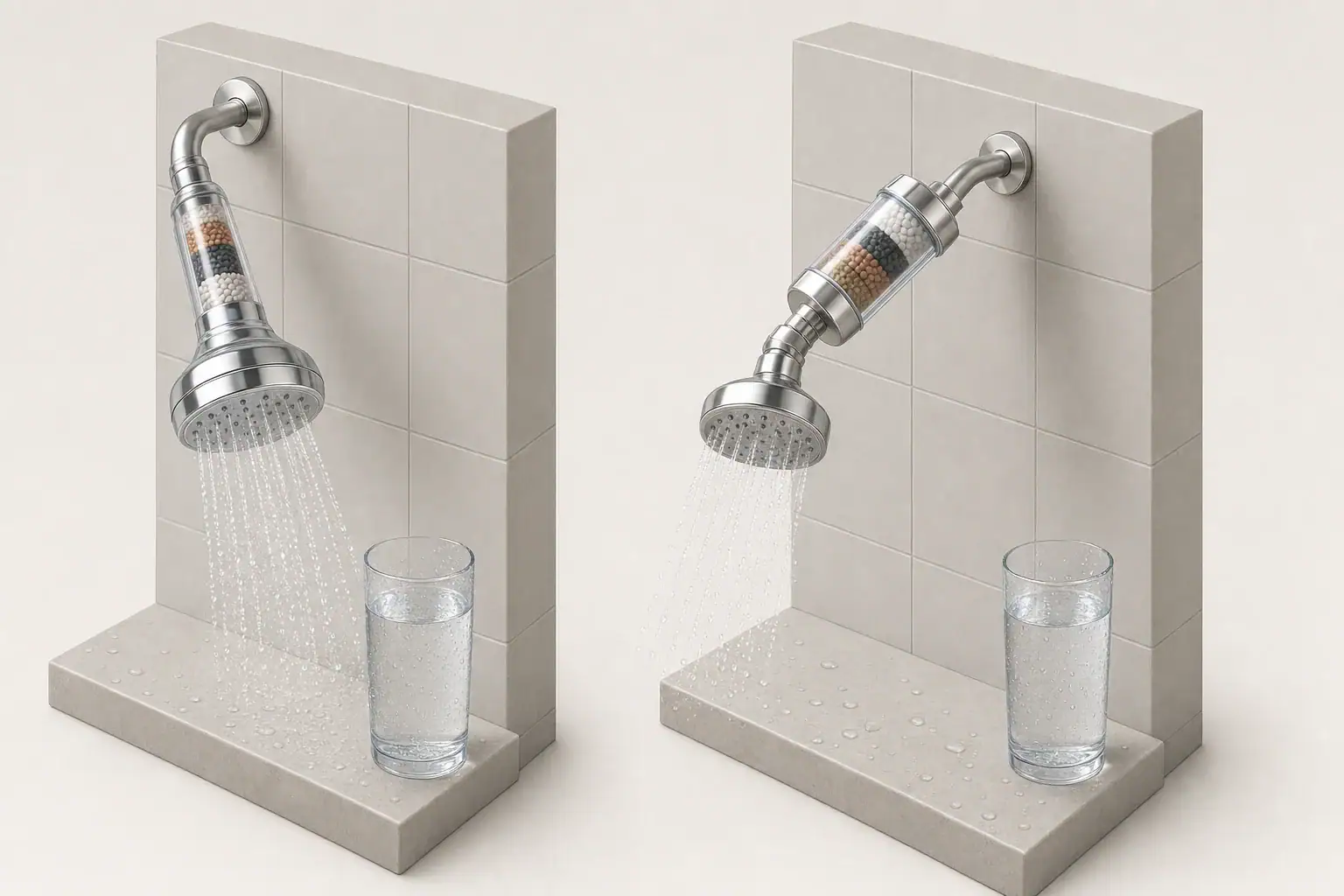
A filtered showerhead is usually easier when replacing a basic fixed showerhead because it combines the spray head and filter in one unit. An inline shower filter is often easier when the goal is to keep an existing showerhead, especially one with preferred spray settings or a handheld hose.
The physical installation is only part of the decision. Available space, cartridge access, fixture compatibility, and the effect on showerhead position can determine which setup remains easier over time.
Filtered Showerhead vs. Inline Filter at a Glance
| Decision factor | Filtered showerhead | Inline shower filter |
|---|---|---|
| Initial installation | Usually replaces the existing head as one assembly | Adds a filter between the shower arm and head |
| Keeping the current showerhead | No | Usually yes |
| Number of threaded connections | Typically one main connection | Typically two main connections |
| Added bulk | Built into the new head | Visible behind the existing head |
| Cartridge access | Depends heavily on the head design | Often accessible without replacing the showerhead |
| Future fixture changes | Head and filter may need to be considered together | Filter and showerhead can usually be changed separately |
When a Filtered Showerhead Is Easier
An integrated filtered showerhead is the more straightforward option when the current fixture is a conventional fixed head and there is no reason to keep it. Installation commonly involves removing the old head and attaching the new combined unit to the shower arm.
This layout has fewer visible parts than a separate inline canister and showerhead. It can also avoid the extra joint created when an inline filter is placed between two fixtures.
It works well for a simple fixture replacement
A filtered showerhead may be the easier choice when:
- The existing showerhead is already due for replacement.
- A compact, integrated appearance matters.
- The shower has limited clearance around the arm.
- There is no need to preserve specific spray patterns or a favorite showerhead.
- The replacement cartridge can be reached without removing several parts.
The trade-off is reduced flexibility. The available spray settings, head size, and filtration design come as one package. If either the spray performance or filter arrangement is unsuitable, replacing one part independently may not be practical.
When an Inline Shower Filter Is Easier
An inline filter is a separate housing installed between the wall-mounted shower arm and the showerhead. It usually requires one additional threaded connection, but it allows the existing head to remain in service.
That makes an inline setup convenient when the current showerhead is comfortable, has useful spray controls, or would be expensive or difficult to duplicate. The filter can generally be serviced or replaced without changing the spray fixture.
It offers more flexibility
An inline filter may be easier when:
- The current showerhead should be retained.
- The household wants to select the filter and showerhead separately.
- A removable filter is useful in a rental, subject to the lease and fixture rules.
- The cartridge housing provides direct, uncomplicated access.
- The showerhead may be upgraded later without replacing the filter assembly.
The main complication is added length and weight at the shower arm. Depending on the housing shape, an inline filter can move the showerhead forward or downward. This may reduce headroom, alter the spray angle, or interfere with a wall, shower caddy, or glass enclosure.
Compatibility Can Matter More Than Installation Time
Many shower fixtures use common threaded connections, but compatibility should not be assumed. Thread type, connection depth, swivel clearance, and the weight supported by the shower arm all matter.
Fixed showerheads
Both layouts are commonly suited to a basic fixed shower arm. An integrated model generally creates the least complicated arrangement, while an inline unit makes it possible to preserve the existing head.
Handheld showerheads
A handheld setup requires closer attention to where the filter sits relative to the hose bracket and diverter. An inline housing may prevent a handheld cradle from rotating properly or may leave too little clearance for the hose connection.
Some layouts place the filter before the handheld hose, while others require a fixture-specific arrangement. The installation instructions should show that the filter is intended for the planned position. Connections should not be forced into alignment.
Rain showerheads and extended arms
Large rain heads can already place substantial leverage on an extended shower arm. Adding a heavy inline housing may increase that load. An integrated filtered head may reduce the number of separate components, but its total weight and dimensions still need to suit the arm.
If a shower arm is loose, corroded, damaged, or unsupported, adding either type of filter is not a good substitute for repairing the fixture.
Which Is Easier to Maintain?
Maintenance depends more on cartridge access than on whether the filter is integrated or inline. A separate inline housing is often convenient because the showerhead can stay attached while the filter body is opened or exchanged. However, a housing mounted close to a wall may be difficult to grip.
Some filtered showerheads provide simple cartridge access from the face or back of the head. Others must be removed from the arm or partially disassembled. Before choosing a format, check the complete cartridge-change procedure rather than looking only at the initial installation.
Useful maintenance questions include:
- Can the cartridge be changed without tools?
- Does the housing need space to twist or separate?
- Will residual water spill when the housing is opened?
- Are seals or O-rings accessible for inspection?
- Is the replacement schedule based on elapsed time, estimated water use, or noticeable performance changes?
Replacement intervals vary with cartridge design, water quality, shower use, and manufacturer instructions. A universal replacement schedule should not be assumed.
Pressure and Spray Differences
Any filter creates some resistance to flow. The noticeable effect depends on incoming pressure, filter media, cartridge condition, fixture design, and the showerhead’s own flow controls.
An inline filter does not automatically cause a larger pressure change than an integrated head. A well-matched inline unit may work acceptably with the current fixture, while an integrated model may feel different simply because it uses another spray pattern. Conversely, a clogged or overdue cartridge in either format can reduce flow.
For a home that already has weak shower flow, compare the filter’s stated operating requirements with the home’s conditions. Do not remove mandated flow controls or other safety-related components to compensate for a pressure problem.
What Shower Filters Can and Cannot Address
Choosing the easier housing style does not establish filtration performance. Filter media, water temperature, contact time, flow rate, and the specific contaminant or water-quality issue are more important than whether the cartridge sits inside the head or behind it.
Some shower filters for chlorine are designed to reduce certain forms of chlorine under specified conditions. Performance for chloramine may differ, and broad claims should not be treated as proof of reduction. Look for clearly stated, independently certified performance when a specific reduction is important, and verify that the certification applies to the exact model and claim.
A typical shower filter should not be assumed to:
- Soften hard water by removing dissolved calcium and magnesium.
- Make microbiologically unsafe water safe to use.
- Remove every chemical, metal, odor, or dissolved mineral.
- Provide the same performance throughout an overdue cartridge’s service life.
White mineral deposits, persistent scale, or soap-scum problems generally point to hardness rather than a simple chlorine issue. Changing from an inline filter to a filtered showerhead will not resolve that fundamental difference. See hard water feel in the shower for more on the distinction.
Installation Details That Affect Ease
For either design, follow the fixture and filter instructions. Shut off the shower control, allow the fixture to drain, protect finished surfaces from tools, and avoid overtightening threaded parts. Thread-sealing tape should be used only where the instructions call for it; some connections rely on washers or gaskets instead.
After installation, check each connection while the shower is running. A leak at an inline setup can come from either side of the filter, while an integrated showerhead usually has fewer external joints to inspect. Cross-threaded fittings, missing washers, doubled gaskets, and excessive tightening are common causes of installation trouble. See this guide to installing a shower filter tool-free for additional leak-prevention steps.
Common Selection Mistakes
- Ignoring dimensions: A compact-looking housing can still lower or extend the showerhead enough to affect comfort.
- Focusing only on the first installation: Cartridge access may matter more over several years of use.
- Assuming all handheld systems fit: Brackets, hoses, and diverters can conflict with an added inline body.
- Choosing by filter format alone: Integrated and inline designs can use very different media and make different reduction claims.
- Expecting a shower filter to soften water: Most do not remove the hardness minerals responsible for scale.
- Overlooking shower-arm condition: A loose or damaged arm should be addressed before adding weight.
Related guides: How often to replace shower filter cartridges • Leaking shower filter connections • KDF media in shower filters
A Practical Way to Choose
Choose a filtered showerhead for the simplest one-piece replacement when the existing head is basic, clearance is limited, and the new head’s spray options are acceptable.
Choose an inline shower filter when retaining the current showerhead is the priority, separate filter replacement is appealing, and there is enough room for the added housing and connections.
Before deciding, measure clearance around the shower arm, review the cartridge-change steps, confirm fixture compatibility, and check the exact performance claims for the water-quality issue being addressed. Those details are more reliable indicators of long-term ease than the housing style by itself.
Frequently asked questions
Is a filtered showerhead easier to install than an inline shower filter?
Usually, yes. A filtered showerhead commonly replaces the existing fixed head at one main connection, while an inline filter adds a separate housing and an additional connection.
Can an inline shower filter be used with an existing showerhead?
Often, yes. An inline filter is designed to sit between the shower arm and showerhead, but thread type, clearance, weight, and fixture instructions should be checked first.
Which option is easier to maintain?
Cartridge access matters more than the format. Inline housings often allow service without replacing the showerhead, while some integrated heads have accessible cartridges and others require removal or disassembly.
Will an inline shower filter reduce water pressure?
Either filter style can reduce flow somewhat. The effect depends on incoming pressure, filter design, cartridge condition, and the showerhead’s flow controls rather than on the housing style alone.
Can a shower filter soften hard water?
Most shower filters should not be expected to soften water because they do not remove the dissolved calcium and magnesium minerals responsible for hardness and scale.
- NSF/ANSI standards explained (42/53/401/58)
- Clear trade-offs: pitcher vs faucet vs under-sink vs RO
- Maintenance planning: cost per gallon and replacement cadence