
MCL, MCLG, and action level are not interchangeable drinking water limits. An MCL is generally an enforceable limit for a contaminant in public drinking water. An MCLG is a non-enforceable public health goal. An action level is a concentration or sampling result that triggers required steps under a specific regulation rather than serving as a universal safe-versus-unsafe boundary.
The distinction matters when reading a water quality report, interpreting laboratory results, or deciding whether household treatment deserves consideration. The number alone is not enough: the type of limit, measurement units, sampling method, and source of the water all affect what the result means.
How the three terms differ
| Term | Meaning | Enforceable? | How it is used |
|---|---|---|---|
| MCL | Maximum Contaminant Level | Yes, under the applicable drinking water regulation | Sets a compliance limit for public water systems |
| MCLG | Maximum Contaminant Level Goal | No | Expresses a health-based goal without considering treatment feasibility or cost |
| Action level | A rule-specific concentration or sampling threshold | It triggers enforceable actions rather than functioning like a conventional MCL | Determines when monitoring, corrosion control, public education, replacement, or other steps may be required |
What an MCL means
The U.S. Environmental Protection Agency establishes federal MCLs under the Safe Drinking Water Act. An MCL is the highest permitted level of a regulated contaminant in water delivered by a public water system, subject to the compliance calculations and sampling requirements in the relevant rule.
MCLs are set as close to the corresponding health goal as the EPA considers feasible. Feasibility can account for available treatment technology, measurement capability, and cost. As a result, an MCL may be higher than its MCLG.
For example, the federal arsenic MCL is 10 micrograms per liter, while its MCLG is zero. This does not mean that exposure below 10 micrograms per liter is identical to zero exposure. It means the enforceable standard and the health-based goal serve different regulatory purposes.
An MCL is more than a comparison number
Compliance may depend on where samples are collected, how often testing occurs, and whether results are averaged over a defined period. A single result above an MCL does not always establish a formal violation by itself. Conversely, one low household sample does not prove that a public system met every regulatory requirement.
States may adopt limits that are stricter than federal requirements. A water utility’s report should therefore be read against the applicable state and federal standards for the report year.
What an MCLG means
An MCLG is the contaminant level at which no known or anticipated adverse health effects would occur, with an adequate margin of safety. It is a public health objective rather than a legal compliance limit.
Some MCLGs are zero, particularly when regulators determine that no exposure level can be identified as risk-free. Others are set above zero. A zero MCLG does not necessarily mean that laboratories can reliably measure zero or that treatment can remove every trace. It also does not convert the MCLG into an enforceable requirement.
MCLGs are useful for understanding why an enforceable MCL may not represent a line between zero risk and definite harm. They can also help households decide whether they want to reduce a contaminant below the legal limit, especially when a resident has concerns that warrant individualized guidance from a qualified health professional.
What an action level means
An action level is a trigger built into a particular regulatory framework. The best-known examples involve lead in tap water and copper, which can enter water through service lines and household plumbing rather than being present at the same concentration throughout a utility’s source water.
Under lead and copper regulations, compliance is based on required tap sampling and a specified statistical calculation, commonly involving the 90th percentile of sampled homes. If the action level is exceeded, the water system may have to perform additional actions such as optimizing corrosion control, increasing monitoring, providing public education, or addressing lead service lines. Exact obligations depend on the rule in effect, the system, and state implementation.
An action level exceedance does not mean every sampled home had the same result. It also does not mean that a result just below the action level is a health goal. For lead, the federal MCLG is zero, while the action level functions as a system-wide regulatory trigger.
Why action levels require context
Lead and copper concentrations can vary among neighboring buildings because plumbing materials, water use patterns, stagnation time, corrosion control, and sampling procedures differ. A utility-wide action level result cannot replace testing at a particular home when the concern is that home’s tap water.
Action levels and associated requirements can also change as regulations are revised. Use the definitions and thresholds stated in the current water report or laboratory guidance rather than relying on an older number found elsewhere.
How to compare a test result with a drinking water limit
1. Match the contaminant exactly
Similar names do not always refer to the same regulated form. For example, a report may express nitrate as nitrogen rather than as the full nitrate compound. Compare only results and limits that use the same chemical definition.
2. Check the units
A number can appear much larger or smaller simply because the units differ. One milligram per liter equals 1,000 micrograms per liter. In water, parts per million is often approximately equivalent to milligrams per liter, while parts per billion is often approximately equivalent to micrograms per liter. Use the laboratory’s stated units and convert carefully before comparing values.
3. Identify the type of benchmark
Determine whether the number is an MCL, MCLG, action level, state standard, health advisory, or another screening value. Only then can the comparison answer the right question. Comparing a result directly with an MCLG, for example, does not establish whether a public water system violated an enforceable standard.
4. Review the sampling location and time period
A source-water sample, treatment-plant sample, distribution-system sample, and first-draw tap sample can represent different conditions. Water quality reports may also show a range, an annual average, or the highest detected level rather than one result from a household faucet.
5. Look for the reporting language
Annual Consumer Confidence Reports commonly identify the contaminant, detected amount or range, applicable limit, goal, likely source, and whether a violation occurred. The utility’s violation statement is more informative about regulatory compliance than comparing one displayed number without reading its column heading or footnotes.
What these limits mean for home filtration
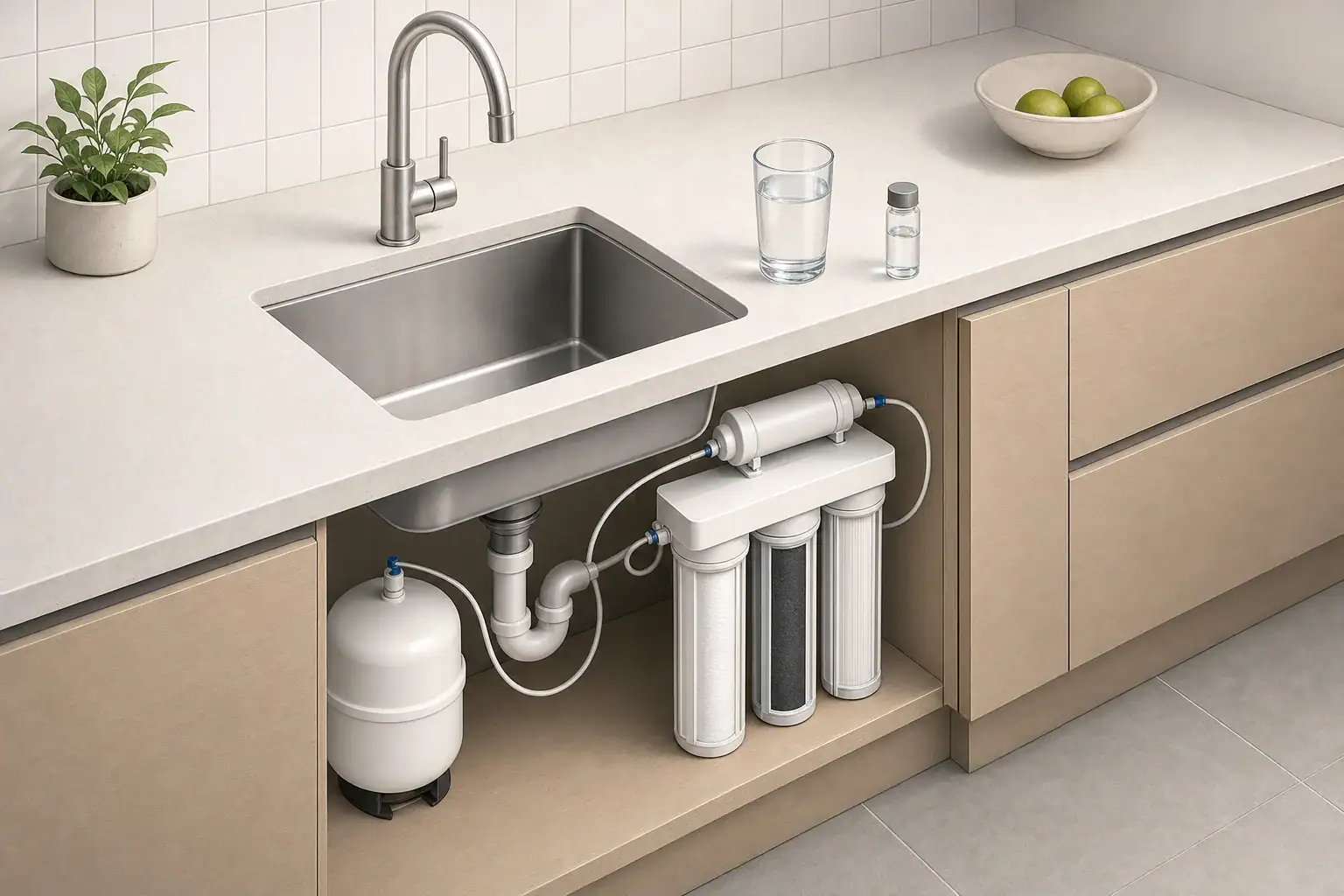
A regulatory limit does not automatically determine whether a home needs a filter. Public water systems are responsible for meeting applicable standards, while household treatment is an optional additional control in many situations. Private wells are different: they are generally not regulated by the federal drinking water program, so owners are responsible for appropriate testing and treatment.
When considering filtration, start with a contaminant-specific result rather than choosing a system based only on taste, appearance, or a broad claim. Important questions include:
- Was the contaminant detected, and in what units?
- Does the result come from the utility, the home itself, or a private well test?
- Is the comparison value an enforceable limit, a health goal, or an action trigger?
- Does the treatment system have an independent certification listing that specifically covers reduction of the contaminant?
- Can the household follow the required cartridge changes, membrane replacement, flushing, and other maintenance?
Certification to a general filtration standard does not mean a device reduces every contaminant covered somewhere within that standard. The product’s certification listing should name the specific reduction claim. Performance also depends on correct installation, compatible water conditions, flow rate, and timely maintenance.
Common interpretation mistakes
- Treating an MCLG as a legal limit: It is a non-enforceable health goal.
- Treating an action level as an MCL: An action level triggers rule-specific responses and may be based on system-wide sampling calculations.
- Ignoring units: Comparing milligrams per liter with micrograms per liter without conversion can create a thousandfold error.
- Assuming below the MCL means zero risk: An MCL is an enforceable standard, not a promise of zero exposure or zero risk for every person.
- Assuming one high result proves a utility violation: Formal compliance may use multiple samples, defined locations, and averaging rules.
- Using utility data as a substitute for premise-plumbing testing: Lead and copper can vary substantially from one building to another.
Related guides: CCR quick checklist • Private well water testing schedule • NSF/ANSI 53 vs 401 vs 58
A practical reading order
When a report presents several numbers, first find the measured result and its units. Next identify whether the comparison value is an MCL, MCLG, or action level. Then check the sampling location, reporting period, and any violation or explanatory notes. This sequence separates an enforceable compliance issue from a health-based goal or a trigger for additional regulatory action.
Frequently asked questions
What is the difference between an MCL and an MCLG?
An MCL is an enforceable drinking water standard for public water systems. An MCLG is a non-enforceable health-based goal that may be lower than the MCL.
Does a result below an MCL mean the water has no risk?
No. An MCL is a regulatory compliance limit, not a guarantee of zero exposure or zero risk. The contaminant, concentration, exposure conditions, and individual circumstances still matter.
Is an action level the same as a drinking water limit?
No. An action level is a rule-specific threshold that triggers required actions, often based on defined sampling and calculation procedures rather than a single universal concentration limit.
Can one tap-water test prove that a utility violated an MCL?
Usually not. Utility compliance can depend on required sampling locations, timing, sample numbers, and averaging or statistical calculations under the applicable rule.
How should I compare a laboratory result with a water standard?
Match the contaminant form and units first, then identify whether the benchmark is an MCL, MCLG, action level, or another value. Also review where and when the sample was collected.
- NSF/ANSI standards explained (42/53/401/58)
- Clear trade-offs: pitcher vs faucet vs under-sink vs RO
- Maintenance planning: cost per gallon and replacement cadence