
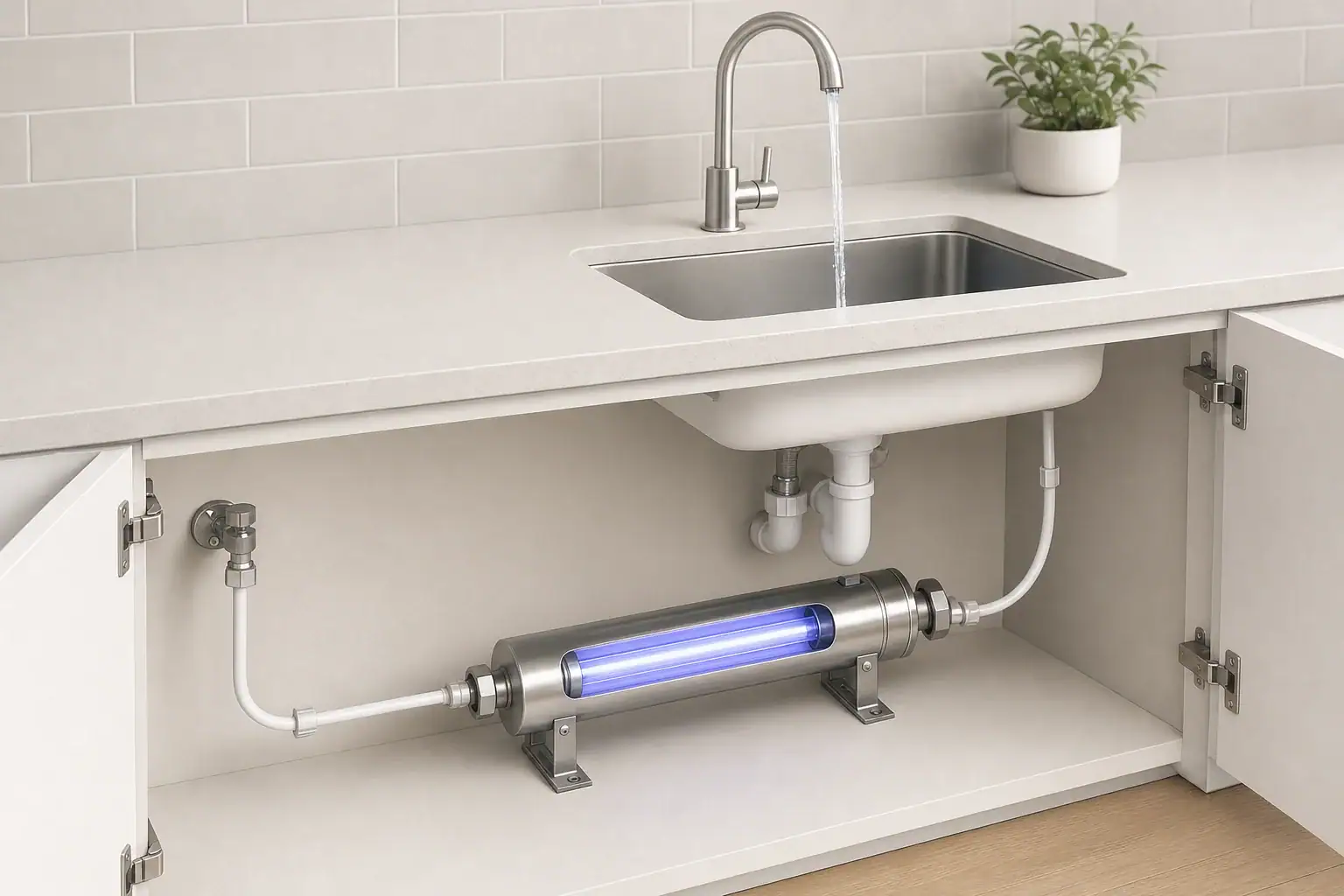
NSF/ANSI 55 Class A and Class B identify two different intended uses for ultraviolet water treatment systems. Class A systems are intended to inactivate microorganisms in microbiologically contaminated water that is otherwise suitable for UV treatment. Class B systems provide supplemental treatment only for water already considered safe to drink.
The practical distinction is the condition of the incoming water. Class A is generally the relevant category when microbial contamination is a credible concern, such as with some private wells. Class B may be suitable when the supply is already disinfected and potable but additional control of nuisance microorganisms is desired.
Neither class removes sediment, chemicals, metals, salts, or other dissolved contaminants. Certification also does not mean a UV system will work effectively at any flow rate or with water of any quality.
Class A and Class B at a glance
| Criterion | Class A | Class B |
|---|---|---|
| Intended incoming water | Microbiologically contaminated water that meets the system’s other water-quality requirements | Disinfected or otherwise potable water |
| Primary purpose | Inactivation of microorganisms, including pathogens covered by the standard | Supplemental reduction of normally occurring nuisance microorganisms |
| UV dose benchmark | 40 mJ/cm² | 16 mJ/cm² |
| Appropriate for an unsafe microbial supply | Potentially, when correctly selected, installed, and maintained as part of a suitable treatment approach | No |
| Typical decision factor | A source such as a private well has a credible microbial risk | The source is already considered potable |
The dose values are part of the standard’s performance framework, but dose alone does not establish certification. A certified system is evaluated as a complete unit under defined operating conditions.
What NSF/ANSI 55 Class A means
Class A systems are designed for water that may contain disease-causing microorganisms. The standard uses a UV dose benchmark of 40 millijoules per square centimeter, commonly written as 40 mJ/cm².
This class addresses microorganisms such as bacteria, viruses, and protozoan cysts or oocysts within the scope of the standard. UV works by exposing microorganisms to ultraviolet light that interferes with their ability to reproduce. It inactivates them rather than physically filtering them out.
Class A does not mean that any contaminated source can be made potable by placing a UV chamber in the plumbing. Important boundaries remain:
- The water must be sufficiently clear for UV light to pass through it.
- Flow must remain within the certified system rating.
- Water characteristics must remain within the manufacturer’s specified limits.
- The unit must receive power and be maintained correctly.
- Other contaminants require separate testing and treatment.
- Class A systems are not intended to treat wastewater or water contaminated by raw sewage.
Class A equipment also incorporates safeguards required for its certified configuration, such as monitoring and an alarm for inadequate UV intensity. Exact features vary by system. An alarm warns of a treatment problem, but it does not correct the cause or confirm that downstream plumbing remains uncontaminated.
What NSF/ANSI 55 Class B means
Class B systems use a lower UV dose benchmark of 16 mJ/cm². They are intended for supplemental bactericidal treatment of disinfected public drinking water or other water that has been tested and deemed acceptable for drinking by the appropriate authority.
The purpose is to reduce normally occurring, nonpathogenic or nuisance microorganisms. Class B is not intended to disinfect a microbiologically unsafe supply. It should not be selected as a substitute for Class A merely because it costs less, supports a higher flow rate, or fits more easily into the available space.
A possible Class B application is a point-of-use or building water line receiving an established potable supply where supplemental microbial control is desired. Whether that treatment is useful depends on the plumbing, water use, and the specific problem being addressed.
Why UV dose and flow rate must be considered together
UV dose depends partly on light intensity and exposure time. As flow through a chamber increases, water generally spends less time exposed to the UV source. That is why a system’s rated flow is tied to its validated treatment performance.
A high-flow Class B unit is not equivalent to a lower-flow Class A unit. The class reflects the intended microbial treatment level, not simply chamber size, lamp wattage, or plumbing connection diameter.
When sizing a system, compare the certified flow rating with the highest flow that may pass through the chamber at one time. For a whole-house installation, simultaneous use of showers, faucets, appliances, and fixtures can matter. A flow-control device may be part of the certified configuration and should not be removed or bypassed.
Water quality can limit UV performance
UV treatment relies on light reaching microorganisms. Sediment and cloudiness can shield them, while deposits on the quartz sleeve can reduce the amount of UV energy reaching the water.
Before choosing either class, review the system’s limits for factors such as:
- Turbidity and suspended sediment
- UV transmittance, which indicates how readily UV light passes through the water
- Iron and manganese
- Hardness and scale formation
- Color or organic matter
- Operating pressure, temperature, and flow
Prefiltration or other treatment may be needed, particularly for private well water. Pretreatment must be selected from actual water-test results rather than assumed from appearance alone. Clear water can still contain microorganisms, while cloudy water can interfere with UV even when its microbial condition is unknown.
Certification applies to the complete system
A product description stating that a lamp produces a certain dose is not the same as certification to NSF/ANSI 55. Look for the exact model in the listing of an accredited certification body and verify the certification claim as Class A or Class B.
Certification applies to the evaluated configuration. The chamber, UV source, power supply, sensor, flow controls, and other specified components may all affect performance. Substituting incompatible parts or operating beyond the rated flow can undermine the conditions represented by the certification.
Also distinguish these phrases when reviewing equipment:
- Certified to NSF/ANSI 55: The listed system has undergone third-party evaluation to applicable requirements of the standard.
- Designed to meet NSF/ANSI 55: A manufacturer statement that does not by itself confirm third-party certification.
- Uses a 40 mJ/cm² dose: A dose statement that does not by itself establish Class A certification.
Choosing the appropriate class
Start with the status of the water source
If the incoming water is already disinfected and recognized as potable, Class B may be considered for supplemental control. If microbial contamination is known or reasonably possible, Class B is not the appropriate category.
For a private well, testing is especially important. Well construction, flooding, nearby septic systems, surface-water influence, and previous positive microbial tests may affect the treatment decision. A Class A system may be appropriate, but the full water analysis and source conditions determine whether pretreatment or corrective work is also necessary.
Decide whether treatment is point of use or point of entry
Class A and Class B do not specify installation location. Either type may be offered in different configurations. A point-of-entry system treats water before it is distributed through the home, while a point-of-use system treats water at a particular fixture.
If contamination could occur in untreated plumbing downstream of the UV unit, installation location becomes part of the safety decision. UV also leaves no ongoing disinfectant residual in the plumbing.
Match the certified flow to peak demand
Use peak flow, not average daily consumption, when evaluating capacity. Undersizing can allow water to move through the chamber faster than intended. Oversizing is not automatically harmful, but it may increase purchase and maintenance costs without improving the treatment decision.
Account for power interruptions
Most residential UV systems require continuous electricity. During a power failure, treatment stops even though water may still be able to flow unless the installation includes an appropriate protective control. Households relying on UV for microbial protection should have a plan for outages, alarms, and restart procedures consistent with manufacturer and local health guidance.
Maintenance affects both classes
UV performance can decline even when the source still appears illuminated. Lamp-based systems generally require UV-source replacement on a manufacturer-defined schedule because germicidal output falls with use. A visible glow is not proof that the required dose is being delivered.
Routine tasks may include:
- Replacing the UV lamp or other UV source at the specified interval
- Cleaning or replacing the quartz sleeve when deposits accumulate
- Replacing sediment prefilters before they become excessively restricted
- Checking alarms, indicators, sensors, and any protective controls
- Inspecting for leaks and confirming that flow remains within the rating
- Testing source and treated water at intervals appropriate for the supply
After installation, service, a prolonged shutdown, or a confirmed microbial problem, downstream plumbing may require sanitization under appropriate professional or public-health guidance. UV only treats water as it passes through the active chamber; it does not automatically disinfect contaminated pipes, storage tanks, or fixtures.
Common classification mistakes
- Choosing Class B for well-water risk: Class B is intended for water already considered potable, not as primary treatment for a potentially unsafe source.
- Comparing only wattage: Lamp wattage does not establish delivered dose or certified performance.
- Ignoring peak flow: Treatment performance is linked to the system’s rated operating flow.
- Assuming UV treats every contaminant: UV does not remove arsenic, lead, nitrate, PFAS, hardness minerals, sediment, or most other nonmicrobial contaminants.
- Treating an alarm as optional: An alarm can indicate inadequate intensity or another fault that requires prompt attention.
- Relying on marketing language: Confirm the exact model, class, and rated flow in a third-party certification listing.
A practical selection rule
Use the incoming water’s established microbial status as the first dividing line. Class B is supplemental treatment for water already accepted as potable. Class A is the more relevant standard classification when a suitable water source has a credible microbial contamination risk, but it must still be selected around test results, water clarity, peak flow, pretreatment needs, and maintenance capability.
If testing shows microbial contamination, repeated positives, or signs of source damage, consult the local health department or a qualified water-treatment professional. The source problem, plumbing condition, and nonmicrobial contaminants may need attention in addition to UV treatment.
Frequently asked questions
Is NSF/ANSI 55 Class A better than Class B?
Class A is not simply better; it is intended for a different application. It is the relevant classification when microbial contamination is a credible concern, while Class B is supplemental treatment for water already considered potable.
Can I use a Class B UV system on private well water?
Not as primary treatment for a well with known or possible microbial contamination. Test the well water and consider a properly selected Class A system, along with any needed pretreatment or source repairs.
Does a Class A UV system remove chemicals or sediment?
No. UV inactivates susceptible microorganisms but does not remove sediment, hardness, metals, salts, PFAS, nitrate, or most other chemical contaminants.
How do I size a UV water system?
Match the system’s certified flow rating to the highest expected simultaneous water demand. Also confirm that turbidity, UV transmittance, iron, hardness, and other water conditions meet the manufacturer’s requirements.
What happens if the UV system loses power?
Treatment stops during a power interruption. If UV is relied on for microbial protection, follow the manufacturer’s outage and restart procedures and use appropriate protective controls where needed.
Related guides: When UV disinfection makes sense • What a positive total coliform test means • How to verify a filter certification claim
- NSF/ANSI standards explained (42/53/401/58)
- Clear trade-offs: pitcher vs faucet vs under-sink vs RO
- Maintenance planning: cost per gallon and replacement cadence