
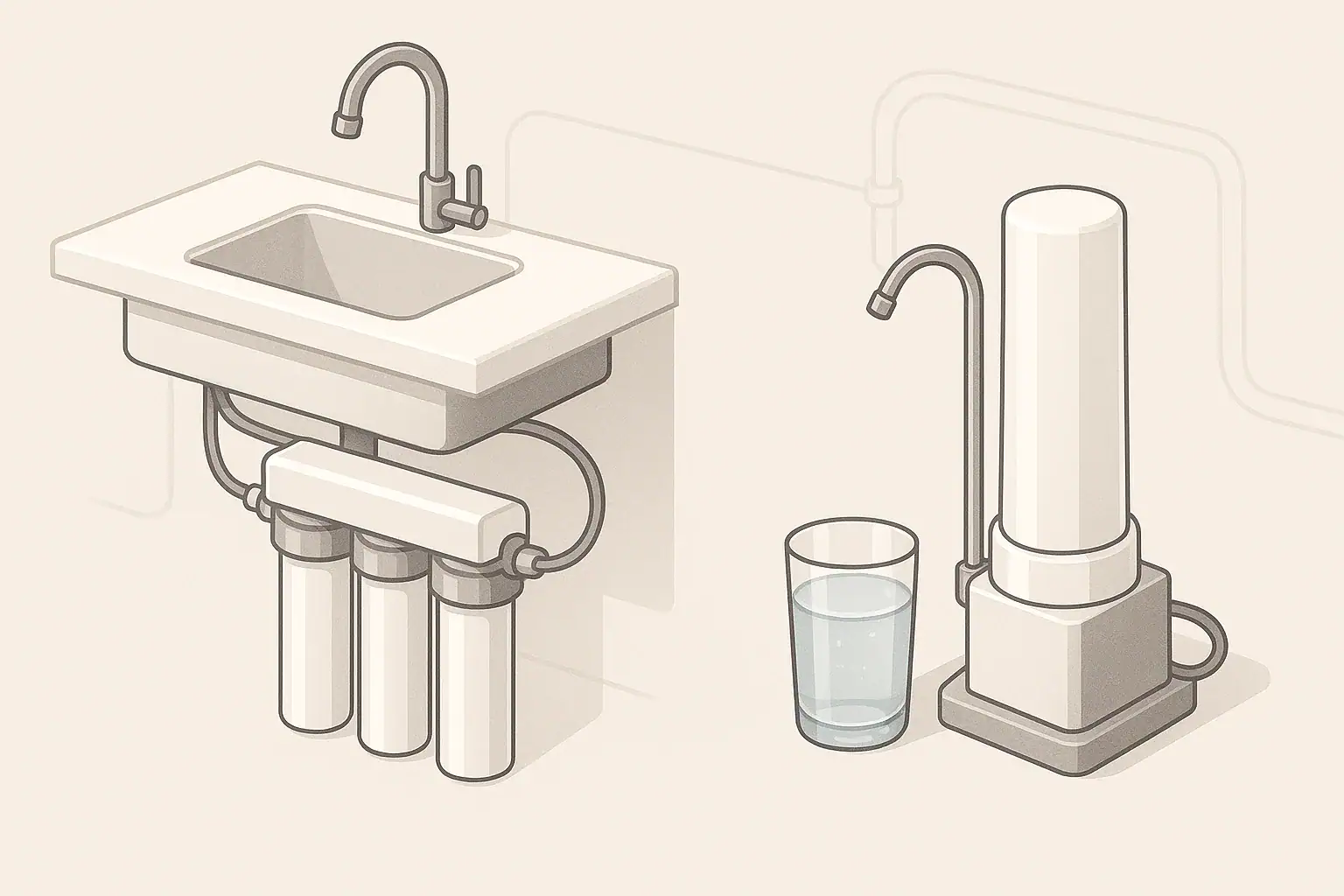
What “Long-Life” Means on a Water Filter Box
Many home water filters are marketed as “long-life” or “long-lasting,” but those phrases are not standardized. One product might call three months long-life, while another reserves the term for filters rated for years. To make sense of these claims, it helps to understand what manufacturers usually mean when they set a lifespan.
Most long-life claims are based on one or both of these measures:
- Time-based rating – for example, up to 6 months, 1 year, or 3 years of use.
- Volume-based rating – for example, up to 300 gallons, 1,000 gallons, or 10,000 gallons of water treated.
Those ratings are typically calculated under controlled conditions that assume:
- Relatively clean incoming water (often municipal, not problematic well water)
- Moderate daily usage (for example, one household’s typical kitchen use)
- Stable pressure and temperature
In real homes, water quality, usage patterns, and plumbing conditions vary widely. That means the real-world life of a long-life filter may be shorter or, in some cases, longer than the label suggests. A “12-month” cartridge might last only 6–9 months under heavy use or with sediment-heavy water, while a lightly used kitchen filter on relatively clean city water may function acceptably beyond its time rating.
Because there is no legal definition of “long-life” for most consumer filters, it is more useful to look at the type of filter and its rated capacity than to rely on the phrase alone.
How Filter Technology Shapes Lifespan
Different filtration technologies wear out or clog at different rates. When a product advertises long life, it often reflects the underlying media type and how hard that media has to work for typical contaminants.
Carbon filters
Activated carbon filters are common in pitchers, faucet-mounted systems, under-sink cartridges, and refrigerator filters. They primarily reduce chlorine, some taste and odor compounds, and various organic chemicals.
Carbon cartridges have two main limits:
- Adsorption capacity – over time, the carbon’s microscopic pores fill up with substances it has captured.
- Flow restriction – fine carbon blocks can clog with sediment and particles.
Long-life carbon filters usually address these limits by:
- Increasing the amount of carbon media
- Using a denser or more efficient carbon block design
- Adding a separate pre-filter to catch sediment before it reaches the carbon
Sediment filters
Sediment filters trap sand, rust, and other particles. Their life depends most on how much particulate matter is in the water and how fine the filter is rated (for example, 5 microns vs. 50 microns).
Long-life sediment filters often:
- Have a larger surface area (pleated designs instead of simple spun cartridges)
- Use graded density to load sediment gradually
- Are oversized for the system’s usual flow rate
Reverse osmosis (RO) membranes
RO membranes are semi-permeable barriers used in many under-sink systems. They can often last several years, but only if:
- Pre-filters effectively remove chlorine and sediment before water reaches the membrane
- Incoming water pressure is adequate and stable
- The membrane is regularly flushed by the system’s design
In RO systems, a “long-life” claim usually refers to the RO membrane itself, not the pre-filters. Pre-filters often require more frequent replacement, even when the membrane is rated for several years.
Specialty media (iron, hardness, specific contaminants)
Some systems use resin or specialty media to address issues like hardness, iron staining, or specific contaminants such as certain volatile organic compounds (VOCs). These media have defined capacities and may need regeneration or replacement based on:
- The concentration of the target substance in the water
- The total volume treated
- Maintenance practices (for example, brine regeneration where applicable)
For these filters, “long-life” usually assumes that incoming water stays within certain quality ranges. If water chemistry changes, lifespan can shift dramatically.
Example values for illustration.
| Filter type | Typical long-life time rating (example) | Typical long-life volume rating (example) | Primary limiting factor |
|---|---|---|---|
| Pitcher carbon cartridge | 2–6 months | 40–150 gallons | Carbon capacity and flow restriction |
| Faucet-mounted carbon filter | 2–4 months | 100–300 gallons | Fine carbon clogging |
| Under-sink carbon block | 6–12 months | 500–2,000 gallons | Adsorption capacity |
| Whole-house sediment cartridge | 1–6 months | Varies widely | Sediment loading |
| RO membrane (under-sink) | 2–5 years | Several thousand gallons | Scaling and fouling |
| Specialty media (targeted contaminant) | 6–36 months | Media-specific capacity | Target contaminant load |
These ranges are examples only and not product specifications.
Why Real-World Lifespan Often Differs From the Label
Even when a filter is advertised as long-life, several everyday variables can shorten (or occasionally extend) its useful life. Understanding these factors helps you set realistic replacement expectations.
Incoming water quality
Water quality has more impact on filter life than almost any other factor. Key influences include:
- Sand, rust, and sediment – clog sediment filters and carbon blocks, increasing pressure drop.
- Chlorine and chloramine levels – consume activated carbon capacity.
- Dissolved minerals (hardness) – contribute to scale on RO membranes.
- Organic matter and color – load carbon and other media more quickly.
Municipal water that is already relatively clear may allow a long-life filter to approach or meet its rated capacity. Well water with heavy sediment, iron, or hardness can reduce that same filter’s lifespan substantially.
Household usage patterns
Long-life ratings assume “typical” use. Actual homes vary widely:
- A small household that mostly drinks bottled or unfiltered tap water may use the filtered tap only for coffee or cooking, extending filter life.
- A large family that relies on the filter for all drinking, cooking, and even pet water can exceed the assumed daily gallons, shortening life.
- Appliances connected to filtered lines (ice makers, built-in coffee machines) add additional load.
For example, if a filter is rated for 600 gallons at an assumed 2 gallons per day, the label might estimate 12 months. If your home uses 4 gallons per day through that same filter, the capacity would be reached in about 6 months instead of 12.
Pressure, temperature, and installation details
Operating conditions also play a role:
- Pressure – very low pressure can reduce performance in some systems, while unusually high pressure can stress housings and seals.
- Temperature – most residential filters are designed for cold or room-temperature water; hot water can damage media and shorten life.
- Orientation and fittings – proper mounting and correct fittings help maintain consistent flow and avoid leaks that might encourage early replacement.
These factors influence performance and convenience more than the chemistry of the filter, but they can still shape how long the filter is practical to keep in service. For installation tips and common mistakes to avoid, see Cartridge Change Mistakes That Cause Leaks.
Signs a Long-Life Filter Is Near the End of Its Useful Life
Even with a long-life rating, filters do not work indefinitely. Instead of relying on time alone, watch for signs that indicate a filter is nearing the end of its useful life.
Noticeable flow reduction
A common sign of a spent filter is a drop in water flow:
- Faucet filters may slow to a trickle.
- Under-sink filters may take much longer to fill a glass.
- Whole-house sediment filters may cause weak flow throughout the home.
Flow reduction suggests that the filter is clogged with particles or buildup. Some gradual reduction is expected over time, but a major drop often means it is time to replace the cartridge, even if you have not reached the full rated interval.
Return of taste or odor
Many people notice a clear difference in taste or odor right after installing a new filter. As a long-life filter nears the end of its capacity, that improvement may fade. You might detect:
- Stronger chlorine-like smell or taste compared with earlier weeks
- Return of musty or earthy notes the filter previously reduced
- Less overall difference between filtered and unfiltered taps
Changes in taste and odor are one of the simplest everyday indicators that it may be time to change a filter, even if the calendar suggests some life remains.
Reached or exceeded rated capacity
Some long-life systems include a usage indicator or timer. For others, you may need to estimate based on your typical daily use. Once you have reached the approximate gallon capacity or time rating, it is generally wise to change the filter even if the water still looks and tastes acceptable.
Staying within labeled intervals aligns with how the filter was designed and tested and helps avoid relying on media that may be saturated even if performance changes are subtle.
How to Set Realistic Replacement Intervals for Long-Life Filters
Because real-world conditions vary, treating the label interval as a precise promise often leads to disappointment. A more practical approach is to use the manufacturer’s rating as a starting point and adjust based on your own water and usage.
Step 1: Note both time and volume ratings
If a product lists both “up to 12 months” and “up to 1,000 gallons,” both statements matter. The practical rule of thumb is usually to replace the filter whichever comes first: time limit or volume limit.
Time limits consider factors like potential bacterial growth within a standing filter cartridge during long, slow use, while volume limits capture the mechanical and chemical exhaustion of the media.
Step 2: Estimate your household’s filtered water usage
To estimate usage, think about how you use filtered water each day. For example:
- Drinking glasses and bottles filled from the filter
- Cooking water (pasta, soup, rice, coffee, tea)
- Appliances connected to the filter (ice maker, refrigerator dispenser)
You might conclude that your household sends about 3–5 gallons per day through a kitchen filter, or more if you rely on it heavily. Dividing the rated gallon capacity by that daily estimate gives a rough number of days you can expect.
Step 3: Adjust for your source water
If you know that your water is:
- Very hard
- High in sediment or visible particles
- High in chlorine or has strong taste/odor
It is reasonable to shorten the interval somewhat. For example, you might plan to replace a “12-month” under-sink carbon filter every 8–10 months, especially if flow slows or taste changes appear earlier.
Step 4: Track one or two cycles
One practical method is to mark installation dates on the housing or on a simple log and note when you see meaningful changes (flow, taste, or an indicator light). After one or two full cycles, you will have a more accurate sense of your home’s real-world filter interval than any generic long-life claim.
Maintenance Habits That Help Long-Life Filters Reach Their Potential
Good maintenance will not make a filter last forever, but it can help a long-life cartridge or membrane reach more of its rated capacity without major performance problems.
See Cleaning and Sanitizing Filter Housings: A Simple Routine for practical maintenance steps.
Pre-filtration for sediment-heavy water
If your water contains noticeable sand, rust, or other particles, a dedicated sediment pre-filter can protect more expensive long-life cartridges or RO membranes. The pre-filter is usually cheaper and easier to replace and can take the brunt of clogging, leaving downstream media to focus on finer contaminants.
Avoiding hot water through cold-water filters
Most point-of-use filters are designed for cold or room-temperature water only. Running hot water through them can damage carbon blocks, O-rings, and plastic housings. Over time, that can reduce effectiveness and shorten life. Using filtered water only on the cold side and mixing with hot water as needed at the sink is a simple way to stay within design limits.
Respecting maximum pressure ratings
Residential filter housings and cartridges are built to handle typical household pressures, but excessive pressure fluctuations or very high pressure can stress seals and housings. If your home has unusually high pressure, a properly installed pressure-reducing valve (by a qualified professional) can protect both plumbing and filtration equipment.
Keeping track of replacement dates
Even with long-life filters, it is easy to forget when they were installed. Some simple options include:
- Writing the installation date on the filter housing with a marker
- Recording it in a household maintenance notebook
- Setting calendar reminders based on expected intervals
This helps avoid unintentionally running a filter years past its intended service life. For a simple planning guide, see Replacement Planner Basics: Estimate Your Next Filter Change Date.
Example values for illustration.
| Filter location | Label rating (time) | Label rating (volume) | Suggested starting interval (time) | When to shorten interval |
|---|---|---|---|---|
| Pitcher filter | 2 months | 40 gallons | Every 2 months | Heavy daily refills or taste change |
| Faucet-mounted filter | 3 months | 100 gallons | Every 2–3 months | Flow slows or chlorine taste returns |
| Under-sink carbon filter | 12 months | 1,000 gallons | Every 9–12 months | High usage or strong tap odor |
| Whole-house sediment filter | 6 months | Not specified | Every 3–6 months | Visible pressure drop or discoloration |
| RO pre-filters | 6–12 months | Capacity-based | Every 6–12 months | High sediment or high chlorine |
| RO membrane | 2–5 years | Several thousand gallons | Every 2–4 years | Reduced production or rising TDS trend |
| Specialty media cartridge | Varies | Media-specific | Within label time range | Source water above typical levels |
Use your own water tests, usage, and observations to refine these example intervals.
Frequently asked questions
How often should I actually replace a “long-life” filter?
Start with the manufacturer’s time and volume ratings and replace whichever comes first. Shorten intervals for high sediment, strong chlorine, heavy household use, or any return of taste/odor. Track one or two cycles to set a practical schedule for your home.
Can I clean or flush a cartridge to extend its life?
Most disposable carbon and specialty cartridges are not designed to be cleaned; flushing won’t restore adsorption capacity. Some systems (like RO membranes) benefit from periodic flushing per the system design, but follow manufacturer guidance rather than attempting DIY cleaning.
Will adding a pre-filter make a long-life filter last longer?
Yes. A sediment pre-filter removes particles that clog downstream media, protecting carbon blocks and membranes so the main filter reaches more of its rated capacity and maintains flow longer.
What are the simplest signs that a long-life filter needs replacing?
Look for a noticeable flow drop, the return of taste or odor the filter previously reduced, or having reached the rated time/volume. Any of these mean it’s time to replace the cartridge even if the label interval hasn’t fully elapsed.
Related guides: Replacement Planner Basics: Estimate Your Next Filter Change Date • Cleaning and Sanitizing Filter Housings: A Simple Routine • Cartridge Change Mistakes That Cause Leaks • Subscription Replacement Programs: Are They Worth It?
Recommended next:
- NSF/ANSI standards explained (42/53/401/58)
- Clear trade-offs: pitcher vs faucet vs under-sink vs RO
- Maintenance planning: cost per gallon and replacement cadence