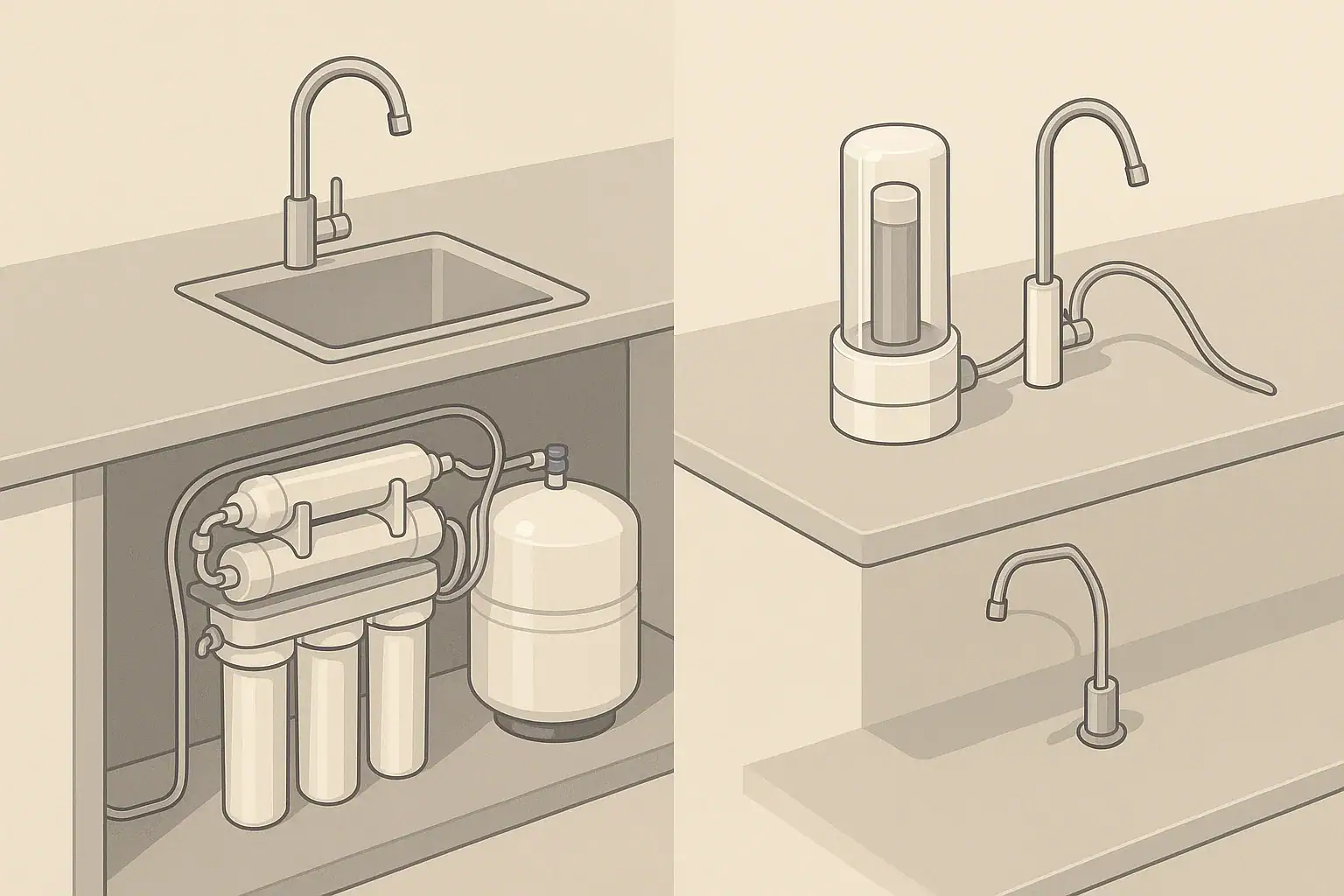
Why RO Membrane Replacement Matters
In a home reverse osmosis (RO) system, the membrane is the core component that does most of the heavy filtering. Prefilters and postfilters handle sediment, chlorine, and taste, but the RO membrane is what significantly reduces dissolved solids such as salts and many other dissolved substances.
Over time, every RO membrane gradually loses performance. It can plug up, reducing flow, or it can allow more dissolved solids through. Replacing it at the right time helps you maintain predictable water quality, protect downstream cartridges, and avoid unnecessary service calls.
This article focuses on practical, at-home checks you can use to decide when to replace an RO membrane, without relying only on calendar reminders.
Typical Lifespan of an RO Membrane
Most residential thin-film composite (TFC) RO membranes are designed to last several years under normal conditions. However, real-life lifespan depends heavily on your water quality and system maintenance.
Common lifespan ranges
In many home RO systems, membrane replacement is often recommended somewhere in this general range:
- About 2–3 years for homes with higher usage or challenging water
- About 3–5 years for homes with moderate usage and well-maintained prefilters
These ranges are examples only, not guarantees. Some membranes may last longer with gentle use and clean feed water, while others may need replacement sooner if they are exposed to chlorine, heavy sediment, or high hardness without adequate prefiltration.
Factors that shorten membrane life
The following conditions can reduce how long your RO membrane stays effective:
- Poor prefilter maintenance (sediment and carbon filters not changed on time)
- Chlorine or chloramine breakthrough that reaches the membrane
- Very hard water causing scale at the membrane surface
- High total dissolved solids (TDS) in the feed water
- Consistently low water pressure making the membrane operate inefficiently
- Long idle periods where water sits in the system and fouling builds
Example values for illustration.
| Condition | Typical Situation | Likely Effect on Lifespan (Example Only) |
|---|---|---|
| Prefilter changes | On schedule | Supports longer membrane life |
| Feed water hardness | Moderate to high | May shorten life if not managed |
| Feed water TDS | Higher than average | Membrane works harder, life may reduce |
| Chlorine/chloramine control | Good carbon filtration | Helps protect membrane |
| Household use | Light to moderate | Can allow several years of use |
| System pressure | Within manufacturer range | Helps maintain performance |
| Storage or long idle periods | System unused for months | May encourage fouling or stagnation |
Use this checklist with your system manual and local water information when planning replacement.
Key Signs Your RO Membrane May Need Replacement
Instead of guessing by calendar alone, watch for these practical signs in day-to-day use.
1. Noticeably higher TDS in RO water
A common way to track RO membrane performance is with a simple TDS meter. TDS (total dissolved solids) is not a specific contaminant test, but it does tell you roughly how much dissolved material is in the water.
To use TDS as a membrane check, you typically compare:
- Feed water TDS (from the tap supplying the RO)
- RO product water TDS (from the RO faucet)
Most healthy residential membranes show a substantial drop in TDS from feed to product water. When a membrane ages, the RO water TDS usually drifts upward.
Warning signs include:
- RO water TDS has increased significantly compared with previous readings
- RO water TDS approaches a level where the reduction from feed water is much smaller than it used to be
- Day-to-day readings are consistently higher, not just a short-term fluctuation
Check your system documentation for any example performance expectations, then use those as a reference over time. TDS meters are approximate tools, but they are very useful for spotting trends.
2. Changes in taste or odor
If you drink your RO water regularly, you become familiar with its normal taste. A worn membrane can allow more dissolved minerals and other dissolved substances to pass, which may change the flavor of the water.
Consider replacing the membrane if:
- RO water starts tasting noticeably closer to your tap water
- You detect new or stronger mineral notes
- Postfilter changes do not restore the usual taste
Keep in mind that taste and odor can also come from postfilters, storage tanks, or plumbing. If you change your carbon postfilter and still notice persistent change in taste alongside rising TDS, the membrane may be involved.
3. Lower flow from the RO faucet
A fouled or scaled membrane can restrict water flow, even if it is still reducing TDS well. Signs of flow issues include:
- RO faucet flow rate is much slower than before
- Tank takes noticeably longer to fill after being emptied
- System seems to run for long periods while producing little water
Slow flow can also result from low household pressure, a nearly empty storage tank, clogged prefilters, or issues with the flow restrictor. If prefilters are current and pressure is adequate, a persistently slow flow may point toward membrane fouling.
4. More frequent prefilter or postfilter issues
If a membrane is no longer performing effectively, downstream filters can accumulate more material than expected. You may notice:
- Postfilters needing replacement sooner than suggested intervals
- Unusual discoloration in housings or cartridges
- Odors from the storage tank or postfilter section
These signs do not prove the membrane is worn out by themselves, but in combination with rising TDS and taste changes, they strengthen the case for replacement.
5. System age and unknown history
If you move into a home with an existing RO system and do not know when the membrane was last changed, it is often reasonable to:
- Replace sediment and carbon prefilters immediately
- Test TDS of feed and RO water after prefilter replacement
- Plan on a membrane replacement if age is unknown and TDS reduction is poor
Membranes that are several years old with no service records are frequently near the end of their practical lifespan.
Simple At-Home Checks You Can Do
You do not need specialized lab equipment to monitor RO membrane performance. With basic tools and attentive observation, you can make informed decisions.
Check 1: TDS comparison test
A handheld TDS meter is a small tool that measures conductivity and converts it into an approximate TDS reading. To compare your RO and tap water:
- Flush the RO faucet for a short time to clear any stagnant water.
- Rinse the meter probe with RO water according to its instructions.
- Collect a small cup of RO water and measure TDS.
- Collect a small cup of cold tap water that feeds the RO and measure TDS.
- Record both numbers in a notebook or spreadsheet.
Repeat this test periodically under similar conditions. Watching the trend over months is more helpful than reacting to a single reading.
Check 2: Flow and refill time observation
Many under-sink RO systems use a pressurized storage tank. You can get a rough sense of membrane production by watching how the tank refills:
- Turn on the RO faucet and run water until the flow rate drops noticeably, indicating the tank is mostly empty.
- Turn the faucet off and note the time.
- After a set period (for example, 1 or 2 hours), open the faucet again and observe how strong the flow feels.
If refilling takes much longer than it used to, despite normal household pressure and fresh prefilters, the membrane may be fouled or partially blocked.
Check 3: Visual inspection during maintenance
During scheduled prefilter changes, take a moment to inspect the system:
- Look for unusual discoloration, deposits, or cloudiness in housings.
- Note any accumulated sediment that seems excessive for the interval.
- Check for leaks or drips that might indicate stress on the membrane housing.
Membranes are usually enclosed, so you will not see the membrane surface itself, but the condition of upstream filters can provide clues about how hard the membrane is working.
Check 4: Listening for frequent drain flow
RO systems send a portion of water to the drain during operation. If you notice the drain line running for long periods while you are not using much RO water, it may signal that the system is struggling to produce water efficiently.
However, continuous or frequent drain flow can also be related to tank pressure, check valves, or automatic shutoff valves, so consider it a supporting clue alongside TDS and flow observations, not a stand-alone diagnosis.
How Prefilters and Water Quality Affect Membrane Timing
Membrane replacement timing is closely tied to how well the water is prepared before it reaches the membrane.
Role of sediment prefilters
Sediment filters remove sand, rust, and other particles that could plug the RO membrane surface. If sediment filters are not serviced on schedule:
- More particulates may reach the membrane and clog it.
- System pressure at the membrane may drop, reducing performance.
Maintaining clear, properly sized sediment filtration helps the membrane last closer to its potential lifespan.
Role of carbon prefilters for chlorine and chloramine
Many RO membranes are sensitive to chlorine. Carbon prefilters reduce chlorine, and in some cases help reduce chloramine, before water reaches the membrane. If chlorine or chloramine breaks through:
- The membrane material can degrade over time.
- Performance may decline more quickly than expected.
On city water supplies that use chlorine or chloramine, timely carbon prefilter replacement is essential to membrane life.
Hardness, scaling and fouling
Hard water can contribute to mineral scale on the membrane surface. Over time, this can:
- Reduce water production rate
- Increase waste-to-product water ratios
- Make it harder for flushing to restore performance
Some installations use additional treatment upstream of the RO system to help manage hardness. If your water is very hard, discuss options with a water treatment professional and consult your system documentation for any specific recommendations.
Example Planner: Aligning Membrane Changes with Other Maintenance
It is often practical to think about RO membrane replacement alongside other maintenance tasks, so you can handle them in the same general time frame and keep a clear record.
Example values for illustration.
| Component | Example Interval Range | Notes for Planning |
|---|---|---|
| Sediment prefilter | Every few to several months | Change more often with cloudy or sandy water |
| Carbon prefilter | Every several months to about a year | Critical for protecting the RO membrane from chlorine |
| RO membrane | About 2–5 years | Confirm timing with TDS checks and system manual |
| Postfilter (carbon) | About 6–12 months | Helps maintain taste and odor quality |
| Storage tank check | Annually | Inspect for leaks and confirm reasonable refill time |
| System sanitization | During major filter changes | Follow manufacturer-safe procedures only |
| TDS trend review | Every few months | Use notes to decide if membrane is nearing replacement |
Adjust these examples to your actual water conditions, use patterns, and manufacturer guidance.
Related guides: Replacement Planner Basics: Estimate Your Next Filter Change Date • Cleaning and Sanitizing Filter Housings: A Simple Routine • RO Membrane Lifespan: What Shortens It (and How to Extend It)
By combining TDS readings, taste and flow observations, and a simple maintenance log, you can decide when to replace your RO membrane with more confidence, instead of relying only on the calendar.
Frequently asked questions
How often should I test my RO water TDS?
Test every few months and after changing prefilters or if you notice taste, odor, or flow changes. Tracking a trend over time is more useful than a single reading.
Can I clean or flush the membrane to extend its life?
Flushing the system can remove loose deposits, but chemical cleaning is specialized and may require a professional. Cleaning helps some types of fouling but won’t restore chlorine-damaged membranes.
What TDS change indicates it’s time to replace the membrane?
There is no single universal number. Look for a sustained, significant rise in RO TDS or a clear drop in percent rejection compared with your baseline or the manufacturer’s spec. Short-term spikes alone are not conclusive.
Should I replace the membrane if flow is low but TDS is still good?
First check prefilters, tank pressure, valves, and household water pressure. If those are normal and production is still slow, membrane fouling is a likely cause and replacement or professional service is reasonable.
Recommended next:
- Replacement Planner Basics: Estimate Your Next Filter Change Date
- Cartridge Change Mistakes That Cause Leaks
- Cleaning and Sanitizing Filter Housings: A Simple Routine
- Subscription Replacement Programs: Are They Worth It?
- Long-Life Filters: What “Long Life” Really Means
- How to Store Spare Filters Without Ruining Them
- More in Maintenance & Replacement →
- NSF/ANSI standards explained (42/53/401/58)
- Clear trade-offs: pitcher vs faucet vs under-sink vs RO
- Maintenance planning: cost per gallon and replacement cadence