
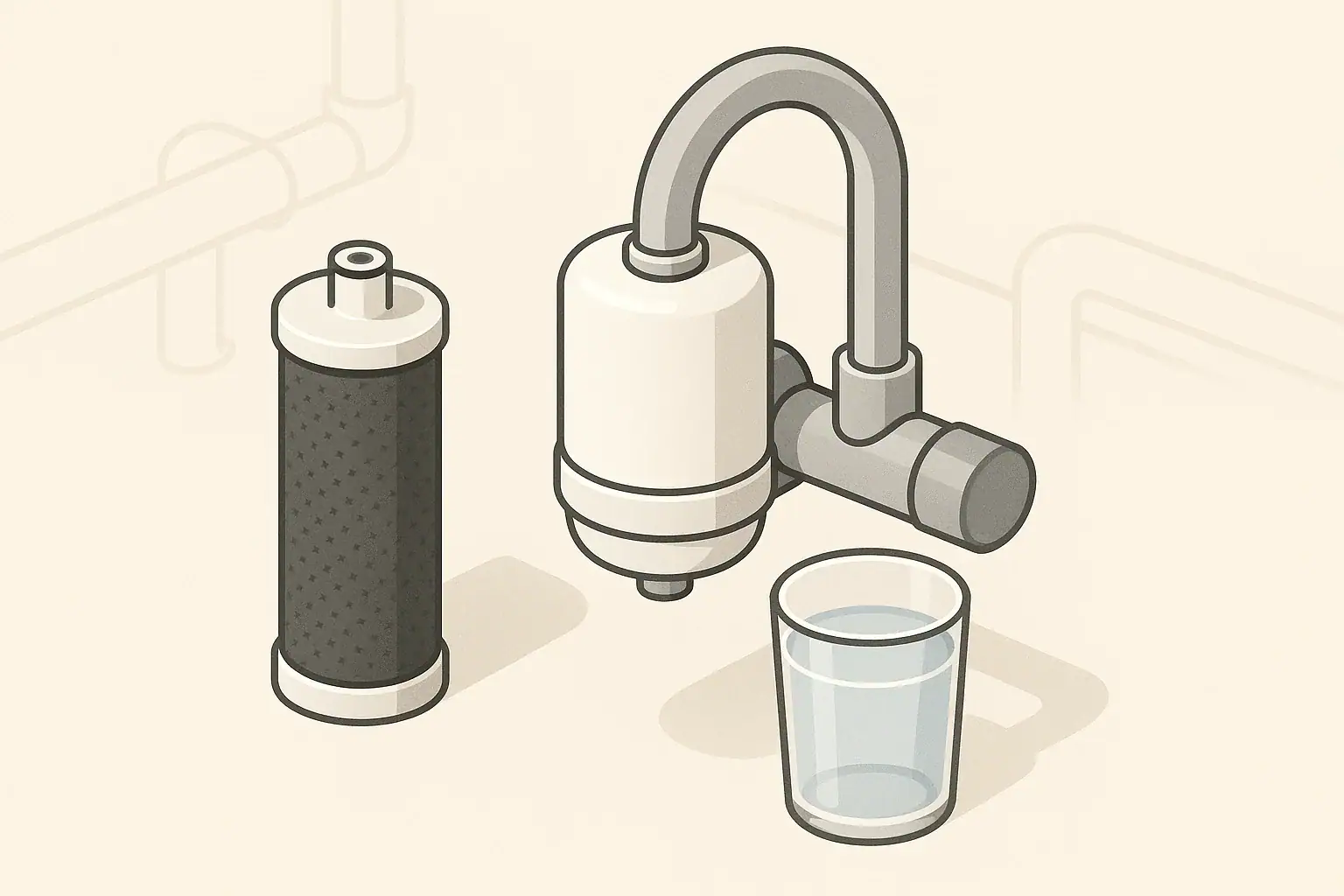
Faucet-mount filters are popular because they are compact, removable, and usually easy to install without permanent plumbing changes. For renters, small kitchens, and people who want filtered water at one sink, they can be a practical option.
Chloramine makes the decision more specific. Many faucet filters use activated carbon, but not every carbon filter is equally suited to reducing chloramine taste and odor. A filter that performs well for free chlorine may not perform the same way for chloramine, especially at the higher flow rates and smaller cartridge sizes common in faucet-mounted designs.
This article explains what to check beyond basic carbon, including carbon type, contact time, flow rate, third-party testing language, replacement planning, and everyday usability.
Why Chloramine Needs a Different Look Than Chlorine
Many municipal water systems use a disinfectant to help maintain water quality as treated water moves through pipes. Free chlorine and chloramine are two common disinfectant residuals. They are related, but they do not behave the same way in a household filter. If you want a broader comparison, see chlorine vs chloramine.
Free chlorine is generally easier for many activated carbon filters to reduce. That is why a basic carbon pitcher, faucet attachment, or refrigerator filter may noticeably improve chlorine taste and odor.
Chloramine is more stable in distribution systems. That stability is useful for utilities, but it also means chloramine can be harder to reduce with a small amount of ordinary carbon. A filter may improve taste somewhat but still leave a noticeable swimming-pool, medicinal, or chemical taste for some users.
Chloramine is mainly a taste and odor concern for many households
For most people shopping for a faucet filter, the practical issue is taste, odor, and confidence in the filter choice. A home filter should not be viewed as a replacement for municipal treatment or as a guarantee of pure water. Instead, it is a point-of-use polishing step that may reduce selected substances when properly designed, installed, and maintained.
Check your water utility information first
Before buying a filter specifically for chloramine, confirm whether your utility uses chloramine, free chlorine, or changes seasonally. Annual water quality reports and utility customer service pages often describe the disinfectant type. If the report is unclear, contacting the utility directly can be more reliable than guessing from taste alone. You can also use your city’s consumer confidence report to verify the water treatment details.
Why Small Faucet Filters Can Struggle With Chloramine
Faucet-mount filters have limited space. The cartridge must fit on the faucet, remain light enough for daily use, and allow water to flow fast enough for filling glasses, pots, and coffee makers. Those design limits matter for chloramine.
Carbon filtration depends partly on contact time. Water must spend enough time in contact with the carbon surface for reduction to occur. A larger cartridge, slower flow, and carbon suited for chloramine generally improve the chance of better performance. A very small cartridge with a fast flow path may not provide enough contact time for meaningful chloramine reduction.
Basic activated carbon may still help with general taste and odor. However, when chloramine is the target, look for filters that specifically mention chloramine reduction rather than only chlorine taste and odor. The distinction is important because chlorine and chloramine are not interchangeable performance claims.
Carbon type matters
Carbon used in filters can vary by source material, activation method, particle size, block structure, and surface chemistry. Some filters use catalytic carbon or modified activated carbon intended to improve chloramine reduction. The term catalytic carbon is not a guarantee by itself, but it is often a sign that the filter is designed with chloramine in mind.
For faucet-mount filters, the strongest product information usually combines the right carbon type with a stated flow rate, rated capacity, and independent testing or certification language that names chloramine.
Example values for illustration.
| What to check | Why it matters | Practical sign to look for |
|---|---|---|
| Chloramine-specific claim | Chloramine is harder to reduce than free chlorine | Performance language names chloramine, not only chlorine |
| Carbon type | Some carbon media are better suited to chloramine | Catalytic carbon or tested carbon blend |
| Flow rate | Fast flow can reduce contact time | Stated filtered-water flow in gallons per minute |
| Cartridge size | More media can support longer contact and capacity | Reasonable cartridge volume for the claimed use |
| Rated capacity | Performance can decline as media is used | Gallons or months are clearly stated |
| Third-party testing | Claims are easier to compare when verified | Certification or test data names chloramine reduction |
| Compatibility | Not all faucets accept attachments | Adapter and faucet-type limits are described |
Specs That Matter Beyond Basic Carbon
The words activated carbon are only a starting point. For chloramine, the details behind the claim are more useful than the label on the media. If you are comparing formats, faucet-mount vs under-sink filters is a useful tradeoff to review.
Look for chloramine-specific performance language
A filter description may say it reduces chlorine taste and odor. That is a common carbon claim, but it does not necessarily mean the same filter has been evaluated for chloramine. When chloramine is your main concern, look for wording that directly says chloramine reduction.
Be cautious with broad phrases such as removes chemicals or purifies water. These phrases are too general to guide a practical purchase. A better specification identifies the contaminant or aesthetic concern, the test basis, and the rated life of the cartridge.
Understand certification language carefully
Independent standards and certification programs can help consumers compare products, but the details matter. A filter may be certified for one claim and not another. For example, a product might be evaluated for chlorine taste and odor, while a different claim such as lead, particulate reduction, or chloramine may not be included.
For chloramine, check whether the product documentation specifically lists chloramine reduction under the relevant tested performance. If a product only says tested to a general standard without naming the exact reduction claim, review the performance data sheet or contact the manufacturer.
Separate aesthetic claims from broader contaminant claims
Chloramine reduction is commonly discussed in relation to taste and odor. A faucet filter may also advertise reductions for sediment, lead, VOCs, PFAS, or other substances, but those are separate questions. Do not assume that good chloramine performance means broad contaminant reduction, or that a filter aimed at lead automatically performs well for chloramine.
The most reliable approach is to match the filter to your actual goals: better taste, lower disinfectant odor, particle reduction, or specific contaminant reduction shown in your local water report or household testing.
Flow Rate Contact Time and Real Faucet Use
Flow rate is one of the most important practical details for faucet-mount chloramine reduction. When water moves through the cartridge quickly, it has less time to interact with the carbon media. Slower flow can feel less convenient, but it may support better reduction for harder-to-treat taste and odor issues. For a practical lens on this, see water pressure vs flow rate.
Many faucet filters are designed to balance convenience and performance. A very fast stream may be nice for filling a pot, but it may not be ideal for chloramine reduction unless the cartridge is specifically designed and tested for that flow.
Watch for pressure and bypass behavior
Some faucet filters include a selector that switches between filtered and unfiltered water. This is useful because it helps preserve cartridge life when washing dishes or rinsing the sink. Use the filtered setting for drinking and cooking water, and use the unfiltered setting for general tasks when appropriate.
Do not modify the filter to increase flow beyond its intended design. Increasing pressure, removing internal parts, or bypassing safety features can damage the unit, create leaks, or reduce performance.
Do not judge performance only by taste
Taste can be helpful, but it is not a precise measurement. Some people detect chloramine easily; others do not. Temperature, plumbing conditions, and other taste contributors can affect perception.
If chloramine reduction is important to you, performance data is more useful than taste alone. At-home test strips can provide a rough screening tool, but they have limitations. For more specific concerns, use a qualified laboratory or consult your utility and product documentation.
Installation Fit and Daily Use Checks
A faucet-mount filter only works if it fits your faucet and stays practical in daily use. Many units are designed for standard threaded faucets, but they may not fit pull-down sprayers, handheld sprayer faucets, unusual aerators, or some designer fixtures. If fit is uncertain, check faucet-mount filter compatibility before buying.
Before buying, check the faucet type, aerator threading, adapter requirements, and available clearance around the sink. A filter that bumps into the backsplash, blocks a soap dispenser, or makes the faucet hard to use may not be a good long-term choice.
Consider kitchen workflow
Faucet filters add weight and bulk to the end of the faucet. That may change how comfortably the faucet swivels or how easy it is to fill tall containers. In a small sink, the filter body may reduce usable space.
Also check whether the filter is intended for cold water only. Many faucet-mounted carbon filters are not designed for hot water. Running hot water through a carbon cartridge can reduce performance or damage components, depending on the design.
Account for renters and temporary setups
For renters, a faucet-mount filter can be attractive because it usually does not require drilling, permanent plumbing changes, or under-sink storage. Keep the original aerator and any removed parts so the faucet can be restored when moving out.
If the faucet does not accept an attachment, avoid force-fitting parts or using unsafe adapters. A countertop gravity filter, countertop plumbed unit, or under-sink system installed with permission may be more appropriate. Some people also compare a pitcher vs faucet-mount setup when space is tight.
Maintenance Testing and Replacement Planning
Carbon filters do not last forever. As water passes through the media, the cartridge gradually loses capacity. Chloramine reduction can decline before a cartridge looks dirty, because appearance is not a reliable indicator of chemical performance.
Follow the stated replacement schedule for gallons, months, or filter-life indicators. If your household uses a large amount of filtered water, gallons may be reached before the calendar date. If use is low, the calendar interval may still matter for hygiene and manufacturer guidance. A filter capacity calculator can help translate daily use into a rough replacement timeline.
Use filtered water selectively
One simple way to extend useful life is to use filtered water only when it matters. Drinking water, ice trays, coffee, tea, and cooking water may be good uses. Dishwashing, handwashing, and rinsing the sink usually do not need filtered water.
If the filter has a bypass setting, using it correctly can reduce unnecessary cartridge loading and may help maintain performance through the intended interval.
Watch for pressure drop and leaks
A slowing stream can mean the cartridge is clogging with sediment or reaching the end of its service life. Faucet-mounted units also have seals, adapters, and housings that should be checked periodically. Stop using the unit if it leaks, cracks, or no longer attaches securely.
When changing cartridges, follow the manufacturer instructions for flushing and handling. Do not sanitize or refill sealed cartridges unless the product is specifically designed for that purpose.
When to Consider a Different Treatment Format
A faucet-mount filter may be a good fit for improving taste at one sink, but it is not always the best chloramine solution. If your household uses a lot of filtered water, wants faster flow, or has multiple water quality goals, another format may be easier to live with.
Under-sink carbon systems can hold larger cartridges and may provide more media volume than a faucet attachment. Some countertop systems also allow larger media beds without permanent installation. Reverse osmosis systems can address a wider range of dissolved substances, but they include different tradeoffs such as slower production, storage tanks or tankless sizing, drain water, and maintenance needs.
For chloramine specifically, larger catalytic carbon stages are often considered when contact time and capacity are priorities. The right choice depends on space, budget, water use, maintenance comfort, and the exact performance claims you need.
Think in terms of fit, not best overall
There is no single best filter format for every home. A faucet-mount model may be ideal for an apartment with a compatible faucet and moderate drinking-water use. It may be less ideal for a large household that fills many bottles and cooking pots each day.
Before moving to a more complex system, write down the problem you want to solve, how much filtered water you use, and whether chloramine is the only concern. That short planning step can prevent buying more system than you need or choosing a filter that is too small for the job.
Example values for illustration.
| Household pattern | What it can mean | Planning cue |
|---|---|---|
| One person, drinking water only | Lower daily gallon use | Calendar interval may matter more than gallons |
| Two to three people, drinks and cooking | Moderate cartridge loading | Track approximate filtered gallons weekly |
| Large household | Capacity may be reached quickly | Consider larger cartridges or under-sink options |
| Noticeable taste returns | Performance may be declining | Replace cartridge and review chloramine-specific data |
| Filtered flow slows | Sediment or clogging may be present | Replace as directed and check faucet screen |
| Long period of nonuse | Stagnant water may sit in cartridge | Flush as directed before drinking |
| Frequent bypass use | Filtered gallons may be lower | Still follow maximum calendar guidance |
Related guides: Faucet-Mount Filter Compatibility: How to Check Your Faucet Type • Faucet-Mount vs Under-Sink Filters: Convenience vs Performance • How to Install a Faucet-Mount Filter Without Leaks • Troubleshooting a Faucet-Mount Filter with Slow Flow
Practical Takeaways for Evaluating Faucet Mount Filters
For chloramine, do not stop at the phrase activated carbon. Check whether the filter documentation specifically names chloramine reduction, and look for testing or certification details that match that claim.
Pay close attention to flow rate, cartridge size, carbon type, and rated capacity. A small faucet-mounted unit can be convenient, but chloramine reduction benefits from enough media and contact time.
Also consider the sink itself. Faucet compatibility, clearance, cold-water-only instructions, bypass use, and cartridge replacement habits all affect whether the filter will work well in daily life.
If a faucet-mount filter fits your water use and has chloramine-specific performance information, it can be a practical point-of-use option. If you need higher capacity, faster flow, or several treatment goals at once, compare it with countertop or under-sink systems before choosing.
Frequently asked questions
Can a basic activated carbon faucet filter reduce chloramine?
Sometimes, but not always well. Chloramine is harder to reduce than free chlorine, so look for a filter that specifically names chloramine reduction instead of only chlorine taste and odor.
What carbon type is better for chloramine?
Filters that use catalytic carbon or a carbon blend designed for chloramine are often a better sign than basic carbon alone. The product should still include clear testing or performance details.
Why does flow rate matter so much?
Faster flow usually means less contact time between water and carbon. For chloramine reduction, slower flow and enough cartridge media can improve the chance of better performance.
How do I know when to replace the cartridge?
Follow the manufacturer’s gallon or month rating, not just taste. Performance can decline before the filter looks dirty, especially with disinfectant reduction claims.
Will a faucet-mount filter fit every kitchen faucet?
No. Many fit standard threaded faucets, but some do not work with pull-down sprayers, unusual aerators, or limited-clearance sinks. Check compatibility before buying.
Is taste alone enough to judge chloramine removal?
No. Taste can be helpful, but it is not precise. Product data, certification language, and replacement timing are more reliable ways to judge whether the filter is a good fit.
Recommended next:
- Best Faucet-Mount Filters for Chlorine Taste (High Flow Picks)
- Faucet-Mount Filter Compatibility: How to Check Your Faucet Type
- Faucet-Mount vs Under-Sink Filters: Convenience vs Performance
- How to Install a Faucet-Mount Filter Without Leaks
- Faucet-Mount Filters for Renters: No-Drill Setup Guide
- Troubleshooting a Faucet-Mount Filter with Slow Flow
- More in Faucet-Mount Filters →
- NSF/ANSI standards explained (42/53/401/58)
- Clear trade-offs: pitcher vs faucet vs under-sink vs RO
- Maintenance planning: cost per gallon and replacement cadence