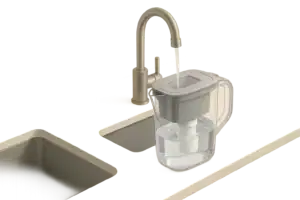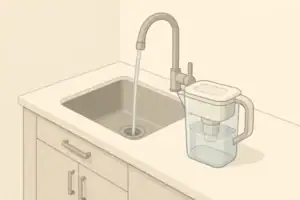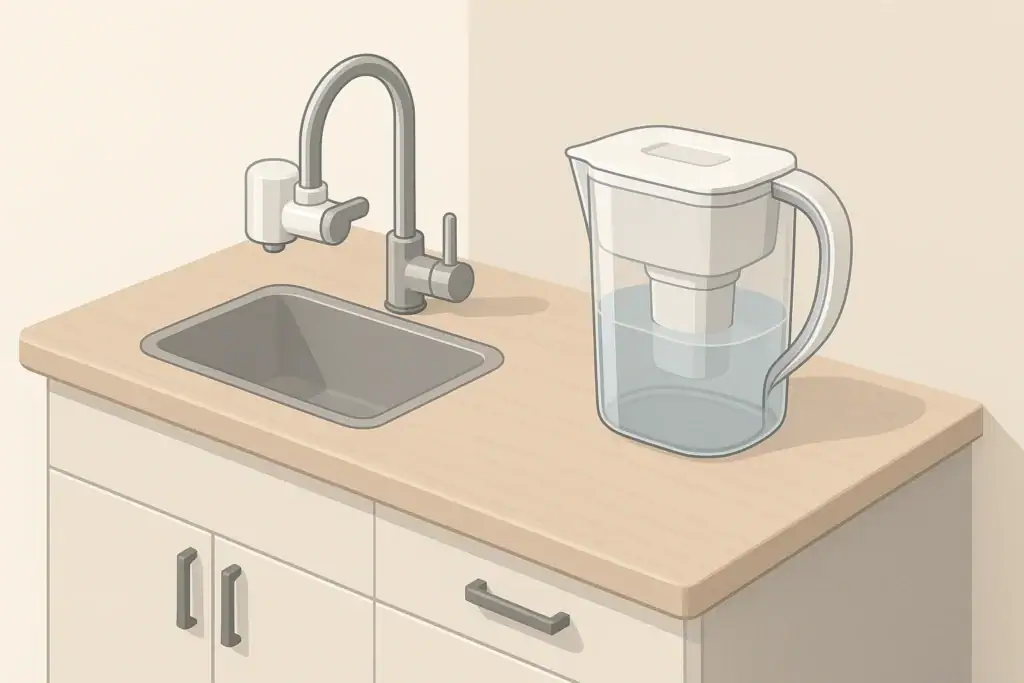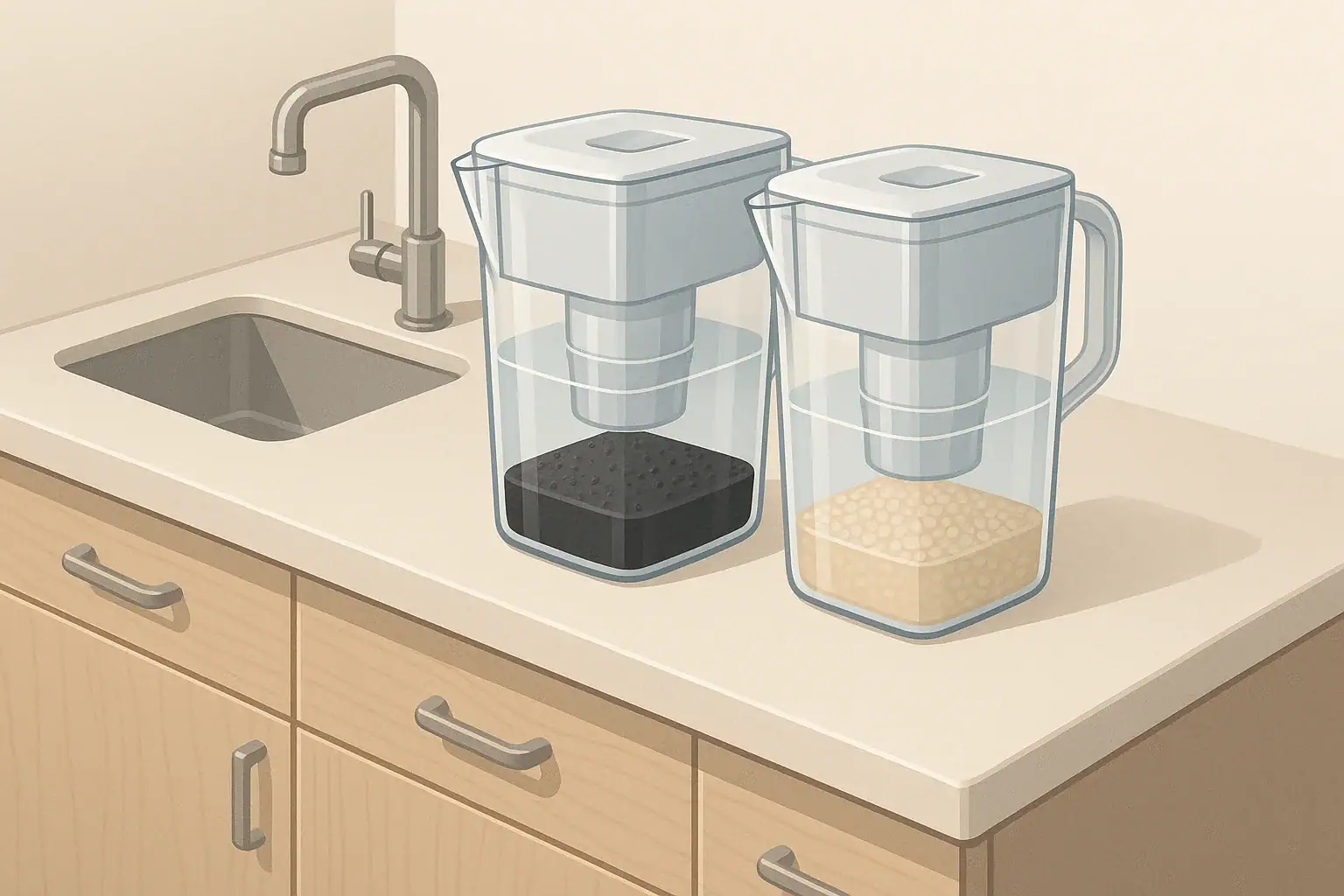
For many households in the US, a pitcher filter is the first step toward better tasting tap water. When people talk about taste, they are usually describing a mix of flavor and smell: chlorine or “pool” odor, metallic notes, earthy or musty tones, and sometimes a flat or bitter aftertaste.
Pitcher filters target those issues in different ways. Two of the most common technologies inside pitchers are:
- Activated carbon (often in granules or blocks)
- Ion exchange resins (small polymer beads that swap ions in the water)
Many pitchers combine both, but some lean heavily on one or the other. Understanding how each medium works can help you decide which is more likely to improve taste in your home.
How Pitcher Filters Improve Taste
For many households in the US, a pitcher filter is the first step toward better tasting tap water. When people talk about taste, they are usually describing a mix of flavor and smell: chlorine or “pool” odor, metallic notes, earthy or musty tones, and sometimes a flat or bitter aftertaste.
Pitcher filters target those issues in different ways. Two of the most common technologies inside pitchers are:
- Activated carbon (often in granules or blocks)
- Ion exchange resins (small polymer beads that swap ions in the water)
Many pitchers combine both, but some lean heavily on one or the other. Understanding how each medium works can help you decide which is more likely to improve taste in your home.
How Activated Carbon Pitchers Affect Taste
Activated carbon is a highly porous form of carbon with a large internal surface area. In pitcher filters, it is typically made from sources like coconut shells or coal, then processed to create microscopic pores. As water passes through, many compounds stick to the carbon surface in a process called adsorption.
What Activated Carbon Is Best At
For taste and odor, activated carbon is especially effective against:
- Chlorine taste and odor from municipal disinfection
- Some chlorination byproducts that can add off-flavors
- Many volatile organic compounds (VOCs) that cause chemical or solvent-like smells
- Musty or earthy odors from natural organic matter
When chlorine-smelling tap water suddenly tastes “cleaner” after filtration, activated carbon is usually doing most of that work. NSF/ANSI Standard 42 is commonly associated with filters tested for aesthetic effects such as chlorine taste and odor reduction.
Limitations for Taste Improvement
Activated carbon does not remove everything that affects taste. It is less effective on:
- Dissolved minerals that cause hardness (calcium, magnesium)
- Sodium that can create a slightly salty flavor
- Very small or highly soluble ions like nitrates or some metals, unless paired with other media
In areas with very hard water, you may notice that carbon improves chlorinous or chemical notes but leaves a mineral or chalky taste. Texture in the mouth (such as a “dry” feeling) often comes from minerals rather than the organic compounds that carbon targets.
Example values for illustration.
| Aspect | Activated Carbon Pitcher | Ion Exchange-Focused Pitcher |
|---|---|---|
| Main taste targets | Chlorine, some organics, many odors | Hardness minerals, some metals, some bitterness |
| Water source that benefits most | Chlorinated municipal supplies | Hard or mineral-heavy supplies |
| Typical change in mineral level (example only) | Small to moderate change | Moderate to larger change |
| Risk of flat-tasting water | Lower if minerals remain | Higher if many minerals removed |
| Filter clogging tendency | May clog faster with sediment | Flow more affected by scale or fouling |
| Best for users who say | “My water smells like a pool” | “My water tastes metallic or chalky” |
How Ion Exchange Pitchers Affect Taste
Ion exchange resins are tiny beads that attract and hold specific ions while releasing others. In pitcher filters, ion exchange is commonly used to reduce hardness and certain metals. This can noticeably change both the flavor and feel of the water.
What Ion Exchange Is Best At
Depending on the resin formulation, ion exchange in pitchers can target:
- Calcium and magnesium, the minerals responsible for hardness
- Some heavy metals such as lead or copper, when the resin is designed for that purpose
- Iron and manganese in certain cases, which can cause metallic or rusty taste
By reducing hardness minerals, ion exchange can make water taste less chalky or bitter and feel “softer” or smoother on the tongue. Some users notice that beverages like coffee and tea taste less harsh when hardness is lowered.
Trade-Offs in Taste and Mouthfeel
Because ion exchange changes the mineral content, it can produce different taste outcomes:
- If your tap water is very hard, removing some hardness minerals can make a dramatic improvement in taste and reduce scale on kettles and coffee makers.
- If your tap water is only moderately hard, heavy mineral reduction can sometimes make the water seem flat or less crisp.
- Some resins exchange minerals for sodium or other ions, which may slightly alter flavor for some people.
Ion exchange resins must be formulated and used correctly to avoid releasing excess resin particles or changing taste in an undesirable way. Many pitcher cartridges pair ion exchange with activated carbon to balance mineral adjustment with chlorine and odor reduction.
Which Pitcher Type Improves Taste More for Your Water?
The answer depends on what is causing the off-taste in your tap water. In practice, most modern pitchers combine activated carbon and ion exchange, but the emphasis on one versus the other still matters.
If Your Water Tastes Like a Swimming Pool
Common signs of chlorine issues include:
- Strong “pool” or bleach-like smell when you run the tap
- Tea or coffee that smells chemical or harsh
- Water that smells fine at the plant but picks up odor in distribution lines
In these cases, a pitcher with robust activated carbon typically delivers the biggest improvement in taste and odor. Look for filters that state they are tested for chlorine taste and odor reduction, often associated with NSF/ANSI 42 claims.
If Your Water Tastes Metallic, Bitter, or Chalky
When the main complaints are mineral or metal related, ion exchange can be more noticeable:
- White scale on kettles, coffee makers, and faucets
- Metallic taste from older plumbing
- Chalky or bitter flavor even after chilling
Here, a pitcher that emphasizes ion exchange for hardness minerals or metals may change taste more dramatically than carbon alone. Reducing hardness can also alter how beverages brew and how soap behaves at the sink.
If You Are Not Sure What Is Causing the Bad Taste
If the source of the off-taste is unclear, consider:
- Requesting a consumer confidence report (CCR) from your water utility if you are on municipal water.
- Using a basic test kit for hardness or checking recent hardness values if your utility provides them.
- Noting whether taste problems are mainly smell-driven (chlorine-like) or texture-driven (chalky, metallic, or drying).
As a general rule:
- Smell or chemical taste → activated carbon is usually the primary solution.
- Mineral, metallic, or chalky taste → ion exchange typically plays a larger role.
NSF/ANSI Standards Relevant to Taste-Focused Pitchers
Pitcher filters in the US are often tested against voluntary NSF/ANSI standards. For taste and basic contaminant reduction, some of the most relevant include:
- NSF/ANSI 42: Aesthetic effects, including chlorine taste and odor, and sometimes particulate reduction.
- NSF/ANSI 53: Health-related contaminant reduction, such as certain metals and organic chemicals.
- NSF/ANSI 401: Reduction of some emerging contaminants, including certain pharmaceuticals and chemicals, which can influence taste or odor in some cases.
A pitcher does not need a certification to work, but independent testing provides a consistent way to compare claims. When evaluating any pitcher, check whether the standard, specific contaminants, and conditions (such as flow rate and capacity) are clearly stated.
Example values for illustration.
| Standard | Main Focus | What to Verify on a Pitcher Filter |
|---|---|---|
| NSF/ANSI 42 | Aesthetic effects | Chlorine taste and odor reduction and any particulate claims |
| NSF/ANSI 53 | Health-related contaminants | Specific metals or organic compounds listed as reduced |
| NSF/ANSI 401 | Emerging contaminants | Which pharmaceuticals or chemicals were tested |
| NSF/ANSI 58 | Reverse osmosis systems | Generally not for pitchers, more for under-sink RO systems |
| Additional particulate ratings | Fine particle reduction | Class of particulate reduction, if listed |
| Capacity and flow conditions | Performance over time | Tested capacity and recommended replacement schedule |
Maintenance and Cost Considerations That Affect Taste
Even the best filter media will not maintain taste improvements if cartridges are used beyond their intended life or if the pitcher is not cleaned regularly. Taste and odor often provide early clues that it is time for maintenance.
Filter Replacement and Capacity
Every pitcher cartridge has a rated capacity, often expressed in gallons or liters, and an approximate time frame such as weeks or months. Exceeding that capacity can lead to:
- Return of chlorine or chemical odors
- Reduced flow as pores clog with sediment or organic matter
- Possible release of previously adsorbed compounds in the case of saturated carbon
Some users keep a simple log or calendar reminder based on household consumption. For example, a family that uses several pitchers per day may reach the rated capacity in less than the maximum suggested time.
Cleaning the Pitcher
Periodic cleaning of the reservoir, lid, and spout with mild dish soap, followed by thorough rinsing, helps maintain neutral taste. Avoid strong scented cleaners that can leave residual flavors.
When Taste Changes Suddenly
If your filtered water suddenly tastes different, consider:
- Whether you recently installed a new cartridge and need to flush more water through it according to instructions.
- Whether there have been changes in your tap water, such as seasonal treatment adjustments by your utility.
- Whether the pitcher has been idle for several days, allowing water to sit in contact with the media.
Discarding stale water, flushing a few fresh refills, and ensuring timely cartridge replacement often restores the desired taste.
Balancing Taste Improvement with Cost Per Gallon
Different cartridges have different media loads and replacement intervals, which affect cost per gallon of filtered water. Filters with more advanced ion exchange or higher carbon content may cost more but can also last longer or provide more noticeable taste improvement in certain water conditions.
To estimate cost per gallon for your household, you can divide the cartridge price by its rated capacity and compare that with how quickly you actually use water. This helps you decide whether an enhanced taste from a more complex cartridge is worth the extra ongoing cost for your specific needs.
For many homes, a balanced pitcher that uses both activated carbon and ion exchange—maintained on schedule and matched to the local water characteristics—provides a practical way to consistently improve everyday drinking water taste.
Frequently asked questions
How do activated carbon and ion exchange pitchers differ in the contaminants that affect taste?
Activated carbon primarily adsorbs chlorine, many volatile organic compounds, and organic matter that cause odors and chemical tastes, while ion exchange targets hardness minerals and certain dissolved metals that affect mineral flavor and mouthfeel. Together they address both smell-driven and mineral-driven taste issues.
Can an ion exchange pitcher make my water taste salty or add sodium?
Some ion exchange resins replace calcium and magnesium with sodium (or occasionally potassium), which can slightly raise sodium levels and subtly change flavor. The increase is usually small, but people on low-sodium diets should check product details or choose resins formulated to avoid sodium exchange.
Will activated carbon remove metallic tastes from plumbing or dissolved metals?
Activated carbon is generally less effective at removing dissolved metal ions that cause metallic tastes; it can reduce certain metal-associated organic compounds but not free metal ions. For metals like lead or copper, look for cartridges specifically tested for those contaminants under health-related standards.
How should I choose between a carbon-focused pitcher and an ion-exchange-focused one?
Check whether your water issue is smell-driven (chlorine/chemical) or mineral-driven (hardness/metallic); activated carbon is usually best for odor and chlorine, while ion exchange helps with hardness and some metals. If you’re unsure, a combined cartridge that includes both media often gives the most balanced improvement.
How does maintenance affect the taste performance of these pitchers?
Using cartridges beyond their rated capacity or failing to clean the pitcher can reduce effectiveness and may reintroduce off-flavors as media become saturated or biofilms develop. Follow replacement schedules, flush new cartridges per instructions, and clean the pitcher regularly to maintain consistent taste.
Recommended next:
- Best Pitcher Water Filters for Better-Tasting Tap Water (Chlorine Focus)
- Pitcher Filter vs Bottled Water: Cost per Gallon Breakdown
- How Often Should You Replace Pitcher Filters? (By Household Size)
- TDS in Pitcher-Filtered Water: What Changes and What Doesn’t
- Pitcher Filters for Renters: What to Look For (Capacity + Fridge Fit)
- Pitcher Filter Maintenance: Cleaning & Sanitizing Without Off-Flavors
- More in Pitcher Filters →
- NSF/ANSI standards explained (42/53/401/58)
- Clear trade-offs: pitcher vs faucet vs under-sink vs RO
- Maintenance planning: cost per gallon and replacement cadence