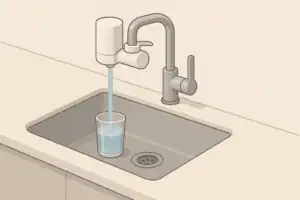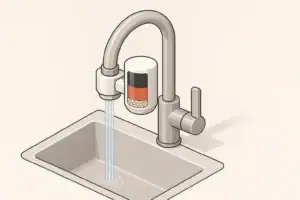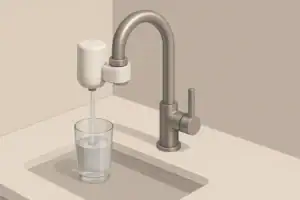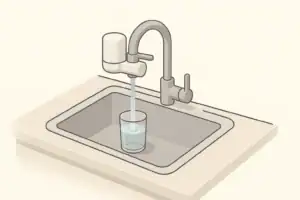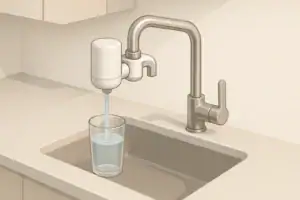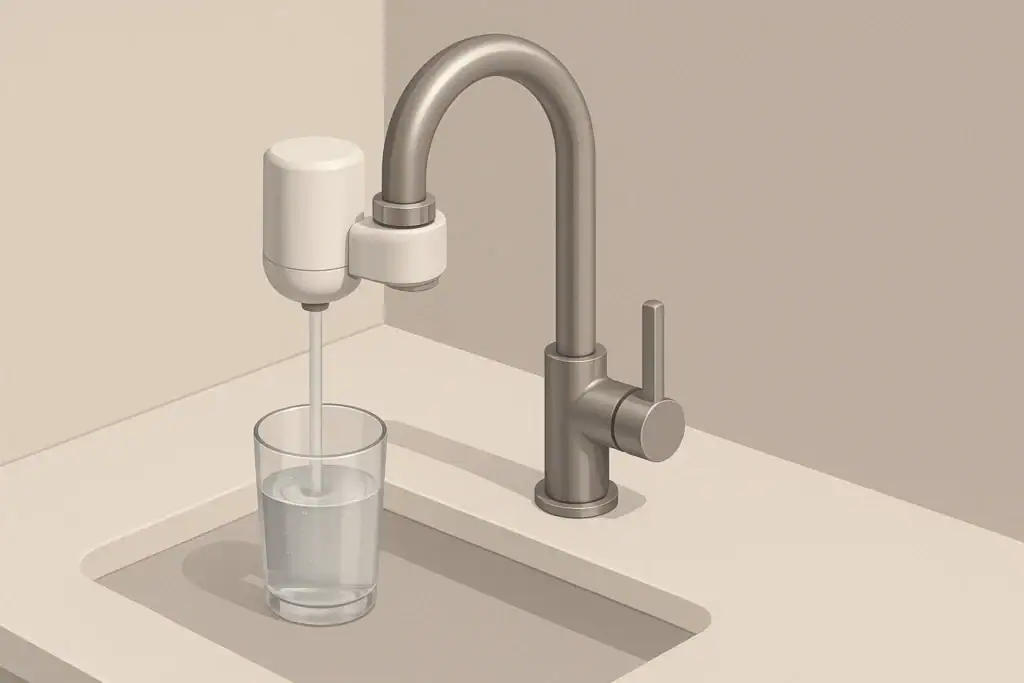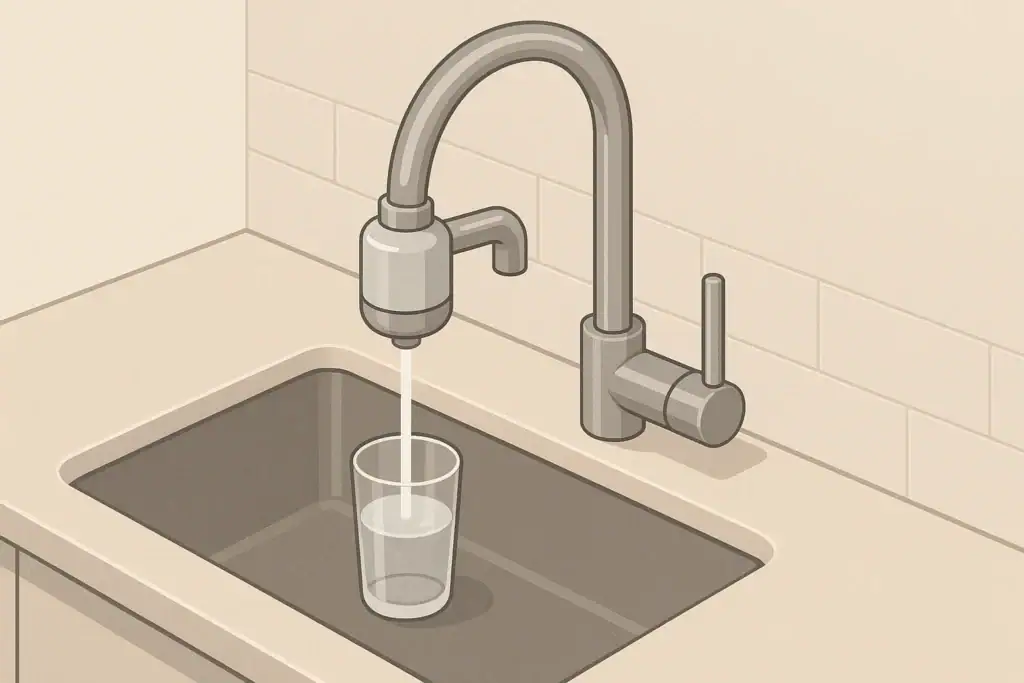
Lead in tap water typically comes from plumbing materials, not from the source water itself. Older homes may still have lead service lines, lead solder on copper pipes, or brass fixtures that can leach small amounts of lead into the water, especially if the water is corrosive.
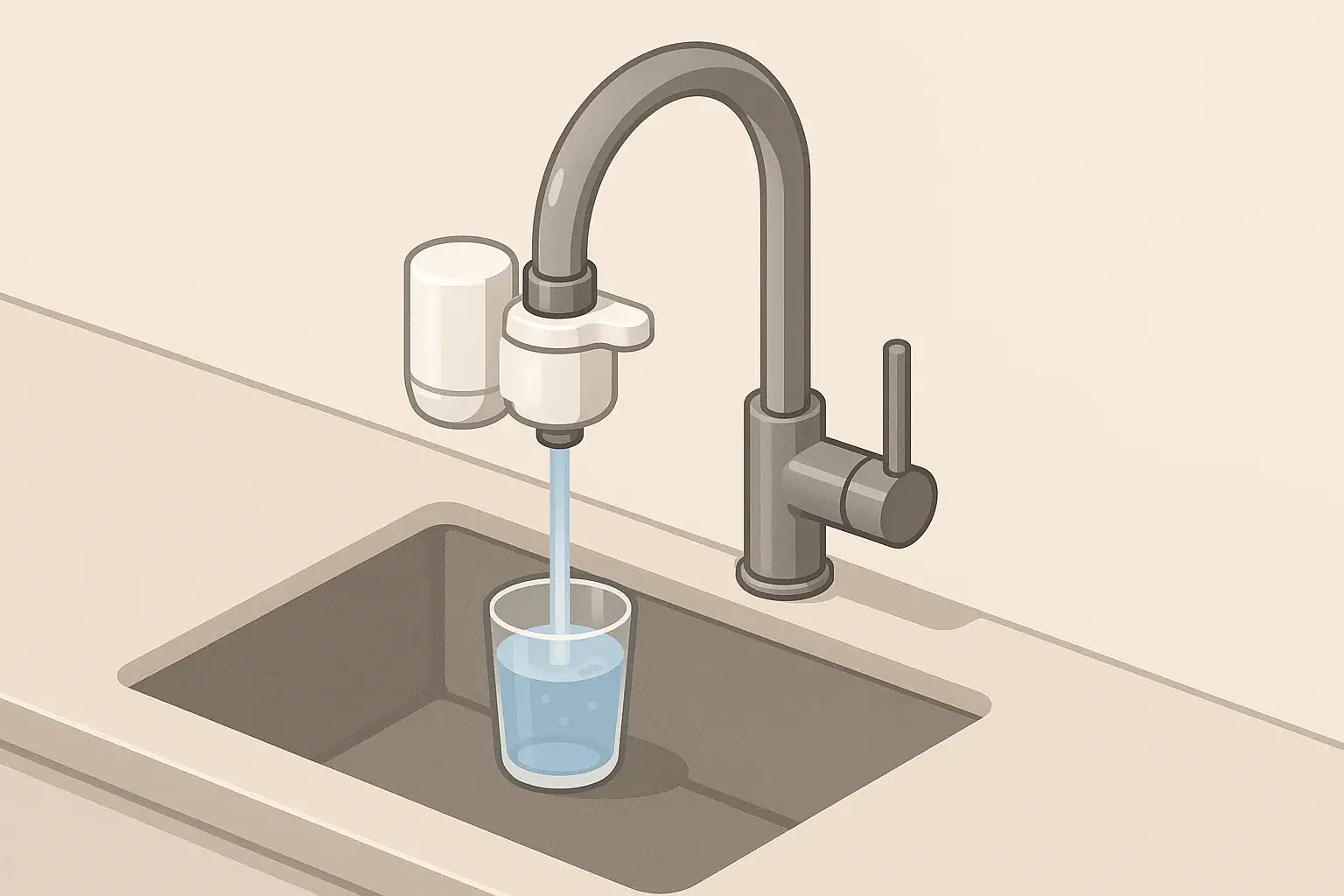
Faucet-mount filters are popular because they are easy to install and use. Many people assume that any faucet filter will remove lead, but that is not always true. Some faucet-mount devices are designed only to improve taste and odor of chlorine, while others are tested to reduce lead and additional contaminants.
To know whether a specific faucet-mount filter can reduce lead, you need to understand how to read the product label and look for the right certifications and wording, not just general marketing claims.
Why Lead in Tap Water Is a Concern for Homeowners
Can Faucet-Mount Filters Remove Lead?
Faucet-mount filters can reduce lead, but only if they are specifically engineered and tested for that purpose. Many faucet filters are certified only for basic aesthetic improvements, such as reducing chlorine taste and odor, but not for health-related contaminants like lead.
When evaluating a faucet-mount filter for lead reduction, pay attention to two main elements:
- Whether it is tested to a health-based standard for lead (commonly NSF/ANSI 53)
- Exactly how the packaging or label describes its performance (for example, “certified to reduce lead” vs. “helps improve water quality”)
Faucet-mount filters that reduce lead usually rely on a combination of fine mechanical filtration and adsorption media. Many use a type of carbon block or other porous media that can capture lead particles and adsorb dissolved lead. However, the design, flow rate, and contact time all affect how effectively the filter can treat lead.
Example values for illustration.
| Filter format | Typical installation location | Lead reduction available? | When it may fit best |
|---|---|---|---|
| Faucet-mount | On kitchen faucet outlet | Often, if NSF/ANSI 53 for lead | Renters or anyone wanting quick installation |
| Pitcher/dispenser | Countertop or refrigerator shelf | Available on some models | Small households, occasional filtered water use |
| Under-sink (carbon block) | Cold line under kitchen sink | Commonly available | Higher daily use, less clutter at faucet |
| Reverse osmosis (RO) | Under sink with dedicated faucet | Often part of multi-stage reduction | Multiple dissolved contaminants plus lead |
| Whole-house filter | Main line near entry point | Less common for lead alone | Broad sediment, chlorine, or other issues |
| Fridge/ice filter | In-line or inside refrigerator | Possible but not guaranteed | Filtered water and ice at refrigerator only |
How to Read the Label for Lead Reduction Claims
The most reliable way to know whether a faucet-mount filter is designed to reduce lead is to read the label carefully. Packaging often includes marketing language that sounds reassuring but does not guarantee lead reduction.
Look for Clear Wording About Lead
On the box or product information, look for direct, unambiguous phrases. These are examples of stronger and weaker wording:
- Stronger indicators: “Certified to reduce lead,” “Tested and certified for lead reduction,” “Meets NSF/ANSI 53 for lead.”
- Weaker, non-specific phrases: “Improves water quality,” “Reduces impurities,” “Advanced filtration,” without naming lead.
If the packaging only mentions taste, odor, chlorine, or sediment, and does not mention lead anywhere in the performance claims, you should assume it is not designed or tested for lead reduction.
Understand NSF/ANSI Certifications for Lead
Several independent standards are commonly referenced on water filter packaging in the United States. For lead, the key one to know is:
- NSF/ANSI 53: A standard for filters that address certain health-related contaminants, including lead, when specifically claimed. A faucet-mount filter can be certified to this standard, but only for the contaminants it lists.
You may also see NSF/ANSI 42 on faucet filters. That standard focuses on aesthetic effects, such as chlorine taste and odor and some particulates. NSF/ANSI 42 alone does not indicate lead reduction.
Some manufacturers list multiple standards. For example, a faucet filter might be certified to NSF/ANSI 42 for chlorine and NSF/ANSI 53 for lead and other contaminants. Always check which contaminants are actually referenced under each standard rather than assuming that any certified filter will handle lead.
Where to Find Certification Details
Details about certifications are usually found in these places:
- The front or side of the product box, where logos or seals may appear
- The performance data sheet, often included as a folded insert or printed on the packaging
- The user manual that comes with the faucet-mount filter
The performance data sheet typically lists contaminants that the filter is certified to reduce, along with conditions such as assumed influent levels and approximate filter life. If lead is not explicitly listed on that sheet, the device should not be relied on for lead reduction.
How Faucet-Mount Filters Treat Lead
While design details vary, many faucet-mount filters use a combination of mechanical and adsorption processes:
- Mechanical filtration: A fine porous structure can physically trap particles, including lead-containing scale or rust fragments.
- Adsorption media: Carbon-based or specialty media can attract and hold dissolved lead ions on the surface of the media.
The overall ability of a faucet-mount filter to reduce lead depends on factors like filter material, how long water is in contact with the media, and how consistently the user replaces cartridges as they become exhausted.
Flow Rate and Contact Time
Flow rates that are higher mean water passes through the filter more quickly, which reduces contact time with the media. Faucet-mount filters are designed to balance convenience with performance, but they usually have a limited flow rate when in “filtered” mode for this reason.
If the water seems to rush through unusually fast, or if you notice a sudden increase in flow through the filtered setting, that can be a sign that the cartridge is no longer providing the same level of filtration, and it may be time to replace it according to the manufacturer’s schedule.
Lead Particles vs. Dissolved Lead
Lead in water can be present as very fine particles or dissolved ions. A filter must be able to address both forms if it is to provide meaningful lead reduction in typical household conditions.
- Fine particulate lead may be captured by tight mechanical filtration.
- Dissolved lead relies more on adsorption and specific media properties.
This is why labeling and certifications matter. A faucet filter designed only for large sediment may not perform well for dissolved lead, even if it visibly clears the water.
Checking Your Water and Plumbing Before Relying on a Faucet Filter
Before deciding that a faucet-mount filter is enough for your situation, it helps to understand how lead might be entering your home’s water and how you use water throughout the house.
Know Your Plumbing Materials
Lead risk is higher in older neighborhoods or homes built when lead components were more common. You can often learn about your local system from utility reports or by inspecting visible plumbing in your home, such as service line entry points or accessible pipe sections.
Even if your public water supplier controls corrosion and monitors lead at the system level, lead can still leach from household plumbing components. Filters installed at the faucet only treat water at that outlet, not throughout the home.
Consider Where You Need Filtered Water
A faucet-mount filter treats water at a single tap. This can be suitable if:
- Most of your drinking and cooking water comes from one kitchen faucet
- You want a solution that does not involve modifying plumbing under the sink
- You may move soon or live in a rental where permanent changes are not practical
If you routinely draw water from multiple locations (such as bathroom sinks or a refrigerator dispenser) and you want consistent treatment for each, you may need a combination of solutions or a different filter format.
Maintenance: Keeping Faucet-Mount Filters Working Effectively
Even a faucet-mount filter that is certified to reduce lead will only perform as intended if it is installed and maintained correctly. Overused or clogged cartridges can allow more contaminants to pass through or may significantly slow down water flow.
Replace Cartridges on Schedule
Cartridge life is usually stated in terms of gallons or months of typical household use. These are approximate values based on standard test conditions. Heavier use, higher sediment, or challenging water quality can shorten practical life.
Common cues that it may be time to replace a cartridge include:
- Notable decrease in flow rate through the filtered setting
- Changes in taste or odor compared with a fresh cartridge
- Reaching the recommended time or volume limit from the manufacturer
Many faucet-mount filters have simple indicators or reminders, such as a mechanical dial or a guideline in the manual about how often to change the cartridge based on average daily use. Tracking replacement dates can help keep performance closer to what was tested.
Use the Bypass Setting Wisely
Most faucet-mount devices offer both unfiltered and filtered modes. Using unfiltered tap water for dishwashing and cleaning and reserving filtered mode for drinking and cooking helps extend cartridge life and may reduce ongoing costs per gallon of filtered water.
However, it is important to remember that only water passing through the filtered mode receives treatment. If lead reduction is important for a particular use, always switch the device to the filtered setting and allow it to run briefly according to the instructions, especially after periods of non-use.
Cold Water vs. Hot Water
Manufacturers usually recommend using only cold water through faucet-mount filters. Hot water can damage filter media and may reduce performance or shorten cartridge life. For cooking, a common practice is to draw cold filtered water and then heat it separately.
Understanding Certifications: A Quick Reference for Faucet-Mount Filters
Certifications provide a standardized way to compare filters and understand what each one has been tested to do. For lead reduction, you will most often see references to NSF/ANSI 53, but other standards may also appear on product packaging for different performance aspects.
When you read these standards on a label, it helps to know that they usually apply to specific claims, not to every possible contaminant. A faucet-mount filter can be certified to multiple standards at once, with each covering different parts of its performance.
Example values for illustration.
| Standard | Main focus | What to look for on a faucet filter | Example label check |
|---|---|---|---|
| NSF/ANSI 42 | Aesthetic effects (taste, odor, chlorine) | Improved taste/odor or chlorine reduction only | Does the data sheet limit claims to chlorine and particulates? |
| NSF/ANSI 53 | Health-related contaminants (including lead when listed) | Specific mention of lead among certified contaminants | Does the performance sheet list “lead” under certified claims? |
| NSF/ANSI 401 | Select emerging compounds (e.g., some pharmaceuticals) | Additional chemical reduction beyond basics | Are any emerging contaminants named and quantified? |
| NSF/ANSI 58 | Reverse osmosis systems | Generally not used for basic faucet-mount filters | Is the product an RO system with a dedicated faucet? |
| NSF/ANSI 372 | Lead content of materials (low-lead construction) | Indicates low-lead components, not lead removal | Is the claim about material composition rather than filtration? |
| Independent laboratory testing | Non-NSF labs that may follow similar protocols | Clear reference to methods and contaminants tested | Are test conditions and contaminants described in writing? |
Putting It All Together for Your Home
Faucet-mount filters can be a useful part of a lead reduction strategy in many homes, especially when they are properly certified and maintained. The key is not to assume that every faucet filter will remove lead, but to verify it through the label, performance data sheet, and certifications.
By checking for explicit lead claims under the appropriate standards, understanding where and how you use water, and keeping up with cartridge replacement, you can decide whether a faucet-mount filter alone meets your needs or whether it should be combined with other filtration approaches elsewhere in your home.
Frequently asked questions
Do faucet-mount filters remove lead?
They can remove lead, but only if the filter is specifically designed and certified for lead reduction. Check the performance data sheet and look for certification to a health-related standard that explicitly lists lead, such as NSF/ANSI 53.
Do faucet-mount filters remove dissolved lead as well as lead particles?
Some certified faucet-mount filters address both particulate and dissolved lead by combining fine mechanical filtration with adsorption media. However, not all filters do both, so verify the specific claims on the product’s test data sheet.
What label claims or certifications prove a faucet-mount filter reduces lead?
Look for explicit statements like “certified to reduce lead” and a listing of NSF/ANSI 53 (or equivalent test results) that names lead among the tested contaminants. A certification seal alone does not prove lead removal unless the contaminant list or performance data includes lead.
How often should I replace the cartridge to maintain lead reduction performance?
Replace cartridges according to the manufacturer’s recommended gallons or months of service and watch for signs like reduced flow or changes in taste. Heavy use or poor source water can shorten life, so track replacement dates and follow any indicator provided.
Will a faucet-mount filter protect all taps in my home from lead?
No. Faucet-mount filters treat only the outlet where they are installed, so other taps and appliances will not receive the same treatment. If you need whole-house protection or treatment at multiple locations, consider under-sink, dedicated-faucet RO systems, or whole-house options in addition to faucet filters.
Recommended next:
- Best Faucet-Mount Filters for Chlorine Taste (High Flow Picks)
- Faucet-Mount Filter Compatibility: How to Check Your Faucet Type
- Faucet-Mount vs Under-Sink Filters: Convenience vs Performance
- How to Install a Faucet-Mount Filter Without Leaks
- Faucet-Mount Filters for Renters: No-Drill Setup Guide
- Troubleshooting a Faucet-Mount Filter with Slow Flow
- More in Faucet-Mount Filters →
- NSF/ANSI standards explained (42/53/401/58)
- Clear trade-offs: pitcher vs faucet vs under-sink vs RO
- Maintenance planning: cost per gallon and replacement cadence