
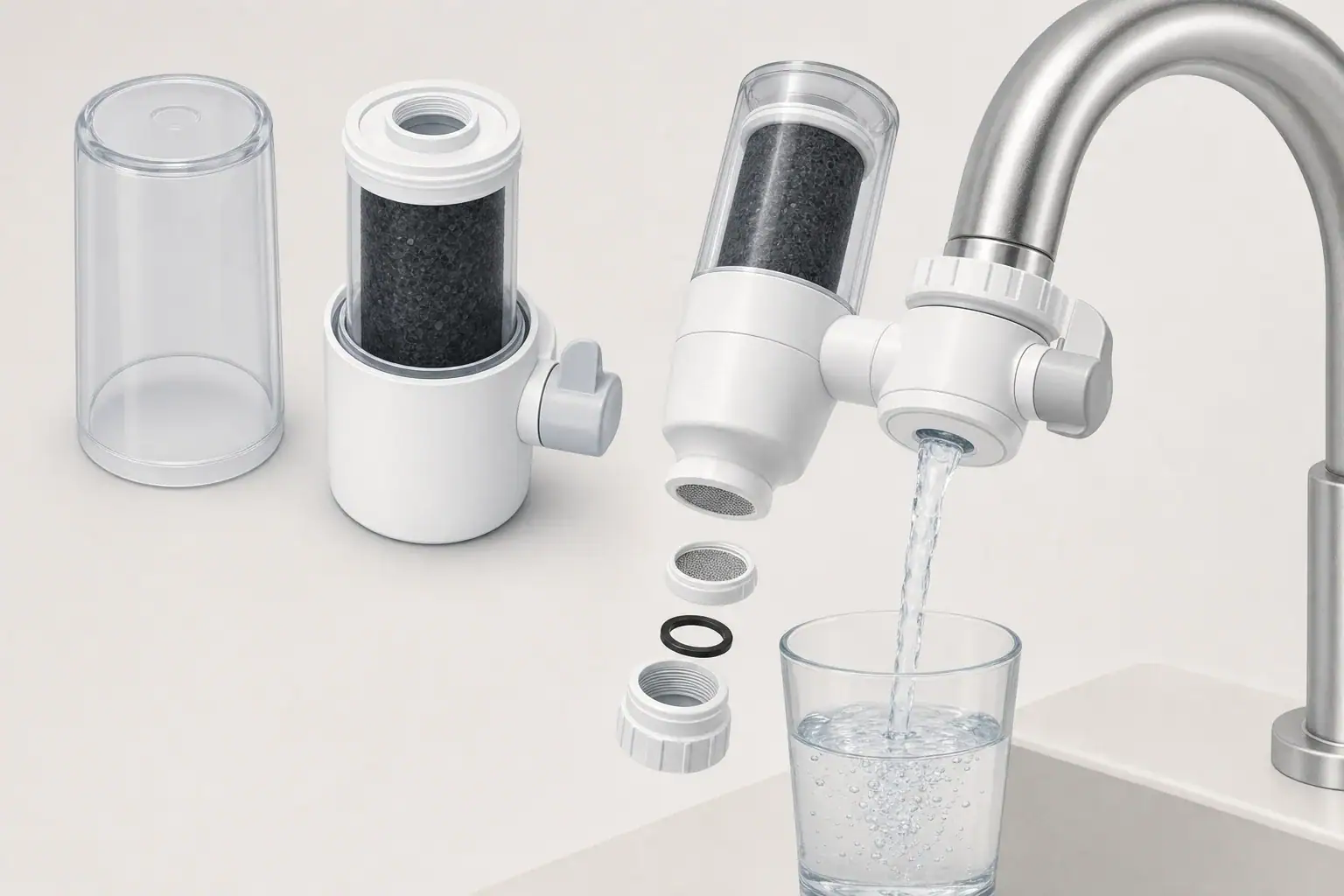
A faucet-mount filter that splashes or sends water sideways usually has an obstructed or misaligned outlet screen, excessive flow, debris in the aerator area, or an improperly seated adapter or gasket. First determine whether the spray comes from the water outlet or from the connection to the faucet. That distinction points to different fixes.
Reduce the faucet flow before taking anything apart. If the stream becomes smooth at a moderate setting, the unit may simply be receiving more flow than its outlet can handle. If the sideways jet continues, inspect the outlet screen, adapter, seals, and cartridge installation.
Identify Where the Sideways Spray Starts
Dry the outside of the faucet and filter, then run cold water at a low setting. Watch where the first droplets appear. Avoid placing your face close to the outlet because a loose adapter can release suddenly under pressure.
| What happens | Likely area | First check |
|---|---|---|
| Water exits sideways from the filtered outlet | Outlet screen, internal debris, or cartridge seating | Lower the flow and inspect removable outlet parts |
| Water sprays from the faucet connection | Adapter, gasket, or threads | Reseat the adapter and confirm the correct seal |
| Spray occurs in filtered mode only | Filtered-water outlet or cartridge path | Inspect the filtered outlet and cartridge position |
| Spray occurs in both filtered and bypass modes | Faucet outlet, adapter, or diverter assembly | Check the mounting connection and inlet |
| Flow sputters briefly after cartridge service | Trapped air | Flush with cold water as directed by the manufacturer |
A short period of sputtering after installing a cartridge can come from trapped air. A persistent stream that shoots in one direction is more consistent with a blocked outlet opening, a displaced screen, or physical damage.
Check the Flow Before Disassembling the Filter
Faucet-mount filters restrict water as it passes through the cartridge. Opening the faucet fully can create turbulence, especially if the outlet has a small screen or several individual openings.
- Switch the filter to its normal operating position.
- Turn on cold water slowly.
- Stop increasing the flow once the stream is steady.
- Compare filtered mode with the unfiltered bypass mode, if the unit has one.
If the spray appears only at high flow, using a lower faucet setting may resolve it. However, a sudden change in behavior at the same usual flow can indicate debris or a shifted component rather than normal flow sensitivity.
Do not remove a built-in flow regulator or enlarge outlet openings. Those parts may control pressure through the housing and help the cartridge operate as intended. If household water pressure seems unusually high at several fixtures, that is a broader plumbing issue rather than a faucet-filter adjustment.
Inspect the Outlet Screen or Aerator Area
A conventional faucet aerator is often removed before a faucet-mount filter is installed. The filter may then provide its own outlet screen, diffuser, or aerator-like insert. Small particles or mineral deposits in that component can redirect part of the stream sideways.
Remove accessible parts carefully
Turn off the faucet and follow the filter manufacturer’s removal instructions. Close or cover the sink drain so small screens and seals cannot fall into it. If the outlet screen is designed to be removed, note the order and orientation of every part before separating them.
Rinse loose debris away with clean water. A soft brush can help clean a removable screen, but avoid sharp tools that could enlarge or deform its openings. Do not soak the cartridge or housing in vinegar, bleach, detergent, or another cleaner unless the manufacturer specifically permits it.
Look for an uneven or damaged screen
Hold the removable screen under good lighting and check for:
- Particles blocking only part of the mesh
- A screen sitting at an angle
- A cracked plastic diffuser
- A bent metal insert
- A missing gasket or spacer
- Mineral buildup concentrated on one side
Reinstall the components in their original order. A screen inserted backward or a gasket placed on the wrong side can produce an irregular stream or leakage around the outlet.
Check the Faucet Adapter and Gasket
If water sprays from above or behind the filter instead of from the outlet, focus on the mounting connection. Faucet-mount filters commonly use an adapter and a flat gasket to seal against the faucet spout.
Remove the filter with the water off and inspect the adapter. It should thread on straight and sit evenly against the faucet. Cross-threading can leave one side higher than the other, allowing a thin, forceful spray to escape through the gap.
Also check that the gasket is present, flat, and free of cuts. Do not stack extra washers to compensate for the wrong adapter. Extra seals can prevent adequate thread engagement and make the connection less secure.
Many faucet aerator connections seal with a gasket rather than thread-sealing tape. Adding tape where it is not specified can interfere with alignment or prevent the adapter from seating fully. Use only the adapter, seals, and installation method intended for the unit and faucet thread type. See this guide to faucet filter adapters for common fit problems.
Confirm the Cartridge Is Seated Correctly
A cartridge that is tilted, loose, or not fully locked into place can disturb the internal water path. Turn off the water, remove the cartridge according to its instructions, and inspect its sealing surfaces for displaced O-rings, packaging material, or visible debris.
Reinsert the cartridge without forcing it. If the cartridge has alignment marks or a locking position, confirm that it reaches the intended stop. Forcing an incompatible cartridge can damage the housing or seals.
After reassembly, flush the filter with cold water for the period specified by its manufacturer. This can clear trapped air and loose carbon fines from a new cartridge. Flushing may correct temporary sputtering, but it will not repair a cracked diffuser, stripped adapter, or damaged diverter. Review the faucet-mount cartridge change guide if the issue started after replacement.
Consider Faucet Compatibility
Faucet-mount filters are generally intended for compatible fixed spouts with removable aerators. Pull-down, pull-out, handheld spray, and irregularly shaped faucets often cannot support this type of attachment safely or securely.
Even when threads appear to match, the spout must provide enough flat sealing surface for the gasket. A shallow thread connection, recessed aerator, or damaged faucet thread can allow the filter to sit crooked and leak under normal flow.
If the filter has always angled to one side or required unusual force to install, verify faucet compatibility rather than tightening it further. Overtightening can crack plastic adapters, distort gaskets, or damage faucet threads.
Common Troubleshooting Mistakes
- Opening the faucet fully during the first test: Start with low flow so a loose connection does not spray forcefully.
- Testing with hot water: Faucet-mount cartridges are commonly intended for cold water. Hot water may affect filter media, seals, or housing materials.
- Poking through outlet holes: A pin or wire can damage screens and permanently change the flow pattern.
- Using pliers directly on plastic parts: Concentrated tool pressure can crack an adapter or housing.
- Adding random washers or thread tape: Unspecified parts can prevent the designed seal from seating correctly.
- Assuming an old cartridge causes every spray problem: A spent cartridge more often causes reduced flow. A directional jet usually warrants an outlet or connection inspection.
Related guides: Install a faucet-mount filter without leaks • Faucet filter switch valve problems • Kitchen faucet flow rate calculator
When Cleaning and Reseating Are Not Enough
Stop using the filter if the housing is cracked, the adapter will not remain secure, the diverter is loose, or water leaks from a seam that is not designed to open. Adhesive, makeshift clamps, and patched pressure-bearing parts are not dependable repairs.
A missing proprietary screen, stripped thread, damaged valve, or deformed housing may require the appropriate replacement component or replacement of the faucet-mount unit. If the faucet itself has damaged threads or sprays irregularly after the filter is removed and its original aerator is reinstalled, the faucet may need plumbing service rather than additional filter work.
Frequently asked questions
Why is my faucet-mount filter spraying sideways?
A sideways stream usually comes from debris, mineral buildup, a misaligned outlet screen, or a damaged diffuser. If water sprays from the connection instead, inspect the adapter, gasket, and faucet threads.
Can high water flow cause a faucet filter to splash?
Yes. A faucet-mount filter may produce turbulence when the faucet is opened fully. Test it with cold water at a lower setting before disassembling the unit.
Should I clean the filter outlet with a pin or wire?
No. Sharp tools can enlarge or deform the outlet openings. Rinse removable parts with clean water and use a soft brush only when appropriate.
Why does the filter sputter after I replace the cartridge?
Brief sputtering can be trapped air or loose carbon fines after cartridge service. Flush the filter with cold water for the time specified by its manufacturer.
When should I replace a spraying faucet-mount filter?
Replace the affected component or unit if the housing is cracked, threads are stripped, the adapter will not stay secure, or the outlet diffuser is damaged or missing.
- NSF/ANSI standards explained (42/53/401/58)
- Clear trade-offs: pitcher vs faucet vs under-sink vs RO
- Maintenance planning: cost per gallon and replacement cadence