
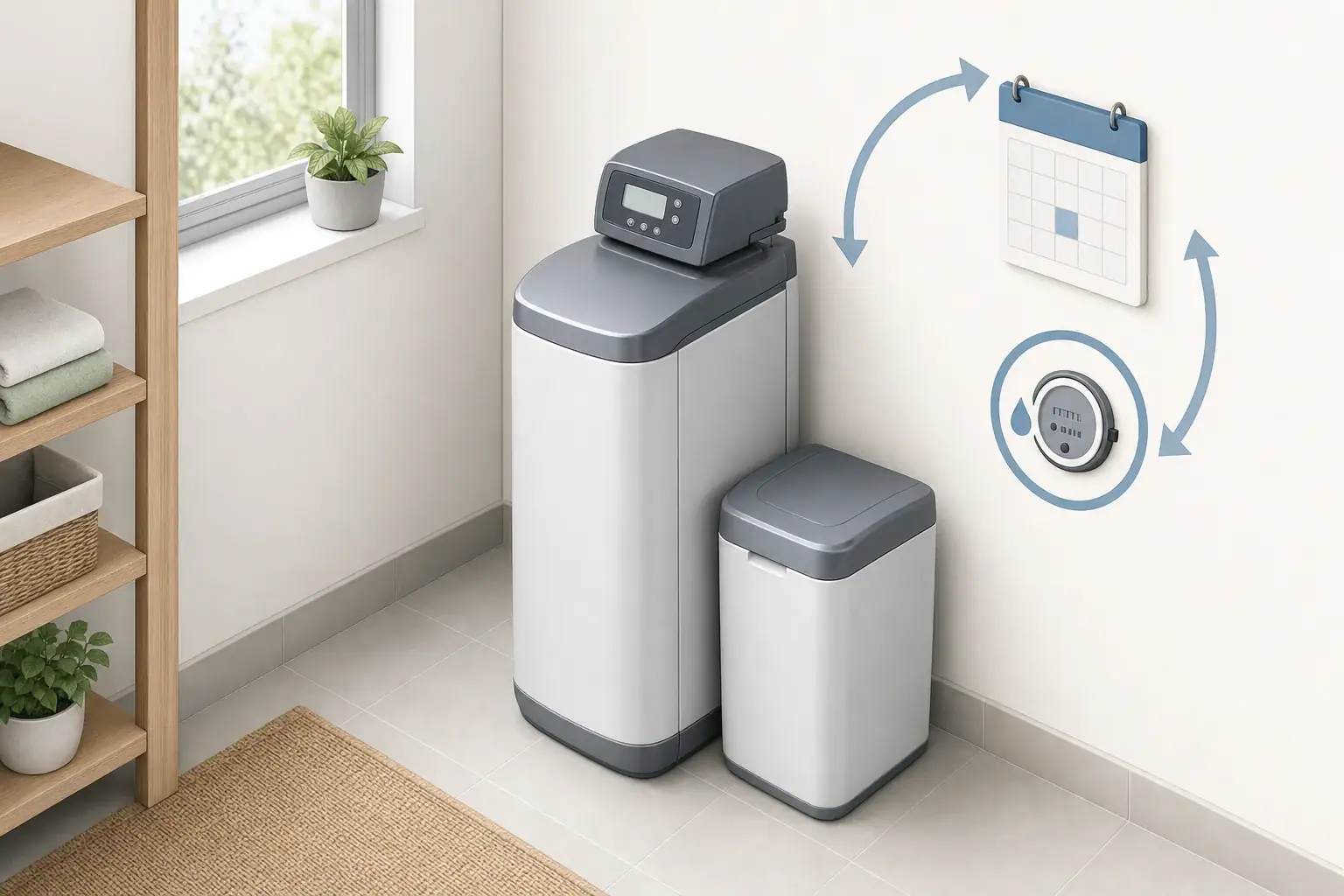
Quick answer: There is no universal water-softener regeneration interval. Metered units regenerate after calculated treatment capacity is used, while timer-controlled units follow programmed days. Compare the manual’s usable capacity, hardness, reserve, household water use and maximum-day override to decide whether the interval makes sense.
How often does a water softener regenerate?
A water softener may regenerate based on water use, on a fixed calendar schedule, or through a combination of both. The interval depends primarily on incoming hardness, softened-water use, usable treatment capacity, reserve capacity and controller settings. The U.S. Environmental Protection Agency identifies hardness, water use and softening capacity as key factors in regeneration frequency and distinguishes demand-initiated controls from scheduled controls in its WaterSense water-purification guidance.
The practical question is not whether the system matches a generic number of days. It is whether the controller’s mode and programmed inputs reasonably explain the interval you see.
Metered and timer-controlled softeners follow different schedules
Demand-initiated or metered controls
A metered softener measures water passing through its control valve. The controller uses its programmed capacity, hardness setting and reserve method to estimate how much treated water remains. When calculated capacity is reached, it may start regeneration immediately or queue the cycle for a programmed time, often overnight.
For example, the Pentair Fleck 5600SXT service manual documents meter-immediate and meter-delayed modes, as well as time-clock and day-of-week modes. Those names and programming choices are specific to that controller, so use the manual for your exact valve before changing a setting.
Timer and day-of-week controls
A timer-controlled softener regenerates after a selected number of days or on selected days of the week, whether the household used very little or a great deal of water. Its schedule may therefore stay the same during a vacation, a change in household size or a period of unusually high use.
Some metered controls also have a maximum-day override. This forces a regeneration after a specified number of days even if the meter indicates that capacity remains. An override can explain why a metered softener repeatedly regenerates on a predictable calendar interval.
What changes a water softener regeneration schedule?
| Input | What to check | Likely effect on timing |
|---|---|---|
| Usable capacity | Capacity at the current programmed salt dose, rather than only the largest grain number in the model name | More usable capacity generally permits more water between cycles. |
| Hardness | Current source-water hardness in the units required by the controller | Higher hardness uses capacity faster per gallon. |
| Reserve | Whether reserve is expressed as gallons, grains or a percentage, and whether it is already included in the displayed capacity | A larger reserve generally triggers regeneration sooner. |
| Softened-water use | Water that actually flows through the softener | Higher use shortens the interval on a metered system. |
| Overrides and adjustments | Maximum-day override and any model-specific compensation settings | These can reduce the time or gallons between cycles. |
Use the documented working capacity
An advertised maximum grain figure may not be the capacity currently used by the controller. Capacity can vary with salt dose and settings. For example, the Whirlpool WHES40/WHES44 manual lists different capacities for different salt doses and notes that installed performance can differ from laboratory-rated performance. Those figures apply only to the listed models and conditions.
Look for the capacity associated with your exact model and actual settings. If the manual does not make that clear, avoid assuming that the largest number in the product name is the usable programmed capacity.
Confirm the hardness setting and units
Many softener controllers use grains per gallon (GPG), while a utility report or laboratory report may state hardness in milligrams per liter as calcium carbonate. Confirm the unit required by the controller before entering a number. Our guide to water hardness in grains per gallon versus ppm explains the unit difference.
Hardness can vary by source, location and season. A utility value may be useful for planning, but it does not necessarily represent a private well or the water currently reaching one home. If the setting is important to your softener’s performance, use an appropriate current result and follow the controller manual when entering it.
Apply iron compensation only when the manual directs it
Some manufacturers instruct owners to adjust the hardness setting when certain dissolved iron is present. This causes a demand controller to calculate fewer gallons between regenerations. The Whirlpool manual above provides an adjustment method for specified Whirlpool models; do not apply that formula to another brand, controller or form of iron unless that equipment’s instructions say to do so.
A worked estimate of the regeneration interval
This example is only a planning calculation. It is not a recommended setting for every softener.
- Documented working capacity: 24,000 grains
- Separate reserve: 3,000 grains
- Incoming hardness: 15 grains per gallon
- Water passing through the softener: 180 gallons per day
Daily hardness load: 180 gallons per day × 15 grains per gallon = 2,700 grains per day.
Capacity available before reserve: 24,000 grains − 3,000 grains = 21,000 grains.
Estimated interval: 21,000 grains ÷ 2,700 grains per day = about 7.8 days.
A meter-delayed controller might begin the cycle at its next scheduled regeneration time rather than exactly 7.8 days after the prior cycle. Actual household use also varies. Do not subtract reserve again if the manual states that the displayed or programmed usable capacity already includes it.
Can daily regeneration be normal?
Yes. Daily regeneration can be consistent with a household’s settings when daily hardness load is close to the capacity available before reserve. It can also occur because a timer is set for daily operation or because a one-day override is active.
Investigate a new daily pattern when nothing has changed in household use, occupancy, hardness or settings, or when your manual-based estimate suggests a much longer interval. Do not lower the hardness setting or remove reserve solely to make cycles less frequent. Incorrect settings can leave too little treatment capacity before the next regeneration.
How to check the display and manual
Start with the exact valve or controller manual, not only the name on the mineral tank. Record the current values before making changes.
- Complete softener model and valve/controller model
- Control mode: meter immediate, meter delayed, timer or day-of-week
- Working capacity at the programmed salt dose
- Hardness setting and its units
- Reserve or safety-factor method
- Maximum-day override
- Scheduled regeneration time
- Remaining gallons or remaining days, if shown
- Flow indicator, queued-cycle indicator or regeneration indicator
- Cycle history or regeneration count, if available
- Whether irrigation or other high-use plumbing bypasses the softener
Display icons and labels vary by controller. The Fleck manual, for example, documents controller-specific flow and queued-cycle indicators. Match what you see on the display to the manual for that exact controller instead of relying on a generic icon explanation.
When a changed interval needs troubleshooting
First compare the new interval with practical changes: additional occupants or guests, more laundry, irrigation routing, a plumbing change, or a change in source water. Then check whether a power interruption reset the clock or programmed values, whether the maximum-day override changed, and whether the flow indicator responds when water is used.
If the settings and water use appear unchanged but the interval no longer agrees with the documented calculation, use the manufacturer’s diagnostic instructions or contact a qualified water-treatment professional. Persistent cycling, error messages, failure to return to service or unexpected drain flow are fault symptoms rather than ordinary schedule questions.
Related water softener guides
How to set a water softener hardness level • Water softener salt usage • Can you use water while a water softener regenerates?
Frequently asked questions
Should every water softener regenerate on the same number of days?
No. Metered softeners respond to calculated capacity use, while timer-controlled units follow their programmed calendar. Hardness, water use, capacity, reserve and any maximum-day override can make two homes with similar equipment regenerate on different intervals.
Why does a metered softener regenerate on the same day each week?
It may be reaching its calculated capacity at a similar rate, or a maximum-day override may be forcing the cycle. Check the control mode, remaining-gallon display and override setting in the exact controller manual.
Does a longer interval always mean a softener is working better?
No. A longer interval may reflect lower water use, lower hardness, more available capacity or different settings. It is useful only when the interval matches the equipment’s documented capacity and the home’s actual softened-water demand.
- NSF/ANSI standards explained (42/53/401/58)
- Clear trade-offs: pitcher vs faucet vs under-sink vs RO
- Maintenance planning: cost per gallon and replacement cadence