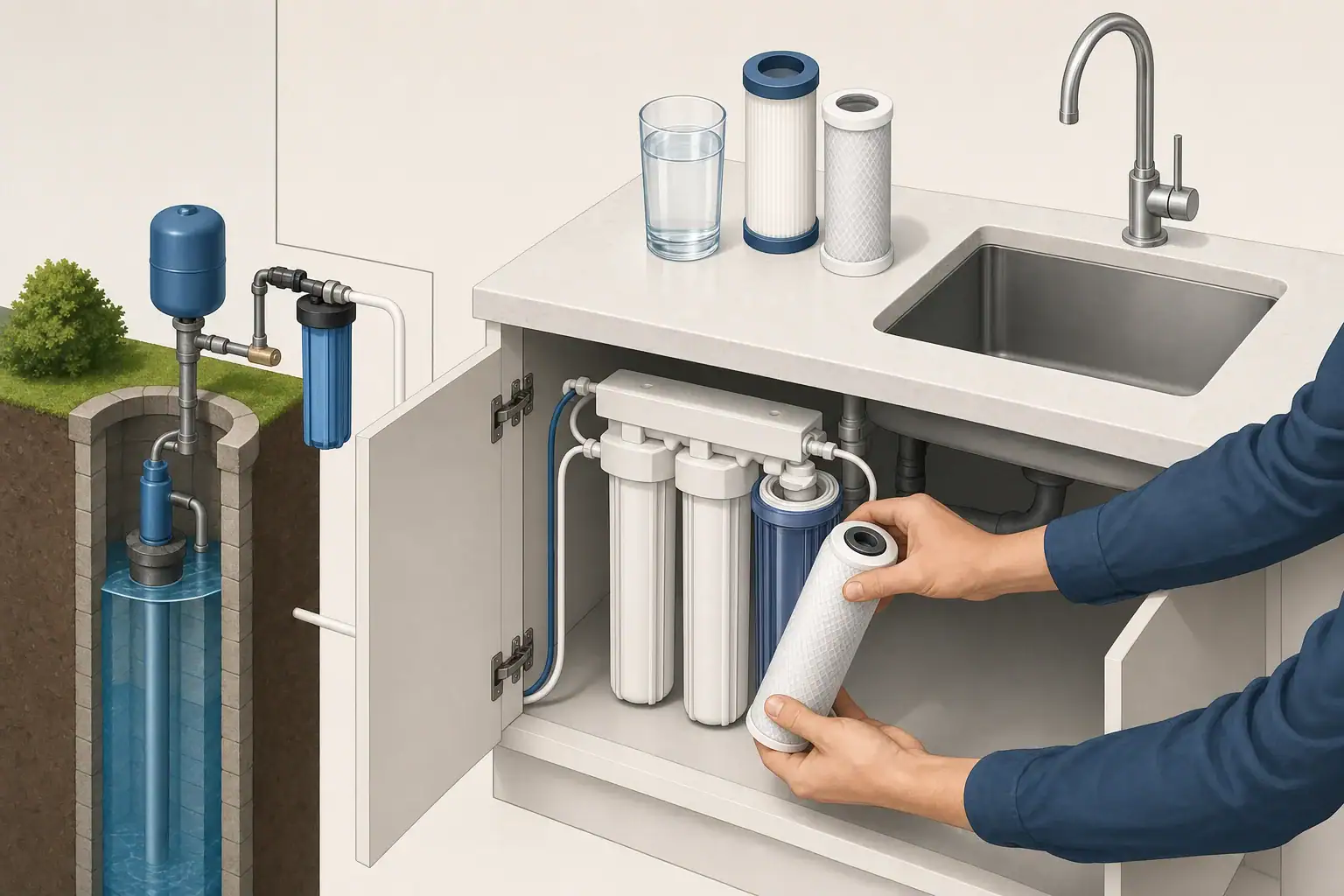
Private wells can be affected by pesticides used on farms, lawns, gardens, rights-of-way, and nearby properties. Whether a pesticide reaches groundwater depends on the chemical, soil, geology, rainfall, application practices, and condition of the well.
A clear response starts with laboratory testing. A result can then be compared with appropriate federal or state guidance before treatment is selected. Because pesticides differ chemically, there is no single filter that performs equally well for every product.
Why Pesticides May Reach a Private Well
Pesticides include herbicides, insecticides, fungicides, and other products intended to control unwanted organisms. Some break down relatively quickly in soil. Others, or their breakdown products, can persist and move with water.
Potential pathways into a well include:
- Movement through permeable soil into shallow groundwater
- Runoff entering a poorly sealed or damaged well casing
- Backflow from pesticide mixing or application equipment
- Spills near the wellhead or chemical storage areas
- Floodwater entering a well that is not adequately protected
- Long-term regional use affecting an aquifer
Well construction matters. A shallow well drawing from groundwater near the surface may face different risks than a properly constructed deep well. Depth alone, however, does not guarantee protection. Cracks, missing caps, poor grading, and deteriorated seals can create direct entry routes.
Source control should accompany treatment whenever possible. Keeping mixing, storage, and disposal activities away from the wellhead can reduce future risk. A licensed well professional can evaluate construction defects without requiring unsafe alterations by the homeowner.
How to Test Well Water for Pesticides
Most basic well-water packages do not include a comprehensive pesticide analysis. Testing for bacteria, nitrate, hardness, or total dissolved solids does not show whether pesticides are present. A separate laboratory panel is usually needed.
Choose a targeted laboratory panel
Start with a laboratory accredited by the relevant state or recognized accreditation program for the requested methods. Ask which pesticides and breakdown products are included, because a result described as a pesticide screen may cover only a defined list.
Local information can make testing more useful. County extension offices, environmental agencies, nearby land-use records, and the labels of products used on the property may help identify likely compounds. If a spill is suspected, provide the laboratory with the product name and active ingredient rather than requesting only a broad, generic screen.
Collect the sample correctly
Use the containers supplied by the laboratory. Pesticide tests may require specially prepared bottles, preservatives, temperature control, or protection from light. Do not rinse the bottles or transfer water into household containers.
The laboratory should specify whether to sample at the well, before treatment, or at a drinking-water faucet. An untreated sample helps characterize the source. A second sample after treatment can evaluate system performance. Follow instructions about removing faucet aerators, flushing, refrigeration, and delivery time.
Test when conditions are informative
There is no universal schedule for testing every private well for every pesticide. Testing is especially relevant after a known spill, a change in taste or odor associated with a chemical event, flooding, damage to the well, or a detection in nearby groundwater. A private well water testing schedule can help identify other risk-based testing needs.
Seasonal sampling may be useful where pesticide application and heavy rainfall occur during predictable periods. A single nondetect does not necessarily describe every season, particularly for shallow wells or intermittent sources.
Example values for illustration.
| Report finding | Practical next step |
|---|---|
| No compounds detected | Review the tested compound list and reporting limits; repeat testing if local risks or conditions change. |
| One low-level detection | Check the qualifier and comparison value, then consider a confirmation sample. |
| Result near a comparison value | Confirm promptly and ask the laboratory or appropriate agency how to interpret uncertainty. |
| Result above an applicable benchmark | Use an appropriate alternative water source while confirming the result and evaluating correction or treatment. |
| Several pesticides detected | Investigate the source and select treatment using data for each identified compound. |
| Detection appears only seasonally | Inspect the well and repeat sampling during comparable weather or application periods. |
| Unexpected or qualified result | Discuss quality-control notes with the laboratory before making a major treatment decision. |
How to Read and Confirm Laboratory Results
A pesticide report usually identifies the compound, concentration, measurement unit, analytical method, reporting limit, and any data qualifiers. The reporting limit is important: a nondetect generally means the compound was not measured at or above that laboratory threshold. It does not establish that the concentration was absolutely zero.
Private wells are generally the owner’s responsibility and are not regulated in the same way as public water systems. Some pesticides have federal drinking-water standards for public systems, while others may have state guidance values or health-based screening levels. Use the comparison value identified by the appropriate state or federal authority, and make sure its units match the laboratory result.
Qualifiers may indicate estimated concentrations, sample handling issues, or possible laboratory interference. An unexpected positive result is often worth confirming with a new sample before purchasing equipment. However, if a result exceeds an applicable benchmark, local authorities may recommend using another source for drinking and cooking while confirmation and corrective steps are underway.
Boiling is not a general pesticide treatment. It may leave many compounds behind and can concentrate substances that do not evaporate with the water. Taste, odor, clarity, hardness, and total dissolved solids also cannot reliably confirm the presence or absence of pesticides.
Matching Treatment to the Detected Pesticide
Treatment should be selected for the exact compound or group found by the laboratory. Useful performance evidence includes independent testing for reduction of the named contaminant under conditions similar to the home’s water quality and expected usage. Learn how to verify a filter’s certification claim before relying on product performance statements.
Activated carbon
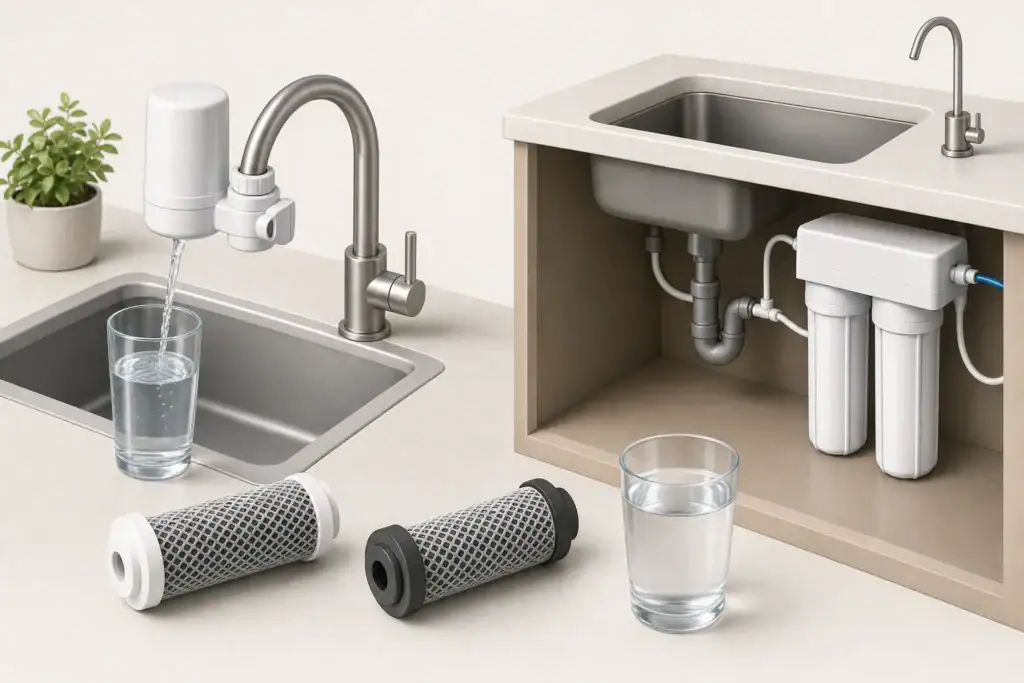
Granular activated carbon and carbon block filters can reduce many organic pesticides through adsorption. Performance varies considerably with the pesticide’s chemistry, carbon type, contact time, flow rate, water temperature, and competition from natural organic matter or other contaminants.
Carbon has a finite capacity. Once adsorption sites become occupied, contaminant reduction can decline without an obvious change in taste or flow. Replacement should therefore be based on validated capacity information, water use, and follow-up testing rather than appearance alone.
Reverse osmosis
Reverse osmosis can reduce some pesticides and other dissolved contaminants at a drinking-water faucet. Results depend on the compound, membrane, pressure, pretreatment, water temperature, and maintenance. It should not be assumed that every reverse osmosis system reduces every pesticide. See what reverse osmosis removes for broader context on its capabilities and limitations.
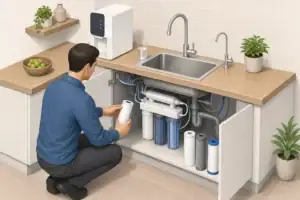
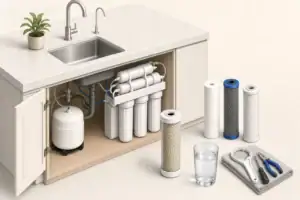
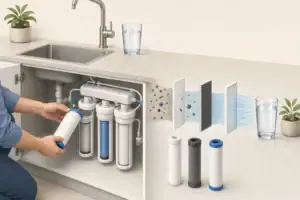
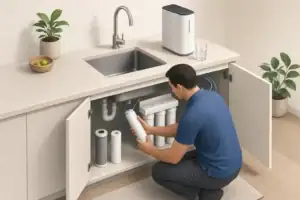
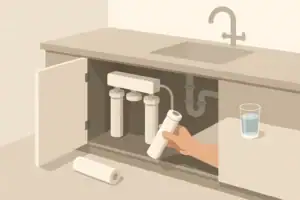
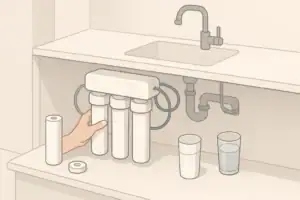
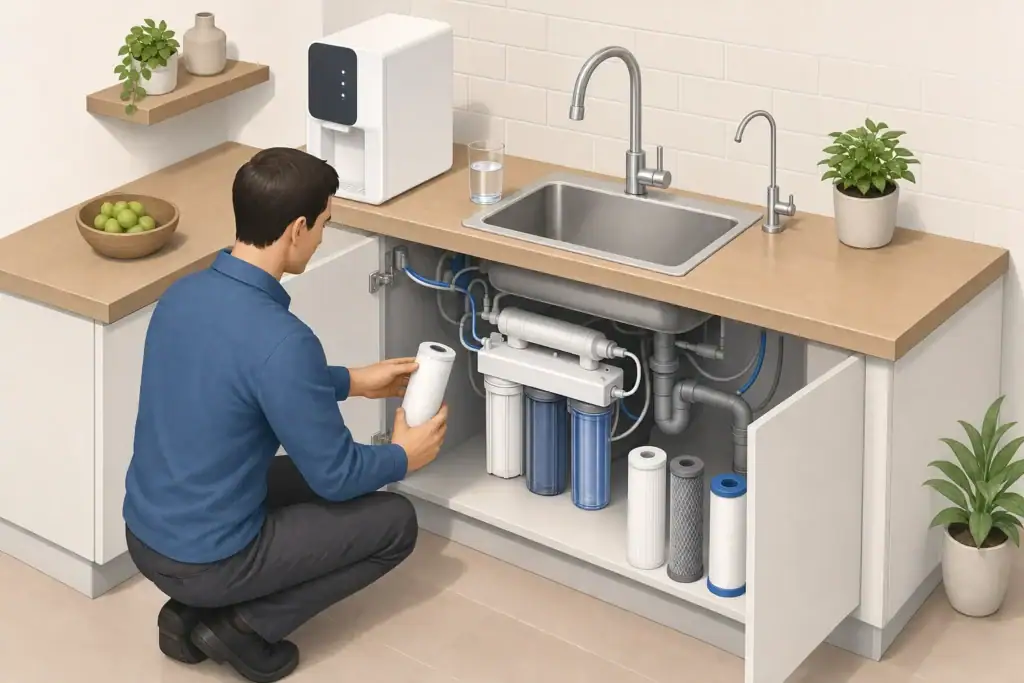
An under-sink system typically includes sediment and carbon pretreatment, a membrane, and a storage tank or tankless delivery design. It also sends a portion of incoming water to the drain. The system’s contaminant-specific performance data are more informative than broad statements about removal percentages.
Other treatment methods
Specialty adsorbents or advanced treatment processes may be appropriate for certain compounds, particularly in larger or professionally designed systems. Ion exchange performance is compound-specific and is not a universal pesticide solution.
Ultraviolet disinfection inactivates susceptible microorganisms but does not remove dissolved pesticides. Sediment filters remove particles and protect downstream equipment, but dissolved pesticide molecules generally pass through them. Water softeners are intended mainly for hardness minerals and should not be selected as broad pesticide treatment.
Point-of-Use Versus Whole-House Treatment
Point-of-use treatment serves one drinking-water location, usually the kitchen sink. It may be a practical option when the primary goal is water for drinking, cooking, beverages, and ice. Smaller systems generally cost less to operate and make it easier to monitor a defined volume of treated water.
Whole-house, or point-of-entry, treatment handles water before it is distributed throughout the building. It may be considered when a detected pesticide is relevant to multiple household uses or when an agency or water-treatment professional recommends broader control. These systems require enough media, contact time, and flow capacity for peak household demand. Compare whole-house vs point-of-use filters when deciding which treatment scope fits the need.
A whole-house carbon tank should not be sized only by pipe diameter. Important factors include:
- The identified pesticide and its concentration
- Peak and average household flow
- Carbon type and media volume
- Required contact time
- Competing organic matter and sediment
- Pressure loss through the system
- Sampling access before and after treatment
Treatment does not correct a damaged well or continuing spill. If surface water can enter the casing, fixing the entry pathway is usually a priority. Work involving the pressure tank, well controls, electrical components, backflow prevention, or major plumbing should be handled by qualified professionals and completed under applicable codes.
Sizing, Maintenance, and Performance Verification
A treatment system must deliver adequate water at the required flow without exhausting the media or reducing pressure excessively. A small carbon cartridge may be suitable for a dedicated faucet but not for simultaneous showers, laundry, and other whole-house demands.
Influent water quality can also affect service life. Sediment may clog cartridges, hardness may contribute to scaling, and natural organic matter can compete for activated carbon capacity. Pretreatment should address a documented need rather than being added automatically.
Plan replacements before installation
Filter-change claims based only on months can be misleading because households use different amounts of water. A replacement plan should consider rated capacity, actual volume, pressure drop, elapsed time, and contaminant testing. A water meter dedicated to the treatment system can help track use when permitted and properly installed.
Verify treatment with laboratory testing
After installation and flushing according to the equipment instructions, collect a treated-water sample using the same accredited laboratory and an appropriate analytical method. Sampling both before and after treatment provides stronger evidence than testing the treated tap alone.
Periodic verification is especially important for carbon because breakthrough may not produce a noticeable taste, odor, or color. Keep records of sample results, cartridge changes, media replacement, service work, and unusual events such as flooding or long periods of nonuse.
Example values for illustration.
| Component or task | Replacement or service basis | Important note |
|---|---|---|
| Sediment prefilter | Pressure drop, visible loading, or specified capacity | It protects downstream media but does not remove dissolved pesticides. |
| Carbon cartridge | Validated capacity, water volume, elapsed time, and test results | Do not wait for taste or odor to signal pesticide breakthrough. |
| Whole-house carbon media | Professional sizing data and before-and-after testing | Service life varies with flow, concentration, and competing organics. |
| RO prefilters | Manufacturer schedule, pressure change, and water conditions | Timely replacement helps protect the membrane. |
| RO membrane | Performance monitoring, production decline, and test results | General dissolved-solids readings do not confirm pesticide reduction. |
| Postfilter | Rated service life or noticeable flow and taste changes | Its role may differ from that of the primary treatment stage. |
| Laboratory verification | After startup, after major service, and at risk-based intervals | Use a panel that includes the original detected compounds. |
Related guides:
Pesticides & Herbicides: What Filters Can Reduce Them? •
Whole House Filters for Private Wells: Why Testing Comes Before Buying •
Reverse Osmosis 101: What RO Removes (and What It Doesn’t) •
Replacement Planner Basics: Estimate Your Next Filter Change Date
A Practical Response Plan for a Pesticide Detection
A calm, staged approach helps avoid both unnecessary equipment and delayed action:
- Review the report. Confirm the compound, concentration, unit, reporting limit, and any qualifier.
- Find the applicable comparison value. Use current information from the appropriate state or federal authority.
- Confirm when appropriate. Recollect the sample using the laboratory’s containers and handling instructions.
- Investigate the source. Review pesticide use, spills, drainage, flooding, and the condition of the wellhead.
- Use interim water if advised. When a result exceeds an applicable benchmark, follow guidance from local environmental or public health authorities about drinking and cooking water.
- Select contaminant-specific treatment. Compare carbon, reverse osmosis, or specialized options using evidence for the pesticide actually detected.
- Size for the intended use. Decide whether one drinking-water faucet or the whole building requires treatment.
- Retest and document. Verify performance after installation and maintain a record-based replacement schedule.
Testing remains central even after treatment is installed. A properly selected and maintained system can reduce targeted pesticides, but only laboratory results can show how it is performing under the conditions at a particular well.
Frequently asked questions
How often should a private well be tested for pesticides?
There is no universal schedule. Consider testing after a spill, flood, well damage, nearby groundwater detection, or seasonal pesticide use and heavy rainfall. Repeat testing when local conditions or risks change.
Can a standard well-water test detect pesticides?
Usually not. Basic tests for bacteria, nitrate, hardness, or total dissolved solids do not typically include pesticide analysis. Ask an accredited laboratory for a targeted pesticide panel.
Can boiling water remove pesticides from a private well?
No. Boiling is not a general pesticide treatment and may concentrate compounds that do not evaporate. Use laboratory results to identify an appropriate treatment option instead.
Do carbon filters remove all pesticides from well water?
No. Activated carbon can reduce many organic pesticides, but results depend on the compound, filter design, flow rate, contact time, and filter capacity. Confirm performance for the pesticide detected and replace media on schedule.
Should I retest my water after installing treatment?
Yes. Test treated water after installation and flushing, using a method that includes the original detected pesticide. Periodic follow-up testing helps confirm that the system continues to perform as intended.
- NSF/ANSI standards explained (42/53/401/58)
- Clear trade-offs: pitcher vs faucet vs under-sink vs RO
- Maintenance planning: cost per gallon and replacement cadence