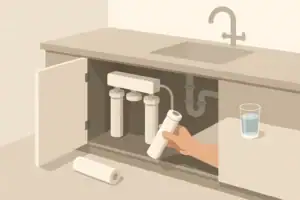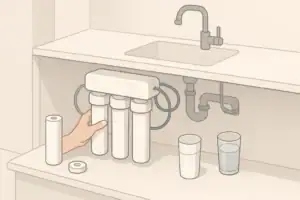
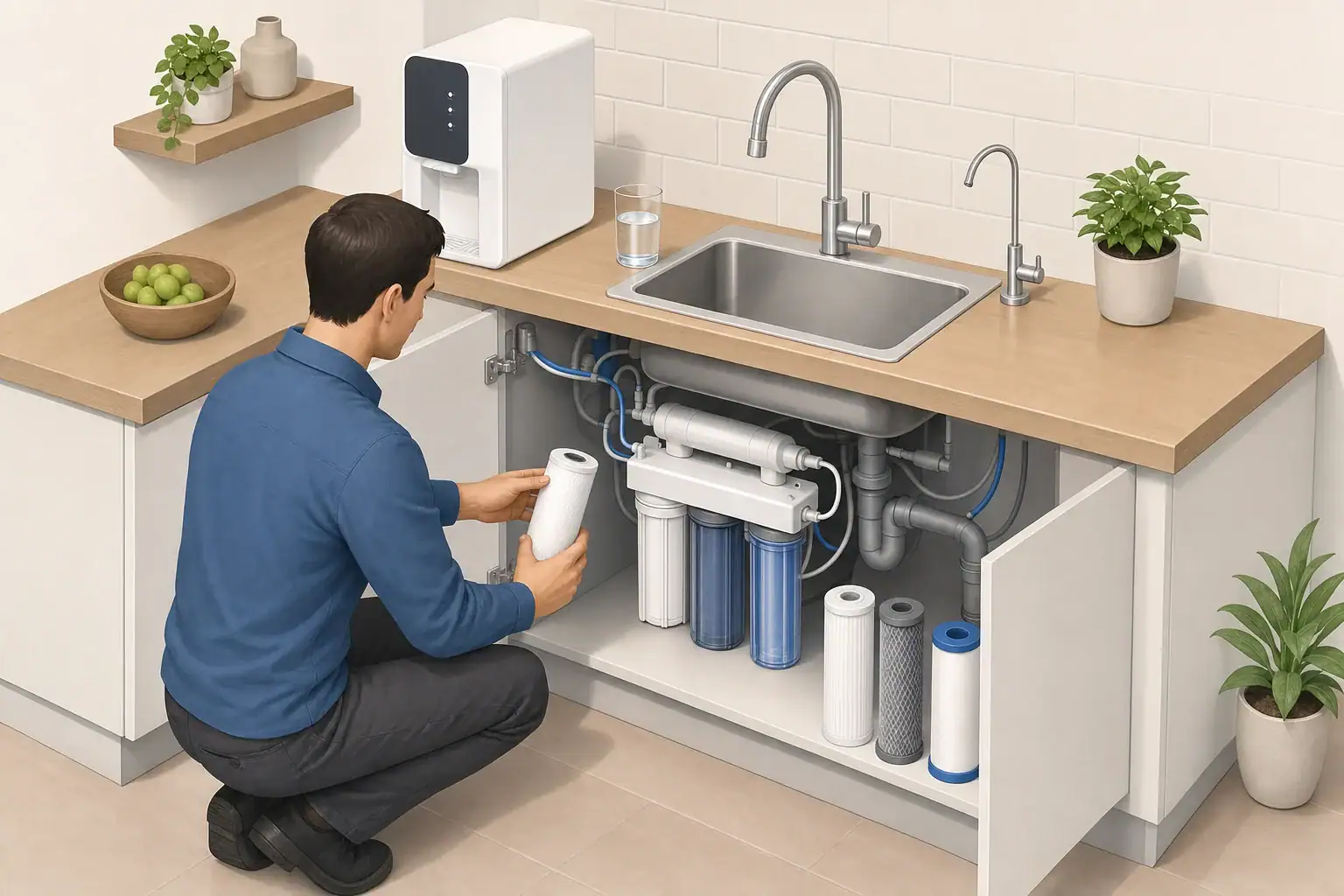
Volatile organic compounds, commonly called VOCs, are a broad group of carbon-based chemicals that can enter drinking water from fuels, solvents, industrial activities, household products, and other sources. Because individual VOCs behave differently, no single treatment claim applies equally to every compound.
Activated carbon is often the most practical household treatment for many VOCs. Reverse osmosis systems may also help, especially when they include suitable carbon stages. However, performance depends on the specific contaminant, its concentration, water conditions, filter design, flow rate, capacity, and maintenance.
The right decision starts with identifying what is actually present. A filter intended mainly for chlorine taste or sediment should not automatically be assumed to reduce a confirmed VOC problem.
What Are VOCs in Drinking Water?
VOCs tend to evaporate into the air under ordinary environmental conditions. Examples include certain components of gasoline, degreasers, dry-cleaning solvents, paint-related chemicals, and manufacturing compounds. Some disinfection byproducts are also commonly evaluated within VOC laboratory panels.
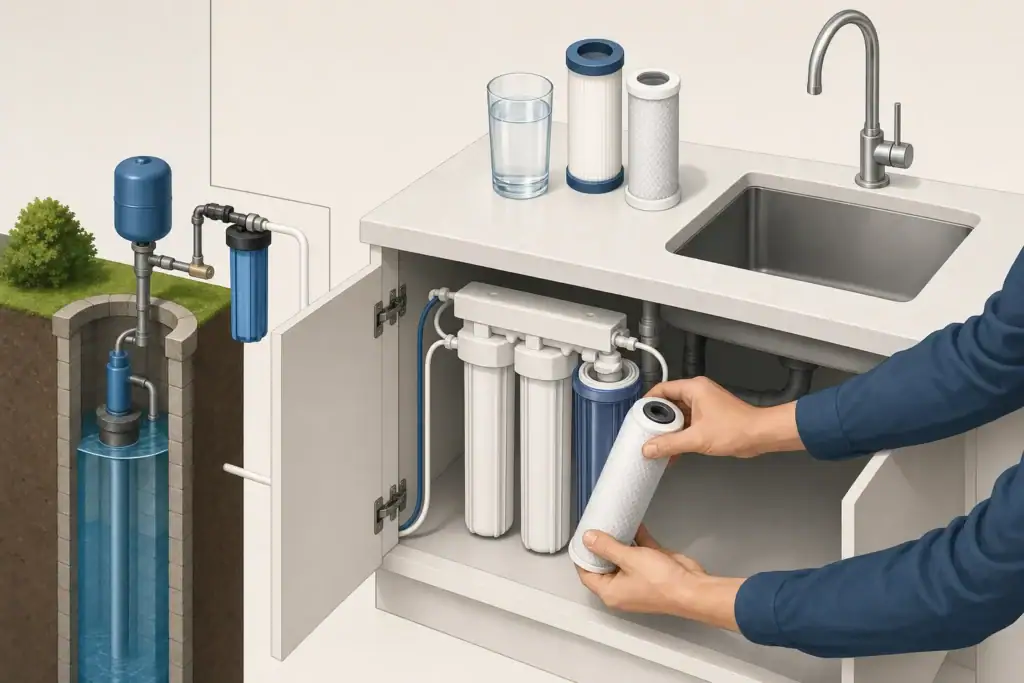
Possible sources vary by water supply. Groundwater can be affected by leaking fuel storage, spills, landfills, septic activity, or historical commercial operations. Surface-water sources may receive runoff or discharges. VOCs can also enter water through localized contamination near a private well.
Odor is not a reliable screening tool. Some compounds may produce a noticeable solvent-like or fuel-like smell, but others may be present without an obvious taste or odor. Conversely, an unusual odor does not prove that a VOC is present.
Why the specific compound matters
The term VOC covers many chemicals with different molecular sizes, affinities for carbon, and tendencies to move between water and air. A filter may reduce one compound effectively while providing limited reduction for another.
Concentration also matters. A small cartridge treating occasional drinking water has a different capacity than a large media tank treating all household water. Treatment selection should therefore be based on compound-specific evidence rather than a general statement that a product removes VOCs.
How VOCs Are Identified and Why Testing Matters
If VOC contamination is suspected, use a laboratory that is qualified for drinking-water analysis and request an appropriate VOC panel. Private well owners may seek guidance from their state or local environmental health agency when selecting tests.
VOC samples require careful collection because the target compounds can escape from the water. Laboratories commonly provide special vials and detailed instructions intended to prevent air bubbles or headspace. Follow those instructions exactly, and do not transfer the sample to another container.
Public water customers can review their utility’s annual water quality information, but that report describes the regulated distribution system rather than every condition inside a building. Learn how to read a consumer confidence report before using it to assess a site-specific concern. Targeted tap testing may still be useful when there is a local spill, unusual odor, plumbing concern, or other site-specific reason.
Use results to define the treatment goal
A useful laboratory report identifies the compounds detected and their measured concentrations. Those results can be compared with current guidance from the relevant water authority. They also provide a baseline for selecting treatment and checking whether it works under actual household conditions.
Example values for illustration.
| Treatment type | Potential role | Main limitation |
|---|---|---|
| Granular activated carbon | Can adsorb many common VOCs | Performance varies by compound, capacity, and contact time |
| Carbon block | Can provide VOC reduction at a drinking-water tap | Pressure drop and limited cartridge capacity must be considered |
| Reverse osmosis with carbon stages | May address a broader mixture of dissolved contaminants | VOC reduction may rely substantially on the carbon stages |
| Engineered aeration | Can transfer many volatile compounds from water to air | Requires controlled ventilation and professional design |
| Purpose-designed distillation | May reduce some VOCs when vapor control is included | Some volatile compounds can carry over without proper design |
| Sediment filtration | Protects downstream equipment from particles | Does not target dissolved VOCs |
| UV, softening, or remineralization | Addresses microbes, hardness, or mineral balance | Not a primary VOC treatment method |
Activated Carbon Filters for VOC Reduction
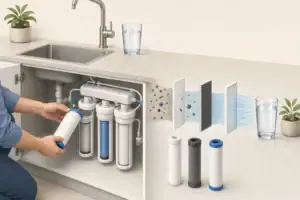
Activated carbon has a large internal surface area that attracts and holds many organic compounds through adsorption. It is widely used in pitcher filters, faucet-mounted units, refrigerator filters, under-sink cartridges, reverse osmosis systems, and whole-house media tanks.
Carbon is not interchangeable across all products. The carbon source, pore structure, amount of media, cartridge construction, and water contact time can all affect performance. A small taste-and-odor cartridge may contain carbon but lack sufficient capacity or verified performance for a specific VOC.
Granular carbon versus carbon block
Granular activated carbon consists of loose media. It can support good flow and is commonly used in larger tanks and cartridge housings. Water distribution through the media is important because channeling can reduce contact time.
Carbon blocks compress carbon particles into a dense structure. They may provide more consistent contact and can also capture some particles, but a restrictive block can reduce faucet flow as it loads. Compare carbon block and activated carbon under-sink filters when evaluating these media formats for a specific installation. Neither format is automatically better for every VOC or installation.
What to verify before choosing carbon
Look for independent test information that names the particular VOC or VOC group covered by the reduction claim. Certification to a drinking-water treatment standard can provide useful evidence, but its scope must be read carefully. A certification for chlorine taste and odor does not establish performance for every organic contaminant.
Also check the rated capacity, flow rate, replacement schedule, required pressure, and test conditions. Laboratory ratings do not eliminate the need for timely cartridge replacement, especially when contaminant concentrations or household water use are high.
Reverse Osmosis, Aeration, and Distillation
Reverse osmosis systems
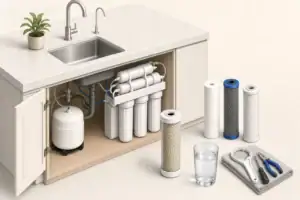
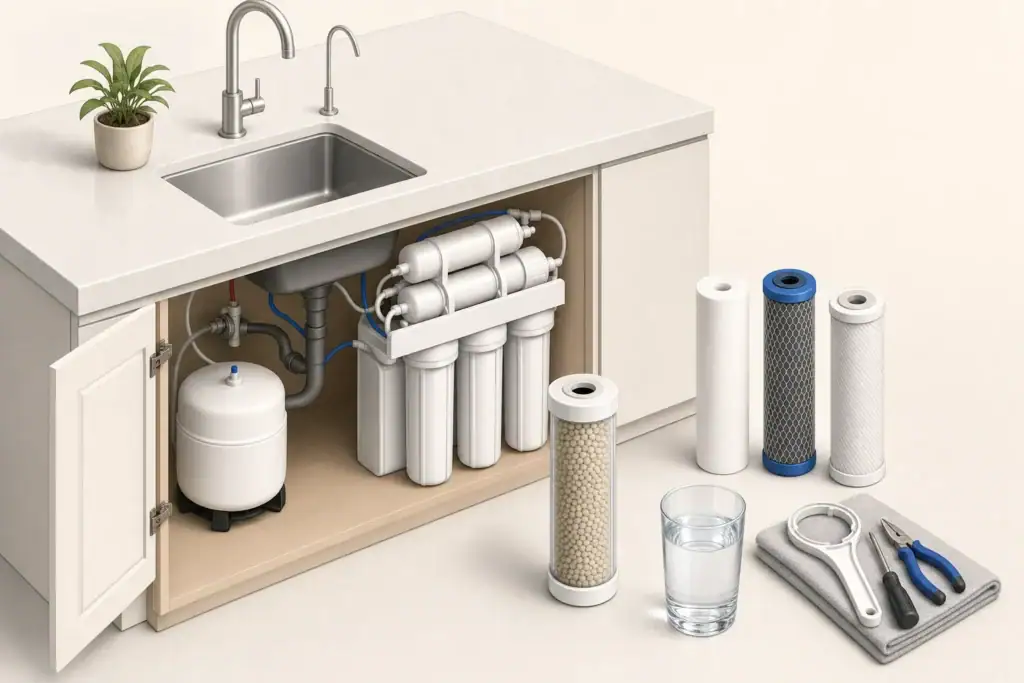
Reverse osmosis uses pressure to move water through a semipermeable membrane. It can reduce many dissolved substances, but VOC behavior varies. Most residential RO systems also include activated carbon prefilters or postfilters, which may perform much of the VOC reduction.
When evaluating an RO system for a known VOC, review the verified claim for the complete system rather than assuming the membrane alone will solve the problem. See what reverse osmosis removes and what it does not, then account for feed-water pressure, production rate, storage capacity, rejected water, and the replacement intervals for every treatment stage.
Engineered aeration
Aeration exposes water to air so volatile compounds transfer out of the water. Properly designed systems can be effective for certain VOCs and may be used at the point of entry where all household water requires treatment.
However, the removed compounds must be exhausted safely. Aeration can also require pumps, storage, ventilation, and follow-up treatment. It is not an appropriate improvised indoor project. A water treatment professional familiar with the detected compounds and applicable codes should design the system.
Distillation
Basic distillation is not automatically reliable for VOC control. Because some VOCs are more volatile than water, they can enter the vapor stream and condense with the product water. A purpose-designed unit may use venting, fractionation, or carbon treatment to manage these compounds.
Distillation also uses energy and produces water slowly, so it is generally considered for limited drinking and cooking use rather than normal whole-house flow.
Choosing Point-of-Use or Whole-House Treatment
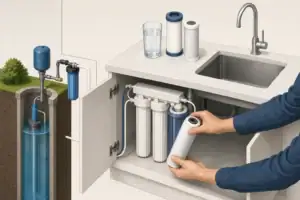
Point-of-use treatment serves one location, usually the kitchen faucet. It can be practical when the goal is to treat drinking and cooking water, the contaminant is well characterized, and a suitable certified device is available.
Pitcher, faucet, countertop, and under-sink carbon filters differ mainly in media quantity, flow, convenience, and capacity. Larger under-sink cartridges usually allow more media and longer contact than compact devices, but actual performance must still be verified.
Point-of-entry treatment processes water before it reaches household fixtures. It may be considered when testing confirms contamination across the supply and treatment is needed beyond one drinking-water tap. Since VOCs can transfer from water to indoor air during water use, the appropriate treatment location should be discussed with qualified local professionals when contamination is significant or widespread.
Questions to ask before selecting a system
- Which specific VOCs were detected, and at what concentrations?
- Is the filter independently tested for those compounds?
- Does the performance rating apply to the complete system?
- What capacity and flow rate were used during testing?
- Will household pressure support the required flow?
- How will treatment effectiveness be confirmed after installation?
- Who will track cartridge or media replacement?
For renters or apartments, portable and faucet-connected options may be easier to manage, but they should still have compound-specific evidence. Obtain property approval before making plumbing changes, and use installation methods that preserve required backflow protection and other safety features.
Maintenance, Replacement, and Performance Checks
Carbon does not provide unlimited protection. Adsorption sites become occupied over time, and contaminant breakthrough may occur without a noticeable change in taste, odor, or appearance. A filter should therefore be replaced according to its rated capacity, service interval, and actual water use.
High contaminant levels, competing organic matter, heavy chlorine demand, and faster-than-rated flow can shorten useful media life. Sediment can also create pressure loss or interfere with water distribution through a treatment bed.
Track use instead of relying on appearance
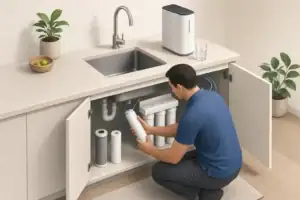
Record installation dates, meter readings when available, filter changes, sanitation, and test results. Estimate your next filter change date from the system’s capacity and actual usage. Replace cartridges with compatible components that preserve the system’s verified performance. Do not wait for an odor to return before taking action.
After installing treatment for a confirmed VOC, collect a treated-water sample according to the laboratory’s instructions. Follow-up testing can show whether the system is reducing the target compounds under real conditions. Periodic retesting may be appropriate when the source is ongoing or when media exhaustion is difficult to predict.
Sudden changes in flow, pressure, odor, or test results deserve attention. Stop relying on a system with damaged housings, leaks, overdue media, or uncertain performance until it has been inspected and the treated water has been evaluated.
Example values for illustration.
| Component | Planning example | Reasons to service sooner |
|---|---|---|
| Pitcher or faucet carbon cartridge | About 1 to 3 months | Rated capacity reached or flow declines |
| Under-sink carbon cartridge | About 6 to 12 months | High use, elevated VOC levels, or pressure loss |
| RO carbon prefilter | About 6 to 12 months | Chlorine breakthrough, fouling, or rated capacity reached |
| RO membrane | About 2 to 5 years | Reduced production or declining verified performance |
| RO carbon postfilter | About 12 months | Taste change or manufacturer capacity reached |
| Whole-house carbon media | Often measured in years | Test results, water volume, or contaminant loading indicate exhaustion |
Related guides:
VOCs in Water: How Carbon Filters Work •
How to Verify a Filter’s Certification Claim •
RO Filter Replacement Schedule: Prefilters vs Membrane •
Whole House vs Point-of-Use Filters
A Practical Decision Process
Begin with a qualified water test rather than selecting a filter based only on odor or a broad marketing statement. Identify the compounds, concentrations, likely source, and whether the issue affects one fixture or the incoming supply.
For many household situations, a properly sized activated carbon system with evidence for the detected VOC is the first technology to evaluate. Reverse osmosis may be useful when other dissolved contaminants also need treatment, but its carbon stages and system-level claims remain important.
Where contamination affects all household water or involves concentrations that exceed applicable guidance, consult the water supplier, local health or environmental authorities, and a qualified treatment professional. Confirm performance with treated-water testing and maintain the equipment according to capacity rather than taste alone.
Frequently asked questions
Can a standard water filter remove VOCs?
Not necessarily. A filter should have independent performance information for the specific VOC or VOC group detected, because a general chlorine or sediment claim does not confirm VOC reduction.
Is activated carbon effective for VOCs in drinking water?
Activated carbon can reduce many VOCs, but effectiveness depends on the compound, carbon amount, contact time, flow rate, contaminant level, and filter maintenance.
Should I choose reverse osmosis for VOC contamination?
Reverse osmosis may be useful, particularly when other dissolved contaminants also need treatment. Review verified VOC claims for the complete system, including its carbon stages.
How often should a VOC filter be replaced?
Replace it according to the rated capacity, service interval, and actual water use. Do not rely on odor, taste, or appearance to indicate that carbon media is exhausted.
Do I need to test my water after installing a VOC filter?
Follow-up testing is a practical way to confirm that the system reduces the identified compounds under actual household conditions, especially after treating a confirmed contamination issue.
- NSF/ANSI standards explained (42/53/401/58)
- Clear trade-offs: pitcher vs faucet vs under-sink vs RO
- Maintenance planning: cost per gallon and replacement cadence