Nitrate in well water cannot be identified by taste, smell, or appearance. Clear water may contain nitrate, while unpleasant-tasting water may have none. A laboratory test is therefore the starting point for deciding whether treatment is needed and which treatment method is appropriate.
Testing also provides information that product descriptions cannot. It identifies the nitrate concentration, the units used, and other water-quality conditions that may affect treatment. Without those details, a homeowner could buy a filter that does not reduce nitrate, undersize a suitable system, or overlook pretreatment needed to protect it.
This test-first approach is especially important for private wells. Unlike public water systems, private wells are generally managed by the property owner, although state and local requirements may apply.
Why Nitrate Requires a Test-First Decision
Nitrate is not a visible water problem
Nitrate is a dissolved ion. It does not normally create particles that a sediment cartridge can capture, and it does not reliably cause a recognizable odor, color, or flavor. Household observations alone cannot establish whether nitrate is present.
Nitrate can enter groundwater from several sources, including fertilizer use, manure, wastewater systems, natural soil processes, and land disturbance. A result from a neighboring property may provide regional context, but it does not replace testing because well depth, construction, geology, and local land use vary.
A result determines whether treatment is relevant
A laboratory report answers the first practical question: Is nitrate present at a concentration that requires follow-up under applicable guidance? It also establishes a baseline for comparing future results.
The U.S. Environmental Protection Agency sets a maximum contaminant level of 10 milligrams per liter for nitrate measured as nitrogen in public water systems. Private wells are not regulated under the federal public water rules, so owners should compare results with current state or local health department guidance. Households with pregnant people or infants should seek timely guidance from a qualified health authority when a result is elevated.
How to Obtain a Useful Well Water Test
Use an appropriate laboratory
For a treatment decision, use a laboratory certified or accredited for the requested drinking-water analyses where possible. Local health departments, state drinking-water programs, and extension services may provide lists of laboratories or well-testing programs.
Ask whether the analysis reports nitrate, nitrate plus nitrite, or both. Follow the laboratory’s sampling, preservation, and delivery instructions. Improvised containers or delayed delivery can reduce confidence in the result.
Test more than nitrate when planning treatment
A nitrate result is essential, but a broader well-water panel can reveal conditions that influence equipment selection and maintenance. Useful parameters may include coliform bacteria, pH, hardness, total dissolved solids, sulfate, iron, manganese, turbidity, and nitrite. The appropriate panel depends on local geology and land use.
Sample location matters as well. A raw-water sample taken before existing treatment shows what enters the house. A separate sample after treatment indicates how the installed system performs. Clearly label each sample so the results are not confused.
Example values for illustration.
| Test finding | Why it matters | Practical response |
|---|---|---|
| Nitrate confirmed | Establishes whether nitrate-specific treatment should be evaluated | Compare the concentration and units with applicable guidance |
| Nitrite detected | May change how the result is evaluated | Discuss the result with the laboratory or local health authority |
| Coliform bacteria detected | Indicates a separate microbial concern | Investigate the well and follow official disinfection guidance |
| High turbidity or sediment | Can foul valves, membranes, and cartridges | Evaluate appropriate sediment pretreatment |
| High hardness | Can contribute to scale on membranes or distillers | Include scale control in system planning |
| Iron or manganese present | Can foul treatment components | Determine whether separate pretreatment is needed |
| High sulfate or dissolved solids | Can affect ion exchange or membrane performance | Have the complete water analysis reviewed before sizing |
How to Read a Nitrate Laboratory Result
Check the reporting units
Nitrate results are commonly reported either as nitrate-nitrogen, written as NO3-N, or as the full nitrate ion, written as NO3. These are not numerically interchangeable. For illustration, 10 milligrams per liter as nitrate-nitrogen corresponds to approximately 44 milligrams per liter as nitrate ion.
Do not compare a nitrate-ion result directly with a guideline expressed as nitrate-nitrogen. If the report is unclear, ask the laboratory to confirm the analyte and units rather than converting the value informally.
Review the detection limit and trend
A report may use terms such as not detected, below reporting limit, or less than a stated value. These phrases do not always mean absolute zero. They mean the analyte was not quantified above the laboratory’s specified limit.
One result is a snapshot. Nitrate can vary with rainfall, agricultural activity, groundwater movement, well condition, and seasonal recharge. Common public health guidance recommends testing private wells for nitrate at least annually, with additional testing after flooding, well repair, changes in nearby land use, or an unexplained change in water quality. Local recommendations should take priority. See a private well water testing schedule for a broader testing overview.
Why Common Household Filters May Not Reduce Nitrate
The word filter covers many different technologies. A device that improves taste or captures sediment is not automatically designed for dissolved nitrate.
- Activated carbon: Useful for certain taste, odor, chlorine, and organic-compound concerns, but standard carbon filtration is not considered a reliable nitrate treatment.
- Sediment cartridges: Capture suspended particles such as sand or rust. Dissolved nitrate passes through ordinary sediment media.
- Water softeners: Conventional softening media primarily exchange hardness minerals. A standard softener should not be assumed to reduce nitrate.
- Ultraviolet systems: Used for microbial control under suitable conditions. UV light does not remove dissolved nitrate.
- Boiling: Does not remove nitrate and can increase its concentration as water evaporates.
Some systems combine several stages. Carbon and sediment stages may protect equipment or address other contaminants, but their presence does not establish nitrate performance. The nitrate-specific stage and its verified reduction capability are what matter.
Treatment Options to Evaluate After Testing
Reverse osmosis
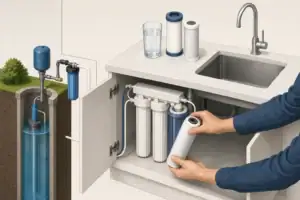
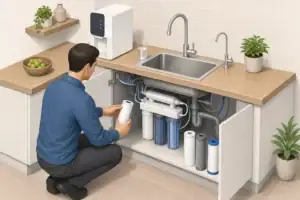
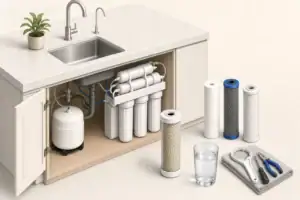
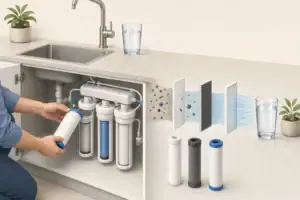
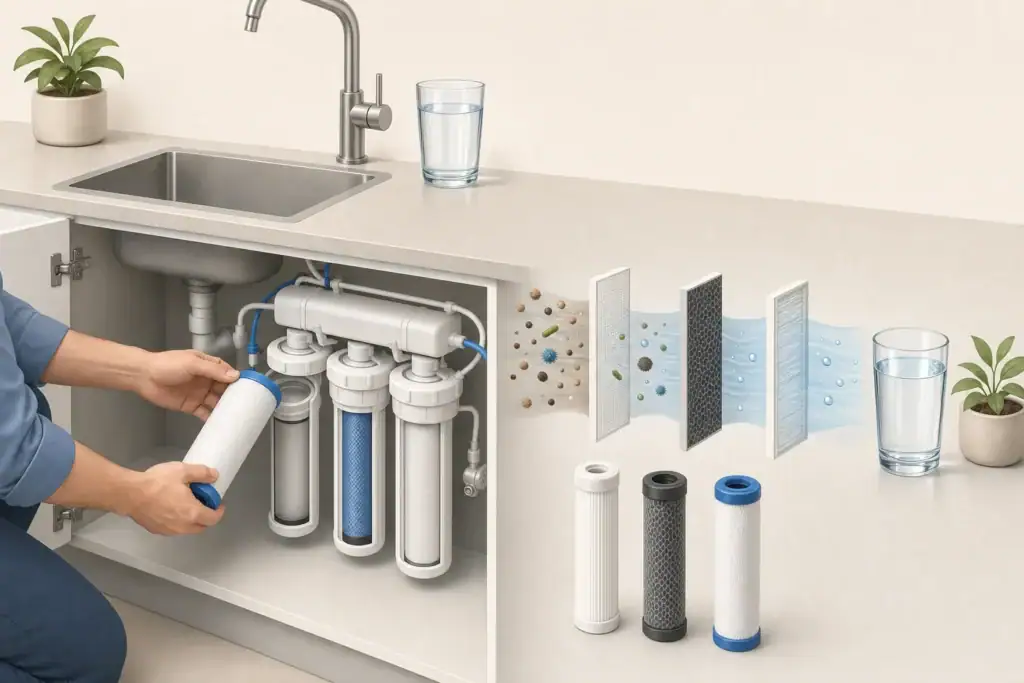
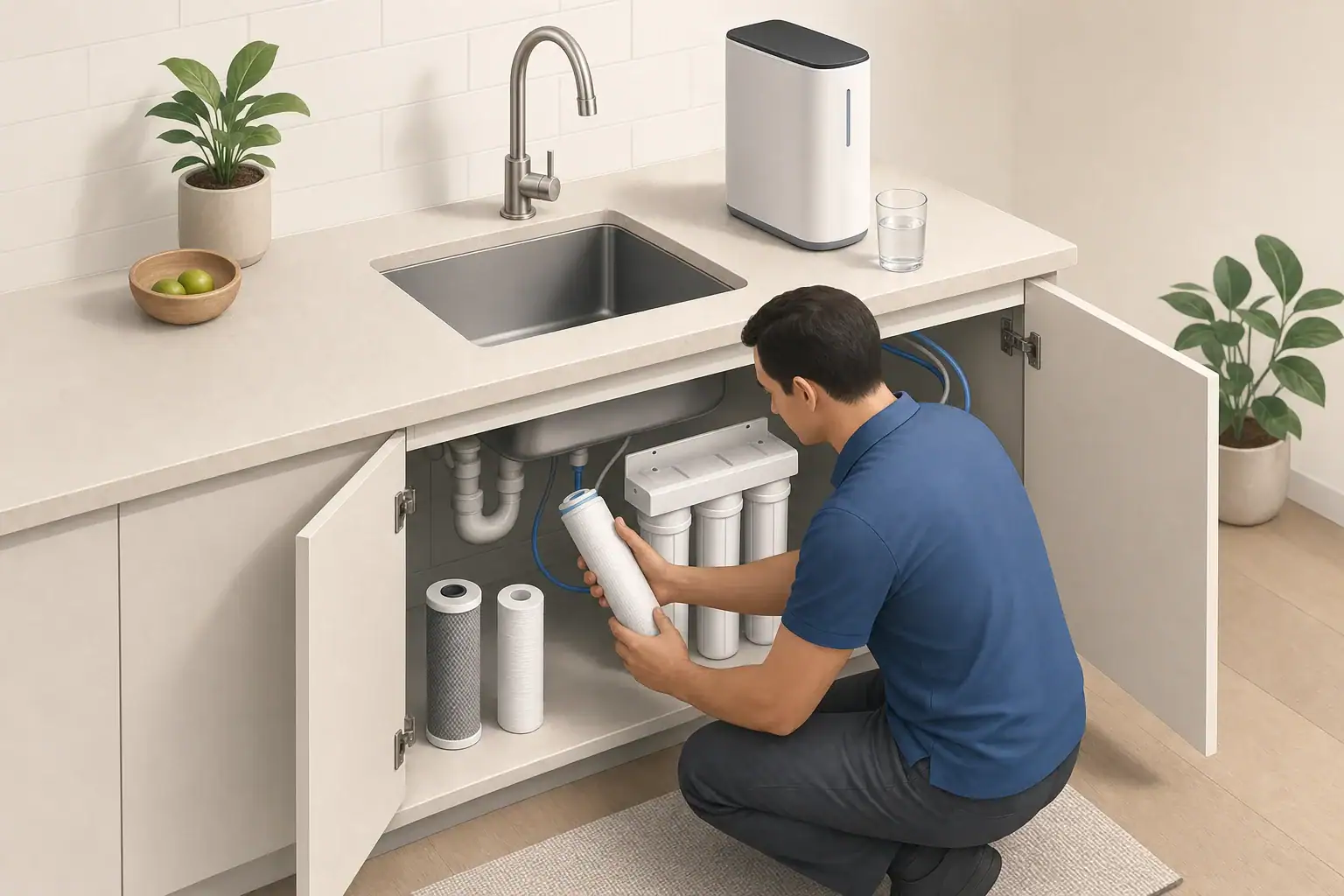
Reverse osmosis uses pressure to move water through a selective membrane. Properly selected residential systems can reduce nitrate and many other dissolved substances. They are commonly installed at a kitchen sink for drinking and cooking water.
Performance depends on membrane condition, water pressure, temperature, feed-water chemistry, and maintenance. Reverse osmosis also produces a reject-water stream. When comparing systems, look for independently verified performance that specifically includes nitrate reduction under an applicable drinking-water standard, rather than relying on a general filtration statement. Learn more about NSF 58 RO certification when reviewing these claims.
Distillation
A distiller boils water and collects condensed vapor, leaving many dissolved substances behind. It can be practical for producing limited quantities of drinking water, but output rate, electricity use, cleaning needs, and mineral scale should be considered.
Distillation differs from simply boiling water in an open pot. The treatment effect comes from collecting the condensed vapor while leaving concentrated residue in the boiling chamber.
Nitrate-selective anion exchange
Anion exchange can be configured for nitrate reduction and may be considered for larger water demands. It requires appropriate resin selection, careful sizing, regeneration, and monitoring. Competing ions such as sulfate can affect capacity and performance.
Poorly applied or exhausted media may not provide dependable reduction. Whole-house ion exchange should be designed from a complete water analysis by a qualified water-treatment professional. Regeneration waste and local discharge requirements also need consideration.
Point-of-use versus whole-house treatment
Point-of-use treatment serves one faucet or a limited set of fixtures. It is often selected when nitrate reduction is needed mainly for drinking, beverage preparation, and cooking. Whole-house treatment processes all water entering the building and involves higher flow rates, greater capacity, and more complex maintenance.
The right scope depends on the test result, household use, other contaminants, plumbing layout, and local advice. Whole-house treatment is not automatically better, and point-of-use equipment is not automatically sufficient for every household. For wider planning considerations, see whole-house filters for private wells.
Installation, Maintenance, and Verification
Plan around actual operating conditions
Before purchasing equipment, document the well pump pressure range, available flow, peak household demand, installation space, drain access where required, and electrical needs. Confirm that the system is intended for private well water and can operate within the home’s pressure and water-quality conditions.
Pretreatment may be needed when sediment, hardness, iron, or manganese could foul a membrane or resin. Adding stages without a water-quality reason can increase pressure loss and maintenance, so each component should have a defined purpose.
Retest treated water
Installation is not the final verification step. Have treated water tested after the system is commissioned to confirm that it performs under actual household conditions. Continue testing on a schedule appropriate to the treatment method, test result, manufacturer instructions, and local guidance.
Cartridge age alone does not prove performance. Water use and contaminant loading vary among homes. Pressure changes, altered taste, or reduced flow can signal a service issue, but nitrate breakthrough may have no sensory warning. Follow an appropriate RO filter replacement schedule where reverse osmosis is used.
Example values for illustration.
| Component or task | Maintenance trigger | Verification step |
|---|---|---|
| Sediment prefilter | Pressure drop, visible loading, or scheduled interval | Check flow and inspect the replaced cartridge |
| Carbon prefilter | Rated capacity or manufacturer schedule | Record replacement date and water use |
| Reverse osmosis membrane | Declining performance or specified service interval | Use a laboratory nitrate test to confirm reduction |
| Anion exchange resin | Calculated capacity, regeneration schedule, or breakthrough | Test treated water rather than relying on taste |
| Distiller chamber | Visible mineral buildup or operating instructions | Inspect and clean using the approved procedure |
| Storage tank and faucet | Routine sanitation schedule or service event | Inspect for leaks and follow sanitation instructions |
| Whole treatment system | After repair, extended shutdown, or water-quality change | Retest nitrate and other relevant parameters |
A Practical Test-Before-Shopping Checklist
A disciplined selection process reduces guesswork and helps distinguish nitrate treatment from general water filtration. Before comparing equipment, complete these steps:
- Obtain a current nitrate result from an appropriate laboratory.
- Confirm whether the result is reported as nitrate-nitrogen or nitrate ion.
- Compare the result with current state, local, and federal drinking-water guidance as applicable.
- Test other parameters that can affect treatment selection or equipment life.
- Decide which fixtures need treated water and estimate realistic daily demand.
- Rule out sediment, standard carbon, conventional softening, and UV as stand-alone nitrate solutions.
- Compare nitrate-specific performance information for reverse osmosis, distillation, or appropriately designed anion exchange.
- Account for pressure, flow, drain needs, replacement parts, sanitation, and ongoing testing.
- Collect a treated-water sample after installation to verify actual performance.
If an initial result is unexpectedly high or inconsistent with earlier tests, contact the laboratory or local health authority about confirmation sampling. Until the result is understood, follow their advice about water used for drinking, cooking, and infant formula preparation.
Testing turns filter shopping into a defined treatment decision. It identifies the problem, narrows the suitable technologies, informs sizing, and creates a baseline for proving that the selected system continues to work.
Frequently asked questions
Can I tell whether my well water has nitrate without testing?
No. Nitrate usually has no reliable taste, odor, or color, so a laboratory analysis is needed to identify and measure it.
What nitrate units should I look for on a well-water report?
Check whether the report states nitrate as nitrogen, often written as NO3-N, or as nitrate ion, written as NO3. These units use different numerical values and should not be compared directly.
Will a standard refrigerator, carbon, or sediment filter remove nitrate?
Do not assume so. Standard carbon and sediment filtration are not reliable stand-alone nitrate treatments. Verify that a system is specifically rated for nitrate reduction.
How often should a private well be tested for nitrate?
Annual nitrate testing is commonly recommended, with additional testing after flooding, well work, nearby land-use changes, or unexplained water-quality changes. Follow local guidance where available.
Should I test the water again after installing nitrate treatment?
Yes. Test treated water after installation and at intervals appropriate to the treatment method and local recommendations. Testing confirms actual performance because nitrate reduction cannot be verified by taste or appearance.
Related guides:
Nitrates in Well Water: What Filtration Works Best? •
Private Well Water Testing Schedule: What to Check and When •
Reverse Osmosis 101: What RO Removes (and What It Doesn’t) •
Whole House Filters for Private Wells: Why Testing Comes Before Buying
- NSF/ANSI standards explained (42/53/401/58)
- Clear trade-offs: pitcher vs faucet vs under-sink vs RO
- Maintenance planning: cost per gallon and replacement cadence