
How Nitrates Get Into Well Water
Nitrates are common in private wells, especially in rural or agricultural areas. They are a form of nitrogen that easily dissolves in water and moves with groundwater.
Common sources of nitrates around homes and small communities include:
- Fertilizer use on lawns, gardens, and farm fields
- Animal manure from livestock operations or hobby farms
- Septic systems and leaching fields
- Decomposing vegetation or organic matter
Because nitrates are dissolved ions, they do not settle out or get removed by simple sediment filtration. They move with groundwater and can reach private wells, especially shallow wells or wells near potential contamination sources.
Unlike issues such as hardness or iron, you usually cannot see, taste, or smell nitrates in water. Testing is the only reliable way to know if they are present and at what level.
Testing Well Water for Nitrates
Before choosing a filtration system, it is important to know whether nitrates are present and how high the levels are. Without a test result, you are guessing, and it is harder to size and select treatment properly.
Types of nitrate tests
Common options for homeowners include:
- Lab testing: A certified laboratory test is generally the most reliable and detailed. You typically collect a sample in a clean bottle and ship or deliver it to the lab.
- Professional water testing services: Some local water professionals or health agencies offer sampling and testing for private wells.
- Home test kits and strips: These can provide a quick indication, but they are usually less precise than lab testing. They can be useful for screening or for checking trends over time.
How often to test
For private wells, general guidance is to test for nitrates at least once a year, and also:
- After major flooding or heavy rain events that might affect groundwater
- After well repairs, pump replacement, or plumbing work that could disturb the system
- If land use around your home changes, such as new agriculture or development
Because nitrate levels can change with seasons and rainfall, a single test provides a snapshot, not a permanent answer. Regular testing helps you see patterns and confirm whether filtration is working as expected.
Common filtration types versus nitrate removal suitability
Example values for illustration.
| Filter or Process Type | Typical Use | Works Well for Nitrates? | Notes |
|---|---|---|---|
| Basic sediment filter | Whole-house or prefilter | No | Removes sand, rust, larger particles only |
| Granular activated carbon | Pitchers, faucet, under-sink units | No (for most designs) | Targets chlorine, taste, and many organic chemicals |
| Reverse osmosis membrane | Under-sink or small point-of-use | Yes | Designed to reduce many dissolved ions including nitrates |
| Distillation unit | Countertop batch treatment | Often | Can reduce nitrates; performance varies by design |
| Ion exchange for hardness only | Typical water softener | Not reliably | Primarily exchanges calcium and magnesium, not optimized for nitrates |
| Specialized anion exchange | Whole-house or point-of-use | Yes | Uses resins designed for nitrate and other anions |
| UV disinfection | Whole-house or point-of-entry | No | Targets microorganisms, does not remove dissolved chemicals |
These examples are simplified and do not cover every specialized product design.
Why Common Filters Do Not Remove Nitrates
Many people first try pitcher filters, faucet-mounted filters, or a basic whole-house sediment filter when they are concerned about water quality. These can help with some issues, but nitrates behave differently than sediment or chlorine.
Sediment filters
Sediment filters trap particles based on size (for example, sand, rust, and dirt). Nitrates are dissolved and move with the water as individual ions, which are far smaller than the pore size of standard cartridges. As a result, sediment filters simply let nitrates pass through.
Standard carbon filters
VOCs in waterActivated carbon is excellent for reducing many organic chemicals, chlorine, and some taste and odor problems. However, nitrate ions are small, highly soluble, and not strongly attracted to carbon surfaces in typical home filters. Most standard carbon-based systems are not designed or certified to reduce nitrates.
If nitrates are your main concern, carbon alone is unlikely to be enough. Carbon is still useful as a prefilter or for improving taste alongside nitrate-focused treatment.
Filtration Methods That Reduce Nitrates
To address nitrates effectively, you generally need a treatment method designed for dissolved ions. At the home scale, the most common approaches are reverse osmosis, distillation units, and anion exchange systems using specialized resins.
Reverse osmosis (RO) for nitrates
Reverse osmosis uses a semi-permeable membrane to separate water from many dissolved contaminants. Under pressure, water passes through the membrane, while many ions and molecules stay in the waste stream.
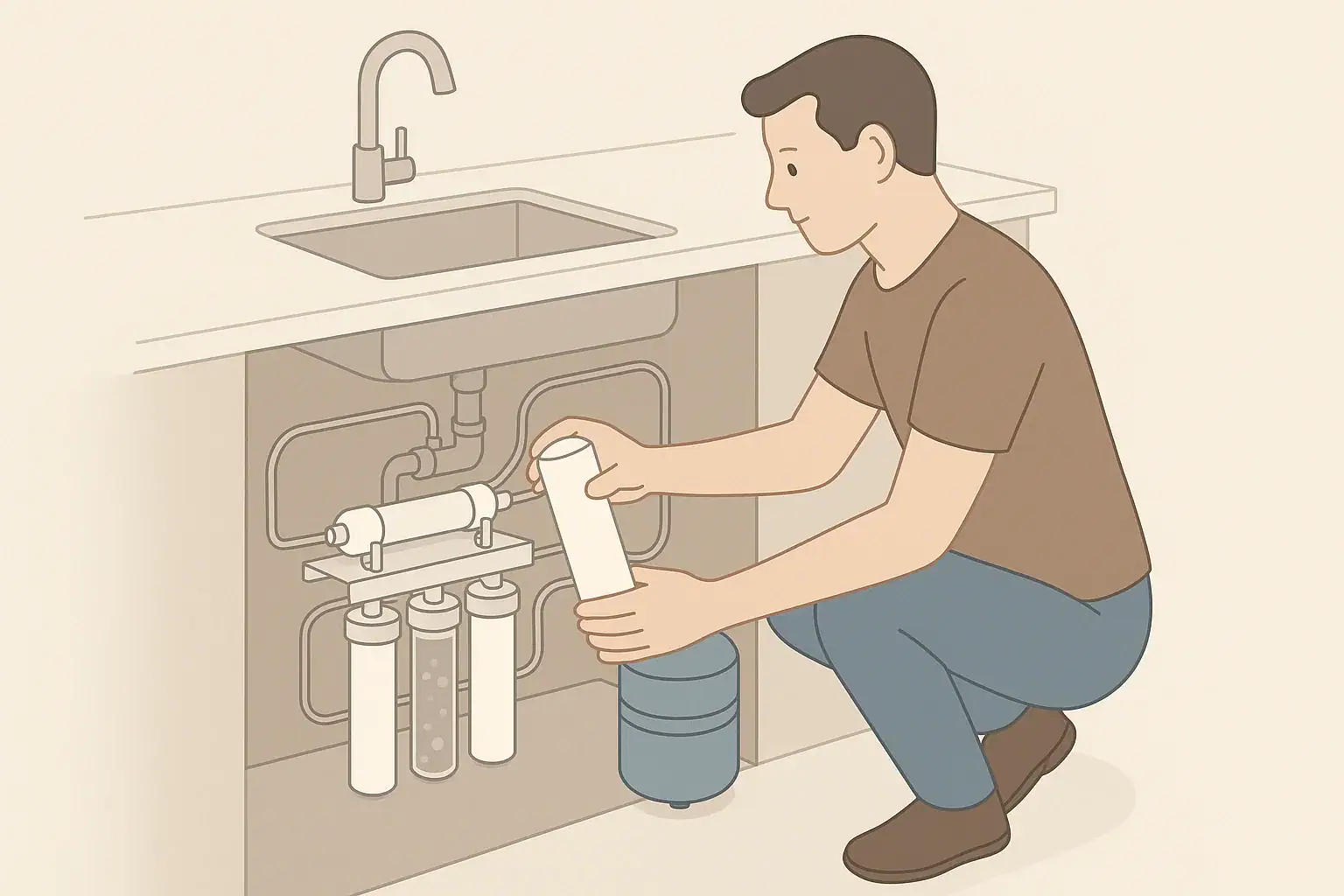
RO is widely used as a point-of-use system, typically installed under a kitchen sink with a small storage tank or as a tankless system. In many designs, RO can substantially reduce nitrate levels.
Key characteristics of RO for nitrate treatment:
- Point-of-use focus: Usually treats water for a single faucet rather than the whole house.
- Multi-stage design: Often includes sediment and carbon prefilters, the RO membrane, and sometimes post-filters or remineralization cartridges.
- Waste water: Produces a separate waste stream that goes to the drain during operation.
- Flow rate: Treated water production is slower than regular tap flow; storage tanks or tankless designs with higher production rates help manage this.
For nitrate concerns, pay attention to system sizing (gallons per day), expected reduction performance, and maintenance requirements for the membrane and prefilters.
Distillation units
Distillation involves boiling water and then condensing the steam, leaving many impurities behind. Some home distillers can reduce nitrates as part of this process, although performance depends on the design and how well volatile substances are managed.
Characteristics of distillation for households include:
- Batch operation: Water is treated in batches, often a few liters at a time.
- Energy use: Heating water to boiling requires electricity or another energy source.
- Speed: Production is typically slower than many RO systems, but suitable for drinking and cooking volumes in some homes.
Some people use distillers alongside separate carbon filters to improve taste and address other contaminants. If nitrates are a primary concern, verify that a given design is intended to reduce dissolved salts and similar contaminants.
Anion exchange systems for nitrates
Anion exchange is a process where negatively charged ions (such as nitrates) are exchanged for other anions on a resin. It is somewhat similar in concept to how typical cation-exchange water softeners swap calcium and magnesium for sodium or potassium, but the media and chemistry are different.
For nitrate treatment, specialized anion exchange resins are used. These may be configured as:
- Point-of-use cartridges: Installed under a sink or in a dedicated drinking water line.
- Point-of-entry systems: Treating water for the whole house, sometimes alongside or integrated with other equipment.
Important points about anion exchange:
- Resin selection matters: Not all anion resins target nitrates equally, and design details affect performance.
- Water chemistry: Other anions (such as sulfate or chloride) may compete with nitrate for the resin, influencing real-world treatment results.
- Regeneration and service: Larger systems often regenerate with salt or are serviced by professionals at intervals, depending on design.
Because system design can be complex, many homeowners work with a water treatment professional to size and configure anion exchange systems for nitrates.
Choosing Between Point-of-Use and Whole-House Treatment
When nitrates show up in well water testing, one of the first decisions is whether to treat only drinking and cooking water or to treat all water entering the home.
Point-of-use (POU) nitrate treatment
Point-of-use systems treat water at a specific tap, usually the kitchen sink, where most drinking and cooking water is drawn. Common POU options for nitrates include under-sink RO systems, dedicated RO faucets, and small anion exchange cartridges.
Advantages of POU for nitrates:
- Typically lower upfront cost than whole-house systems
- Easier to install in many homes (often under one sink)
- Smaller cartridges and membranes to maintain
- Can combine with a separate whole-house system for other issues such as hardness or iron
POU is often sufficient when the main concern is water that is directly consumed, and when other water uses (such as bathing or laundry) are not a priority for nitrate treatment.
Point-of-entry (POE) or whole-house nitrate treatment
Point-of-entry systems treat water as it enters the home, supplying all fixtures. Whole-house nitrate treatment is less common than POU, but some households consider it when they want every tap to have nitrate-reduced water.
Potential reasons to consider whole-house nitrate treatment include:
- Desire for a single treatment point rather than multiple POU units
- Households that use many taps for drinking or cooking
- Interest in consistent water chemistry to protect some types of plumbing or appliances (depending on overall water quality)
Anion exchange systems are more often used at the point-of-entry than RO, because whole-house RO requires managing larger volumes, substantial waste water, and more complex plumbing and pressure considerations.
For many homes, a combined approach works well: a whole-house system for issues like hardness, iron, or sediment, plus a POU system (such as RO) specifically for nitrates and similar dissolved contaminants at the kitchen sink.
Planning and Sizing Nitrate Treatment Systems
Once you know your nitrate levels and have a sense of POU versus POE, the next step is choosing and sizing equipment realistically. This involves thinking about flow rate, daily water use, available space, and maintenance expectations.
Flow rate and household demand
Different systems produce treated water at different rates:
- Under-sink RO: Rated in gallons per day (for example, tens to low hundreds of gallons per day). Actual production depends on pressure, temperature, and membrane condition.
- Distillers: Produce water in batches; total daily capacity depends on cycle time and tank size.
- Anion exchange POE systems: Sized based on peak flow (gallons per minute) needed for showers, laundry, and other simultaneous uses.
For drinking-water-only systems, even modest production rates are often adequate, as long as you have a storage tank or can plan around batch operation. Whole-house systems need to handle higher instantaneous flows without causing major pressure drops.
Waste water, drain connections, and pressure
Some nitrate treatment methods require additional planning for waste and plumbing:
- RO systems: Produce concentrate water that must drain away; this requires a suitable drain connection and awareness of approximate waste volumes.
- POE anion exchange: May require a drain for regeneration cycles and a nearby electrical outlet, depending on design.
- Pressure needs: RO membranes perform best within certain pressure ranges; low pressure may require a booster pump, while very high pressure may need regulation.
When planning, consider where equipment will sit, how it will connect to existing plumbing, and how easy it will be to access for cartridge changes or service. It is important not to bypass or disable any safety features or required drains.
Maintenance, filter life, and monitoring
Nitrate treatment is not a set-and-forget decision; ongoing maintenance matters for consistent performance.
Typical maintenance tasks include:
- Replacing prefilters (such as sediment and carbon) on schedule so RO membranes or resins are protected
- Replacing RO membranes or POU nitrate cartridges at intervals recommended by the manufacturer and based on actual water use
- Regenerating or servicing anion exchange resins if you have a regenerating system or a service-exchange arrangement
- Periodic sanitizing of storage tanks and housings as part of routine system hygiene
Regular water testing, even with simple field kits, can help confirm that nitrate levels remain within the target range and that filters are still performing as expected. Testing can also guide whether it is time to replace cartridges earlier than expected under heavy use.
Example planner for nitrate-focused filter maintenance
Example values for illustration.
| Component Type | Example Use Case | Typical Check Interval | Typical Replacement or Service Interval |
|---|---|---|---|
| Sediment prefilter | Prefilter for RO or anion exchange | Every 1–3 months | About every 3–12 months, depending on sediment load |
| Carbon prefilter | Odor and chlorine control before RO | Every 3–6 months | About every 6–12 months, depending on usage |
| RO membrane | Under-sink RO treating drinking water | Annual performance check | About every 2–5 years, depending on water quality and use |
| POU nitrate cartridge | Dedicated nitrate-reducing filter at a tap | Every 3–6 months | Often every 6–12 months or based on treated volume |
| POE anion exchange resin | Whole-house nitrate treatment | At each regeneration or service visit | Resin life can extend multiple years with proper care |
| Water testing for nitrates | Any nitrate treatment setup | At least once per year | More frequent testing after changes or if levels fluctuate |
This planner is a general guide; always adjust based on local water quality and real-world system performance.
Related guides: PFAS Removal Options: RO vs Carbon vs Whole House • VOCs in Water: How Carbon Filters Work • Lead in Tap Water: Practical Steps Before Buying a Filter
Putting a Nitrate Treatment Plan in Place
Addressing nitrates in well water is a step-by-step process rather than a single purchase. The basic order is:
- Test your well for nitrates and other common parameters
- Decide whether you need drinking-water-only or whole-house treatment
- Match an appropriate technology, such as RO, distillation, or anion exchange
- Size the system for your flow rate, daily use, and available space
- Plan for regular maintenance and periodic retesting
By combining realistic expectations with periodic testing and maintenance, homeowners can manage nitrates in well water in a controlled, predictable way, while also planning for other water quality goals such as improving taste, controlling hardness, or managing iron and sediment.
Frequently asked questions
Can a standard pitcher or sediment filter remove nitrates?
No. Pitcher-style filters and sediment cartridges remove particles and some organics, but dissolved nitrate ions pass through. Use a technology designed for dissolved ions (RO, distillation, or anion exchange) if nitrates are present.
Should I treat the whole house or just the kitchen tap?
Many homeowners treat only drinking and cooking water with a point-of-use system because it is simpler and less expensive. Whole-house treatment is possible but requires larger equipment and planning for flow rates, waste water, and maintenance.
How often should I maintain components and test my water?
Typical practice is to check prefilters every few months, test RO performance annually and replace membranes every 2–5 years as needed, and test well water for nitrates at least once per year or after major events.
What plumbing or space considerations should I plan for?
Plan for a drain connection for RO concentrate and possible regeneration drain for anion systems, sufficient space for tanks or housings, and power access if equipment requires electricity or a booster pump.
How do I decide between RO, distillation, and anion exchange?
Choose based on measured nitrate levels, daily demand, available space, waste-water tolerance, and overall water chemistry. RO is common for under-sink POU use, anion exchange can work for POE or higher-flow setups, and distillation is a batch option for smaller needs.
Recommended next:
- NSF/ANSI standards explained (42/53/401/58)
- Clear trade-offs: pitcher vs faucet vs under-sink vs RO
- Maintenance planning: cost per gallon and replacement cadence