
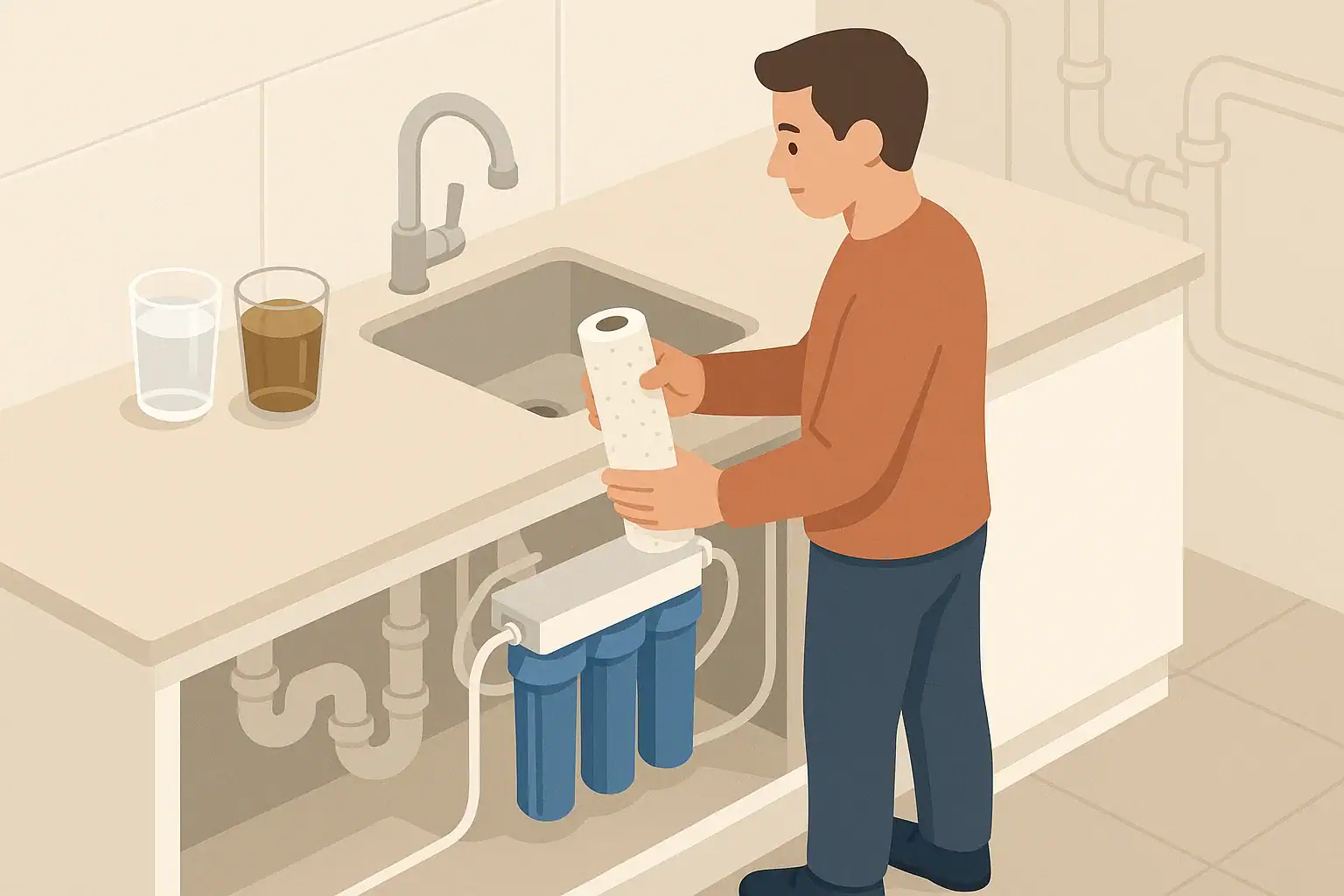
Why Brown Water Happens in the First Place
Brown or discolored tap water is common enough that most homeowners will see it at some point. It can be unsettling, but the cause is usually traceable to either sediment or rust particles moving through your plumbing and into your fixtures.
Understanding the difference between sediment and rust helps you:
- Narrow down where the problem is coming from (city lines, well, or in-house plumbing)
- Decide whether it is likely temporary or ongoing
- Choose an appropriate filtration or maintenance approach
This article focuses on visual and practical clues you can use at home. It does not replace professional water testing or plumbing inspection, but it can help you make more informed decisions about next steps.
Sediment vs Rust Particles: The Core Differences
Sediment and rust particles can both create brown, yellow, or orange water, but they come from different sources and behave differently in water.
What Is Sediment in Tap Water?
Sediment is a broad term for small solid particles suspended in water. In home plumbing, this may include:
- Sand and silt from wells or disturbed water mains
- Fine soil or clay particles
- Debris from aging pipes or construction activities
Sediment problems are especially common on private wells, but they can also occur on municipal systems after main breaks, hydrant flushing, or repairs.
What Are Rust Particles?
Rust particles are tiny fragments of iron corrosion from steel or iron plumbing components. Common sources include:
- Old galvanized steel or iron water lines
- Steel well casings or drop pipes
- Water heaters with corroding interior surfaces
Rust is essentially oxidized iron. When the interior of a metal pipe corrodes, flakes or fine particles can break loose and flow to your tap, creating orange-brown coloration.
How They Differ in Everyday Terms
In practice, you can think of the difference this way:
- Sediment = general grit, dirt, or sand-like material in water
- Rust = iron-based corrosion from metal surfaces, often creating a more orange-brown tint
Both can be present at the same time, but identifying which is dominant can guide your filtration choices.
Example values for illustration.
| Observation | More Typical of Sediment | More Typical of Rust Particles |
|---|---|---|
| Color in a clear glass | Tan, yellow, or cloudy with visible specks | Orange-brown or tea-colored tint |
| Feel of residue when dried | Gritty, sandy, may scratch surfaces | Fine, powdery, can smear into reddish stain |
| Behavior after sitting 1–2 hours | Heavier particles often sink clearly to bottom | Fine haze may stay suspended or form light layer |
| Common source locations | Wells, disturbed mains, construction nearby | Old iron or steel pipes, aging water heater |
| Effect on fixtures | Can clog aerators and shower heads | Leaves reddish-brown staining over time |
| Typical filtration response | Mechanical sediment filter (e.g., cartridge) | Iron/rust-focused filtration or pipe replacement |
This table is for general guidance and does not replace lab testing or professional inspection.
Visual and Simple At-Home Checks
You can gather useful information with a few low-risk, non-invasive checks using clear glasses, white paper, and basic observation. These do not provide definitive lab results, but they help you frame the problem.
Check 1: Color and Clarity in a Clear Glass
Run cold water from the problem tap for a short time, then fill a clear glass and hold it up to good light over a white background.
Notice:
- Color – yellowish, tan, orange-brown, or gray
- Clarity – clear-colored, cloudy, or with floating particles
- Uniformity – even tint or visible specks and streaks
Sediment-heavy water often looks cloudy with visible specks, while rust-heavy water can look more like a uniform tea-colored tint, sometimes with very fine particles.
Check 2: Let It Settle
Set the glass aside, undisturbed, for one to two hours.
Afterward, look for:
- Layer at the bottom – suggests heavier sediment such as sand or grit
- Fine haze suspended – can be very fine sediment or rust particles
- Clearer water at the top – indicates solids are settling out
If a clear layer forms on top with noticeable material at the bottom, basic sediment filtration is often part of the solution. If the whole glass remains colored with little settling, dissolved or very fine iron may be involved and may need different treatment.
Check 3: Wipe Test on a White Surface
Allow a small sample to dry on a clean, white, non-porous surface (such as a white plate). Once dry, gently wipe with a finger or tissue.
Notice whether the residue is:
- Gritty and scratchy – suggests sand or mineral sediment
- Fine and reddish-brown – more typical of rust particles
- Gray or multi-colored specks – mixed sediment and pipe debris
This simple test gives a feel for what is physically in the water without special tools.
Where in the Plumbing the Brown Water Starts
Location clues are often as important as what the water looks like. Pay attention to when and where the discoloration occurs.
Is It Only Hot Water or Both Hot and Cold?
- Only hot water is discolored: often points toward sediment or rust buildup inside the water heater. Flushing the heater or evaluating its age and condition may be appropriate.
- Both hot and cold are discolored: indicates an issue occurring before the water heater, such as incoming supply lines, well equipment, or municipal mains.
Is It One Fixture or the Whole House?
- One faucet or bathroom: can indicate localized pipe corrosion or a fixture-specific issue such as trapped debris in the supply line or aerator.
- Multiple fixtures or entire home: suggests a problem near the point of entry, at the well, or from the municipal line feeding your home.
If you are on city water and neighbors also see brown water at the same time, the cause may be utility line flushing, main breaks, or nearby construction disturbing long-settled deposits.
Does It Clear After Running the Tap?
- Clears after running for a short time: often indicates a temporary disturbance, such as stirred-up sediment in your household plumbing or service line.
- Stays consistently discolored: suggests a more constant source like ongoing corrosion, continuous sediment intrusion, or well issues.
Make note of how long it takes to clear, if it clears at all, and whether the discoloration returns quickly after the tap is off for a while.
Common Sources of Sediment in Brown Water
Once you suspect sediment, think about how it might be entering your system. The likely sources differ between well and municipal water.
Private Well Water
Sediment in well water may come from:
- Natural formation materials – sand and silt drawn up with the water
- Well screen or casing issues – damage or wear letting formation material enter the well
- Pump placement – a pump set too low can draw in more sediment
Changes in groundwater level, pump cycling, or nearby construction can shift how much sediment appears at your tap.
Municipal Water Systems
On city water, sediment can arise when long-settled materials in water mains are disturbed. Triggers include:
- Hydrant flushing programs
- Main breaks or repairs
- Construction that changes flow patterns
These events typically cause temporary discoloration. Utilities often recommend running cold taps for a period until water clears. Persistent or severe issues may warrant contacting the water provider for information and possible sampling.
In-House Sediment Sources
Even if incoming water is reasonably clear, your own plumbing can contribute:
- Scale and debris breaking loose from old pipes
- Accumulated material in water heater tanks
- Disintegrating rubber washers or internal parts in valves
These sources often show up as occasional bursts of brown water, clogged aerators, or debris caught in faucet screens.
Common Sources of Rust Particles
If your checks suggest rust, the source is usually iron or steel components that are corroding.
Old Iron or Steel Service Lines
Many older homes still have iron or steel lines bringing water from the street or well to the house. Over time, interior corrosion can build up and eventually flake off, leading to bursts of rust-laden water.
Clues include:
- Building age with original steel or iron plumbing
- Reddish-brown staining in sinks, tubs, or toilets
- Discoloration that appears after periods of no use, then clears
Galvanized Steel Interior Plumbing
Inside the home, older galvanized steel pipes can corrode from the inside out. As the coating breaks down, iron is exposed and rusty scale can form. This scale may eventually release into the water.
In some cases, one branch of plumbing will show more issues than another, depending on pipe material and water usage patterns.
Water Heaters and Rust
Water heaters can contribute rust in two main ways:
- Tank-type heaters – internal steel surfaces and anode rods corrode over time, potentially leading to rust-colored hot water
- Sediment and scale buildup – can trap rust particles, which are then released in bursts when water flow stirs the tank
Rust limited to hot water taps is often related to the heater itself or to the hot-water side of the plumbing.
Filtration and Treatment Options for Sediment and Rust
Once you have a general sense of whether sediment, rust, or both are involved, you can think about basic treatment directions. The goal is usually to reduce particles, protect plumbing and appliances, and improve appearance.
Basic Sediment Filtration
For visible sediment, common approaches include:
- Whole-house sediment filters – installed near where water enters the home; typically use replaceable cartridges with specific micron ratings
- Point-of-use sediment prefilters – under-sink filters or cartridges that protect a single faucet or appliance
- Spin-down or screen filters – often used on wells to catch larger particles before finer filtration
Important considerations:
- Match the filter type and micron rating to the particle size you are actually seeing.
- Size the filter for appropriate household flow rate to avoid excessive pressure drop.
- Plan for regular maintenance; clogged sediment filters can reduce water pressure.
Dealing With Rust and Iron
Rust and iron can appear as particles (visible rust), as dissolved iron that later oxidizes, or both. Options depend on the severity and form:
- Mechanical filters – can capture larger rust flakes and particles.
- Specialty iron filtration media – used in dedicated systems designed to oxidize and filter iron, more common on well water.
- Pipe repair or replacement – may be needed if the main source is severely corroded plumbing.
Because iron behavior depends on pH, oxygen content, and other water chemistry factors, professional testing and advice can be useful, especially on well systems with chronic iron issues.
Role of Carbon Filters and RO Systems
Carbon filters and reverse osmosis (RO) systems are often part of home filtration setups, but they are not primarily designed to handle heavy sediment loads by themselves.
- Carbon filters – mainly target taste, odor, and certain dissolved contaminants. They typically work best when sediment is pre-filtered to avoid clogging.
- Reverse osmosis systems – include prefilters to protect the membrane; excessive sediment or rust can shorten component life and reduce performance if prefiltration is inadequate.
When brown water is driven mainly by particles, a staged approach with a dedicated sediment step is usually more effective than relying only on carbon or RO.
Maintenance Habits That Help Prevent Brown Water Surprises
Some brown water events are unavoidable, especially when utilities work on mains or when groundwater conditions change. Still, routine maintenance reduces how often you see discolored water inside your home.
Regular Sediment Filter and Prefilter Replacement
Any sediment or prefilter cartridge has a limited life. As it captures more particles, it can clog and lose effectiveness.
General practices include:
- Following manufacturer-recommended replacement intervals as a starting point
- Adjusting intervals based on observed pressure drop or visibly dirty cartridges
- Keeping spare cartridges on hand so you can change them promptly
Waiting until water flow is severely restricted can stress pumps and appliances and may allow bypass of fine particles through degraded filter media.
Water Heater Maintenance
Because heaters can accumulate sediment and release rust or discolored water, many homeowners choose to:
- Periodically flush the tank according to manufacturer guidance
- Monitor heater age and performance as part of long-term planning
- Ask a professional to inspect if hot water discoloration or noises become frequent
Monitoring Aerators and Shower Heads
Faucet aerators and shower heads often act as small, unintended filters. If they clog frequently or collect visible debris, it is a sign that upstream filtration or plumbing may need attention.
Cleaning these components can temporarily improve flow, but understanding why they are collecting material is more important for long-term solutions.
Example values for illustration.
| Component | Typical Check Interval (Example) | What to Look For |
|---|---|---|
| Whole-house sediment cartridge | Every 1–3 months | Darkening media, pressure drop, visible debris |
| Under-sink prefilter | Every 3–6 months | Slower flow at faucet, cloudy cartridges |
| Carbon block for taste/odor | Every 6–12 months | Return of tastes/odors, reduced flow |
| Spin-down or screen filter | Inspect monthly | Accumulated sand, silt, or rust flakes |
| Water heater condition | Annual review | Rusty hot water, noises, age of unit |
| Faucet aerators and shower heads | Every 1–3 months | Clogging, trapped grit or rust fragments |
| Well equipment (if applicable) | Annual service | Pump performance, sediment ingress, casing condition |
These intervals are examples only; actual needs depend on your specific water quality, usage, and equipment.
Related guides: Whole House Filters for Iron and Rust: What Works and What Doesn’t • Best Whole House Sediment Filters: Clear Up Cloudy Water • Reverse Osmosis 101: What RO Removes (and What It Doesn’t) • Lead in Tap Water: Practical Steps Before Buying a Filter
When to Seek Testing or Professional Help
While many brown water events are short-lived and reasonably easy to interpret, some situations call for more formal testing or professional evaluation.
Situations Where Testing Is Helpful
Lab or certified testing is often useful when:
- Brown water is persistent or recurring without a clear trigger
- You rely on a private well and have never had a comprehensive water test
- You are planning major plumbing work or filtration system upgrades
- You want specific measurements of iron, manganese, or other parameters to size treatment correctly
Testing can distinguish between dissolved and particulate forms of iron and identify other water characteristics that affect treatment choices.
When to Involve a Plumber or Water Professional
Consider calling a qualified professional when you notice:
- Sudden, severe discoloration persisting after you run water for a reasonable period
- Evidence of leaks, drops in pressure, or noises in plumbing alongside brown water
- Very old metal plumbing with ongoing rust issues
- Repeated clogging of filters and aerators in a short time
A combination of basic at-home observations, appropriate testing, and targeted professional help gives you the best chance of diagnosing whether sediment, rust particles, or both are behind your brown water.
Frequently asked questions
How can I tell quickly whether the brown water is sediment or rust?
Fill a clear glass and observe: gritty particles that settle to the bottom point to sediment; a more uniform orange-brown tint or a fine reddish residue after drying suggests rust. Combine this with checks like whether only hot water is affected.
If brown water clears after running the tap, do I still need to take action?
If it clears after a short time it’s often a temporary disturbance, but repeated events, frequent filter clogging, or staining indicate a need for inspection, filtration changes, or professional assessment.
Is discolored water always a health risk?
Discoloration is primarily an aesthetic and taste issue. Persistent or unexplained brown water, or water from a private well, should be tested before relying on it for drinking or cooking.
What immediate steps can reduce particle problems before getting professional help?
Run cold taps until clear, clean faucet aerators and shower heads, replace or add a sediment prefilter, and check whether the issue is limited to hot water (which points to the water heater).
Recommended next:
- Lead in Tap Water: Practical Steps Before Buying a Filter
- PFAS Removal Options: RO vs Carbon vs Whole House
- VOCs in Water: How Carbon Filters Work
- Pesticides & Herbicides: What Filters Can Reduce Them?
- Nitrates in Well Water: What Filtration Works Best?
- Arsenic Filtration Basics: What to Look For
- More in Contaminants & Removal →
- NSF/ANSI standards explained (42/53/401/58)
- Clear trade-offs: pitcher vs faucet vs under-sink vs RO
- Maintenance planning: cost per gallon and replacement cadence