
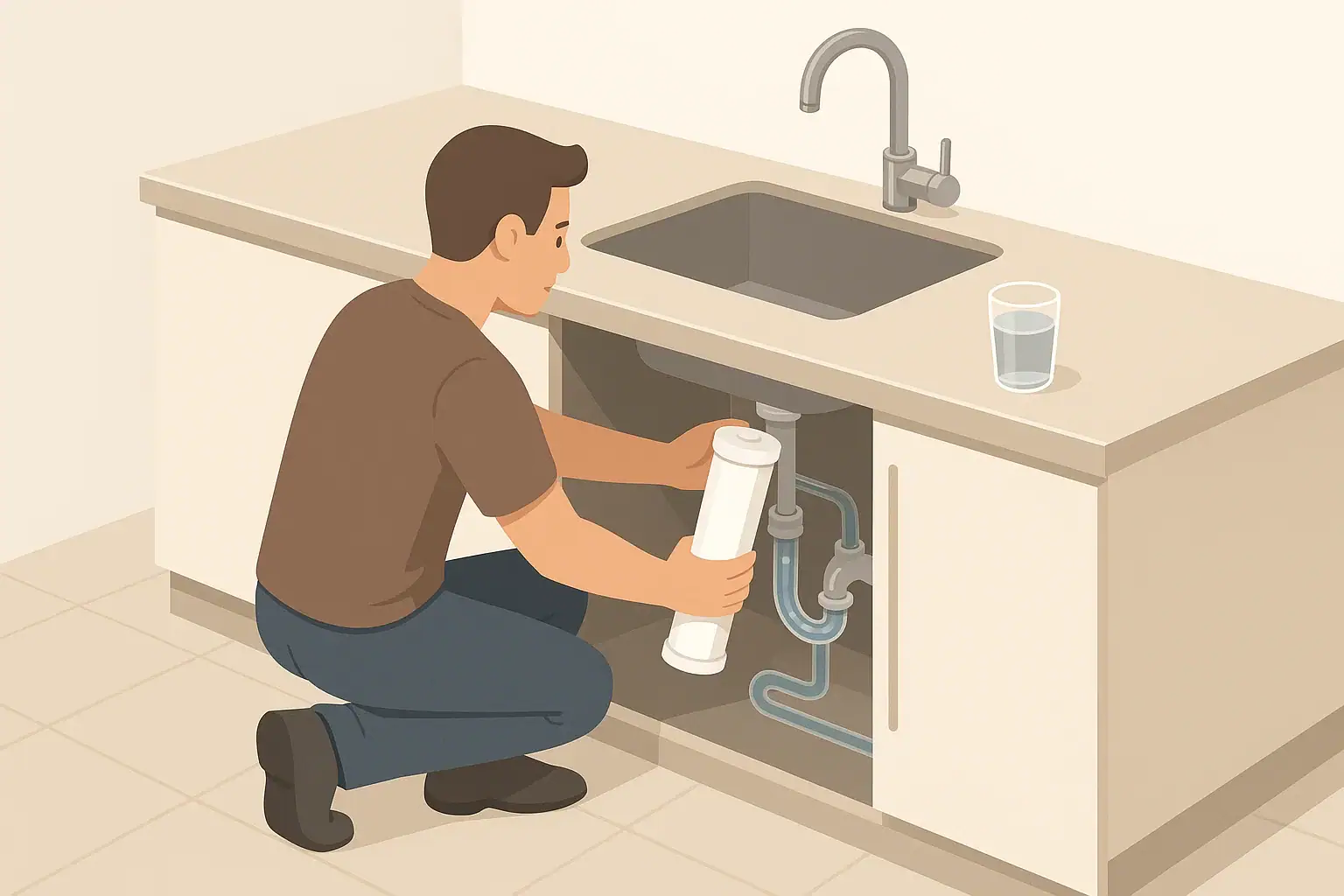
What Are Microplastics in Home Water?
Microplastics are tiny plastic particles that can be found in many environments, including drinking water. They are generally described as plastic pieces smaller than about 5 millimeters, down to sizes that are too small to see with the naked eye. Even smaller particles are often called nanoplastics.
In home tap water, microplastics may come from several sources:
- Wear of synthetic textiles and fibers that reach wastewater
- Breakdown of larger plastic items in the environment
- Fragments and fibers in distribution systems or plumbing
- Atmospheric fallout that eventually reaches water sources
Municipal treatment plants are generally designed to remove many particles and sediments, but they are not specifically optimized for every size and type of microplastic. As a result, some particles may still be present by the time water reaches a household tap.
Home water filtration cannot guarantee complete removal of all microplastics, especially the smallest ones, but certain filter media can help reduce larger fractions. Understanding which media target which size ranges can help you design a realistic, practical setup.
How Microplastic Size Affects Filter Choices
Microplastics vary widely in shape and size. This matters because different filter media are better suited to different particle sizes.
Common size ranges discussed
While exact definitions can differ in research, people often discuss these broad size ranges:
- Visible fragments: hundreds of microns up to several millimeters
- Fine microplastics: roughly 1–100 microns
- Nanoplastics: far below 1 micron, sometimes close to molecular scales
Microfiltration, ultrafiltration, and reverse osmosis membranes each target different parts of this spectrum. Simple sediment filters can also capture larger particles, depending on their micron rating.
Micron ratings and what they really mean
Many filters are labeled with a micron number, such as 5 micron, 1 micron, or 0.5 micron. In broad terms, the smaller the micron rating, the smaller the particles the filter is designed to capture.
However, micron ratings are not all defined in the same way. Labels may use different test methods (such as nominal versus absolute ratings). As a user, you can treat them as a general guide, not a guarantee:
- 5–20 micron: Coarse sediment; good for sand and rust, may catch some larger plastic fragments.
- 1–5 micron: Finer particles; more likely to capture a larger share of visible microplastic pieces and some fibers.
- <1 micron: Very fine particles; used where higher reduction of small particles is desired.
Membrane systems like reverse osmosis and some tight ultrafiltration designs can go far below 1 micron, into ranges where many microplastics are significantly reduced. Still, even those systems are not typically advertised as eliminating every possible particle size.
Example values for illustration.
| Filter type | Typical micron range focus (example) | Main role for microplastics |
|---|---|---|
| Coarse sediment cartridge | 20–50 micron (example) | Catches large plastic fragments and visible debris |
| Fine sediment cartridge | 1–5 micron (example) | Reduces smaller particles and some plastic fibers |
| Carbon block filter | 0.5–5 micron (example) | Combines particle filtration with adsorption of other substances |
| Pleated depth filter | 1–20 micron (example) | High surface area for larger particle loading |
| Ultrafiltration membrane | ~0.01–0.1 micron (example) | Targets very small particles and many microplastics |
| Reverse osmosis membrane | ~0.0001 micron (example) | Strong barrier to dissolved salts and many tiny particles |
| Whole-house sediment + carbon combo | Varies, often 5–20 micron for sediment | Front-line reduction of larger microplastics entering the home |
Numbers shown are broad examples, not specifications for any particular product.
Filter Media That May Help Reduce Microplastics
Several types of filter media commonly used in home systems may help reduce microplastics. Each plays a different role in a multi-stage setup.
Sediment cartridges
What they are: Sediment filters are usually the first stage in a system. They are designed to intercept sand, rust, silt, and other suspended particles.
Why they matter for microplastics:
- They can capture larger plastic fragments and fibers, especially when the micron rating is low (for example, 1–5 microns).
- They protect finer downstream filters from clogging rapidly with debris.
Common forms:
- Spun or melt-blown depth filters: Thickness increases toward the center, so they trap particles throughout the cartridge.
- Pleated filters: Folded material with a large surface area and relatively low pressure drop.
A practical approach is to use a coarser sediment filter at the entry point to the home and finer sediment stages closer to the tap where drinking water is drawn.
Granular activated carbon (GAC)
What it is: GAC is a bed of small carbon granules used for taste, odor, and various organic contaminant reductions.
Role for microplastics:
- GAC is primarily an adsorption medium, not a precision particle filter.
- It may capture some particles by physical entrapment within the bed, but the flow paths between granules are relatively large compared with many microplastic sizes.
In practice, GAC is most useful when combined with dedicated sediment or membrane stages. It should not be relied upon by itself as a focused microplastic barrier.
Carbon block filters
What they are: Carbon block filters compress carbon into a solid or semi-solid block with defined porosity. They are used in many under-sink, refrigerator, and countertop systems.
Why they matter for microplastics:
- They often have a specific nominal micron rating (for example, 0.5–5 microns).
- This allows them to serve as both a chemical reduction stage and a fine particulate filter.
- They can help reduce a portion of microplastics within their particle size range.
Carbon blocks are frequently used as the final stage before the faucet in under-sink systems, where they can tidy up taste and odor while reducing fine particles.
Ultrafiltration (UF) membranes
What they are: Ultrafiltration uses hollow-fiber or similar membranes with very small pores. They are designed to retain many types of suspended solids and some microorganisms while allowing water and smaller molecules to pass.
Why they matter for microplastics:
- UF membranes typically have pore sizes small enough to target many microplastics down into the sub-micron range.
- They operate at line pressure (no separate storage tank is strictly required), though flow rate may be lower than a simple carbon filter.
UF systems are often used as a barrier for suspended particles, including many plastics, while preserving more minerals than reverse osmosis. They can be combined with carbon for taste and odor improvement.
Reverse osmosis (RO) membranes
What they are: RO systems use a semi-permeable membrane and pressure to separate water from many dissolved substances. They are common under the kitchen sink and sometimes in dedicated drinking water stations.
Why they matter for microplastics:
- RO membranes can reject very small particles, including many microplastics and other solids that are far below typical micron ratings of carbon filters.
- In typical residential systems, RO is used along with a sediment prefilter and at least one carbon stage.
RO systems also produce a wastewater stream, so they are usually reserved for drinking and cooking water taps rather than whole-house treatment.
Designing a Practical Home Setup for Microplastic Reduction
There is no single universal configuration, but common home layouts use staged filtration to address both microplastics and other everyday water concerns like taste, odor, and visible particles.
Whole-house entry vs. point-of-use
One decision is whether to focus on:
- Point-of-entry (whole-house): Filters installed where water enters the home.
- Point-of-use (POU): Filters at individual locations such as the kitchen sink, refrigerator, or a dedicated drinking water faucet.
For microplastics, a combination approach is often considered:
- Whole-house sediment and possibly carbon: Helps reduce larger particles, including some microplastics, for all taps.
- POU fine filtration or membrane system: Adds tighter barriers and taste/odor improvement where you drink or cook.
Example stage sequence for city water
For a typical municipal supply, a practical layered sequence might look like this:
- At entry (optional but common):
- Coarse sediment filter (for example, 10–20 micron nominal) to intercept larger particles.
- Optional whole-house carbon stage for chlorine and basic taste/odor improvement.
- At kitchen sink (drinking/cooking):
- Fine sediment or carbon block (for example, 0.5–5 micron nominal).
- Optional ultrafiltration or reverse osmosis membrane if higher reduction of small particles is desired.
- Polishing carbon stage after RO or UF for taste.
Numbers here are only illustrative. Actual choices depend on flow needs, pressure, space, and maintenance preferences.
Example stage sequence for well water
Private wells can vary considerably. If microplastics are a concern (for example, where there is known surface influence or nearby plastic sources), a setup might include:
- Well entry:
- Robust sediment filtration tailored to actual particle load (sometimes in multiple stages from coarse to finer).
- Additional treatment as needed for local issues (such as iron, hardness, or disinfection methods), planned separately from microplastic concerns.
- Point-of-use:
- Carbon block filtration to improve taste and clarity.
- UF or RO where higher reduction of small particles is desired.
Practical Considerations: Flow, Pressure, and Maintenance
Filters that target smaller particles tend to have tighter structures. This can affect flow rate and pressure drop, and how often cartridges need to be changed.
Flow rate and pressure drop
Smaller pores mean more resistance to water flow. In practice:
- Whole-house filters are often kept at coarser micron ratings to maintain good flow for showers, laundry, and multiple fixtures.
- Under-sink or dedicated faucets can use tighter filters (including RO or UF) because the demand is lower and users accept a more modest flow rate for drinking water.
- If pressure is already low in a home, adding several tight filters in series may require careful planning or professional evaluation.
Cartridge life and replacement
Filters that intercept more particles will clog faster. This is especially true if a system has only one fine filter stage doing all the work. Layered designs help by letting a coarser prefilter catch larger debris before water reaches a tight carbon block or membrane.
To keep any microplastic reduction benefit consistent over time, it is important to:
- Follow the manufacturer’s replacement guidelines as a baseline.
- Adjust replacement frequency based on actual water use and observed pressure drop or taste changes.
- Sanitize housings and components as recommended during cartridge changes to avoid microbial growth on captured particles.
What microplastic testing does and does not tell you
Testing for microplastics is more complex than testing for basic water chemistry such as hardness or chlorine. There is not yet a single, simple at-home test that quantifies all microplastic sizes and types.
Some specialized laboratories and research projects analyze microplastics by size or polymer type, but results may not translate directly into consumer filter performance claims. For most households, practical decisions use more general information:
- Understanding typical performance ranges of filter media.
- Using certified filters for other contaminants of concern, when available, while recognizing that certification programs may not yet fully cover microplastics.
- Balancing cost, maintenance, and water use habits.
Example values for illustration.
| Filter stage | Example baseline interval | Signs it may need earlier replacement |
|---|---|---|
| Coarse whole-house sediment (10–20 micron example) | Every 3–6 months (example) | Noticeable drop in whole-house pressure, visible discoloration of cartridge |
| Fine under-sink sediment (1–5 micron example) | Every 3–6 months (example) | Slower flow at drinking faucet, cloudy appearance returns sooner after change |
| Carbon block at drinking tap | Every 6–12 months (example) | Change in taste or odor, reduced flow despite good upstream pressure |
| Ultrafiltration module | Every 12–24 months (example) | Persistent low flow even after prefilters are replaced |
| RO prefilters (sediment + carbon) | Every 6–12 months (example) | RO tank refills slowly, TDS levels at RO faucet rise more quickly than usual |
| RO membrane | Every 2–5 years (example) | Gradual increase in TDS at RO faucet despite fresh prefilters |
| Whole-house carbon (if present) | Every 6–24 months (example) | Return of chlorine taste/odor sooner than expected after a change |
Actual intervals depend on water quality, usage, and specific equipment; follow manufacturer guidance.
Related guides: Sediment vs Rust Particles: Diagnosing Brown Water • PFAS Removal Options: RO vs Carbon vs Whole House • VOCs in Water: How Carbon Filters Work
Key Takeaways for Homeowners
Microplastics are a broad and evolving topic. While research continues, homeowners can take practical steps with established filtration technologies:
- Use sediment filters to catch larger plastic fragments and protect finer stages.
- Rely on carbon block filters for combined taste improvement and fine particulate reduction within their rated range.
- Consider UF or RO membranes at key drinking water points if you want stronger barriers to many small particles, including many microplastics.
- Layer stages from coarse to fine to maintain flow, protect equipment, and keep replacement intervals reasonable.
- Maintain filters on schedule so that any microplastic reduction benefit remains consistent over time.
This approach keeps the focus on practical, manageable filtration choices rather than chasing absolute removal claims, while still using existing technologies in ways that may help with microplastic reduction.
Frequently asked questions
Can a home filter remove all microplastics?
No. Household filters can reduce many microplastics in specific size ranges, but none guarantee removal of every particle. Combining sediment, carbon, UF, or RO stages improves overall reduction for larger and smaller fractions.
Where should I place sediment and fine filters in a home system?
Use coarser sediment filters at the home entry to catch large debris and protect plumbing, and install finer sediment or carbon block stages at point-of-use taps (like the kitchen) for drinking and cooking water.
How often should filters be replaced to keep reducing microplastics?
Follow manufacturer guidelines as a baseline and replace sooner if you notice reduced flow, pressure drops, or taste changes. Layered setups with prefilters help extend the life of finer stages.
Is testing my tap water for microplastics practical for homeowners?
Routine microplastic testing is complex and not widely available for consumers. For most households, focus on selecting appropriate filter media for the particle sizes of concern and maintaining the system; consider specialized lab testing only if there is a specific reason.
Recommended next:
- Lead in Tap Water: Practical Steps Before Buying a Filter
- PFAS Removal Options: RO vs Carbon vs Whole House
- VOCs in Water: How Carbon Filters Work
- Pesticides & Herbicides: What Filters Can Reduce Them?
- Nitrates in Well Water: What Filtration Works Best?
- Arsenic Filtration Basics: What to Look For
- More in Contaminants & Removal →
- NSF/ANSI standards explained (42/53/401/58)
- Clear trade-offs: pitcher vs faucet vs under-sink vs RO
- Maintenance planning: cost per gallon and replacement cadence