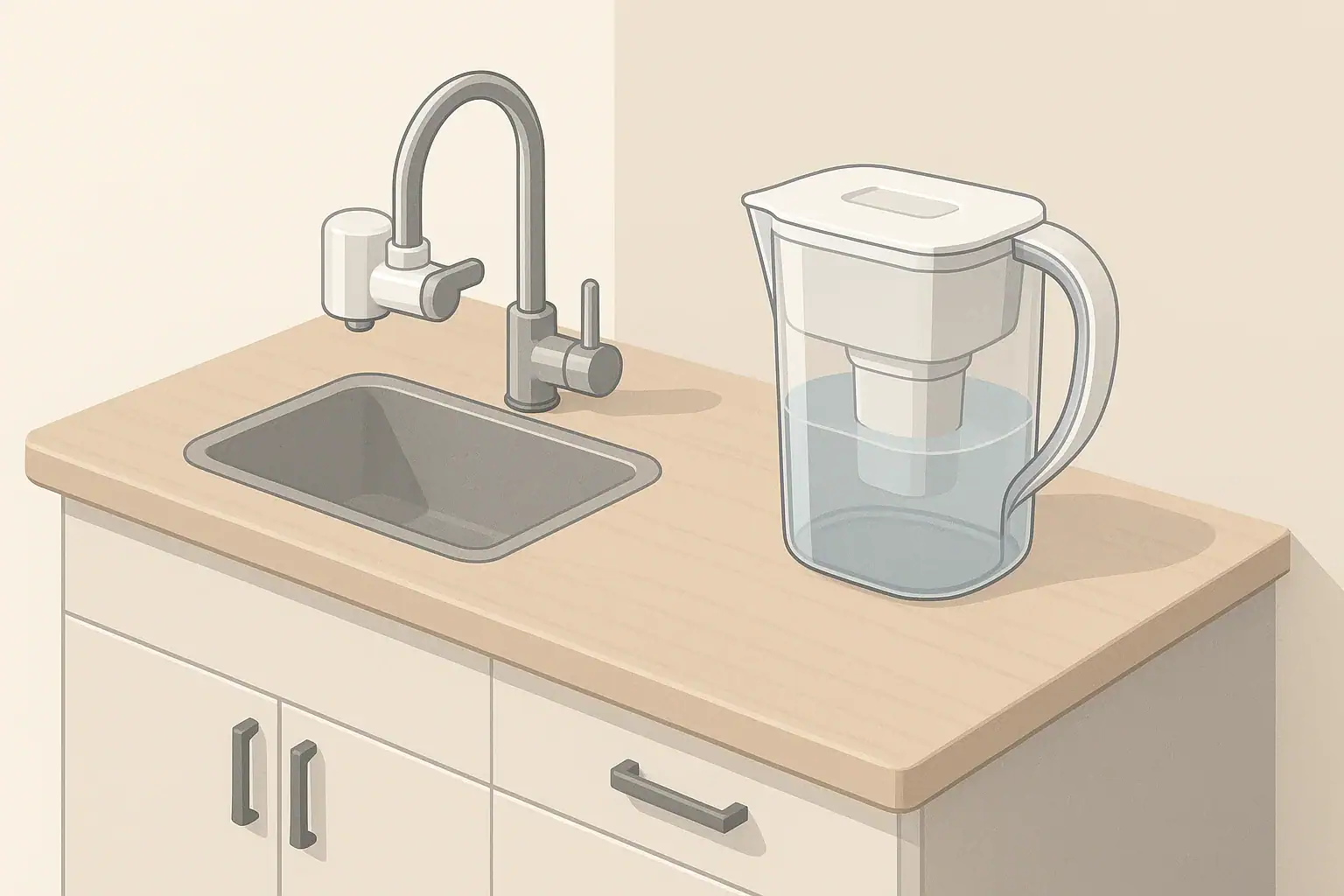
In a small kitchen, every inch of counter and sink space matters. Choosing between a pitcher filter and a faucet-mount filter is not just about water taste. It also affects how crowded your counters feel, how easily you can cook and clean, and how often you need to maintain the system.
Both pitcher and faucet-mount filters are popular in apartments, condos, and older homes where under-sink modifications are not always allowed. They are usually affordable, require no major plumbing changes, and can improve taste and odor from municipal tap water, especially where chlorine is noticeable.
Understanding how each style fits into a small kitchen can help you decide which trade-offs make the most sense for your household.
Why Small Kitchens Need Careful Filter Choices
In a small kitchen, every inch of counter and sink space matters. Choosing between a pitcher filter and a faucet-mount filter is not just about water taste. It also affects how crowded your counters feel, how easily you can cook and clean, and how often you need to maintain the system.
Both pitcher and faucet-mount filters are popular in apartments, condos, and older homes where under-sink modifications are not always allowed. They are usually affordable, require no major plumbing changes, and can improve taste and odor from municipal tap water, especially where chlorine is noticeable.
Understanding how each style fits into a small kitchen can help you decide which trade-offs make the most sense for your household.
How Pitcher Filters Work in a Small Kitchen
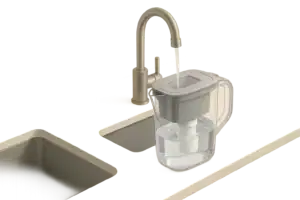
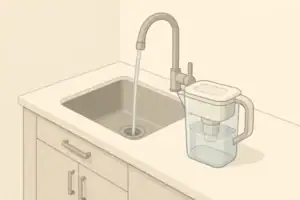
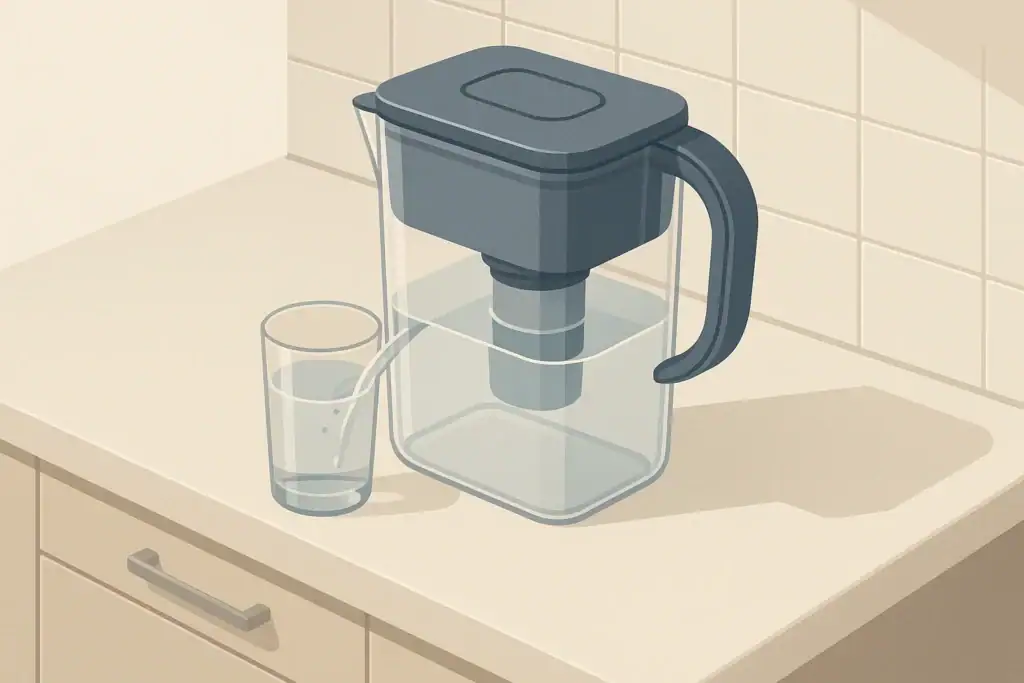
A pitcher filter is a container with a built-in cartridge that water passes through by gravity. You fill a top reservoir from the tap, the water flows through the filter media, and collects in the lower chamber, ready to pour.
Space and Storage Considerations
In a tight kitchen, where you place the pitcher matters as much as its filtration performance.
- Counter space: A full-size pitcher can occupy a noticeable portion of a small counter. If your prep area is limited, this can feel cramped.
- Fridge space: Many people store filtered pitchers in the refrigerator. In small fridges, the footprint of the pitcher competes with food storage.
- Cabinet fit: Some households keep the pitcher in a cabinet when not in use. Height and handle shape can make this awkward in shallow shelves.
Everyday Convenience
Pitchers are simple to use, but they do require a bit of planning.
- Filling and waiting: You need to refill the reservoir and wait for water to pass through. In some designs, this can take a few minutes, especially as the filter loads with sediment over time.
- Serving capacity: Once the lower chamber is empty, you cannot pour filtered water again until more has passed through.
- Portability: Pitchers move easily between the sink, counter, and table. This can be helpful if you drink water in different rooms.
Filtration Basics and Certifications
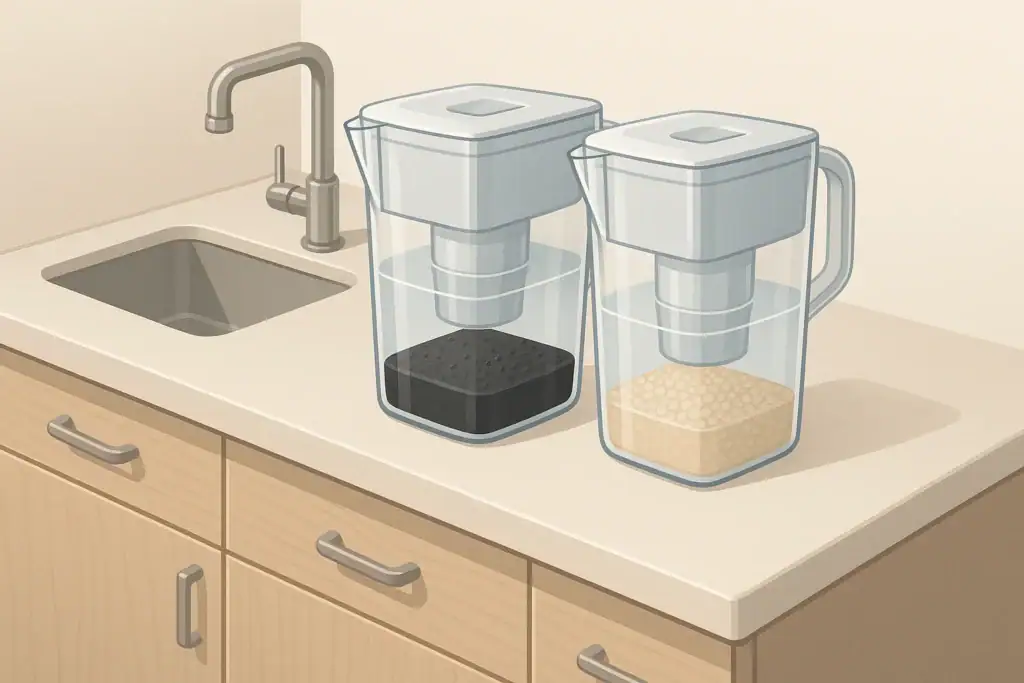
Pitcher filters typically use activated carbon and sometimes ion-exchange or other media. Many are designed to reduce chlorine taste and odor and may also address certain metals or other contaminants, depending on the cartridge.
When comparing pitchers, look for NSF/ANSI certification markings on packaging or documentation rather than relying on marketing terms. Common standards include:
- NSF/ANSI 42: For aesthetic effects such as chlorine taste and odor reduction and particulate reduction.
- NSF/ANSI 53: For reduction of specific health-related contaminants such as certain heavy metals or volatile organic compounds (VOCs).
- NSF/ANSI 401: For reduction of selected emerging contaminants, such as some pharmaceuticals and chemicals that may be present at trace levels.
Not every pitcher is certified to all standards. Always review the performance data sheet to see which contaminants have been tested and verified.
Maintenance and Filter Life
Pitcher filters rely on regular cartridge changes and basic cleaning.
- Filter cartridge: Most pitcher cartridges are rated for a fixed number of gallons or months, whichever comes first. The actual life depends on water quality and how much you use.
- Body cleaning: The pitcher body and lid should be washed periodically to prevent buildup and maintain clarity. Many households wash them along with dishes on a routine schedule.
- Flow slowdown: As the cartridge fills with particles, flow through the media can slow, increasing wait time after filling the reservoir.
Example values for illustration.
| Factor | Pitcher Filter | Faucet-Mount Filter |
|---|---|---|
| Typical space impact | Uses counter or fridge shelf area | Occupies space at faucet, leaves counters open |
| Installation effort | No installation; fill and use | Attaches to faucet; may need basic adapter |
| Best for | Renters who want zero hardware changes | Users who need on-demand filtered water at the sink |
| Flow style | Batch gravity filtration | Filtered stream directly from tap |
| Impact on fridge space | May displace food items | No direct impact |
| Suitability for cooking water | Requires filling pot from pitcher | Filter directly into pots at the sink |
How Faucet-Mount Filters Fit a Small Kitchen
faucet-mount filter connects directly to the end of the kitchen faucet. When you turn the diverter or switch, water passes through the filter media before leaving the spout. Many models also allow you to bypass the filter for tasks such as washing dishes.
Space and Layout Considerations
For small kitchens, faucet-mount filters trade counter space for faucet clearance.
- Counter space: These systems free up counter and fridge space because the filter is suspended at the faucet.
- Sink access: In tight sinks, a bulky filter housing can reduce clearance for tall pots or large pans under the faucet.
- Faucet compatibility: Some decorative or pull-down spray faucets are not compatible with faucet-mount filters. Always check whether your faucet has a removable aerator and standard threads.
On-Demand Convenience
One of the main advantages of faucet-mount filters is immediate access to filtered water for both drinking and kitchen tasks.
- Continuous flow: Instead of filling a reservoir and waiting, you get filtered water as long as the filter is in the “on” position and within its flow limits.
- Cooking and rinsing: It is easy to fill a large pot or rinse produce with filtered water directly from the tap.
- Bypass option: Most faucet-mount designs let you switch to unfiltered mode for washing dishes or cleaning, which helps extend filter life.
Filtration Basics and Certifications
Faucet-mount filters often combine activated carbon with other media, similar to many pitchers, but they operate under tap pressure rather than gravity alone. This can allow for different flow characteristics and sometimes different contaminant reduction claims.
As with pitchers, check for independent certification rather than general statements. Typical standards to look for include:
- NSF/ANSI 42: For reduction of chlorine taste and odor and certain particulates, improving overall taste and clarity.
- NSF/ANSI 53: For specific contaminants such as certain metals, some organic chemicals, or other listed substances.
- NSF/ANSI 401: For selected emerging contaminants, if applicable to the particular model.
The system’s performance data sheet should list exactly which substances were tested and to which standard. This is more reliable than broad marketing phrases like “advanced filtration.”
Maintenance and Filter Life
Faucet-mount filters have replaceable cartridges inside the housing at the end of the faucet.
- Cartridge changes: Replacement schedules are typically based on an approximate gallon rating or a set number of months. Households that cook frequently or have multiple users may reach the gallon limit sooner.
- Flow changes: A noticeable drop in flow rate when the filter is engaged can indicate that the cartridge is nearing the end of its life or is clogged by sediment.
- External cleaning: Because the unit is near splashes and soap, it benefits from periodic wiping to prevent buildup on the housing and diverter control.
Comparing Performance: What Matters Beyond Taste
Both pitcher and faucet-mount filters are often chosen to improve taste and remove the smell of chlorine. However, performance differences can matter when you consider your local water conditions and usage patterns.
Understanding Your Water
Before choosing a filter type, it helps to understand a few basic water metrics and potential contaminants:
- Total dissolved solids (TDS): A general indicator of dissolved minerals and salts. Many carbon-based filters, including pitchers and faucet-mounts, do not dramatically change TDS, even if taste improves.
- Hardness: Related to calcium and magnesium. Pitcher and faucet-mount systems may slightly affect hardness if they use specific media, but are not typically full softening systems.
- pH and turbidity: These affect how water interacts with plumbing and how cloudy it appears. Some filters can reduce turbidity (suspended particles) to improve clarity.
- Common municipal additives: Chlorine or chloramine are often used for disinfection. Many carbon-based filters target chlorine taste and odor; chloramine reduction depends on the specific media and certification.
- Potential contaminants: Households might be concerned about substances such as lead from plumbing components, PFAS, certain VOCs, or microplastics. For these, performance data and certifications become especially important.
NSF/ANSI Standards as a Comparison Tool
Instead of focusing only on whether a system is a pitcher or faucet-mount, you can compare options by which NSF/ANSI standards they meet and which specific contaminants they are certified to reduce.
Points to consider:
- Some pitcher filters are certified only to NSF/ANSI 42 for taste and odor, while others may add NSF/ANSI 53 or 401 claims.
- Some faucet-mount filters are designed with a broader range of claimed contaminant reductions, but this is not guaranteed; check each model.
- Certification does not mean a filter removes everything; it only covers the contaminants and performance levels stated in the official documentation.
Flow Rate and Practical Use
From a usability standpoint, the way water moves through each system matters in daily life:
- Pitchers: Gravity filtration can feel slow if you frequently use large volumes. Users often manage this by refilling the pitcher after each use so it is ready later.
- Faucet-mounts: These depend on household water pressure. If pressure is low or the cartridge is nearing replacement, the filtered stream can be slower than the unfiltered mode but still continuous.
Neither style is designed to deliver very high flow rates like whole-house systems. For heavy kitchen use, some households pair a high-capacity under-sink or reverse osmosis system with a dedicated tap instead. In very small kitchens, however, pitchers and faucet-mounts remain popular because of their compact, accessible installation.
Space, Lifestyle, and Cost: Which Fits Your Kitchen Best?
For small kitchens, the choice between pitcher vs faucet-mount usually comes down to how you use your sink and counters, plus your tolerance for minor installation steps.
Space Trade-Offs in Tight Layouts
Think about where you feel the most crowding today.
- If counter space is scarce: A faucet-mount filter may be more comfortable because it keeps the counter clear. This is especially true in galley kitchens where there is just one narrow prep surface.
- If sink space is tight: A bulky faucet filter can interfere with tall pots or baking sheets. In that case, a pitcher that lives in the fridge might be less intrusive.
- If fridge space is limited: A large pitcher competes with food storage. A faucet-mount filter avoids this entirely.
Daily Habits and Household Size
Your routines and number of users also influence which system feels easier.
- Small households with lower use: A pitcher can be sufficient if you mainly need drinking water and occasional small amounts for coffee or tea.
- Larger households or frequent cooks: Faucet-mount filters often feel more convenient for quickly filling pots, rinsing produce with filtered water, and refilling water bottles throughout the day.
- Guests and shared spaces: Pitchers are self-explanatory to visitors, but a faucet diverter may require a quick explanation about which position is filtered.
Upfront and Ongoing Costs
Both pitcher and faucet-mount systems are generally on the lower end of the cost range compared with under-sink or whole-house filtration. However, ongoing cartridge replacement is an important part of budgeting.
- Upfront purchase: Pitchers often have a similar or slightly lower initial cost compared with faucet-mount systems, depending on design complexity.
- Filter replacement cost per gallon: You can estimate cost per gallon by dividing the cost of a replacement cartridge by its rated gallon capacity. For example, if an illustrative cartridge cost is 20 units of currency and the rated capacity is 100 gallons, the nominal cost per gallon would be 0.2 units. Example values for illustration only.
- Usage intensity: In busy kitchens, you may replace cartridges more frequently than the calendar estimate, making the per-gallon cost more important than the upfront system price.
Choosing Based on Install Limits and Flexibility
Renters and people in older buildings often face restrictions on plumbing changes. Both system types are typically considered non-permanent, but there are still some practical limits.
If You Cannot Change Plumbing
Pitchers are usually the easiest option where any hardware change is discouraged.
- No tools: Pitchers require no tools, no threading parts on and off, and no landlord approval in most cases.
- Moving frequently: Pitchers pack easily and work in any kitchen with a sink or a bathroom tap that can fill them.
Faucet-mount units are still often renter-friendly, but:
- You may need to keep the original aerator in a safe place to reinstall later.
- Some building managers prefer that residents avoid attaching devices to decorative fixtures. It is best to confirm rules in advance.
Compatibility Checks for Faucet-Mount Filters
Before selecting a faucet-mount filter, verify a few basics on your existing faucet:
- Removable aerator: Confirm that the tip of your faucet unscrews to reveal threads.
- Thread type: Many kitchen faucets have either internal or external threads in common sizes. Adapters are usually provided, but some specialty faucets are not compatible.
- Pull-down sprayers: Many pull-down or pull-out spray faucets cannot support a faucet-mount filter at the spray head. In these cases, a pitcher may be the simpler choice.
Flexibility Over Time
Consider whether you plan to upgrade or change your filtration approach in the future.
- Starting simple: Some households begin with a pitcher, then move to a faucet-mount or under-sink system if they find they need more capacity or convenience.
- Combining solutions: In a small kitchen, a common pattern is using a faucet-mount filter for general kitchen use and a smaller pitcher in the refrigerator for chilled water.
Planning Certifications, Maintenance, and Troubleshooting
Whichever style you choose, the long-term success of a small-kitchen filtration setup depends on tracking certifications, sticking to a maintenance schedule, and recognizing simple issues early.
What NSF/ANSI Certifications Mean in Practice
Certification labels can help you compare filters that look similar but perform differently.
- NSF/ANSI 42: Focuses on aesthetic aspects such as chlorine taste and odor and some particulates. Many basic pitcher and faucet systems fall under this category.
- NSF/ANSI 53: Applies to filters that are tested for specific contaminants, which may include some heavy metals or other substances of concern.
- NSF/ANSI 401: Addresses certain emerging contaminants in drinking water, such as some pharmaceuticals or chemicals found at trace levels.
- NSF/ANSI 58: Primarily related to reverse osmosis systems, included here for context within broader water filtration decisions.
In a small kitchen, where you might prefer compact solutions, NSF/ANSI 42 and 53 are the most commonly encountered standards on pitcher and faucet-mount packaging.
Example values for illustration.
| Standard | General focus | What to verify on documents |
|---|---|---|
| NSF/ANSI 42 | Aesthetic improvements (taste, odor, particulates) | Which specific aesthetic claims are certified (for example, chlorine taste and odor) |
| NSF/ANSI 53 | Selected contaminants of concern | List of contaminants tested (such as specific metals or organic compounds) |
| NSF/ANSI 401 | Selected emerging contaminants | Exactly which emerging compounds were evaluated and under what conditions |
| NSF/ANSI 58 | Reverse osmosis system performance | Inclusion mainly relevant if comparing with RO systems, not most pitchers or faucet-mounts |
| Performance data sheet | Detailed claims and limits | Service life, capacity, and any conditions or notes about influent water quality |
| Third-party mark | Proof of independent testing | Name or mark of the certifying body and matching model numbers |
Putting It All Together for a Small Kitchen
Pitcher and faucet-mount filters both offer compact ways to improve the taste, odor, and clarity of tap water without major installations. For very limited counters or fridges, a faucet-mount system can free up space while delivering on-demand filtered water. For unusual faucets, strict rental rules, or those who prefer a completely movable option, a pitcher can be simpler.
In the end, the better choice for your small kitchen depends on where space feels tightest, how often you cook and refill, which certifications match your water concerns, and how much routine maintenance you are willing to perform. Evaluating these factors side by side will help you select a system that fits smoothly into your daily routine while making the most of a compact kitchen layout.
Frequently asked questions
Will a pitcher or faucet-mount filter remove lead from my tap water?
Some pitcher and faucet-mount filters can reduce lead, but only if the specific model has been tested and certified for lead reduction, typically under NSF/ANSI 53. Always check the performance data sheet or certification label to confirm lead reduction before relying on any unit for that purpose.
How often should I change cartridges for pitchers vs faucet-mount filters in a small household?
Change intervals depend on the cartridge’s rated capacity and your local water quality; many filters are rated for a set number of gallons or months. In a small household with light use, cartridges may last several months, but heavy use or high sediment levels will shorten cartridge life, so monitor flow and follow the manufacturer’s guidance.
Can a faucet-mount filter fit on a pull-down or spray kitchen faucet?
Often not; many pull-down or pull-out sprayer heads lack standard threads or cannot support a faucet-mounted housing, making them incompatible. Verify that your faucet has a removable aerator and compatible thread type before choosing a faucet-mount model.
Which option is better for filling large pots for cooking in a small kitchen?
Faucet-mount filters are generally better for filling large pots directly at the sink because they provide on-demand filtered water without repeated refills. However, if the mounted housing blocks clearance for tall cookware or your faucet is incompatible, using a pitcher to fill pots may be a more practical choice.
Do pitcher or faucet-mount filters affect water hardness or total dissolved solids (TDS)?
Most carbon-based pitcher and faucet-mount filters do not significantly change water hardness or TDS, though they can improve taste and reduce chlorine and certain contaminants. Some cartridges include ion-exchange media that reduce specific ions, but these are not substitutes for a dedicated water softener or a reverse osmosis system.
Recommended next:
- Best Pitcher Water Filters for Better-Tasting Tap Water (Chlorine Focus)
- Pitcher Filter vs Bottled Water: Cost per Gallon Breakdown
- How Often Should You Replace Pitcher Filters? (By Household Size)
- TDS in Pitcher-Filtered Water: What Changes and What Doesn’t
- Pitcher Filters for Renters: What to Look For (Capacity + Fridge Fit)
- Pitcher Filter Maintenance: Cleaning & Sanitizing Without Off-Flavors
- More in Pitcher Filters →
- NSF/ANSI standards explained (42/53/401/58)
- Clear trade-offs: pitcher vs faucet vs under-sink vs RO
- Maintenance planning: cost per gallon and replacement cadence