Understanding TDS in Home Tap Water
Total dissolved solids (TDS) is a broad measure of everything dissolved in water that is not pure H2O. It is usually expressed in parts per million (ppm) or milligrams per liter (mg/L), which are numerically equivalent for most home uses.
In typical US tap water, TDS includes a mix of:
- Minerals such as calcium, magnesium, sodium, and potassium
- Bicarbonates, chlorides, and sulfates from natural sources and treatment processes
- Very small amounts of metals like iron, copper, or zinc
- Trace organic material from natural and human sources
Common household TDS meters are simple conductivity-based devices. They estimate how well water conducts electricity and convert that into a TDS reading. They do not identify specific contaminants or distinguish between helpful minerals and unwanted substances.
Because of this, TDS is best used as a general indicator of dissolved content, not as a direct measure of safety or contamination. A high or low TDS value by itself does not say whether water meets local drinking water standards.
What Pitcher Filters Actually Do
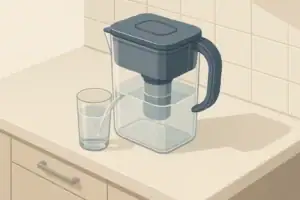
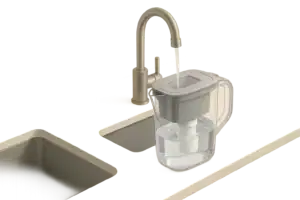
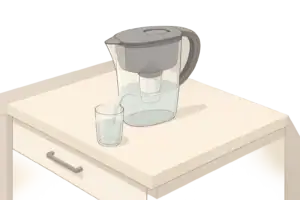
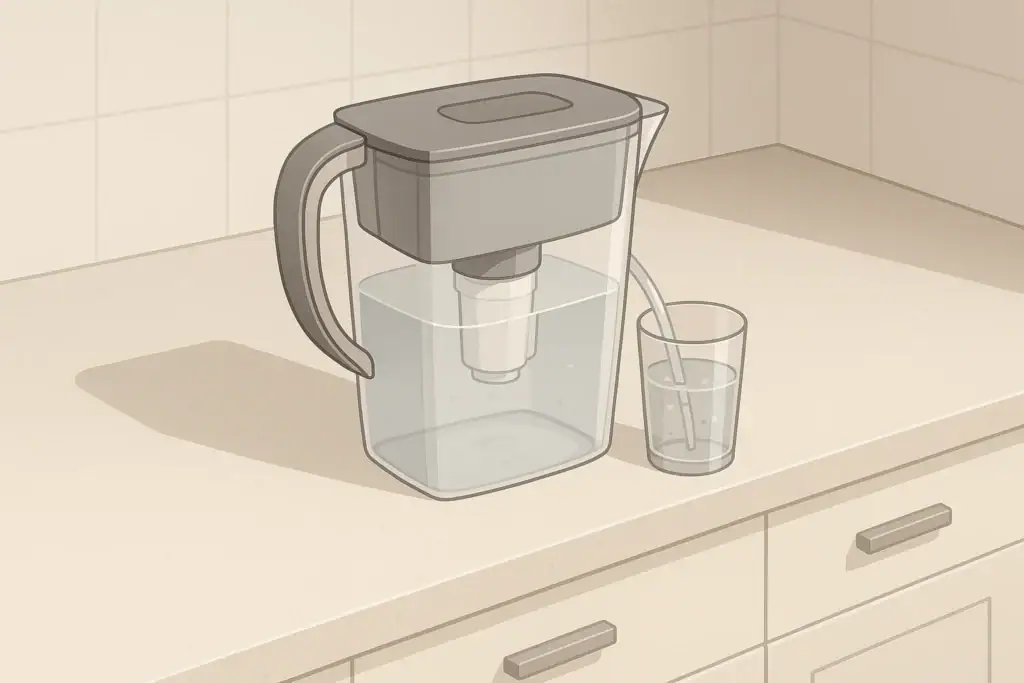
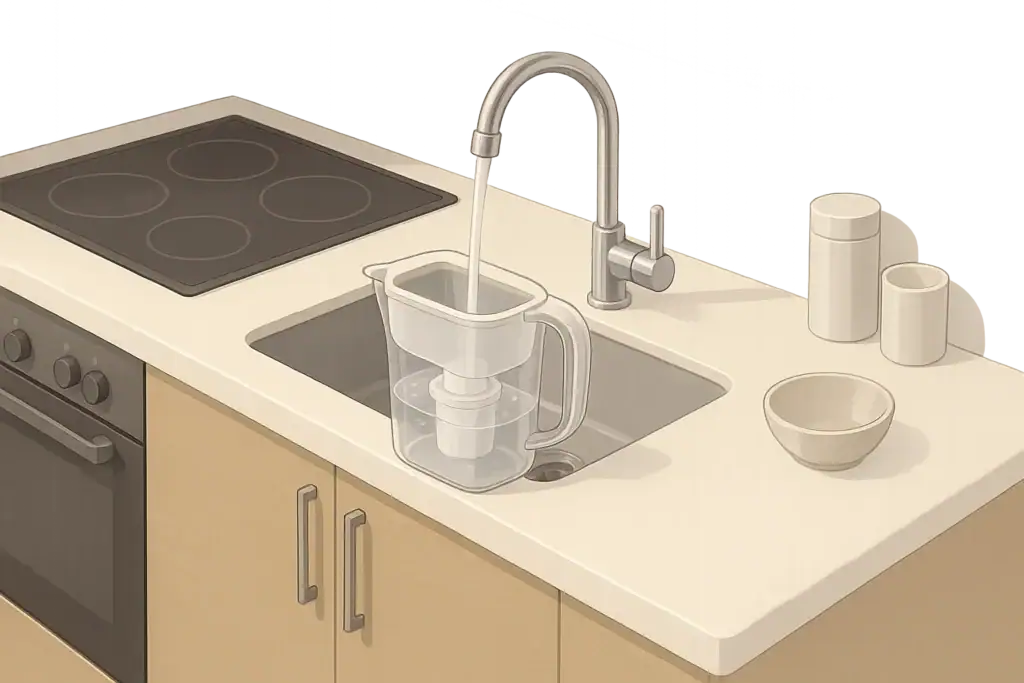
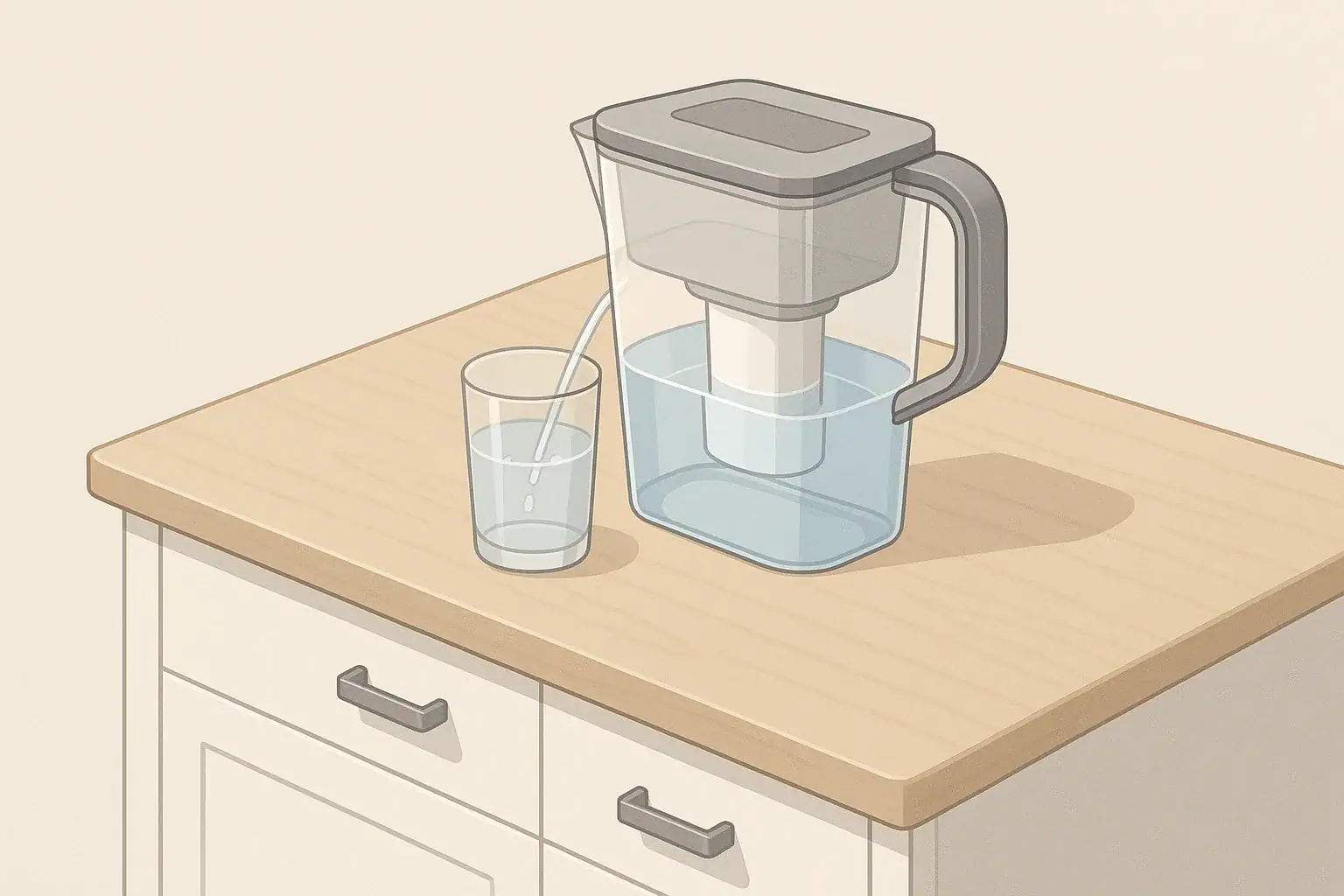
Pitcher filters are gravity-fed systems that typically use a combination of mechanical and adsorption media to improve taste and appearance. They are popular because they are simple, portable, and easy to maintain if cartridges are replaced on schedule.
Most pitcher filters combine several functions:
- Mechanical filtration (often a fine mesh or porous material) to capture sediment and visible particles
- Activated carbon to reduce chlorine, some taste- and odor-causing compounds, and many common household volatile organic compounds (VOCs)
- Additional media in some designs (such as ion-exchange resins or specialty adsorbents) to help target specific dissolved ions or metals
However, pitcher filters are not reverse osmosis systems and are not designed to strip out most dissolved minerals. Their primary goals are:
- Improve taste and odor (especially from chlorine or earthy flavors)
- Improve clarity by removing fine particles
- Reduce selected contaminants (depending on the specific media and certifications)
From a TDS perspective, this means that a pitcher filter can sometimes change the reading, but it may also leave TDS largely unchanged while still improving taste and odor.
Example values for illustration.
| Water type | Typical TDS outcome | What usually changes | Common everyday use |
|---|---|---|---|
| Municipal tap (unfiltered) | Baseline TDS (for example, 100–500 ppm) | Varies by source; minerals, treatment byproducts, trace metals | General household use, cooking, bathing |
| Pitcher-filtered municipal water | Often similar or moderately lower TDS | Chlorine, some organics, some metals reduced | Drinking, coffee, tea, ice |
| Hard well water (unfiltered) | Often higher TDS (for example, >300 ppm) | High calcium and magnesium, possible iron or manganese | General use where hardness is tolerable |
| Pitcher-filtered hard well water | May change slightly if ion-exchange media is present | Some hardness ions, off-tastes, and odors reduced | Drinking and cooking where full softening is not required |
| Reverse osmosis (RO) water | Substantially reduced TDS (often <50 ppm) | Most dissolved minerals and many contaminants reduced | Situations where low-mineral water is preferred |
| Remineralized RO water | Moderate TDS, depending on added minerals | Some minerals intentionally reintroduced | Drinking and specialty beverage preparation |
What Changes About TDS With a Pitcher Filter
Whether TDS changes noticeably with a pitcher filter depends on what is dissolved in your water and what media the pitcher uses. The main ways a pitcher can affect TDS are through adsorption and ion exchange.
Adsorption: Removing Some Dissolved Compounds
Activated carbon and other porous media can adsorb a variety of dissolved compounds onto their surfaces. When this happens, those compounds are no longer dissolved in the water, so overall TDS may drop slightly.
Pitcher filters commonly reduce:
- Chlorine and chlorination byproducts that affect taste and odor
- Certain volatile organic compounds (VOCs) at household levels, depending on the media and exposure time
- Some disinfection byproduct precursors, which can also influence taste and smell
These substances may not contribute a large amount to TDS by weight, so the overall TDS change can be modest even when taste improves significantly.
Ion Exchange: Swapping Some Dissolved Ions
Some pitcher cartridges include ion-exchange resins. These materials can swap ions in the water (such as calcium, magnesium, or certain metals) for other ions attached to the resin (often hydrogen, sodium, or potassium).
This process can result in:
- Change in TDS composition (which ions are present)
- Small increase or decrease in measured TDS depending on how many ions are exchanged and how the meter interprets conductivity
- Reduced hardness feel in some cases, if certain hardness minerals are partially replaced
Because TDS meters do not distinguish among ions, a change in the mix of ions can cause the reading to move up, down, or remain similar even as individual contaminants are reduced.
Particulate Removal: Clearing the Water Without Big TDS Shifts
Pitcher filters also remove fine particles that contribute to turbidity (cloudiness), such as sediment, rust, and some microplastics. These particles are suspended, not dissolved, so they generally do not affect TDS readings at all.
This means water can look clearer and taste cleaner while the TDS value remains about the same. A stable TDS reading does not mean the pitcher is ineffective; it simply indicates that the main changes are in suspended matter and specific dissolved compounds that do not strongly influence conductivity.
What Does Not Change Much About TDS With a Pitcher Filter
Pitcher filters are not designed to produce low-TDS water. Many of the components that dominate TDS in municipal and well water remain essentially unchanged after pitcher filtration.
Major Minerals: Calcium, Magnesium, and Sodium
In most US tap water, a large portion of TDS comes from naturally occurring minerals:
- Calcium and magnesium, which contribute to hardness
- Sodium and potassium, which may be present from natural sources or treatment
- Bicarbonate and sulfate, which are companion ions to these minerals
Standard carbon-based pitcher filters usually leave these minerals largely in place. Even when a pitcher includes some ion exchange, it may only adjust mineral content modestly. Water that starts moderately hard typically remains noticeably mineralized after pitcher filtration.
Overall Conductivity and General Mineral Profile
Because most of the dissolved load remains, conductivity and TDS values often stay in the same general range before and after pitcher filtration. It is common for a TDS meter to show only a small change, even though taste and odor are clearly improved.
This is especially true in areas where TDS is dominated by stable groundwater minerals rather than treatment-related chemicals. In such cases, a pitcher filter is working mainly on chlorine, odors, and specific trace contaminants rather than on bulk dissolved solids.
Microorganisms and TDS
Bacteria, viruses, and other microorganisms are not part of typical TDS readings. Basic consumer TDS meters do not detect microbiological quality. While some pitcher filters are designed to reduce certain microbial contaminants, this performance depends on specialized media and proper maintenance, not on changes in TDS.
In other words, a low or high TDS value does not indicate whether water is free of microorganisms. For microbiological concerns, consumers generally rely on source water safety, treatment at the municipal or well system level, and in some cases, specialized point-of-use devices.
Why Your TDS Meter Reading Might Not Match Expectations
Many people buy a basic TDS meter, test their tap and pitcher-filtered water, and are surprised to see only a small difference—or occasionally even a slight increase. There are several reasons for this.
TDS Meters Measure Conductivity, Not Contaminants
Low-cost TDS meters are essentially conductivity testers. They respond strongly to charged ions (like calcium, magnesium, sodium, chloride, and sulfate) and weakly or not at all to uncharged molecules (many organic compounds and some treatment byproducts).
As a result:
- Removing chlorine and many organics may barely change TDS
- Swapping one set of ions for another can shift readings even if overall water quality improves
- A meter cannot reveal which specific substances have been reduced
Ion Exchange Can Trade Ions Without Lowering TDS
If a pitcher uses ion-exchange resin, it may exchange hardness ions for different ions. TDS can stay similar because the overall amount of dissolved ions does not drop dramatically; only their type changes.
In some situations, a fresh cartridge can temporarily cause a small rise in measured TDS as exchanged ions enter the water. This effect often diminishes after a few fills as the media stabilizes, especially if the manufacturer recommends discarding the first batch or two of filtered water.
Meter Accuracy and Testing Technique
Consumer TDS meters have tolerances and calibration limits. A difference of a few tens of ppm may fall within normal instrument variation. Testing practices also matter:
- Rinsing the meter probe with the water being tested before measurement
- Using clean cups or glasses without leftover mineral deposits
- Waiting several seconds for the reading to stabilize
Because of these variables, it is often more useful to look at relative trends over time (such as changes as a filter ages) than at single absolute numbers.
Using TDS as a Practical Home Metric for Pitcher Filters
Even with its limitations, TDS can be a useful tool for tracking changes in your water, especially when combined with other observations like taste, odor, and flow rate.
Tracking Source Water Variations
Municipal supplies can blend water from multiple sources. Seasonal shifts, drought conditions, or utility maintenance may change your baseline TDS and taste.
By testing unfiltered tap water occasionally, you can:
- Notice when your supply changes source or treatment methods
- Understand typical TDS ranges for your home
- Distinguish between changes due to your pitcher and changes due to the utility
Observing Filter Aging and Cartridge Replacement Timing
As a pitcher filter ages, its media gradually becomes saturated with captured material and particles. While many changes are not visible in TDS, you may see certain patterns:
- Stable TDS with worsening taste or odor can signal a cartridge near the end of its useful life
- Slight upward drift in TDS might reflect reduced adsorption efficiency for certain dissolved substances
- Drop in flow rate (slower drip through the cartridge) often indicates physical clogging rather than TDS shifts
Manufacturer guidance usually provides a recommended maximum volume or time frame for cartridge replacement. TDS readings can complement these guidelines, but they are not a substitute for following stated capacities and schedules.
Comparing Different Filtration Approaches
If you are deciding between pitcher, faucet-mount, under-sink, or reverse osmosis solutions, TDS behavior is one factor among many:
- Pitcher filters – generally modest impact on TDS, focus on taste, odor, and selected contaminants
- Faucet-mount and under-sink carbon systems – similar TDS behavior to pitchers unless they include additional treatment stages
- Reverse osmosis units – large drop in TDS because they remove most dissolved ions
For many households with safe municipal supplies, a pitcher filter’s main role is taste and odor improvement, not TDS reduction. In situations where you specifically want low-mineral water, such as for certain appliances or specialized uses, systems that aggressively reduce TDS may be more appropriate.
Example values for illustration.
| Standard | General focus | Typical relevance to pitcher filters | What to check on documentation |
|---|---|---|---|
| NSF/ANSI 42 | Aesthetic effects (taste, odor, chlorine, particulates) | Very common; relates to taste and appearance improvements | Specific claims for chlorine reduction and particulate class |
| NSF/ANSI 53 | Health-related contaminant reduction | Some pitchers; may cover selected metals or organic chemicals | Exactly which contaminants and test conditions were used |
| NSF/ANSI 401 | Emerging compounds and incidental contaminants | Certain advanced cartridges only | List of specific pharmaceuticals or chemicals tested |
| NSF/ANSI 58 | Reverse osmosis systems | Typically not applicable to pitcher filters | Relevant for RO units when comparing to pitcher performance |
| NSF/ANSI 372 | Lead content in materials | May apply to wetted components of some devices | Confirmation of low-lead construction where specified |
| NSF/ANSI 60 (treatment chemicals) | Safety of chemicals added to water | More relevant to municipal treatment than household pitchers | For context about chemicals used by water utilities |
Putting TDS Readings in Context for Everyday Use
When evaluating TDS in pitcher-filtered water, it helps to treat readings as one piece of a broader picture that also includes local water reports, visible clarity, taste and odor, and the manufacturer’s stated performance and certifications.
A pitcher filter can substantially improve how water tastes and smells while leaving most minerals—and thus most of the TDS—intact. That is often the intended result. For everyday home use, focusing on proper cartridge replacement, verification of any claimed certifications, and awareness of your baseline source water quality will generally be more informative than chasing a specific TDS number.
Frequently asked questions
Will a pitcher filter significantly lower TDS in my tap water?
Usually not; most pitcher filters are not designed to remove the bulk dissolved minerals that dominate TDS in tap water. They primarily adsorb chlorine and organics and may modestly alter ion composition with ion-exchange media, so measured TDS often changes only slightly. If you need a large TDS reduction, reverse osmosis or other targeted systems are more effective.
Why might my TDS meter show a higher reading after installing a new pitcher cartridge?
A new cartridge that contains ion-exchange resin can temporarily exchange ions into the water, raising conductivity and the apparent TDS until the media stabilizes. Manufacturing residues or insufficient rinsing can also cause brief changes, so follow rinse instructions and retest after a few fills; small meter variability may also explain minor differences.
Can a TDS reading tell me if my pitcher removes harmful contaminants?
No. A TDS meter measures overall electrical conductivity and cannot identify specific contaminants or their concentrations. To confirm removal of particular harmful substances, consult independent test data or check for relevant NSF/ANSI certifications for the cartridge.
How can I use TDS measurements to decide when to replace a pitcher cartridge?
Use TDS as a trend indicator rather than a single trigger: record baseline values and watch for gradual drift over weeks or months. Replace the cartridge if taste or odor worsens, flow rate decreases, or if TDS shows a consistent upward trend alongside these signs, and always follow the manufacturer’s replacement schedule.
Do pitcher filters remove microorganisms, and will that affect TDS readings?
Most basic pitcher filters are not certified to reliably remove bacteria or viruses, and microbiological reductions do not show up in TDS measurements. For concerns about microorganisms, use specialized point-of-use technologies or ensure the source water is microbiologically safe rather than relying on TDS readings.
Recommended next:
- Best Pitcher Water Filters for Better-Tasting Tap Water (Chlorine Focus)
- Pitcher Filter vs Bottled Water: Cost per Gallon Breakdown
- How Often Should You Replace Pitcher Filters? (By Household Size)
- Pitcher Filters for Renters: What to Look For (Capacity + Fridge Fit)
- Pitcher Filter Maintenance: Cleaning & Sanitizing Without Off-Flavors
- Do Pitcher Filters Reduce Lead? How to Check Certified Claims
- More in Pitcher Filters →
- NSF/ANSI standards explained (42/53/401/58)
- Clear trade-offs: pitcher vs faucet vs under-sink vs RO
- Maintenance planning: cost per gallon and replacement cadence