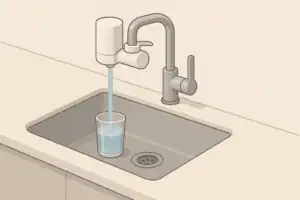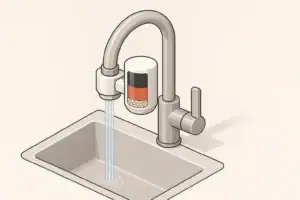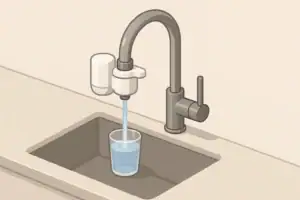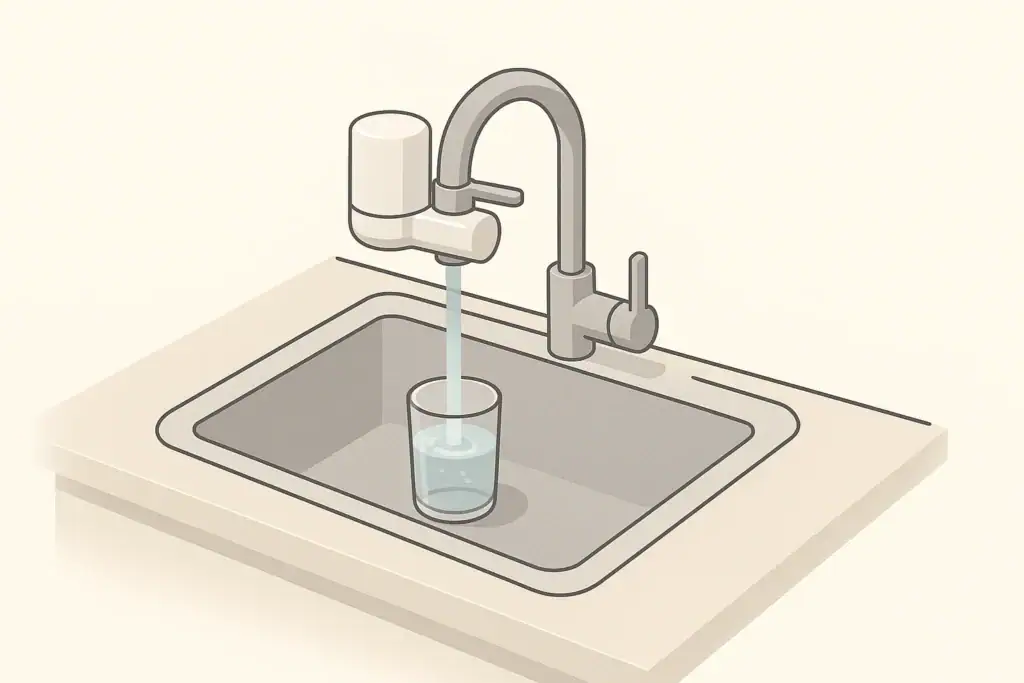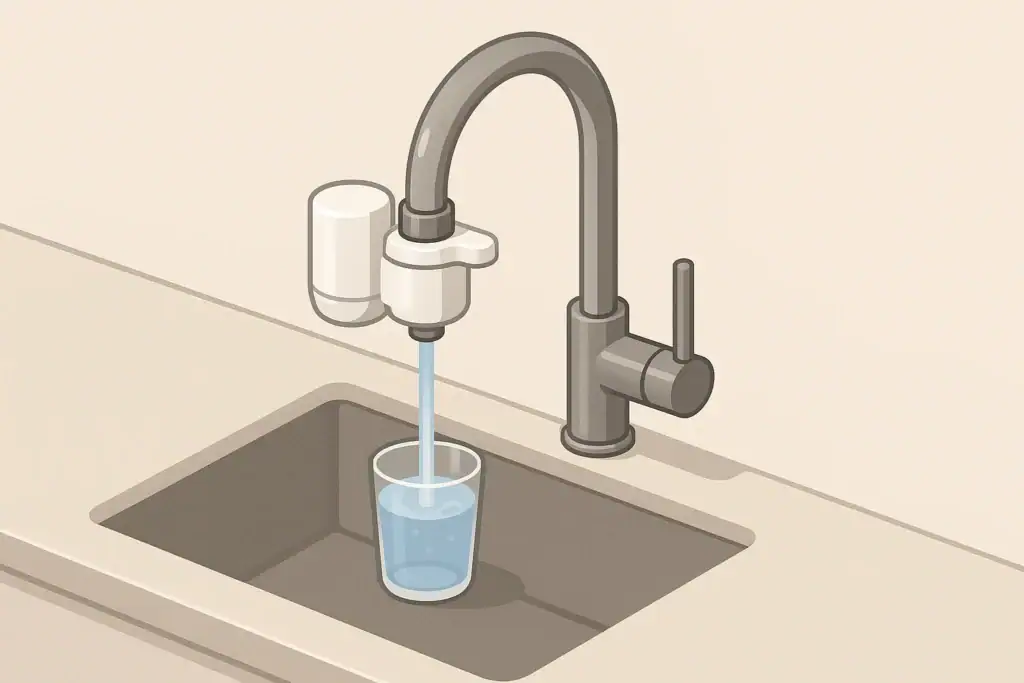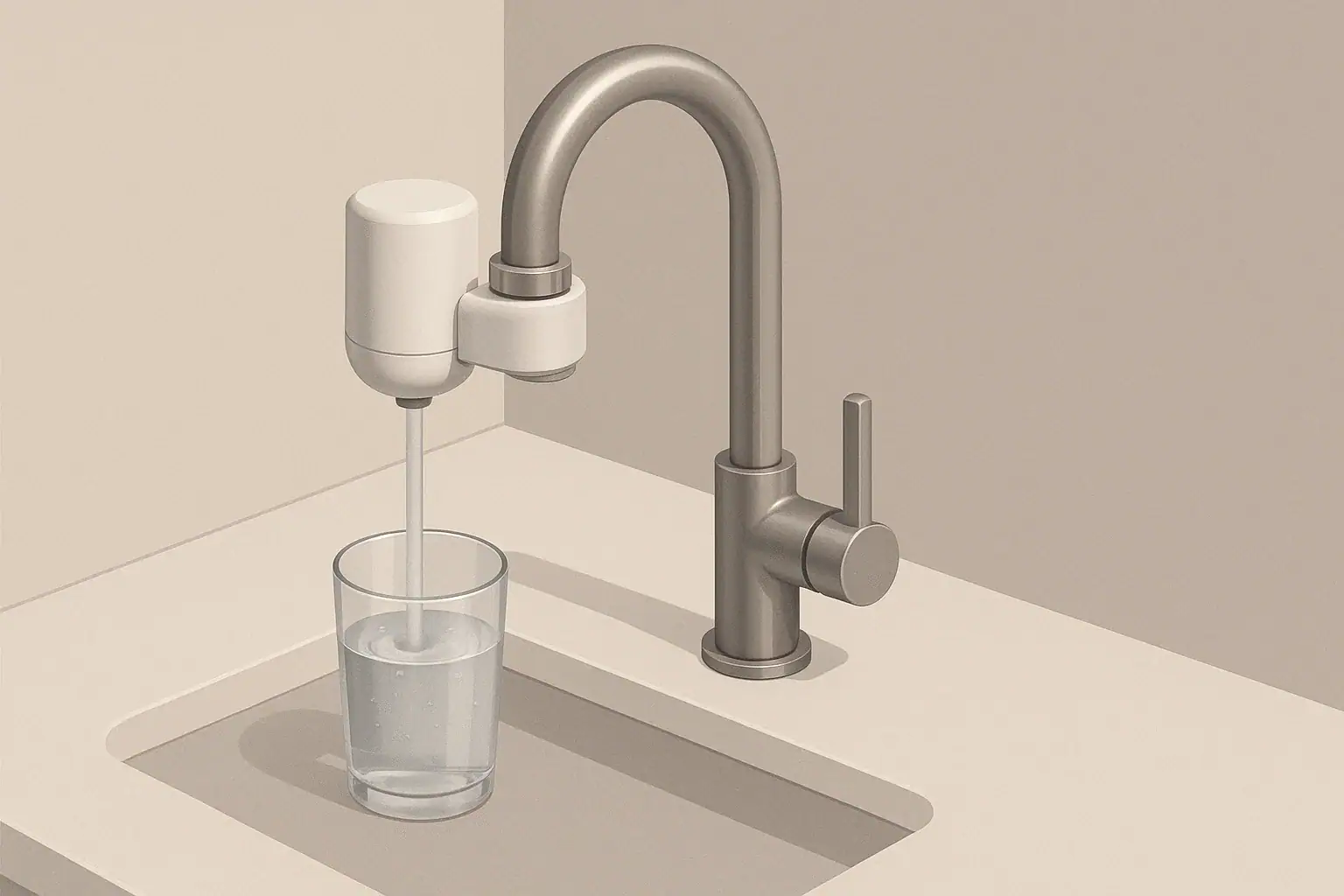
A faucet-mount filter that starts out with a strong stream and gradually slows to a trickle is a common issue. Most slow-flow problems are related to normal clogging, pressure changes, or mechanical wear rather than a defect in the housing itself.
Faucet-mount filters rely on household water pressure to push water through fine filter media. As that media captures particles and chemical residues, it becomes more restrictive. Even small changes in your tap water quality or plumbing can dramatically change how fast water flows through a compact filter.
Common contributors to slow flow include:
- Clogged filter media from sediment, rust, or scale
- Debris in the faucet aerator or adapter screen
- Low household water pressure or partially closed shutoff valves
- Incorrect cartridge installation or using the wrong cartridge type
- Internal bypass or selector valve wear inside the filter housing
Understanding which part of the system is restricting flow will guide the rest of your troubleshooting. The steps below move from quick, non-invasive checks to deeper inspection.
Why Faucet-Mount Filters Slow Down Over Time
A faucet-mount filter that starts out with a strong stream and gradually slows to a trickle is a common issue. Most slow-flow problems are related to normal clogging, pressure changes, or mechanical wear rather than a defect in the housing itself.
Faucet-mount filters rely on household water pressure to push water through fine filter media. As that media captures particles and chemical residues, it becomes more restrictive. Even small changes in your tap water quality or plumbing can dramatically change how fast water flows through a compact filter.
Common contributors to slow flow include:
- Clogged filter media from sediment, rust, or scale
- Debris in the faucet aerator or adapter screen
- Low household water pressure or partially closed shutoff valves
- Incorrect cartridge installation or using the wrong cartridge type
- Internal bypass or selector valve wear inside the filter housing
Understanding which part of the system is restricting flow will guide the rest of your troubleshooting. The steps below move from quick, non-invasive checks to deeper inspection.
Step-by-Step Checks for a Slow Faucet-Mount Filter
Work through these checks in order. After each step, test the filter again. If flow improves, you can stop there and monitor performance over the next few days.
1. Test the Faucet Without the Filter
First determine whether the issue is with the filter or the faucet/plumbing.
- Switch the filter’s diverter or lever to unfiltered tap mode (if available) and run the water.
- If possible, remove the faucet-mount filter entirely and reinstall the original aerator.
If the flow is weak even without the filter, the problem is likely in your household plumbing, shutoff valves, or the faucet aerator, not the filter cartridge. If the flow is strong without the filter but slow when the filter is active, continue with the next steps.
2. Check the Faucet Aerator and Adapter Screens
Small particles from municipal lines or building plumbing can accumulate in your faucet aerator and in the adapter that connects the filter to the faucet.
- Unscrew the aerator or adapter from the faucet spout.
- Look for sand-like grit, rust flakes, or white mineral bits on the screen or inserts.
- Rinse the parts under running water and gently brush them with a soft toothbrush.
- Reassemble and retest flow with and without the filter engaged.
Heavy buildup here can restrict both filtered and unfiltered flow. If cleaning the aerator and adapter restores a strong unfiltered stream, but filtered flow is still slow, the cartridge is likely the main restriction.
3. Inspect and Reseat the Cartridge
A misaligned or loosely seated cartridge can partially block internal channels and cause slow flow or drips where the housing connects.
- Turn off water at the faucet.
- Open the filter housing according to its design (usually by twisting or releasing a latch).
- Remove the cartridge and inspect for cracks, warped seals, or deformation.
- Check inside the housing for any loose plastic film, packaging remnant, or sediment clumps.
- Firmly reinsert the cartridge, making sure it is fully seated and oriented correctly.
After reseating, run water and switch between filtered and unfiltered modes. If flow improves noticeably, misalignment was likely contributing to the problem.
4. Consider Cartridge Age and Water Quality
Faucet-mount cartridges have a limited capacity. They are typically rated for a certain number of gallons or a time period, whichever comes first. The actual usable life depends on your incoming water quality.
Your cartridge may clog faster if:
- Your water has visible sediment or cloudiness.
- You notice frequent brown or discolored water events after plumbing work in your area.
- Your home has older galvanized or iron piping that sheds rust.
- You live in a region with hard water, which can produce fine mineral deposits.
If your filter has slowed down significantly and you are near or past the typical replacement interval, replacing the cartridge is usually the simplest fix.
5. Check Household Water Pressure and Flow
Low incoming water pressure can make any point-of-use filter feel sluggish, especially during peak usage times.
- Test other faucets in your home. If they are all slow, you may have a broader pressure issue.
- Ensure under-sink shutoff valves are fully open.
- If you live in a multi-story building, note that upper floors often experience lower pressure, making small filters more sensitive to clogging.
Faucet-mount filters function best within typical municipal pressure ranges. If your home pressure is consistently low, consider a less restrictive format, such as a pitcher or an under-sink system with a dedicated faucet.
Example values for illustration.
| Filter format | Typical installation point | Relative flow impact | When it may be a better choice |
|---|---|---|---|
| Faucet-mount | Kitchen faucet spout | Moderate to high restriction | Renters, simple installation, basic taste and odor improvement |
| Pitcher filter | Countertop or refrigerator | Does not affect tap flow | Very low tap pressure, occasional filtered water use |
| Under-sink carbon filter | Cold line under kitchen sink | Lower restriction than most faucet-mount units | Frequent cooking and drinking use, stronger flow needed |
| Reverse osmosis system | Under sink with separate faucet | Low flow at dedicated faucet | Users prioritizing broad contaminant reduction over speed |
| Whole-house sediment filter | Main water line entry | May improve flow through point-of-use filters | Homes with visible sediment or rust particles |
| Refrigerator filter | Inside or behind refrigerator | Local to fridge dispenser only | Preference for chilled filtered water and ice |
Distinguishing Normal Clogging from Mechanical Problems
Not all slow flow is simply a sign that the cartridge has reached the end of its service life. In some cases, the internal mechanisms that direct water through the filter can cause restrictions, leaks, or inconsistent flow.
Signs It Is Probably Just a Clogged Cartridge
These patterns usually point to normal clogging:
- Flow slowly decreases over weeks or months, not suddenly in one day.
- Unfiltered mode remains strong and consistent.
- The filter still produces water with normal taste and smell, just more slowly.
- Replacing the cartridge immediately restores normal flow.
In this situation, more frequent cartridge changes or a pre-filter to handle sediment may be helpful if your goal is to preserve a strong flow rate.
Signs of a Housing or Diverter Valve Issue
These symptoms suggest an internal mechanical problem rather than simple clogging:
- Flow becomes weak or erratic suddenly, without a gradual decline.
- The lever or diverter switch feels loose, gritty, or stuck.
- Unfiltered mode is also weaker or sprays unevenly.
- You notice leaks around the filter body or where it attaches to the faucet.
- Flow briefly improves when you jiggle the diverter but then worsens again.
For safety, only perform basic visual inspections on the exterior and accessible internal surfaces. If internal valves or seals are worn or damaged, replacing the housing is typically more reliable than attempting repairs on a compact faucet-mount assembly.
Role of Sediment, Rust, and Hardness in Slow Flow
Water quality characteristics directly affect how quickly a faucet-mount filter clogs.
- Sediment and turbidity: Suspended particles, including sand and silt, can quickly plug fine filter pores, dramatically reducing flow.
- Rust particles: Homes with aging iron or steel pipes can shed rust flakes that accumulate in aerators, adapters, and filter media.
- Hardness minerals: Calcium and magnesium can form fine scale that collects on internal surfaces and screens.
If you repeatedly experience short cartridge life and noticeable grit on faucet screens, adding a simple whole-house or under-sink sediment pre-filter may extend the life of faucet-mount cartridges and help maintain more stable flow.
Maintaining Flow Without Sacrificing Filtration
Once slow-flow issues are resolved, a few habits can help keep your faucet-mount filter operating smoothly without frequent interruptions or surprises.
Track Cartridge Changes by Both Time and Use
Many people rely on a calendar interval alone, but actual water use and local water conditions are just as important. A small household that uses filtered water mainly for drinking may get more time from a cartridge than a large household filling pots and bottles throughout the day.
- Note the installation date on a small sticker near the sink or in a notebook.
- Track visible changes in flow over the cartridge’s life (for example, a small slowdown after a month, a major slowdown near the end).
- Consider a simple estimate of daily filtered gallons, such as a few gallons per day for drinking only or higher amounts for frequent cooking.
When you start to recognize your own pattern of flow decline, you can replace cartridges proactively before the stream becomes uncomfortably slow.
Use Filter Mode Only When Needed
Most faucet-mount devices allow you to switch between filtered and unfiltered water. Using filtered mode continuously can shorten cartridge life and make slow-flow episodes more frequent.
- Use unfiltered water for tasks like washing hands, rinsing dishes, or cleaning.
- Use filtered water only for drinking, cooking, and preparing beverages.
This reduces the total volume of water that needs to pass through the cartridge, helping maintain a faster stream for longer.
Match Filter Type to Your Primary Concern
Filters that target a broader range of contaminants often use denser media or multiple stages, which can reduce flow compared with simpler taste-and-odor filters. Matching the level of filtration to your actual needs helps balance performance and convenience.
- If your main concern is chlorine taste and odor, a basic carbon filter may be sufficient and typically allows higher flow.
- If you are focused on specific contaminants such as lead or certain chemicals, look for a unit that documents independent testing, understanding that flow may be slower.
Reviewing certified capabilities and independent test data can help you decide whether a slower flow is acceptable for the level of filtration you want.
Understanding Certifications for Faucet-Mount Filters
When comparing faucet-mount filters, independent certifications can give you insight into both what the filter is designed to reduce and how it will affect flow. Certifications do not guarantee a particular flow in your home, but they are a useful reference point.
Common NSF/ANSI Standards for Faucet-Mount Systems
Several NSF/ANSI standards are commonly referenced for residential drinking water filters:
- NSF/ANSI 42: Typically covers reduction of aesthetic issues such as chlorine taste and odor.
- NSF/ANSI 53: Often used for reduction of certain substances of structural or other concern, such as some metals.
- NSF/ANSI 401: Relates to reduction of select emerging compounds such as some pharmaceutical residues and industrial chemicals.
- NSF/ANSI 58: Applies to reverse osmosis systems, which are generally separate from faucet-mount units but relevant when comparing formats.
Filter performance is evaluated at specific test conditions, including pressure and flow. Real-world performance may differ based on your plumbing and water characteristics, but certification can help verify that a filter has been independently tested for the claims it makes.
What to Look For When Verifying Certifications
When you review documentation for a faucet-mount filter, pay attention to the following practical details:
- Which standards apply: For example, whether the unit is listed for NSF/ANSI 42 only, or also 53 or 401.
- Which contaminants were actually tested: Standards often cover multiple potential targets, but a specific product may be evaluated for only some of them.
- Rated capacity and conditions: Look for the approximate gallons or time at which performance, including flow, is expected to change under test conditions.
- Any notes on pressure range: Although not a guarantee for your home, the listed test pressure range can help you understand how sensitive a system may be to low pressure.
Using these details, you can better interpret whether a slow flow is a sign that your filter is working as designed but nearing the end of its rated capacity, or whether something else is limiting performance.
Example values for illustration.
| Standard | Typical application | What it generally covers | What a homeowner can verify |
|---|---|---|---|
| NSF/ANSI 42 | Many faucet-mount and pitcher filters | Aesthetic improvements such as chlorine taste and odor | Check listing for chlorine reduction and rated capacity |
| NSF/ANSI 53 | Point-of-use filters, including some faucet-mount units | Reduction of certain specified substances such as some metals | Confirm which individual substances were tested for this model |
| NSF/ANSI 401 | Selected pitcher, faucet-mount, and under-sink systems | Reduction of some emerging compounds (examples: certain pharmaceuticals) | Review list of specific compounds included in testing |
| NSF/ANSI 58 | Reverse osmosis systems | Performance of RO membranes and related components | Verify that the system is listed under this standard if it is RO-based |
| NSF/ANSI 372 | Various drinking water system components | Material safety related to lead content in wetted parts | Look for documentation that components meet lead content requirements |
| NSF/ANSI 61 | Plumbing components and fittings | Material safety for drinking water contact surfaces | Confirm that wetted components are evaluated for material safety |
When to Replace Your Faucet-Mount Filter System
Even with regular cartridge changes and cleaning, a faucet-mount housing will eventually show signs of age. Knowing when to replace the entire unit can prevent chronic slow-flow problems and unpredictable performance.
Consider replacing the housing if you notice:
- Repeated slow-flow episodes shortly after installing new cartridges, with no evidence of widespread low pressure.
- Persistent drips or leaks at the faucet connection or around the housing seam.
- Cracks or discoloration in the plastic body or mounting components.
- A diverter lever that no longer reliably switches between modes.
At that point, you can reassess whether a faucet-mount filter still fits your household’s usage patterns or whether another format—such as an under-sink or whole-house system—may offer a better combination of flow, convenience, and maintenance for your situation.
Frequently asked questions
How can I tell whether the slow flow is caused by the cartridge or my household water pressure?
Switch the device to unfiltered mode or remove the filter and reinstall the original aerator, then run the faucet. If unfiltered flow is strong while filtered flow is weak, the cartridge or filter housing is the likely restriction; if all faucets are weak, the issue is more likely low household pressure or a partially closed valve.
Will cleaning the faucet aerator and adapter screens fix a faucet-mount filter slow flow problem?
Cleaning the aerator and adapter screens often restores unfiltered flow when grit, rust flakes, or mineral deposits are present. If filtered flow remains slow after cleaning, the cartridge media is likely clogged and may need replacement.
How often should I replace the cartridge to avoid frequent slow-flow episodes?
Replace cartridges based on both the manufacturer’s rated capacity and your observed use pattern; heavy sediment, rust, or high daily filtered usage shortens life. Track installation dates and watch for steady declines in flow so you can swap cartridges proactively before performance becomes poor.
Can I improve flow without sacrificing the level of filtration?
Yes—options include using unfiltered water for non-drinking tasks, installing a sediment pre-filter to protect the cartridge, or choosing a less restrictive cartridge designed for your primary contaminant concern. For consistently higher flow, consider an under-sink unit with a dedicated faucet or a different filter format that matches your usage.
When should the entire faucet-mount housing be replaced rather than just the cartridge?
Replace the housing if you see repeated slow-flow episodes immediately after new cartridges, persistent leaks, a loose or stuck diverter, or visible cracks and discoloration. Worn internal valves and seals are difficult to repair reliably in compact housings, so replacement is usually the safer choice.
Recommended next:
- Best Faucet-Mount Filters for Chlorine Taste (High Flow Picks)
- Faucet-Mount Filter Compatibility: How to Check Your Faucet Type
- Faucet-Mount vs Under-Sink Filters: Convenience vs Performance
- How to Install a Faucet-Mount Filter Without Leaks
- Faucet-Mount Filters for Renters: No-Drill Setup Guide
- Do Faucet-Mount Filters Remove Lead? Reading the Label
- More in Faucet-Mount Filters →
- NSF/ANSI standards explained (42/53/401/58)
- Clear trade-offs: pitcher vs faucet vs under-sink vs RO
- Maintenance planning: cost per gallon and replacement cadence