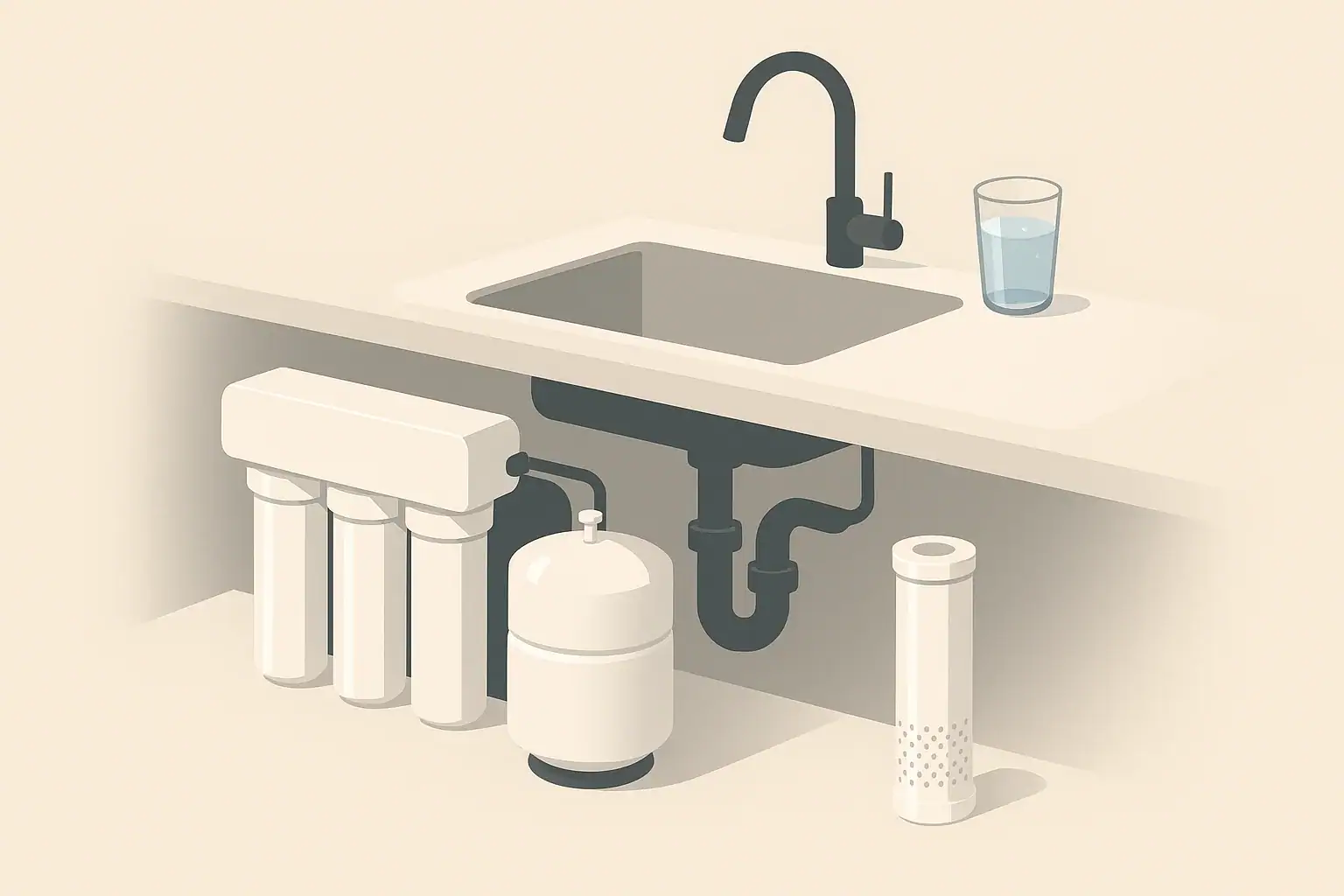
How under-sink carbon filters work
Under-sink carbon filters are commonly used to improve drinking water taste, reduce chlorine-related odor, and provide point-of-use filtration at a kitchen faucet. The two most common carbon formats are carbon block and granular activated carbon, often shortened to GAC.
Both use activated carbon, a porous material with a large internal surface area. As water passes through the carbon, some compounds are held on the carbon surface through adsorption. This is different from a screen or strainer. Carbon does not simply catch everything by size; performance depends on water chemistry, carbon type, cartridge design, flow rate, and how long the water stays in contact with the media.
What a carbon block cartridge is
A carbon block filter is made from fine carbon particles formed into a solid, porous cylinder or block. Water is forced through this dense structure. Because the pathways are more controlled, carbon block cartridges can provide more consistent contact and may also reduce fine particles, depending on the filter design.
Carbon block filters often have lower flow than loose carbon because the water must pass through a tighter structure. This can be a good tradeoff when the goal is stronger taste and odor reduction at a dedicated drinking water faucet.
What a granular activated carbon cartridge is
A granular activated carbon filter contains loose carbon granules inside a cartridge or housing. Water flows through the bed of granules. GAC often allows higher flow with less pressure drop, which can feel more convenient at the sink.
The practical limitation is that water may find easier channels through the media over time. Good cartridge design helps distribute flow, but GAC generally has less uniform contact than a well-designed carbon block.
Why taste, flow, and contact time are connected
Taste performance, faucet flow, and contact time are not separate issues. They are linked. A filter that allows water to move through very quickly may feel convenient, but the water has less time to interact with the carbon. A filter that slows water down may improve contact, but it can feel restrictive if the faucet is used for filling pots, coffee makers, or large bottles.
Contact time is the amount of time water spends in the carbon media. In technical settings, people may refer to empty bed contact time, but homeowners do not need to calculate it precisely for normal buying decisions. The practical idea is simple: larger cartridges, slower flow, and better media distribution generally support better contact.
Under-sink systems create a useful middle ground. They have more space than pitcher or faucet-mounted filters, so they can use larger cartridges. They also avoid some of the flow limitations of small countertop units. Still, the filter format matters.
For a single dedicated drinking water faucet, a carbon block may be acceptable even if it flows more slowly. For a main kitchen cold-water line, flow rate can make GAC or a larger carbon block feel better because the household expects more flow.
Example values for illustration.
| Decision factor | Carbon block | Granular activated carbon |
|---|---|---|
| Taste and odor consistency | Often more consistent because water paths are tighter | Often good, but depends on media distribution |
| Typical flow feel | Can be slower, especially with fine blocks | Often faster with less pressure drop |
| Contact time | Usually more controlled through the block | Can vary if channeling develops |
| Pressure drop | Usually higher than comparable GAC | Usually lower than comparable carbon block |
| Sediment sensitivity | Can clog faster if water has particles | May tolerate some particles better, but still needs protection |
| Fine particle reduction | May help when designed for that purpose | Not usually the main strength |
| Best fit | Dedicated drinking faucet and taste-focused use | Higher-flow sink use and general taste improvement |
| Main caution | Do not oversize expectations if flow is critical | Do not assume higher flow means stronger treatment |
Taste and odor performance in everyday use
For many city water users, the main reason to install an under-sink carbon filter is taste. Chlorine is widely used as a disinfectant in public water systems, and it can leave a noticeable pool-like taste or smell. Activated carbon is well known for reducing chlorine taste and odor when the filter is properly sized and maintained.
Carbon block and GAC can both improve taste. The difference is usually how consistently they do it at a given flow rate. A carbon block may provide stronger taste improvement in a compact cartridge because the water must pass through a more uniform structure. GAC may produce very good taste results when the cartridge is large enough and the flow is not excessive.
Chloramine is a different taste challenge
Some water utilities use chloramine instead of free chlorine. Chloramine can be more difficult for standard carbon to reduce. In those cases, carbon type, contact time, and cartridge size become more important. Catalytic carbon is sometimes used for chloramine-focused applications, but homeowners should look for clear performance information rather than assuming any carbon cartridge will perform the same way.
If the water has a persistent disinfectant taste even after filtration, the cause may be high flow, an exhausted cartridge, a small cartridge, or a disinfectant type that needs a different carbon design.
Other taste sources
Not every taste problem is a carbon problem. Earthy, metallic, plastic-like, sulfur-like, or salty tastes may have different causes. Carbon can help with many organic taste and odor compounds, but it is not a universal treatment method.
For well water, unusual odors should be evaluated carefully before choosing a simple under-sink carbon filter. Some odor issues involve hydrogen sulfide, iron bacteria, plumbing materials, or stagnant water. Carbon may polish taste at the tap, but it should not be used as a substitute for identifying the source of a recurring well water problem.
Flow rate and pressure in kitchen use
Flow rate affects how a filter feels every day. A system can look good on paper but become frustrating if it takes too long to fill a coffee reservoir or cooking pot. At the same time, choosing only for high flow can shorten contact time and reduce taste performance.
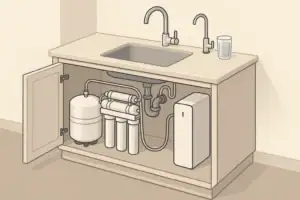
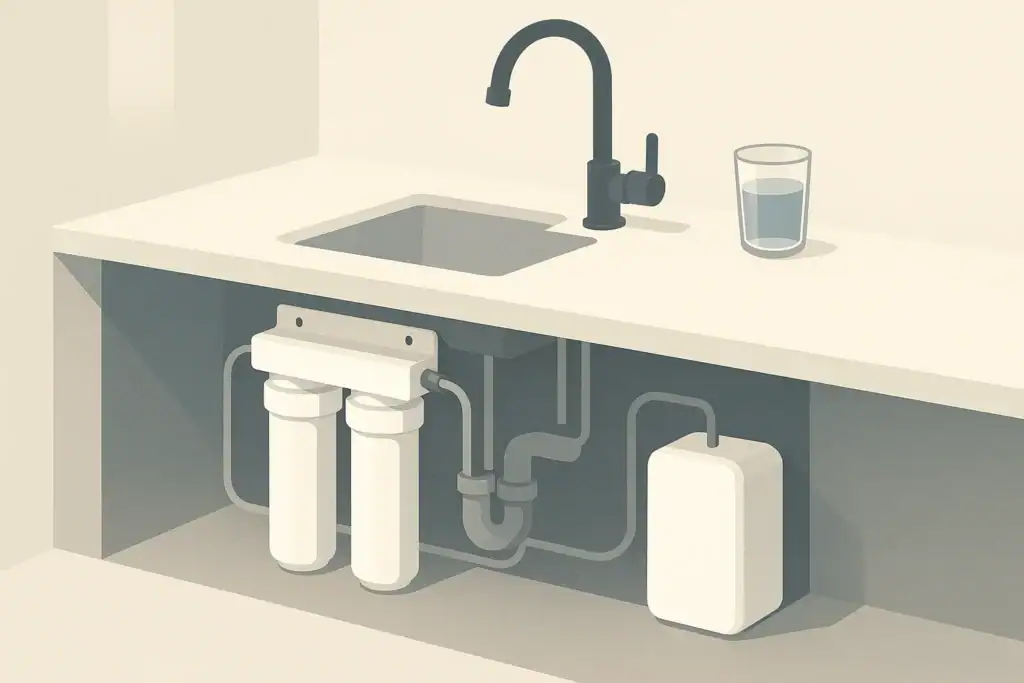
Under-sink carbon filters are usually installed in one of two ways: feeding a separate drinking water faucet or filtering the cold water line to the main kitchen faucet. A dedicated drinking faucet can tolerate lower flow because it is used mainly for glasses, bottles, coffee, and cooking water. A main faucet usually needs higher flow because it is also used for rinsing and general kitchen tasks.
Why carbon block may feel slower
Carbon block cartridges create more resistance because the water must pass through a dense block. Finer pores and smaller pathways can improve contact and particle reduction, but they also increase pressure drop. This pressure drop becomes more noticeable when incoming water pressure is modest, plumbing lines are small, or the cartridge is near the end of its life.
Why GAC may feel faster
GAC cartridges typically allow water to pass through spaces between loose granules. That can reduce resistance and improve faucet flow. This is useful when the system serves more than a small drinking faucet. The tradeoff is that water distribution through the carbon bed matters. If water moves too quickly or channels through part of the bed, taste performance may be less consistent.
A practical approach is to match the filter format to the faucet purpose. Do not choose a very restrictive block for a main faucet unless the cartridge and housing are sized for that use. Do not choose a small high-flow GAC cartridge if the main goal is maximum taste improvement from challenging water.
Contact time, cartridge size, and capacity
Contact time is one of the main reasons similar-looking carbon filters can perform differently. A larger cartridge generally contains more carbon and provides more room for water to spread through the media. This can support better taste improvement and longer service life, but only if the internal design uses the media effectively.
Capacity is related but not identical. A cartridge may be rated for a certain number of gallons under specific test conditions. Real water use can vary. Higher disinfectant levels, more organic matter, sediment, warmer water, and higher flow can all reduce useful life. A household that uses a filter heavily for cooking, coffee, and pets may reach the practical replacement point earlier than a household that fills only a few drinking glasses per day.
Nominal ratings are not the whole story
Some carbon block cartridges list micron ratings. A smaller nominal rating can suggest finer filtration, but it may also increase pressure drop. Micron ratings are most useful when paired with clear test information and a realistic understanding of the water source.
For chemical and taste reduction, contact and adsorption are usually more important than a simple pore-size number. A dense block with good contact may perform well for taste, but that does not mean it removes all contaminants. GAC with adequate bed depth and slow flow can also perform very well for taste and odor.
When certification language matters
If the goal is more than taste, look for filters tested to relevant standards for the specific substance of concern. For example, some systems are tested for chlorine taste and odor, while others may be tested for lead, certain VOCs, or other contaminants. The exact claims matter. A carbon filter being certified for one reduction claim does not automatically mean it is certified for all possible contaminants.
This is especially important for substances such as lead, PFAS, VOCs, or chloramine. Carbon can be part of treatment for some of these concerns, but the filter must be designed and tested for the intended use. Avoid assuming that all carbon block or all GAC filters perform the same.
Choosing between carbon block and granular carbon
The best choice depends on the water problem, faucet use, household expectations, and available space under the sink. There is no universal winner. Carbon block and GAC are both useful formats, but they solve the taste-flow-contact balance differently.
Choose carbon block when
- The main goal is consistent drinking water taste at a separate faucet.
- You can accept a moderate flow rate for glasses, bottles, and coffee.
- You want a compact cartridge with controlled water pathways.
- Your water has low sediment, or the system includes appropriate sediment protection.
- You are comparing filters with specific performance testing for your concern.
Choose GAC when
- You want less pressure drop and a faster faucet feel.
- The system serves a main kitchen faucet or higher-volume use.
- The main goal is general chlorine taste and odor improvement.
- You can use a larger cartridge or housing to support contact time.
- You are willing to replace the cartridge on schedule to reduce channeling and exhaustion concerns.
Consider a staged system
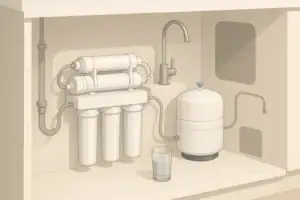
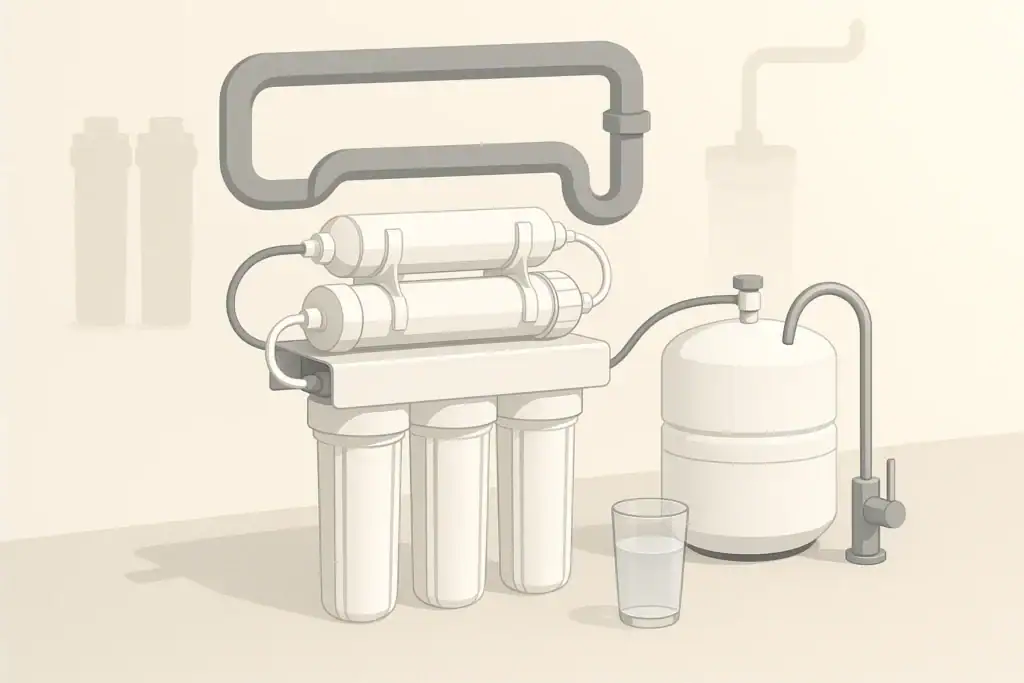
Some under-sink systems use more than one stage. A sediment prefilter may protect a carbon block from clogging. A GAC stage may be followed by a carbon block polishing stage. In reverse osmosis systems, carbon stages are commonly used before or after the membrane, but their role is different from a standalone carbon filter.
Staging can improve usability, but more stages do not automatically mean better water. Each stage adds cost, replacement needs, and potential pressure loss. A simple system matched to the actual water concern is often better than a complicated system with unclear benefits.
Maintenance, replacement, and realistic expectations
Carbon filters are not permanent. Once adsorption sites are used or flow paths become fouled, performance declines. A cartridge may still pass water even when taste improvement is reduced. That is why replacement timing matters.
Use the manufacturer’s replacement interval as a starting point, but adjust based on use and water conditions. If taste returns, flow drops noticeably, or the cartridge has been in service for its maximum time, replacement is usually appropriate. For systems used rarely, time-based replacement still matters because stagnant water and aging seals can affect quality and reliability.
During maintenance, follow the system instructions. Use compatible cartridges, keep housings clean, and check for leaks after service. Do not bypass pressure controls, remove required flow restrictors, or modify plumbing in ways that conflict with code or the product instructions. If the installation requires changes to supply lines, shutoff valves, or drain connections, use qualified help when needed.
What carbon filters should not be expected to do
Carbon filtration should not be described as making water absolutely pure. It does not remove every dissolved mineral, and it is not the same as distillation or reverse osmosis. Standard carbon filters are also not a reliable barrier for all microbes. If microbial safety is a concern, especially on a private well, testing and appropriate treatment should come before taste polishing.
Carbon is best viewed as a practical tool for taste, odor, and certain tested contaminant reductions. It performs best when matched to the water source and used within its rated flow and capacity.
Example values for illustration.
| Use pattern | Flow expectation | Practical filter consideration |
|---|---|---|
| Drinking water faucet only | Moderate flow is usually acceptable | Carbon block can work well if pressure is adequate |
| Main cold-water faucet | Higher flow is usually expected | Larger GAC or larger-format block may feel better |
| Coffee and tea brewing | Moderate flow with good taste consistency | Prioritize chlorine taste reduction and timely replacement |
| Filling large pots | Higher flow reduces waiting | A restrictive small block may be frustrating |
| Low incoming pressure | Any pressure drop is more noticeable | Check rated flow and avoid undersized cartridges |
| High sediment water | Flow may decline over time | Use appropriate sediment filtration before fine carbon |
| Chloramine taste concern | More contact time may be needed | Look for suitable carbon type and tested claims |
| Heavy household use | Capacity is reached sooner | Plan shorter replacement intervals or larger cartridges |
Key takeaways for practical selection
Carbon block and granular carbon filters both have a place under the kitchen sink. The right choice depends on how much flow you need and how much contact time the water should have with the carbon.
- Carbon block usually favors controlled contact and consistent taste performance, with more pressure drop.
- GAC usually favors easier flow, with performance that depends heavily on cartridge size and flow distribution.
- For a dedicated drinking faucet, a carbon block is often a practical fit.
- For a main kitchen faucet, flow requirements may point toward a larger GAC cartridge or a larger low-restriction carbon block.
- For chloramine, lead, PFAS, VOCs, or other specific concerns, compare tested claims rather than relying on carbon type alone.
- Replacement timing is part of performance, not just maintenance.
The most reliable decision is to start with the water source and the sink use. If the issue is ordinary chlorine taste at a drinking faucet, the choice is often simple. If the issue involves low pressure, high flow demand, chloramine, well water odor, or a specific contaminant, cartridge design and tested performance become more important than the words carbon block or GAC by themselves.
Frequently asked questions
Is carbon block better than GAC for taste?
Often, carbon block gives more consistent taste improvement because water moves through a tighter, more uniform path. GAC can also work well, especially in larger cartridges with reasonable flow.
Which filter type has better flow?
GAC usually has less pressure drop and feels faster at the faucet. Carbon block is typically slower, but that tradeoff can support better contact time.
Can an under-sink carbon filter remove chloramine?
Some carbon filters can reduce chloramine, but not all are designed for it. Look for clear test claims and enough contact time rather than assuming any carbon cartridge will work the same.
How often should I replace the cartridge?
Follow the manufacturer’s interval as a baseline, then adjust for water quality and use. Replace sooner if taste returns, flow drops, or the cartridge reaches its service limit.
Do carbon filters remove lead or PFAS?
Only if the filter is specifically tested and certified for those reductions. Carbon type alone is not enough; the product’s stated claims matter.
Should I choose a carbon block for a main kitchen faucet?
Sometimes, but only if the cartridge and housing are designed for the higher flow demand. For many main faucets, a larger GAC system or a larger low-restriction block is a better fit.
Related guides: Best Under-Sink Filters for Chlorine Taste & Odor • Under-Sink Filter Flow Rate Explained: Why GPM Matters • Under-Sink Filter Replacement Schedule: Estimate by Gallons Used • Under-Sink Filters for Lead Reduction: What Certifications to Look For
- NSF/ANSI standards explained (42/53/401/58)
- Clear trade-offs: pitcher vs faucet vs under-sink vs RO
- Maintenance planning: cost per gallon and replacement cadence