
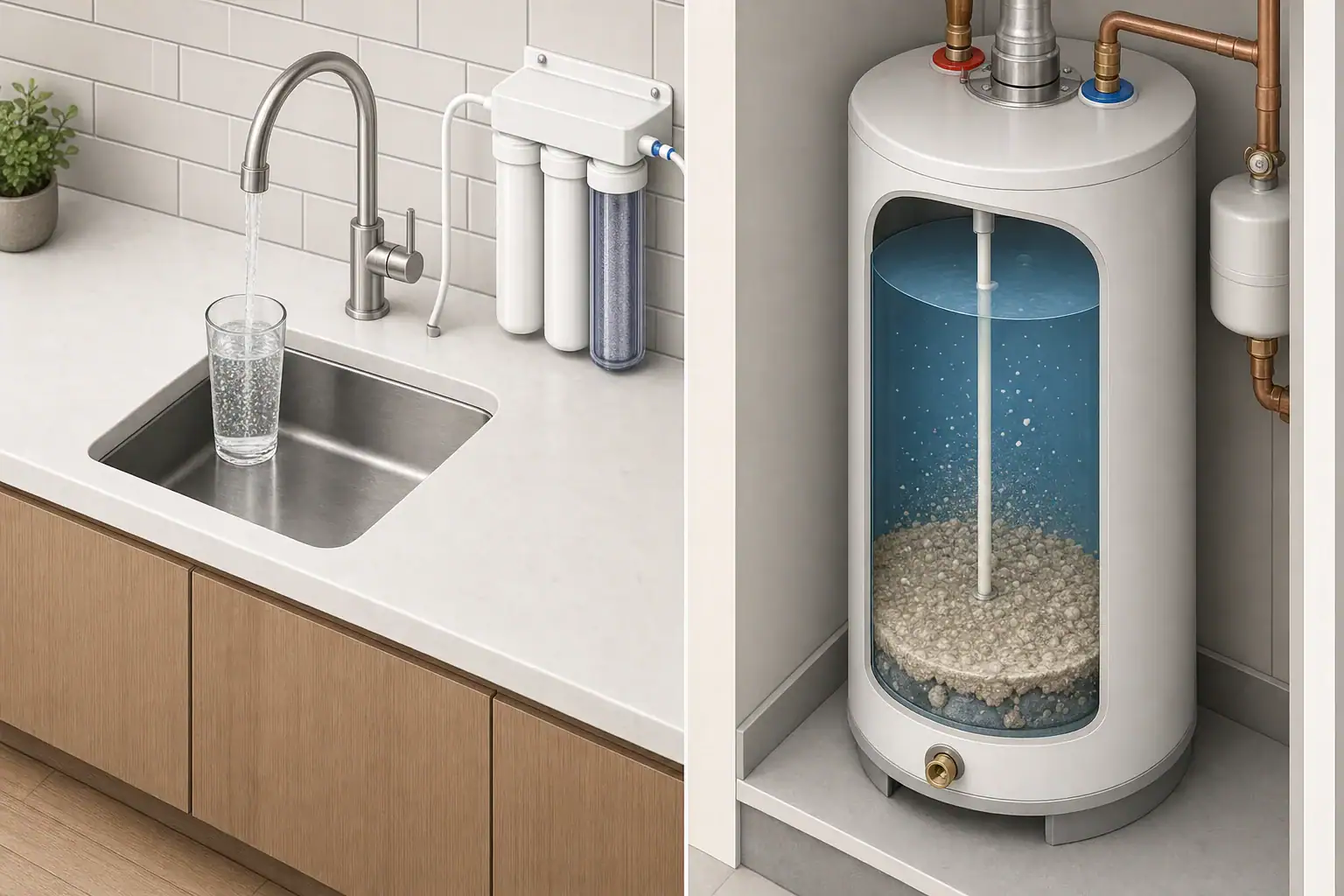
White particles that appear only in hot water usually originate in the water heater or the hot-water plumbing. The two leading possibilities are mineral scale breaking loose inside the heater and fragments from a deteriorating plastic dip tube.
Scale is generally chalky, gritty, or brittle and may react with white vinegar. Dip-tube debris usually looks like irregular pieces of plastic that remain unchanged in vinegar. A failing dip tube may also cause the available hot water to run out sooner than it once did.
First confirm that the problem is limited to hot water
Check more than one fixture before drawing a conclusion. Remove and clean a clogged faucet aerator if necessary, then collect separate hot- and cold-water samples in clean, clear containers.
- Particles at several hot taps but not cold taps: The water heater or hot-water piping is the likely source.
- Particles at only one fixture: Inspect that fixture’s aerator, cartridge, supply line, and local plumbing before blaming the heater.
- Particles in both hot and cold water: The source may be the incoming supply, plumbing materials, water treatment equipment, or utility work rather than the water heater alone.
Let a hot-water sample cool before handling or examining it. Do not collect water directly from a heater drain unless the manufacturer’s procedure is followed and the risks of scalding, pressure, and leakage are properly controlled.
How scale and dip-tube fragments differ
| Clue | Mineral scale | Failing dip tube |
|---|---|---|
| Texture | Chalky, gritty, crusty, or brittle | Plastic-like, often thin or irregular |
| Shape | Grains, chips, or flattened flakes | Small shards, curls, or pieces |
| Vinegar response | May fizz, soften, shrink, or dissolve | Usually remains unchanged |
| Other symptoms | Popping sounds, reduced efficiency, recurring sediment | Hot water runs out unusually quickly |
| Where it forms | Heater surfaces exposed to heated hard water | Inside a storage heater as the tube deteriorates |
These clues are useful but not conclusive by themselves. Sediment can contain a mixture of minerals, corrosion products, and plumbing debris. Appearance also varies with water chemistry and heater design.
Signs that point to mineral scale
Hard water contains dissolved calcium and magnesium. Heating can encourage some of these minerals to form solid deposits on the tank bottom, heating elements, or heat-transfer surfaces. Pieces may eventually break loose and travel through hot-water lines.
Scale becomes more likely when:
- The particles crumble or feel gritty rather than flexible.
- White or tan crust is also visible around hot-water fixtures.
- The heater makes rumbling or popping sounds as it operates.
- The home has measured hard water or a history of scale buildup.
- The debris returns after faucet aerators are cleaned.
Using vinegar as a screening test
Place a few cooled particles in a clean glass and cover them with ordinary white vinegar. Calcium-carbonate-rich scale may release small bubbles or gradually soften and dissolve. Some mineral deposits react slowly, so an immediate lack of fizz does not prove that a particle is plastic.
Do not burn or melt an unknown particle to identify it. Heating plastic or mixed plumbing debris can release irritating fumes and does not provide a dependable household test.
Signs that point to a failing dip tube
A dip tube is the internal pipe that carries incoming cold water toward the bottom of a conventional storage water heater. This helps keep newly admitted cold water away from the hot water leaving near the top.
If the tube cracks or disintegrates, plastic fragments can enter the hot-water outlet. A shortened or broken tube may also release cold water near the top of the tank, causing showers or faucets to turn lukewarm sooner than expected.
Dip-tube failure becomes more likely when:
- The particles look like plastic chips rather than mineral grains.
- They do not soften or dissolve in vinegar.
- Several hot-water aerators repeatedly collect similar pieces.
- The household has experienced a noticeable loss of usable hot-water capacity.
- The heater is an older storage model with an original plastic dip tube.
A tankless water heater does not use the same type of storage-tank dip tube. White debris from a tankless system is therefore more likely to involve scale or another plumbing source, although diagnosis still depends on the equipment and water conditions.
Other sources worth ruling out
Scale and dip-tube failure are not the only explanations. A storage heater can contain sediment associated with anode-rod deterioration, corrosion, or previous plumbing work. Some flexible supply components and fixture cartridges can also shed light-colored material.
A local fixture problem is especially likely when debris appears at one faucet but not at other hot taps. If the material is gelatinous instead of hard or plastic-like, it may involve a different water-heater or water-chemistry issue and should not be classified as scale based on color alone.
What to do after identifying the likely source
If the particles are probably scale
Review the water heater manufacturer’s maintenance instructions. Depending on the heater type and condition, service may involve flushing a storage tank or descaling compatible components. An older tank that has never been drained can develop valve problems or leaks when disturbed, so professional service may be the safer choice.
Testing water hardness can help determine whether ongoing scale control is worthwhile. A water softener can reduce hardness minerals entering the heater, but it will not remove deposits already inside the tank. Other scale-control technologies have different limitations and should not be assumed to provide the same result as ion-exchange softening.
If the particles are probably dip-tube fragments
Flushing may remove loose pieces, but it does not repair the deteriorating tube. A plumber can confirm the heater design, inspect the dip tube, and determine whether replacement is practical. The heater’s age, tank condition, corrosion, and repair cost all affect whether tube replacement or heater replacement makes more sense.
After the source is corrected, faucet aerators and showerhead screens may need cleaning because trapped fragments can continue appearing for a while.
Will a water filter solve the problem?
A whole-house sediment filter installed before the heater generally cannot capture particles created inside the heater. It may reduce incoming sediment, but it is not a repair for existing scale or a broken dip tube.
Installing a standard filter cartridge on a hot-water line is also not a universal solution. Many housings and cartridges are intended only for cold water and can be damaged by higher temperatures. Any component used on a hot-water line must be specifically rated for the expected temperature and pressure.
Filtration can protect a particular outlet from residual debris when suitable equipment is used, but correcting the source is usually more effective than repeatedly catching particles downstream.
Related guides: Whole house filters vs water softeners • Water hardness: grains per gallon vs ppm • Micron ratings for sediment filters
When professional service is appropriate
Arrange qualified service if the heater is leaking, visibly corroded, discharging from its temperature-and-pressure relief system, making new or severe noises, or delivering sharply reduced hot-water capacity. Professional diagnosis is also appropriate when the particle type remains unclear or the heater must be opened, drained, or disconnected.
For a practical initial distinction, compare several fixtures, inspect the cooled particles, and use vinegar only as a screening test. Chalky material that reacts with vinegar favors scale; persistent plastic-like chips combined with shorter hot-water duration favor a failing dip tube.
Frequently asked questions
Why do white particles appear only in my hot water?
If particles appear at several hot taps but not in cold water, the water heater or hot-water plumbing is the likely source. Mineral scale and deteriorating dip-tube fragments are common possibilities.
Will vinegar tell me whether the particles are scale?
Vinegar is only a screening test. Calcium-carbonate-rich scale may fizz, soften, shrink, or dissolve, while plastic-like dip-tube pieces usually remain unchanged. Some mineral deposits react slowly.
Can a failing dip tube make hot water run out faster?
Yes. A damaged dip tube can allow incoming cold water to mix nearer the top of a storage tank, reducing the amount of usable hot water.
Will flushing the water heater remove white particles?
Flushing may remove loose scale or debris, but it does not repair a deteriorating dip tube. Follow the manufacturer’s instructions, and consider professional service for an older or neglected tank.
Will a whole-house sediment filter fix particles coming from the water heater?
No. A filter installed before the heater cannot capture debris created inside the heater. It may reduce incoming sediment, but the underlying heater problem still needs correction.
When should I call a plumber about white particles in hot water?
Arrange service if the heater leaks, is visibly corroded, makes new or severe noises, has sharply reduced hot-water capacity, or requires draining, opening, or disconnection for diagnosis.
- NSF/ANSI standards explained (42/53/401/58)
- Clear trade-offs: pitcher vs faucet vs under-sink vs RO
- Maintenance planning: cost per gallon and replacement cadence