
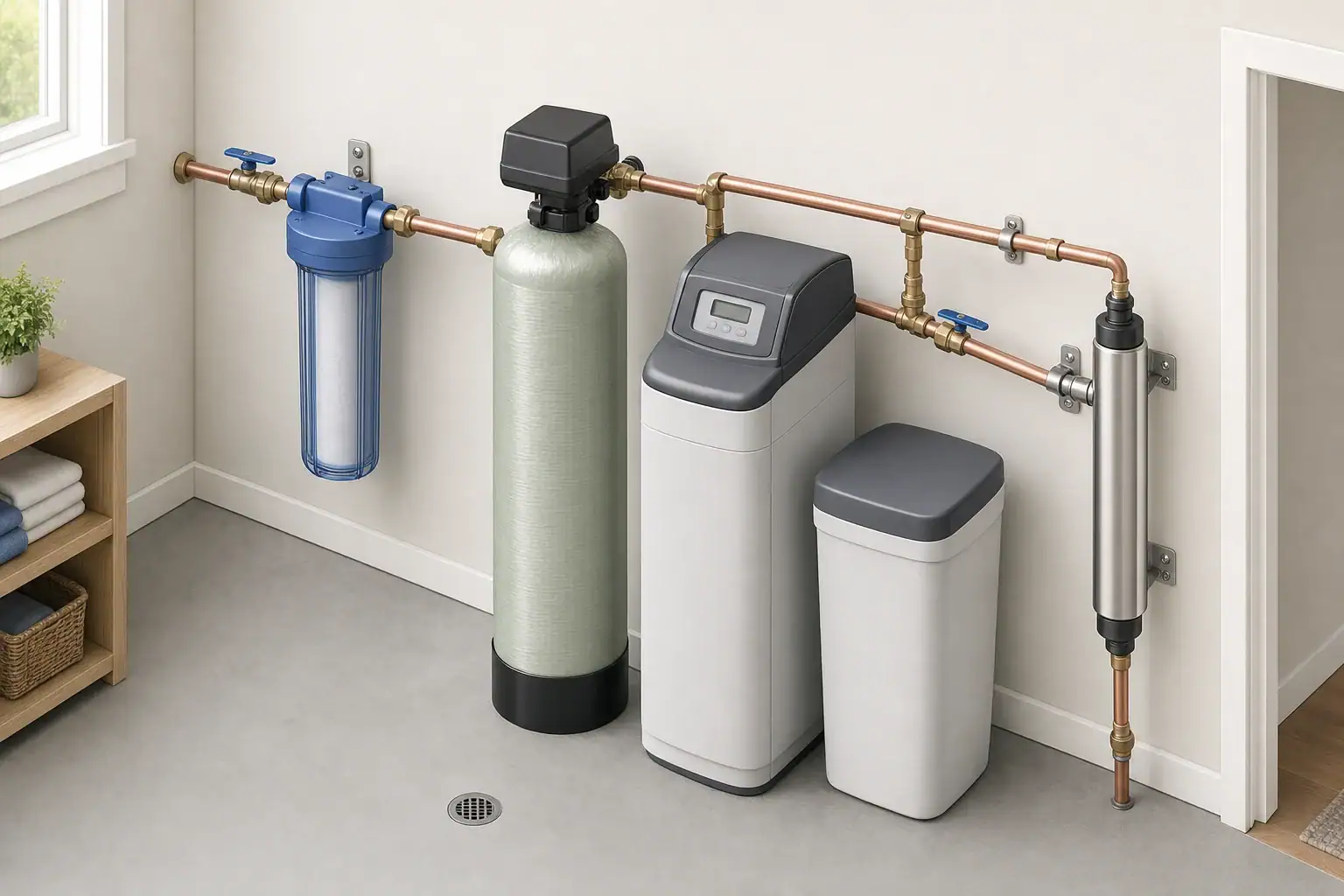
Quick answer: There is no one correct whole house water filter stage order. A practical starting point is required sediment or contaminant pretreatment, then carbon and the softener in the order their manuals allow or require, with UV commonly last. Confirm the design against water test results, peak flow, pressure loss, and each model’s inlet limits.
How to choose a whole house water filter stage order
Start with water-quality information and the job each component is meant to perform. The CDC advises testing tap water and selecting treatment for the chemicals or germs identified. A softener primarily addresses hardness minerals such as calcium and magnesium; UV does not remove chemicals.
For a public water supply, begin with the utility’s current Consumer Confidence Report, then investigate concerns that may be specific to the building or its plumbing. For a private well, use an appropriate laboratory and local health-authority guidance. Taste, odor, clarity, and a TDS reading alone cannot establish whether water is safe to drink.
A planning framework—not a universal plumbing diagram—is:
Required sediment or contaminant-specific pretreatment → carbon and softener in the manufacturer-approved order → UV after its required pretreatment.
The finished layout also needs to meet each component’s service-flow, pressure, drainage, electrical, maintenance, and inlet-water requirements. If requirements conflict, do not resolve the issue by guessing at the order.
When should sediment filtration come first?
Sediment filtration is commonly placed upstream of equipment that suspended material could foul. The Minnesota Department of Health notes that cloudy water containing mud or clay can clog softener resin and that a sediment filter before a softener may help. The same guidance notes that oxidized iron or manganese can foul resin and may require filtration before softening.
That does not mean every home needs a separate sediment cartridge. Confirm that particles or fouling are actually present, then select equipment that can support the needed household flow. A basic sediment filter should not be assumed to treat dissolved iron, manganese, chemicals, or microorganisms.
Should carbon go before or after a softener?
Carbon does not have one universal position relative to a water softener. Its position depends on the carbon system’s intended purpose and the instructions for both exact models.
Carbon before the softener
Put carbon upstream if the softener manual requires it or if the selected carbon equipment is specified as pretreatment. For example, the Pentair 5600SXT softener system manual directs installation of equipment such as sediment, iron, neutralizing, and taste-and-odor filters upstream of that softener. This is a model-specific instruction, not a rule for every softener.
Carbon after the softener
Carbon may follow a softener when it is designed as a downstream polishing stage and both manufacturers permit that arrangement. Before selecting this layout, verify whether either unit needs protection from untreated-water conditions.
Do not choose the location from the word “carbon” alone. Check the media type, intended claim, rated service flow, pressure loss, backwash needs where applicable, and the installation instructions for the exact equipment.
Where does the softener commonly belong?
A softener commonly follows sediment removal and any contaminant-specific treatment needed to protect its resin. It may need to precede UV when hardness is above the UV unit’s permitted inlet level.
For example, the VIQUA Arros owner’s manual lists model-specific inlet conditions that include hardness below 7 grains per gallon (120 mg/L), iron below 0.3 mg/L, manganese below 0.05 mg/L, turbidity below 1 NTU, tannins below 0.1 mg/L, and UV transmittance above 75%. These values apply to the listed Arros systems only; they are not universal UV requirements.
A softener is not a substitute for sediment filtration, contaminant-specific treatment, or disinfection. Its placement should follow tested water conditions and the limits in its own manual.
Why UV is commonly the final stage
UV equipment is commonly installed after filtration and conditioning so incoming water meets the reactor’s specifications. The CDC states that UV used with prefiltration works better than UV alone, and the VIQUA Arros installation diagram identifies the UV system as the final treatment device for that system.
Depending on the model, upstream treatment may be needed for turbidity, hardness, iron, manganese, tannins, or UV transmittance. Check the manual for the exact UV model rather than copying limits from a different manufacturer. UV does not remove chemicals, so placing it last does not replace treatment selected for a tested chemical concern.
Stage-order decision table
| Water or equipment finding | Possible sequencing response | What to verify |
|---|---|---|
| Cloudiness, mud, clay, or particulate fouling | Evaluate sediment filtration before the softener and UV. | Particle conditions, service flow, pressure loss, and cartridge-change or backwash requirements. |
| Iron or manganese may foul softener resin | Use treatment designed for the tested condition before the softener when manuals call for it. | Whether the material is dissolved or oxidized and what the selected equipment is designed to treat. |
| A softener manual calls for taste-and-odor or other filtration upstream | Follow that model-specific upstream requirement. | Exact model number, manual revision, and installation diagram. |
| Carbon is designed as downstream polishing and both manuals allow it | The softener may precede carbon. | Carbon media requirements, flow capacity, treatment purpose, and maintenance instructions. |
| Hardness exceeds the UV model’s inlet limit | Provide manufacturer-approved hardness treatment before UV. | The UV model’s stated inlet-water requirements. |
| The UV manual identifies UV as final treatment equipment | Place UV after required filtration and conditioning. | Turbidity, hardness, iron, manganese, tannin, and UV-transmittance limits. |
| Combined equipment restricts peak household flow | Revisit sizing and design rather than merely rearranging stages. | Rated service flow and pressure-loss information under comparable conditions. |
| Two manufacturer manuals conflict | Pause the layout and obtain written manufacturer or qualified system-designer guidance. | That the guidance covers the exact models and tested water conditions. |
Worked planning example: test results drive the order
Assumptions: A home has a water test showing visible particulate material and hardness. The selected UV manual also requires influent hardness below the test result. The carbon and softener manuals permit the carbon unit to be used after the softener.
A reasonable layout to evaluate would be sediment filtration → softener → carbon → UV. Sediment is considered first to protect downstream equipment from particles; the softener is considered before UV because of the UV model’s hardness limit; carbon is kept after the softener only because the exact manuals allow it; and UV remains last because the model calls for final placement. This example does not establish that the same order fits a different water test or equipment set.
Manual-reading checklist before approving the layout
- Exact model and revision: Match the equipment label, manual, and performance sheet.
- Installation diagram: Identify required upstream and downstream equipment.
- Inlet-water limits: Check listed limits for sediment, turbidity, hardness, iron, manganese, pH, disinfectant, temperature, and other conditions.
- Pretreatment: Identify required filtration or conditioning rather than assuming it is optional.
- Peak flow and pressure: Compare household demand with each component’s rated service flow, operating-pressure range, and documented pressure loss. See the whole-house sizing worksheet for a planning framework.
- Drainage and electrical needs: Confirm that backwashing equipment, the softener, and UV system can be installed as their manuals require and in accordance with applicable local requirements.
- Maintenance: Record cartridge, media, lamp, sleeve-cleaning, inspection, sanitation, and replacement instructions for the exact equipment.
- Performance claims: Verify the exact model, contaminant, operating conditions, and capacity in the manufacturer documentation or an official certification listing. A standard number alone does not prove every reduction claim.
Related guides: Whole-house filters vs. water softeners · When UV disinfection makes sense · How to read a Consumer Confidence Report
Frequently asked questions
Is sediment, carbon, softener, then UV always the right order?
No. It is a possible arrangement, but not a universal one. Sediment may be unnecessary where there is no particulate concern, carbon can be before or after the softener depending on the equipment, and UV placement must follow its model-specific pretreatment and installation requirements.
Can UV replace a carbon filter or water softener?
No. UV does not remove chemicals, and it does not soften water. Select carbon, softening, or other treatment only for identified needs and verify the exact equipment’s documented performance claims.
What should I do if my system manuals disagree?
Do not assume that a generic online sequence resolves the conflict. Obtain written guidance from the manufacturers or a qualified system designer that considers the exact models, water test results, expected flow, and installation conditions.
Have the completed treatment train reviewed when water presents a health concern, the manuals conflict, or the project involves unfamiliar plumbing, drainage, or electrical work. After installation, confirm that the system operates within every manufacturer’s stated conditions and continue testing recommended by the utility, laboratory, or local health authority.
- NSF/ANSI standards explained (42/53/401/58)
- Clear trade-offs: pitcher vs faucet vs under-sink vs RO
- Maintenance planning: cost per gallon and replacement cadence