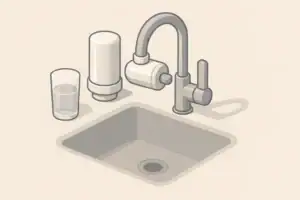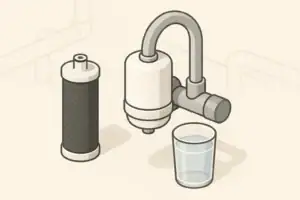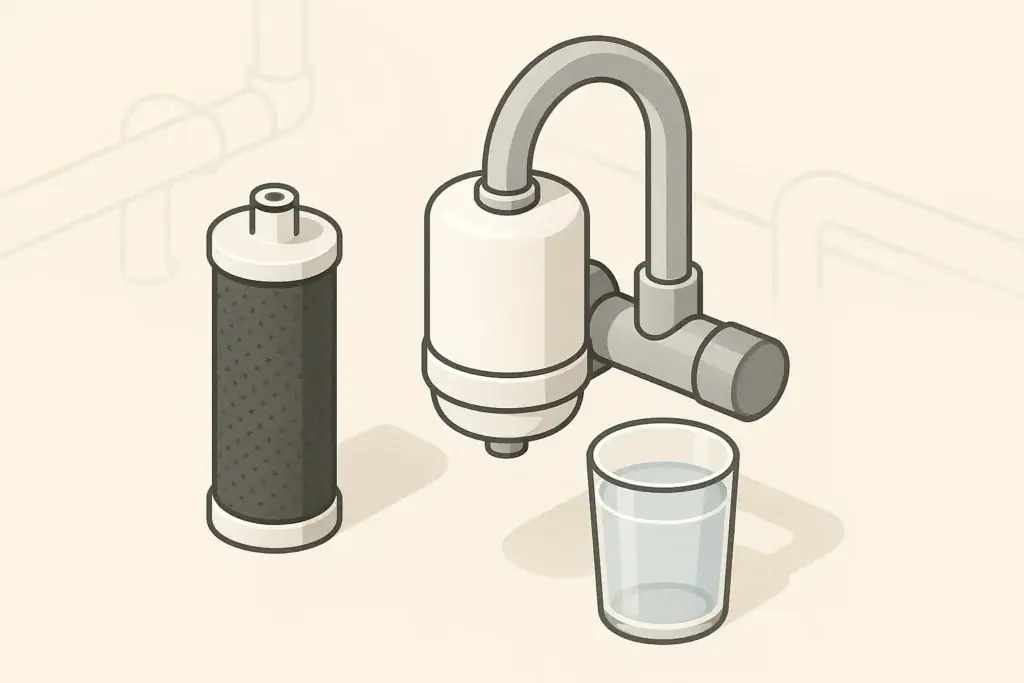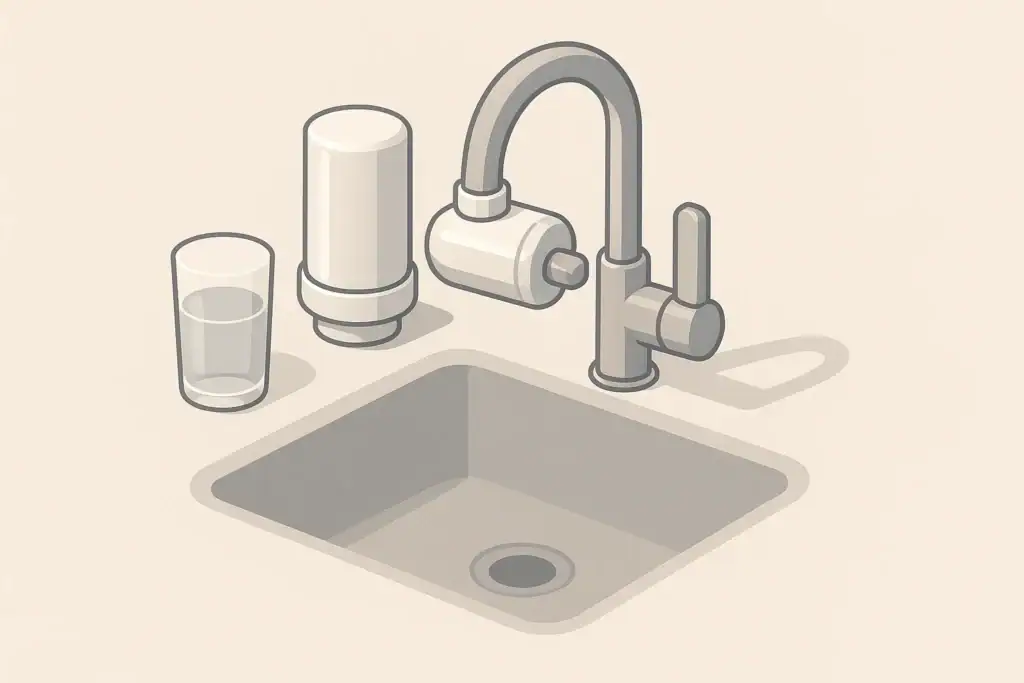
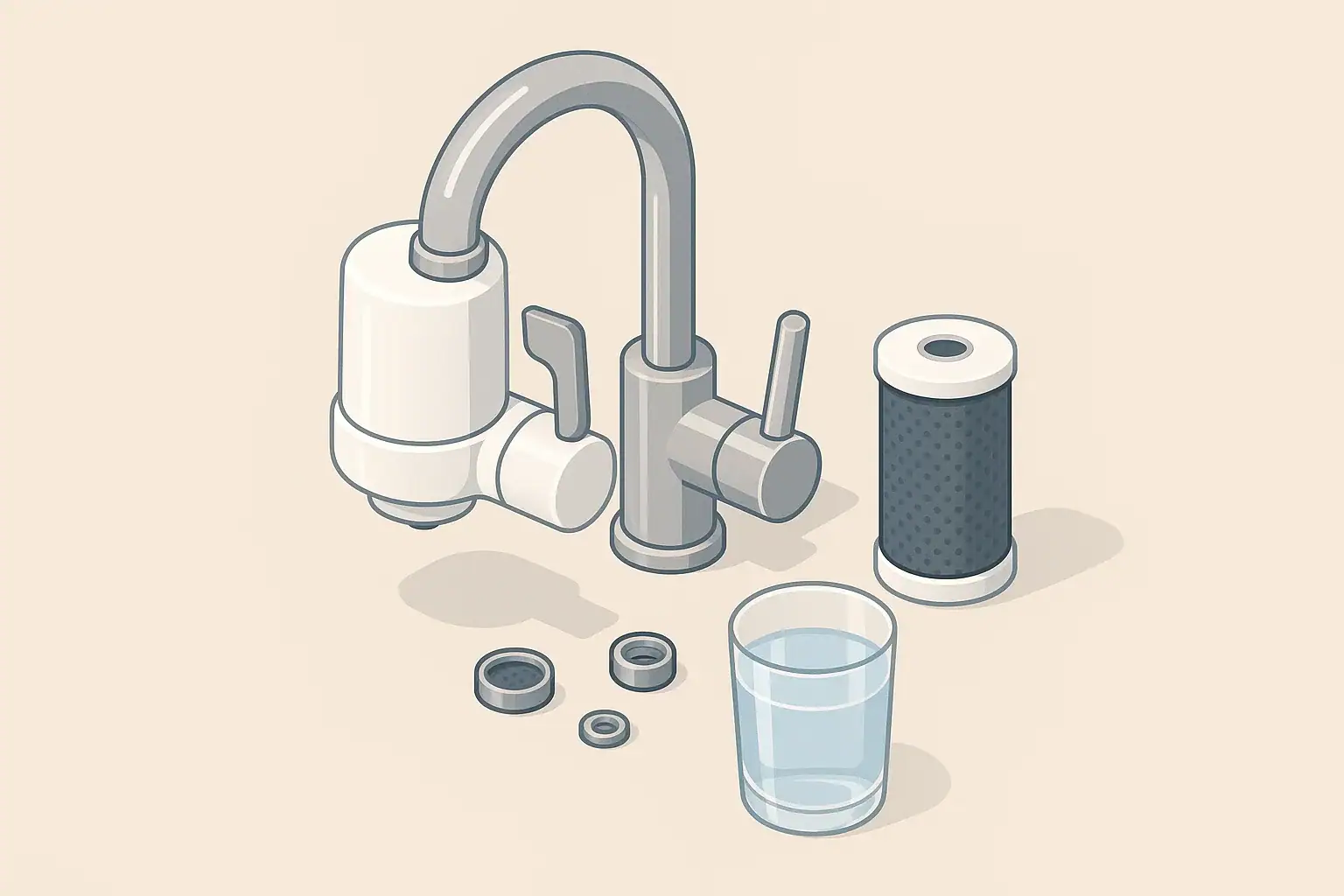
Faucet-mounted water filters are popular because they attach directly to many kitchen faucets without permanent plumbing changes. The small part that makes this possible is the faucet filter adapter. It connects the filter body to the faucet outlet after the original aerator is removed.
Fit problems are common because faucets are not all built the same way. A filter may use a standard threaded connector, while the sink faucet may have a recessed aerator, a pull-down sprayer, a designer outlet, or a nonstandard thread pattern. In some cases, the right adapter solves the issue. In others, a faucet-mounted filter is simply not the best match for that fixture.
Understanding aerators, thread sizes, and common mismatch points can reduce frustration before purchase. It can also help renters avoid unnecessary damage, homeowners avoid leaks, and everyone make a more practical filtration choice.
Why Faucet Filter Adapters Matter
Faucet-mounted water filters are popular because they attach directly to many kitchen faucets without permanent plumbing changes. The small part that makes this possible is the faucet filter adapter. It connects the filter body to the faucet outlet after the original aerator is removed.
Fit problems are common because faucets are not all built the same way. A filter may use a standard threaded connector, while the sink faucet may have a recessed aerator, a pull-down sprayer, a designer outlet, or a nonstandard thread pattern. In some cases, the right adapter solves the issue. In others, a faucet-mounted filter is simply not the best match for that fixture.
Understanding aerators, thread sizes, and common mismatch points can reduce frustration before purchase. It can also help renters avoid unnecessary damage, homeowners avoid leaks, and everyone make a more practical filtration choice.
How Sink Aerators and Faucet Threads Work
A faucet aerator is the small removable piece at the end of many faucet spouts. It often contains a screen and flow-shaping parts that add air to the water stream, reduce splashing, and provide a smoother flow. Faucet filters usually replace this aerator at the outlet.
Male and female faucet threads
Thread direction is one of the first fit details to check. A faucet outlet with threads on the outside is commonly called a male-threaded faucet. A faucet outlet with threads on the inside is commonly called a female-threaded faucet. Faucet filter adapters are used to bridge the filter connector to one of these thread styles.
This naming can be confusing because the adapter and the faucet have opposite mating surfaces. If the faucet has outside threads, the adapter will need inside threads at that connection point. If the faucet has inside threads, the adapter will need outside threads.
Regular versus recessed aerators
Many older or basic kitchen faucets have visible aerators that can be unscrewed by hand or with a gentle gripping tool. Newer faucets may use recessed or hidden aerators. These sit up inside the spout and often require a small plastic key to remove.
A recessed aerator does not always mean a faucet filter will fit. Some recessed designs still expose usable threads after the aerator is removed. Others leave too little thread depth, use uncommon sizing, or have a spout shape that prevents the filter collar from sealing evenly.
Example values for illustration.
| Faucet feature | What it usually means | Adapter concern |
|---|---|---|
| Visible outside threads | Often a standard male-threaded outlet | May need an adapter with matching inside threads |
| Visible inside threads | Often a standard female-threaded outlet | May need an adapter with matching outside threads |
| Recessed aerator | Aerator sits inside the spout | May require a removal key and may not leave enough usable thread |
| Pull-down sprayer | Hose and spray head form the faucet outlet | Usually not compatible with faucet-mounted filters |
| Pull-out sprayer | Spray head pulls forward from the spout | Usually not recommended for attached filter weight |
| Wide waterfall outlet | Non-round or flattened water outlet | Often lacks standard aerator threads |
| Very short spout nose | Limited space below the outlet | Filter body may hit the sink or backsplash |
Common Faucet Thread Sizes and Why They Are Not Universal
Several thread sizes are common in U.S. kitchen and bathroom faucets, but there is no guarantee that a particular sink uses one of them. Common examples include 15/16-inch male and 55/64-inch female aerator connections, along with metric sizes such as M22 and M24. These examples describe thread diameter and style, not filtration performance.
Thread pitch also matters. Two parts may look close in diameter but still fail to tighten correctly if the thread pitch is different. Forcing a mismatched adapter can cross-thread the faucet or damage the adapter, which may create leaks or make the original aerator difficult to reinstall.
How to identify the likely size
The safest starting point is to remove the aerator and compare it with the adapter set supplied with the filter. Many faucet filters include several adapters and washers for common thread types. If none starts smoothly by hand, stop and reassess rather than tightening harder.
If measuring is needed, use a simple ruler or caliper to estimate the outside diameter of the threaded area. The measurement can help narrow the possibilities, but it may not confirm thread pitch. Some hardware stores and plumbing departments have aerator sizing guides, but availability varies.
Washers and seals are part of the fit
An adapter is not only about threads. A small rubber washer or gasket usually creates the water seal. A connection can be the correct thread size and still leak if the washer is missing, doubled up incorrectly, twisted, or seated on a damaged surface.
Use only the washers intended for the adapter connection. Stacking random washers, using tape to compensate for a poor fit, or over-tightening a plastic collar can create new problems. A properly matched adapter normally tightens by hand and seals without excessive force.
Common Fit Problems With Faucet Filter Adapters
Most faucet filter fit problems fall into a few predictable categories. Some can be solved with the right adapter or washer. Others point to a faucet style that is not suitable for a faucet-mounted filter.
The adapter starts but will not tighten
If an adapter catches the first thread but stops after a partial turn, the size or pitch may be wrong. It may also be starting at a slight angle. Back it off and try again gently. If it still binds, do not force it. Cross-threading can damage the faucet outlet.
Water leaks around the adapter
Leaks at the connection usually come from an uneven seal, missing washer, damaged washer, or misaligned adapter. Remove the adapter, inspect the washer, and make sure the sealing surface is clean. Mineral buildup from hard water can also interfere with a flat seal.
A small drip at the filter housing may be a separate issue from the faucet adapter. Check whether the leak is coming from the faucet-to-adapter joint, the adapter-to-filter joint, or the filter housing itself.
The filter hangs at an awkward angle
Some faucets have angled spouts or very short outlet sections. Even if the adapter threads on, the filter body may sit crooked, hit the sink basin, or interfere with handles and backsplash areas. A filter that puts sideways stress on the connection is more likely to loosen or leak over time.
The flow is unexpectedly low
Faucet-mounted filters often reduce flow because water must pass through filter media such as activated carbon. Some reduction is normal. However, very low flow can be caused by a clogged aerator screen left in place, a mispositioned washer, trapped debris from installation, or a cartridge that needs replacement.
Flow also depends on household water pressure and the specific filter design. A faucet filter is convenient, but it is not meant to match the unrestricted flow of an open faucet.
Compatibility Limits: Faucets That Often Do Not Work
Some faucet designs are poor candidates for faucet-mounted filters, even with multiple adapters. This does not mean the faucet is defective. It simply means the outlet was not designed to support an add-on filter.
Commonly incompatible or difficult faucet types include:
- Pull-down kitchen faucets with detachable spray heads
- Pull-out faucets with hose-mounted outlets
- Hand sprayers or side sprayers
- Non-round waterfall or open-channel outlets
- Faucets with very deep recessed aerators and no usable threads
- Commercial-style spring faucets with flexible spray assemblies
- Faucets with fragile finishes or decorative outlet parts that should not carry extra weight
Attaching a filter to a pull-down or pull-out sprayer can strain the hose, connector, or spray head. It may also make the faucet harder to dock correctly. In these cases, a pitcher, countertop unit, refrigerator filter, or under-sink system may be a more practical option depending on the water concern and available space.
Apartment and Rental Considerations
Faucet filters are often appealing in apartments because they do not usually require drilling or permanent plumbing changes. Still, renters should be careful with aerators and adapters. Small parts can be easy to lose, and some faucet finishes scratch easily.
Keep the original parts
After removing the original aerator, store it with its washer in a labeled bag or small container. This makes it easier to restore the faucet when moving out or when cleaning the filter. If a recessed aerator key was supplied with the faucet, keep it with the aerator.
Avoid modifications that change the fixture
Do not grind, cut, glue, or permanently alter the faucet outlet to make a filter fit. Do not bypass pressure features or safety components of a filtration device. If a simple threaded adapter does not work, choose a filter format that suits the sink rather than modifying the plumbing.
For rentals with unusual faucets, a countertop unit that connects temporarily, a pitcher, or a dispenser-style filter may be easier to remove and maintain. The best choice depends on the water quality goal, available counter space, and how much filtered water the household uses.
When an Adapter Is Not the Best Solution
A faucet filter adapter is useful only when the faucet is compatible and the filter format fits everyday use. If the household needs higher filtered-water volume, dislikes reduced faucet flow, or has a faucet style that cannot support a filter, another setup may be more practical.
Faucet-mounted filters are typically chosen for taste and odor improvement and simple point-of-use filtration. They are not the same as under-sink systems, whole-house filters, or reverse osmosis systems. Different technologies and installation locations address different goals, and no single format is best for every sink.
Before buying extra adapters, consider whether the problem is truly a thread mismatch or whether the faucet style is fundamentally incompatible. Buying multiple adapters will not solve a pull-down sprayer limitation, a non-round outlet, or a lack of space below the spout.
Example values for illustration.
| Situation | Possible alternative | Practical tradeoff |
|---|---|---|
| Pull-down sprayer faucet | Pitcher or dispenser filter | No faucet connection, but slower batch filling |
| Need more filtered water for cooking | Under-sink point-of-use system | More installation planning than a faucet filter |
| Limited counter space | Under-sink system | Keeps counter clear but uses cabinet space |
| Rental with unusual faucet | Pitcher or countertop option | Easier removal, but may take counter or refrigerator space |
| Very low faucet pressure | Evaluate pressure before choosing | Some filters may feel slow under low pressure |
| Non-round outlet | Non-faucet-mounted filter | Avoids forcing adapters onto unsupported shapes |
Related guides: Faucet-Mount Filter Compatibility: How to Check Your Faucet Type • How to Install a Faucet-Mount Filter Without Leaks • Troubleshooting a Faucet-Mount Filter with Slow Flow • Faucet Compatibility Problems: When Adapters Don’t Fit
Key Takeaways for Better Faucet Filter Fit
Faucet filter adapters are small parts, but they determine whether a faucet-mounted filter is practical. Start by identifying the aerator style, thread direction, and faucet shape. Remove parts gently, keep the original aerator, and test adapters by hand before tightening.
A good fit should thread smoothly, seal with the correct washer, and support the filter without bending or pulling on the faucet outlet. If the faucet has a pull-down sprayer, recessed nonstandard outlet, or unusual shape, a different filtration format may be the simpler and safer decision.
The most practical approach is to match the filter style to the faucet you actually have, not the faucet you wish it were. That keeps installation simple, reduces leaks, and makes routine filter replacement easier over time.
Frequently asked questions
How do I know if my faucet uses a male or female aerator thread?
Remove the aerator and look at where the threads are located. Threads on the outside of the faucet indicate a male-threaded outlet, while threads on the inside indicate a female-threaded outlet.
Can I use a faucet filter on a recessed aerator?
Sometimes. If the recessed aerator leaves enough usable thread and the faucet outlet is a standard shape, an adapter may work. If the threads are too deep or the fit is unstable, the filter may not be suitable for that faucet.
Why does my adapter leak even though it seems to fit?
A leak usually points to a missing, damaged, or misseated washer, or to a sealing surface that is uneven or dirty. Hand-tightening with the correct washer is usually better than forcing the connection.
Will a faucet filter work on a pull-down sprayer faucet?
Usually not. Pull-down sprayers and similar hose-mounted faucets are often poor matches because the filter adds weight and can interfere with docking and hose movement.
What should I do if the adapter starts threading but then stops?
Back it off right away and try again by hand. If it still binds, the thread size or pitch may not match, and forcing it could damage the faucet or adapter.
Do faucet filters always reduce water flow?
Some reduction is normal because the water passes through filter media. Very low flow, however, can signal an installation issue, a clogged screen, or a cartridge that needs replacing.
- NSF/ANSI standards explained (42/53/401/58)
- Clear trade-offs: pitcher vs faucet vs under-sink vs RO
- Maintenance planning: cost per gallon and replacement cadence