
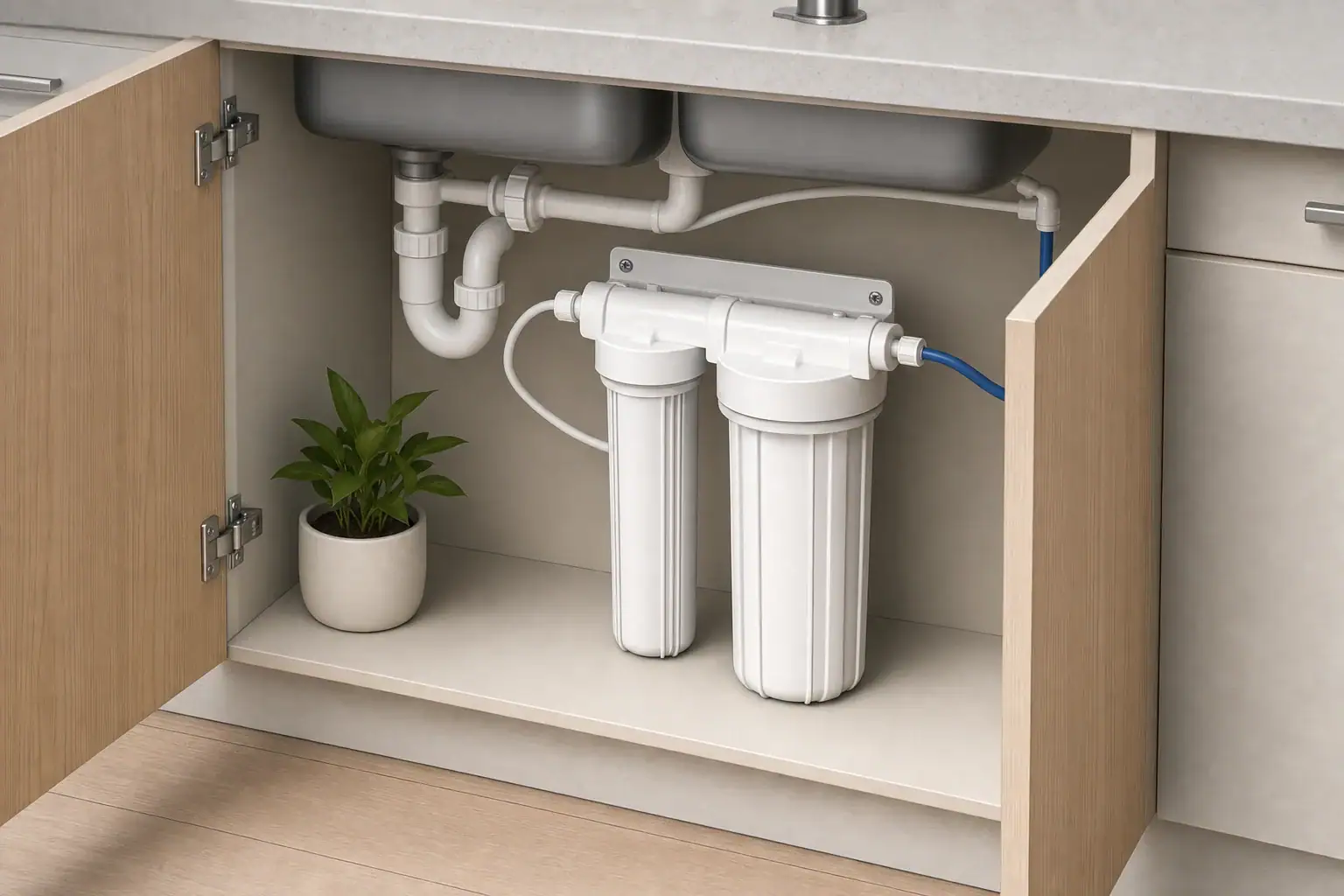
Big Blue and slimline filter housings perform the same basic job: they hold replaceable cartridges and direct water through the filter media. The main difference is cartridge diameter. A Big Blue-style housing generally accepts a cartridge about 4.5 inches in diameter, while a slimline housing generally uses one about 2.5 inches in diameter.
The wider housing is usually the better fit for high-flow, high-capacity, or sediment-heavy applications. A slimline housing takes up less room and can be sufficient for a dedicated faucet, appliance, small household, or other lower-flow installation. Neither format guarantees a particular flow rate or contaminant reduction. Those results depend heavily on the cartridge, housing ports, plumbing, water quality, and operating pressure.
Big Blue and slimline housings at a glance
| Consideration | Big Blue-style housing | Slimline housing |
|---|---|---|
| Typical cartridge diameter | About 4.5 inches | About 2.5 inches |
| Common cartridge lengths | Nominal 10 or 20 inches | Nominal 10 or 20 inches |
| Flow potential | Generally higher with a suitable cartridge | Generally better for lower-flow service |
| Contaminant-holding capacity | Usually greater for the same media and length | Usually lower for the same media and length |
| Installation space | Requires more width, depth, and service clearance | Easier to fit in compact locations |
| Typical use | Whole-house lines or demanding point-of-use systems | Under-sink, appliance, or lighter-duty filtration |
| Cartridge and water weight | Heavier, especially when full | Lighter and easier to handle |
These dimensions are industry conventions rather than universal guarantees. Actual housings, cartridges, caps, brackets, and port sizes vary. Compatibility should be confirmed from the dimensions and specifications for the individual components.
How housing size affects flow
A wider cartridge provides more surface area for water to pass through. With comparable filter media, pore size, and construction, that additional area can reduce water velocity through the media and limit pressure loss. It can also allow the cartridge to keep delivering useful flow longer as sediment accumulates.
That does not mean every wide housing will outperform every slimline model. The complete flow path includes:
- The housing’s inlet and outlet port sizes
- Pipe or tubing diameter
- Cartridge material and construction
- Micron rating and sediment loading
- Flow restrictions in valves, fittings, and downstream fixtures
- The number of housings installed in series
- Available supply pressure
A restrictive carbon block in a wide housing, for example, may produce more pressure drop than a coarse pleated sediment cartridge in a slimline housing. Port size is also not a flow rating. Large ports can reduce one potential restriction, but they cannot compensate for a cartridge that is undersized for the required flow.
Use peak flow, not average daily use
Housing selection should account for the highest flow likely to pass through the filter at one time. For a whole-house installation, that can occur when multiple showers, faucets, or appliances run together. An under-sink drinking-water system normally serves a much smaller flow.
As an illustrative example, if a household expects a peak demand of 8 gallons per minute, the relevant question is not whether a housing has 1-inch ports. The cartridge should have documented flow and pressure-drop information near 8 gallons per minute under comparable conditions. The housing must also be rated for the system’s pressure and temperature.
Capacity depends on what the cartridge is doing
Capacity can refer to several different things, so a larger cartridge should not automatically be interpreted as lasting a specific number of months.
Sediment-holding capacity
A wider sediment cartridge generally has more surface area and room to retain particles. This can be valuable for well water or municipal supplies that carry visible sediment, rust, or recurring pipe debris. More area may extend the time before clogging causes an unacceptable pressure drop.
Water conditions still control service life. A large cartridge exposed to a heavy sediment event can clog sooner than a small cartridge treating consistently clear water. Differential pressure across the filter is often a more useful maintenance signal than the calendar alone.
Adsorptive media capacity
Granular activated carbon, carbon blocks, and specialty media have finite treatment capacity. A wider cartridge can contain more media, but useful life depends on the target substance, concentration, contact time, flow, and cartridge design.
For contaminant reduction, use the cartridge manufacturer’s stated performance information and any applicable independent certification rather than relying on housing size. A housing itself does not establish that a system reduces lead, PFAS, chlorine, or any other specific substance.
Space involves more than housing width
Slimline housings are often favored under sinks because cabinet space is limited by the basin, drain, garbage disposal, supply valves, and stored items. Big Blue-style housings need substantially more room around the body and cap, and a water-filled housing can be heavy.
Measure for the complete installation rather than the housing body alone. Allow for:
- The cap, ports, fittings, and mounting bracket
- Vertical clearance to remove the sump and cartridge
- Room to grip and support the housing during service
- Pipe movement or isolation needed for maintenance
- A practical way to contain residual water when opening the housing
- Access to shutoff valves and any pressure-relief feature provided by the design
A 20-inch cartridge provides more media than a comparable 10-inch cartridge, but it also requires more vertical service clearance. A housing that technically fits between pipes may still be a poor choice if the sump cannot be removed without dismantling nearby plumbing.
Maintenance trade-offs
Big Blue-style filters may need less frequent cartridge replacement when their added media or surface area is well matched to the water conditions. They also cost more to fill with replacement media in many cases, hold more water when opened, and place greater loads on brackets and plumbing.
Slimline cartridges are lighter and easier to maneuver in a cabinet. Their smaller capacity can mean more frequent changes in sediment-heavy or high-use applications. If a slimline filter repeatedly causes declining pressure or short replacement intervals, moving to a wider format may be more practical than continuing to use less restrictive cartridges that do not meet the treatment objective.
Regardless of size, housings should be installed within their listed operating limits and supported as directed by their documentation. Aging sumps, damaged threads, flattened O-rings, overtightening, freezing, excessive pressure, and water hammer can contribute to leaks or housing failure. Components should be inspected during cartridge changes and replaced when their condition or manufacturer guidance calls for it.
Choosing the appropriate format
A Big Blue-style housing is generally more suitable when:
- The filter will serve a whole-house water line.
- Several fixtures may use filtered water at the same time.
- Sediment loading causes smaller cartridges to clog quickly.
- A higher-media-volume cartridge is needed for the treatment goal.
- There is enough structural support and service clearance.
A slimline housing is generally more suitable when:
- The installation serves one faucet, appliance, or low-flow branch.
- Cabinet width or depth is limited.
- Water has a low sediment load and expected use is modest.
- Compactness and easier cartridge handling matter more than maximum capacity.
- The selected cartridge can meet the required flow without excessive pressure loss.
Multiple slimline housings should not be treated as an automatic substitute for one wider housing. Installing stages in series can provide different treatment functions, but each cartridge adds resistance. Parallel plumbing can increase flow capacity, although balanced and serviceable installation requires deliberate design.
Common sizing mistakes
- Choosing from pipe size alone: Matching a housing port to the existing pipe does not establish adequate cartridge flow.
- Ignoring clean-filter pressure drop: A system that barely maintains pressure with a new cartridge will perform worse as the cartridge loads.
- Using housing size as a contaminant claim: Larger dimensions do not prove reduction performance.
- Failing to leave service clearance: Cartridge replacement should not require removing fixed cabinets or forcing plumbing out of position.
- Oversizing without considering stagnation: A very large housing on a lightly used line holds more standing water and may not provide a practical benefit.
- Mixing nominal sizes without checking compatibility: Cartridge diameter and length conventions do not guarantee a proper seal in every housing.
Related guides: Whole house sizing worksheet • Micron ratings for sediment filters • Cleaning and sanitizing filter housings
Practical selection process
Start with the treatment objective and estimated peak flow. Then compare cartridges that address that objective, paying attention to their pressure-drop data, capacity information, operating limits, and independently certified reduction claims when relevant. Choose a compatible housing that fits the cartridge and plumbing while leaving safe access for maintenance.
For most whole-house applications, the added surface area and capacity of a Big Blue-style housing make it the more practical starting point. For a compact under-sink or single-fixture installation, a slimline housing is often sufficient if its cartridge can deliver the required treatment and flow. The correct decision comes from the cartridge’s documented performance and the installation constraints, not housing diameter by itself.
Frequently asked questions
Is a Big Blue housing better than a slimline housing?
Neither is automatically better. A Big Blue-style housing is generally more suitable for higher flow, heavier sediment loading, or greater media capacity, while a slimline housing is often better where space and demand are limited.
Can a slimline filter be used for a whole-house water line?
It can be used only if the selected cartridge has adequate documented flow and acceptable pressure drop at the household’s expected peak demand. Many whole-house applications benefit from the added surface area of a wider housing.
Do larger housing ports mean higher filter flow?
No. Port size is only one part of the flow path. Cartridge design, micron rating, media type, plumbing, supply pressure, and sediment loading can all limit flow.
Does a Big Blue cartridge last longer than a slimline cartridge?
Often, but not always. A wider cartridge may hold more sediment or media, yet actual service life depends on water quality, flow volume, treatment objective, and the cartridge’s design.
How much clearance is needed to change a filter cartridge?
Allow enough room to remove the sump and cartridge below the housing, contain residual water, and access shutoff valves and fittings. Check the housing documentation because required clearance varies by model and cartridge length.
- NSF/ANSI standards explained (42/53/401/58)
- Clear trade-offs: pitcher vs faucet vs under-sink vs RO
- Maintenance planning: cost per gallon and replacement cadence