
Why the “first upgrade” decision matters
Many households reach a point where basic tap water is no longer good enough, whether due to taste, visible sediment, or concern about specific contaminants. When you first look into better filtration, you quickly encounter two very different paths: whole house filters that treat water as it enters the home, and point-of-use filters that treat water right where you drink or use it most (such as at the kitchen sink).
Installing both is common over the long term, but most budgets and schedules mean starting with one system. Choosing which upgrade to buy first affects:
- How your water tastes and smells at the kitchen tap
- How your showers feel and smell
- Appliance wear, scale buildup, and visible staining
- Ongoing costs for cartridges and maintenance
- Whether you may need to re-plumb later for a second system
This guide explains how whole house and point-of-use systems work, what each can realistically handle, and a practical way to decide which one to install first in a typical U.S. home.
Whole house filters vs point-of-use filters: the basics
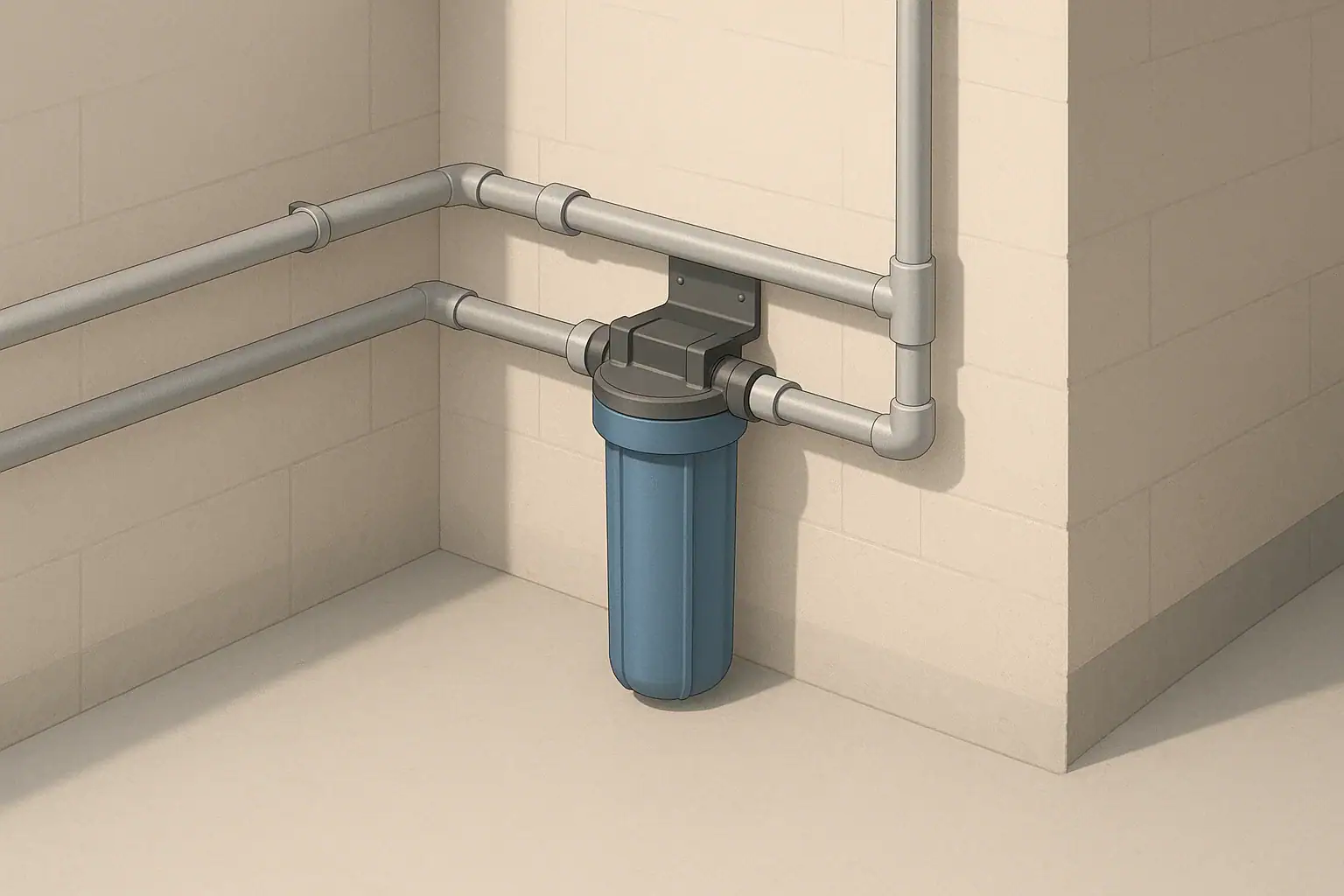
Whole house systems (often called point-of-entry or POE) are installed where water first enters your home, usually in a basement, utility room, or near a well pressure tank. They treat all downstream water: kitchen, bathrooms, laundry, and outdoor spigots (depending on how your plumbing is routed).
Point-of-use (POU) filters treat water at the location where it is used. Common examples include:
- Pitcher and countertop dispensers
- Faucet-mount filters
- Under-sink cartridge systems
- Under-sink reverse osmosis (RO) systems
- Refrigerator and ice-maker inline filters
Because they serve different roles, they often target different contaminants and performance metrics. Whole house filters focus on protecting plumbing and improving general water quality across the home. Point-of-use systems focus on higher-intensity treatment for the water you drink and cook with.
Example values for illustration.
| Main situation | Typical priority | Reasoning |
|---|---|---|
| Bad taste or odor only at kitchen tap | Point-of-use first | Directly improves drinking and cooking water with lower upfront cost. |
| Chlorine smell in showers and whole house | Whole house first | Improves water in all fixtures, especially bathrooms. |
| Visible sediment in multiple faucets | Whole house first | Protects plumbing, appliances, and all taps from particles. |
| Concern about specific drinking contaminants (e.g., lead, PFAS) | Point-of-use first | Easier to target specific contaminants at a single tap. |
| Scale buildup on fixtures and appliances | Whole house first | Treating hardness at entry helps entire plumbing system. |
| Renting or likely to move soon | Point-of-use first | Portable and does not require major plumbing changes. |
| Planning a full plumbing or bathroom remodel | Whole house first | Easier to integrate when pipes are already being modified. |
What whole house filters are good at (and not so good at)
Whole house filters are designed to handle relatively high flow rates for the entire home. Because of that, they often use larger cartridges or tanks with media that is optimized for broad, moderate-level treatment rather than extremely fine, slow filtration.
Strengths of whole house systems
Whole house filters are especially useful when your main problems affect more than just your drinking water.
- Chlorine and chloramine reduction for the entire home. Many municipal supplies use these disinfectants. Carbon-based whole house filters are commonly used to reduce chlorine taste and odor throughout the house, including showers and laundry.
- Sediment and turbidity control. If your water carries sand, silt, rust flakes, or other visible particles, a sediment stage at the point of entry can help protect valves, fixtures, and downstream filters from clogging.
- Scale and hardness management. Some whole house systems are paired with softening or scale-control media to reduce mineral buildup that can shorten the life of water heaters, dishwashers, and fixtures.
- Consistent baseline water quality. With a well-chosen system, every tap in the home starts from a better baseline, making point-of-use filters more effective and easier to maintain.
Limitations and realistic expectations
Despite their appeal as a “whole home solution,” these systems have constraints:
- They are not automatically comprehensive. A typical whole house carbon filter may not be certified to reduce contaminants like lead, PFAS, or certain volatile organic compounds (VOCs) at the low levels often discussed in consumer guidance. Check the specific certifications.
- Flow-rate tradeoffs. Whole house systems must deliver several gallons per minute. That requirement usually means coarser filtration than an under-sink or RO system at the kitchen tap.
- Higher upfront cost and installation complexity. Whole house units are often hard-plumbed into copper, PEX, or similar lines and may require a professional installer, shutoff valves, and bypass loops.
- Possible impact on water pressure. Undersized housings or clogged cartridges can cause noticeable pressure drops, especially when multiple fixtures are used at once.
When a whole house filter is usually the first upgrade
Installing a whole house system first often makes sense when:
- Your main complaints involve showers, laundry, or staining (chlorine odor, rust-colored fixtures, scale rings).
- You are on a private well with noticeable sediment or turbidity.
- You are planning a water heater replacement, bathroom remodel, or plumbing rework and want to integrate filtration at the same time.
- You expect to add point-of-use systems later and want them to last longer and clog less.
What point-of-use filters are good at (and not so good at)
Point-of-use systems concentrate their effort on a small portion of your total water use, usually drinking and cooking. Because they handle lower flow rates and volumes, they can use tighter filter media and more specialized cartridges.
Strengths of point-of-use systems
Common POU formats include pitchers, faucet-mounted units, under-sink cartridges, and under-sink RO systems. Their common advantages are:
- Targeted contaminant reduction. Many POU systems are tested or certified for specific contaminants that are more challenging to handle at whole house scale, such as lead, some PFAS, and many organic compounds associated with taste and odor.
- Better fit for drinking and cooking water. Because they treat lower volumes, they can use fine carbon blocks, ion exchange resins, or RO membranes with longer contact time.
- Lower upfront investment. Pitchers and faucet-mount units cost less to start with. Under-sink systems generally cost less than installing a whole house setup with professional labor.
- Flexibility and portability. Many POU units can be moved to a new home with you or switched among faucets without altering permanent plumbing.
Limitations and realistic expectations
POU filters are powerful at the tap they serve, but they have boundaries.
- They do nothing for showers, laundry, or other unfiltered taps. A perfect under-sink system will not help with chlorine smell in the bathroom or scale in the dishwasher.
- Limited flow and capacity. Pitchers and faucet-mount units may have slower flow, smaller capacity, and more frequent cartridge changes than larger under-sink units.
- Multiple filters may be needed. If you want filtered water in the kitchen, bar sink, and refrigerator, each location may require its own filter or a more complex shared setup.
When a point-of-use filter is usually the first upgrade
Starting with POU filtration is often the most practical choice when:
- Your top priority is improving taste and odor of drinking water at the kitchen sink.
- You are especially focused on specific drinking contaminants that are easier to target at the tap.
- You rent or expect to move soon and want a solution you can take with you.
- Your budget supports a smaller initial investment but regular cartridge changes are acceptable.
Cost, capacity, and maintenance: thinking in cost per gallon
Besides performance, cost per gallon and maintenance effort often determine which system feels sustainable over time. Both whole house and POU filters involve:
- Upfront hardware and possible installation costs
- Replacement cartridges or media
- Occasional sanitization or cleaning tasks
- Downtime or planning for filter changes
Upfront vs recurring costs
Whole house filters typically cost more initially, especially when professional installation and plumbing modifications are considered. Some configurations, such as multi-stage systems or separate softeners, raise that cost further.
Point-of-use systems generally cost less to install, though more advanced under-sink and RO systems still represent a noticeable investment. However, the main ongoing cost for both approaches is replacement media, not the initial hardware.
Capacity and change intervals
Filter capacity is typically measured as a volume of water treated (for example, a certain number of gallons) or a time interval (such as three or six months), whichever comes first. Whole house cartridges may have a higher stated capacity, but they also treat much more water, including for toilets and outdoor use. As a result, their real-world change intervals may be shorter than expected in large households.
Point-of-use filters treat less total volume, but some units use smaller cartridges with lower capacity. Reviewing example cost per gallon can help compare options on equal footing, even if you do not know your exact usage.
Monitoring filter performance over time
Because most filters gradually load with particles and contaminants, performance can change before a visible problem appears. Some signs that replacement may be due include:
- Noticeable drop in water pressure or flow at a filtered tap
- Return of earlier tastes or odors
- Manufacturer’s recommended time or volume limit reached
For whole house filters, tracking pressure before and after the system (if gauges are installed) can show how much restriction the cartridges are adding. For POU filters, a simple timer, calendar reminder, or log can prevent overextending cartridge life.
How your water source and plumbing layout shape the decision
Two homes on the same street can have very different water conditions based on local distribution pipes, plumbing materials, and internal layouts. A few key factors strongly influence whether a whole house or POU filter should be installed first.
Municipal water vs private well
If you are on a municipal supply, your water has already been disinfected and generally monitored for certain regulated contaminants. Chlorine, chloramine, and distribution-related issues (such as main breaks or sediment events) may still be a concern, but you start from a treated baseline.
If you are on a private well, there is no central treatment. Well water may vary seasonally and can carry sediment, hardness, iron, manganese, and microbial risks that are specific to your well and geology. In this setting, a whole house sediment or iron prefilter is often a foundational step, with targeted POU filters added for drinking water.
Existing appliances and plumbing constraints
When deciding what to install first, consider:
- Space near the main water line. Whole house units need clearance for housings and cartridge changes. Tight spaces may make installation more complex.
- Pipe material and accessibility. Some installations are straightforward on exposed PEX or copper; others are difficult if the main line is hidden or in finished walls.
- Appliances you want to protect. Water heaters, dishwashers, clothes washers, and ice makers may all benefit from better baseline water quality.
Future-proofing your setup
If you expect to upgrade in stages, planning ahead can reduce future rework.
- When installing a whole house filter first, consider leaving room and valve access for a future softener or additional stages.
- When starting with an under-sink POU system, think about how you would integrate a future fridge filter or RO unit without duplicating effort.
Using certifications to compare systems fairly
Different filter types often focus on different standards, but comparing them through certifications helps keep expectations grounded. In the U.S., many residential systems reference NSF/ANSI standards. Not every reliable system is certified, but third-party testing and certification provide a consistent way to compare claims.
Key standards commonly referenced for residential water treatment equipment include:
- NSF/ANSI 42: Aesthetic effects such as chlorine taste and odor, and some particulate reduction.
- NSF/ANSI 53: Health-related contaminants such as some heavy metals and certain organic chemicals.
- NSF/ANSI 58: Reverse osmosis systems, including performance and structural requirements.
- NSF/ANSI 401: Emerging contaminants, including some pharmaceuticals and industrial chemicals, where applicable.
When you compare a whole house carbon filter to an under-sink system, for example, one might focus on NSF/ANSI 42, while the other carries both 42 and 53, or additional claims. Reading the specific contaminant list for each certified claim is more informative than looking at standard numbers alone.
Example values for illustration.
| Standard | Typical focus | What to verify on documentation |
|---|---|---|
| NSF/ANSI 42 | Aesthetic issues (chlorine taste/odor, particulates) | Which specific aesthetic claims are certified and at what flow conditions. |
| NSF/ANSI 53 | Health-related contaminants (e.g., some metals, some organics) | Exact contaminants tested, reduction claims, and the model numbers covered. |
| NSF/ANSI 58 | Reverse osmosis system performance and structure | System capacity, recovery ratio examples, and which components are included. |
| NSF/ANSI 401 | Selected emerging contaminants | Which substances were tested; not all emerging contaminants are covered. |
| NSF/ANSI 372 | Lead content in materials | Whether all wetted parts of the system are covered by the certification. |
| Independent lab reports | Supplemental performance data | Lab name, test protocols used, and whether full reports are available. |
Putting it together: a step-by-step way to choose your first upgrade
Instead of starting with the technology, start with your specific goals. A simple sequence can help make the choice clearer.
Step 1: List your top three water concerns
Write down what bothers you most or what you want to change:
- Chlorine smell in showers?
- Spots and scale on fixtures?
- Flat or chemical taste in coffee and tea?
- Rust particles in sink or tub?
- Interest in reducing specific listed contaminants for drinking water?
Step 2: Match concerns with filter scope
Compare your list to what each system type can address most directly:
- If your concerns involve entire-house experiences (showers, laundry, stains), a whole house filter often comes first.
- If they involve taste and specific contaminants at one sink, a point-of-use system usually offers the best initial return.
Step 3: Check your water source information
Review any recent water quality reports, private well tests, or plumber notes you have. Look for mentions of hardness, sediment, iron, chlorine, and any specific regulated contaminants that stand out. This information can refine your decision between a broad whole house improvement and a focused POU system.
Step 4: Evaluate installation constraints
Consider what is realistically possible right now:
- Is the main line accessible without major demolition?
- Do you have space near the entry point for a whole house system?
- Is there room under the kitchen sink or on the counter for a POU unit?
- Are you comfortable with DIY plumbing, or will you schedule professional installation?
Step 5: Estimate total cost over 3–5 years
Look beyond the first purchase and think about cartridge changes and routine checks. A moderate-cost system with affordable, easy-to-find replacement filters is often more practical than an advanced system with expensive, hard-to-source cartridges.
Step 6: Plan for a layered approach
Many households end up with both whole house and point-of-use filtration over time. Starting with the system that addresses your most widespread or pressing concern, then adding a second layer later, is often the most balanced and sustainable path.
By focusing on your water source, household priorities, and long-term maintenance comfort, you can decide whether a whole house or point-of-use filter should be your first upgrade, and leave room to expand your system as your needs change.
Frequently asked questions
If I only notice chlorine smell in showers, should I buy a whole house or point-of-use filter first?
Install a whole house filter first when chlorine odor is present in showers and other taps because it treats all fixtures and improves the bathing experience. If the smell is limited to the kitchen tap only, a point-of-use unit at that sink is often a faster and lower-cost fix.
Can point-of-use systems remove contaminants like lead and PFAS better than whole house systems?
Point-of-use systems such as certified under-sink carbon block filters or reverse osmosis units are more commonly certified to reduce contaminants like lead and certain PFAS at drinking-water concentrations. Whole house systems can address some contaminants but achieving the same certified reductions across high flow rates is less common, so always check third-party certifications for the specific model and contaminant list.
How do long-term costs compare between whole house and point-of-use options?
Whole house systems generally have higher upfront and installation costs but can reduce maintenance issues across multiple appliances, while POU systems usually cost less to start but can have higher per-gallon replacement costs at each location. Compare cost per gallon, expected cartridge life, and installation expenses over a 3–5 year window to see which fits your budget and usage pattern.
Will a whole house filter prevent scale and extend appliance life?
Only systems designed for hardness control—such as water softeners or specific scale-control media—address scale; typical carbon/sediment whole house filters do not remove hardness ions. If scale and mineral buildup are primary concerns, plan for a dedicated softening or scale-management stage at the point of entry.
Can I install a point-of-use system now and add a whole house filter later?
Yes. Many households start with a POU system to quickly improve drinking water, then add whole house filtration later to address showers, laundry, and plumbing protection. When planning upgrades, leave room and valve access at the main line to simplify future whole house installation and avoid redundant work.
Recommended next:
- Whole House Filters vs Water Softeners: Different Jobs Explained
- Best Whole House Sediment Filters: Clear Up Cloudy Water
- Whole House Carbon Filters for Chlorine & Taste: What to Expect
- Whole House Filter Flow Rate: Sizing by GPM and Household Count
- Backwashing Filters Explained: Pros, Cons, and Maintenance
- Installing a Whole House Filter: Placement, Bypass, and Leak Prevention
- More in Whole House Filters →
- NSF/ANSI standards explained (42/53/401/58)
- Clear trade-offs: pitcher vs faucet vs under-sink vs RO
- Maintenance planning: cost per gallon and replacement cadence