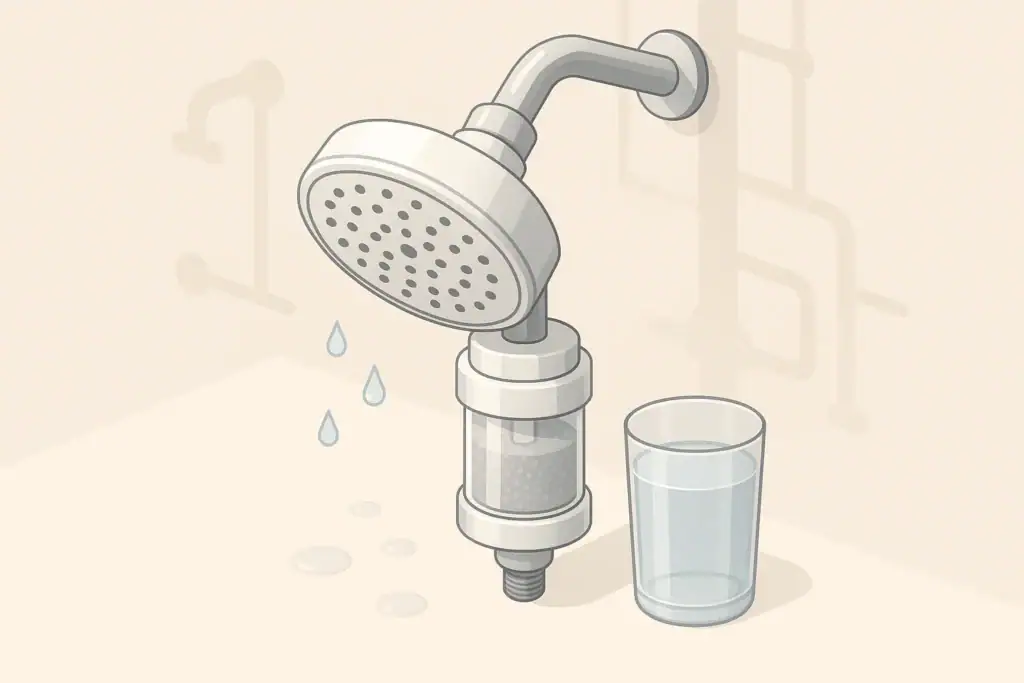

A vitamin C shower filter is a point-of-use device designed to treat water at the showerhead or shower arm. Its main purpose is to reduce chlorine before the water becomes spray, steam, and droplets in the shower area. These filters are popular because they are compact, easy to install compared with larger systems, and focused on a specific nuisance: chlorine odor in shower water.
The key point is that vitamin C filters are not general-purpose drinking water filters, water softeners, or whole-house treatment systems. They use a chemical reaction to neutralize chlorine, most commonly with ascorbic acid or sodium ascorbate. That makes them useful in some shower situations, but limited in others.
This article explains what a vitamin C shower filter does for chlorine, where it fits compared with KDF media shower filters, and what to check before choosing one for a home, apartment, or rental.
Why chlorine is in shower water
Most public water systems in the United States use a disinfectant to help control microbial growth as water travels through pipes. Chlorine and chloramine are two common disinfectants. They are used because water can spend time in storage tanks, mains, and building plumbing before it reaches a faucet or shower.
By the time water reaches a home, some disinfectant residual may still be present. That residual is intentional in municipal water distribution. It helps protect water quality before the water is used. However, the same residual can also contribute to taste and odor complaints at taps and showers.
In a shower, chlorine may be more noticeable than it is in a glass of cold water. Warm water, agitation, and spray can make odors easier to detect. Some people describe the smell as pool-like, sharp, or chemical. The intensity can vary by season, source water, water utility practices, and distance from the treatment plant.
A shower filter is installed at the point of use, so it only treats water passing through that shower. It does not change the disinfectant level in the rest of the home, and it does not replace any treatment performed by the water utility.
How vitamin C reacts with chlorine
Vitamin C is a reducing agent. In water treatment discussions, that means it can chemically react with oxidizing disinfectants such as free chlorine. The reaction converts free chlorine into chloride and other reaction products under ordinary water conditions. In practical terms, the chlorine odor may be reduced because the free chlorine is no longer present in the same active form.
Shower filters that use vitamin C typically rely on ascorbic acid, sodium ascorbate, or a blend of media that releases vitamin C into the water stream. The amount of contact time is short because shower water moves quickly. For that reason, the filter design, dose rate, media surface area, and actual shower flow all matter.
Unlike an adsorptive filter, vitamin C is consumed as it reacts. That is one reason cartridge life is tied to water use and disinfectant level. A cartridge can still allow water to flow after its active media is depleted, but chlorine reduction may decline.
Example values for illustration.
| Option | Main role | Chlorine notes | Key limitation |
|---|---|---|---|
| Vitamin C media | Chemical reduction | Targets free chlorine through a reaction | Media is consumed with use |
| Activated carbon | Adsorption and catalytic reactions | Can reduce chlorine when contact time is adequate | Hot water and high flow can reduce performance |
| Catalytic carbon | Enhanced carbon treatment | Often used where chloramine is a concern | Needs enough media and contact time |
| KDF-type media | Redox treatment | Often paired with carbon in shower filters | Performance depends on water chemistry and design |
| Sediment screen | Particle capture | Does not meaningfully reduce dissolved chlorine | Not a disinfectant treatment media |
| Whole-house carbon | Treats water before fixtures | Can reduce chlorine throughout the home | Larger system with more planning and maintenance |
What vitamin C shower filters can do
The most practical benefit of a vitamin C shower filter is reduction of free chlorine odor at one shower. If the water has a noticeable chlorine smell, and the disinfectant is primarily free chlorine, a properly functioning vitamin C cartridge may make the shower smell less chlorinated.
Because the treatment happens right before water exits the showerhead, it can be appealing in rentals or apartments where larger plumbing changes are not practical. Many units are installed between the shower arm and showerhead, or as part of a filtered showerhead assembly. Installation should follow the product instructions and should not involve bypassing anti-scald, pressure-balancing, or other safety features.
Vitamin C shower filters may also be paired with other media. Some cartridges combine vitamin C with sediment screening, carbon, or mineral media. The specific performance depends on the cartridge design. A longer list of media does not automatically mean better treatment, especially when there is limited space and high shower flow.
For users focused only on chlorine odor in one shower, vitamin C can be a simple and targeted option. It is not usually the best choice for treating all water in a home or for handling a broad list of contaminants.
What vitamin C shower filters do not do
A vitamin C shower filter should not be viewed as a complete water treatment system. It is designed for a narrow purpose. It does not make water pure, sterile, or suitable for uses outside its intended application.
Common limitations include:
- It does not soften hard water or remove calcium and magnesium hardness.
- It does not reliably reduce total dissolved solids, often called TDS.
- It is not a substitute for a certified drinking water filter for lead, PFAS, VOCs, nitrate, or other specific contaminants.
- It does not treat all fixtures in the home.
- It does not correct plumbing problems, water heater issues, or bacterial growth inside a showerhead.
Some marketing language around shower filters can be broad. A practical way to evaluate claims is to separate odor control from contaminant reduction. Reducing a chlorine smell is different from claiming wide contaminant removal. For drinking water concerns, look at filters designed and tested for drinking water applications, and match the technology to the contaminant of concern.
Chlorine versus chloramine in shower water
Free chlorine and chloramine are related but not identical. Free chlorine is generally more reactive and easier for many treatment media to reduce. Chloramine is formed when chlorine combines with ammonia. It is more stable in distribution systems, which is why some utilities use it for longer-lasting residual protection.
Vitamin C can react with chloramine, but real-world shower performance depends on contact time, dose, water temperature, pH, flow rate, and cartridge design. A small shower cartridge with fast-moving water may not treat chloramine as consistently as a larger system designed for that purpose.
If a home receives chloraminated water and the goal is broad reduction before multiple fixtures, a properly sized whole house carbon filter for chlorine, often using catalytic carbon, may be considered. For one shower, a vitamin C cartridge may still reduce some odor, but expectations should be modest unless there is clear performance information for chloramine.
To determine which disinfectant is used, homeowners can check a local water quality report or contact the water utility. Reports may describe residual disinfectant as chlorine, free chlorine, combined chlorine, or chloramine. Terminology varies, so asking the utility directly can be helpful.
Flow rate, contact time, and cartridge life
Showers use more flow than many small drinking water filters. A typical efficient showerhead may use around a few gallons per minute, while some older fixtures use more. That fast flow leaves little time for water to contact the filter media.
For chlorine reduction, contact time matters. If water passes too quickly through too little media, reduction may be incomplete. If the cartridge is undersized for the flow rate, chlorine odor may return sooner or may never fully disappear.
Cartridge life also depends on use. A shower used by one person once per day places less demand on a cartridge than a shared bathroom used multiple times daily. Warmer water, higher disinfectant residual, and longer showers can all increase consumption of the active media.
Filter replacement intervals should be treated as estimates, not guarantees. A manufacturer may list a gallon capacity or a month range, but actual performance depends on local water and use patterns. If chlorine odor returns, flow drops, or the cartridge shows signs of clogging, it may be time to replace it even if the calendar estimate has not passed.
When a vitamin C shower filter is a practical choice
A vitamin C shower filter can make sense when the main concern is chlorine odor at a single shower and the home is served by municipal water. It may also make sense when the user needs a removable, low-commitment option for a rental or apartment.
It is most suitable when:
- The water concern is mainly free chlorine odor.
- The filter will be used at one shower, not the whole home.
- The user is comfortable replacing cartridges on schedule.
- The shower has enough clearance for the added filter housing.
- The existing showerhead and plumbing are in good condition.
Other approaches may fit better in different situations. A whole-house carbon system may be more appropriate when chlorine odor is noticeable at many fixtures. A drinking water filter may be needed for kitchen water concerns. A softener or scale-control system may be relevant for hardness, but that is a separate issue from chlorine.
For private wells, chlorine may not be present unless the well or plumbing has been disinfected or an ongoing treatment system is installed. Well owners should base treatment decisions on water testing and the full water chemistry, not on assumptions drawn from municipal water systems.
Maintenance and replacement planning
Shower filters are easy to overlook because water may keep flowing even after treatment performance has declined. A basic maintenance plan helps keep expectations realistic. The plan does not need to be complicated: note the install date, estimate typical shower use, and watch for changes in odor or flow.
Before replacing a cartridge, turn off the shower and follow the instructions for that specific device. Avoid overtightening housings, cross-threading plastic parts, or using makeshift adapters that are not intended for pressurized shower plumbing. If a permanent change to plumbing is needed, use a qualified professional.
After any filter change, check for leaks during and after the first shower cycle. A slow drip at the shower arm can waste water and may damage surfaces over time. If the assembly becomes heavy or unstable, remove it and reassess the setup rather than forcing it into position.
Example values for illustration.
| Observation | Possible meaning | Practical response |
|---|---|---|
| Chlorine odor returns | Vitamin C media may be depleted | Replace the cartridge and note the service time |
| Lower shower flow | Screen or media may be restricted | Inspect for clogging and replace if needed |
| New leak at connection | Washer, threading, or housing issue | Re-seat parts according to instructions |
| Several daily users | Higher gallons treated | Shorten the replacement interval |
| Long hot showers | More media demand per use | Track odor changes more closely |
| Unused for an extended period | Stagnant water in housing | Flush according to instructions before use |
Related guides: Shower Filters for Chlorine: What They Can (and Can’t) Do • Chlorine vs Chloramine in Tap Water: Taste, Smell, and Filtration • How Often to Replace Shower Filter Cartridges • Whole House Carbon Filters for Chlorine & Taste: What to Expect • Best Shower Filters for Apartment Rentals
Key takeaways for choosing a vitamin C shower filter
A vitamin C shower filter is a targeted option for reducing free chlorine in shower water. It works by chemical reaction, not by softening water or removing every dissolved substance. Its effectiveness depends on the disinfectant type, flow rate, cartridge design, and how much water the shower uses.
For a single shower with a noticeable chlorine smell, it can be a practical and removable solution. For chloramine, whole-home odor issues, drinking water contaminants, hardness, or well water problems, a different treatment approach may be more appropriate.
The most useful buying questions are simple: What disinfectant does the utility use? What flow rate will pass through the cartridge? How often will it need replacement? Is the filter designed for shower use without compromising plumbing safety? Answering those questions will usually lead to a better decision than relying on broad product claims.
Frequently asked questions
Do vitamin C shower filters remove chlorine smell?
They can reduce chlorine smell when the water contains free chlorine and the cartridge is working properly. Results depend on flow rate, cartridge design, and how much disinfectant is in the water.
Will a vitamin C shower filter work for chloramine?
Sometimes, but performance is less predictable than with free chlorine. If chloramine is the main disinfectant, a larger or differently designed filter may be more effective.
Can a vitamin C shower filter soften hard water?
No. Vitamin C filters are for disinfectant reduction, not hardness removal. Hard water needs a separate treatment approach such as a softener or scale-control system.
How often should a vitamin C shower filter be replaced?
Replacement timing depends on water use, disinfectant level, and the manufacturer’s rated capacity. If chlorine odor returns or flow drops, the cartridge may need replacement sooner.
Is a vitamin C shower filter enough for the whole house?
No. It only treats water at the shower where it is installed. For multiple fixtures, a whole-house system is usually more appropriate.
- NSF/ANSI standards explained (42/53/401/58)
- Clear trade-offs: pitcher vs faucet vs under-sink vs RO
- Maintenance planning: cost per gallon and replacement cadence