
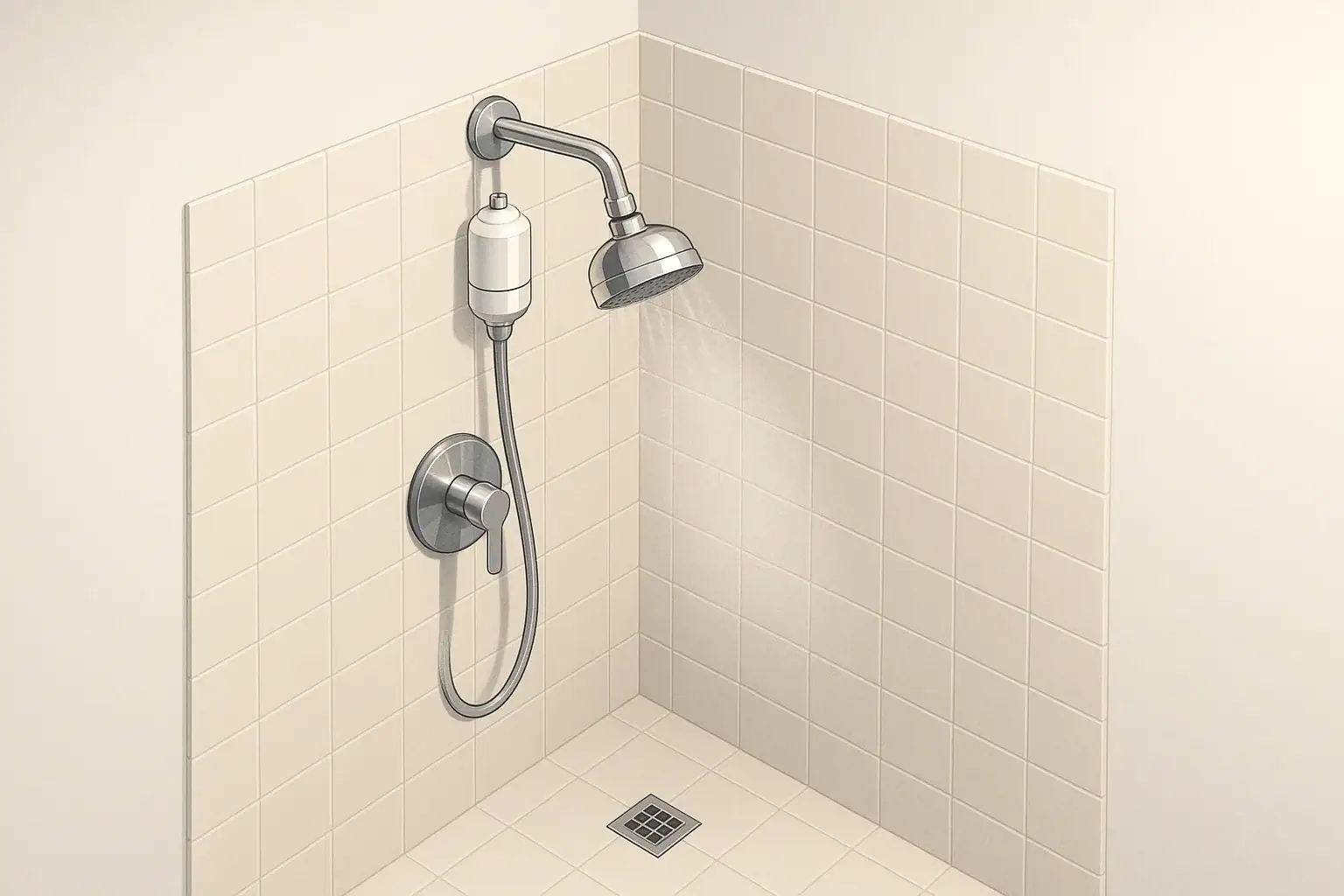
Many renters overlook shower water quality because they cannot modify plumbing lines or install large systems. Yet the water coming from an apartment shower often carries the same chlorine, sediment, and other common tap water additives and impurities found at the sink. A compact shower filter can be one of the simplest renter-friendly upgrades for improving water’s smell, feel, and appearance.
Apartment buildings frequently rely on municipal water supplies that use disinfectants such as chlorine or chloramine. These treatments help keep water microbiologically safe, but they can contribute to strong odors and may leave hair and skin feeling dry or coated. Older buildings may also have aging pipes, which can release rust particles and sediment into the water.
Shower filters for rentals are designed to be:
- Tool-free or low-tool installations that attach to the shower arm or replace the showerhead
- Removable without damage, so you can take them when you move
- Compact enough for small bathrooms and low ceilings
- Capable of working with a wide range of water pressures commonly found in multi-story buildings
Why Shower Filters Matter in Apartment Rentals
Many renters overlook shower water quality because they cannot modify plumbing lines or install large systems. Yet the water coming from an apartment shower often carries the same chlorine, sediment, and other common tap water additives and impurities found at the sink. A compact shower filter can be one of the simplest renter-friendly upgrades for improving water’s smell, feel, and appearance.
Apartment buildings frequently rely on municipal water supplies that use disinfectants such as chlorine or chloramine. These treatments help keep water microbiologically safe, but they can contribute to strong odors and may leave hair and skin feeling dry or coated. Older buildings may also have aging pipes, which can release rust particles and sediment into the water.
Shower filters for rentals are designed to be:
- Tool-free or low-tool installations that attach to the shower arm or replace the showerhead
- Removable without damage, so you can take them when you move
- Compact enough for small bathrooms and low ceilings
- Capable of working with a wide range of water pressures commonly found in multi-story buildings
Key Considerations for Renters Choosing a Shower Filter
When you live in an apartment, your priorities for a shower filter may differ from those of a homeowner. Along with basic filtration performance, you need to think about landlord rules, ease of removal, and how the filter behaves with existing plumbing and water pressure.
Installation Without Landlord Issues
Most apartment leases allow temporary fixtures that do not permanently alter plumbing. Many shower filters simply screw onto the existing shower arm, often between the arm and your current showerhead. Others replace the showerhead entirely but still connect with standard threads.
To avoid conflicts with your landlord:
- Choose filters that attach using standard connections and do not require drilling or cutting
- Keep the original showerhead and any washers in a safe place to re-install before moving out
- Check your lease for any clauses about fixtures, and if in doubt, ask for written approval
Water Pressure and Flow in Multi-Story Buildings
Apartment buildings often experience fluctuating water pressure. High floors may have lower pressure, while lower floors might have high pressure with flow restrictors built into fixtures.
Shower filters add resistance to flow. When choosing a filter, look for:
- Rated flow rate: Typical shower filters are designed for around 1.5–2.5 gallons per minute (example values). If your building already has low pressure, a lower-flow filter may feel weak.
- Compact media design: Smaller cartridges or well-designed internal flow paths can maintain better pressure while still providing filtration.
- Adjustable showerheads: Some filter-and-head combinations have settings that can help compensate for lower pressure, such as more focused spray patterns.
What You Want the Filter to Address
Not every shower filter targets the same issues. Common goals for renters include:
- Reducing chlorine/chloramine: Helps with strong swimming pool-like odors and may improve smell and feel of water.
- Reducing sediment and rust: Useful in older buildings where water can appear cloudy or discolored.
- Improving smell and taste: Taste matters less in shower water but still indicates what is in the water.
- Controlling scale buildup: In hard water areas, some filters or media types help limit mineral deposits on fixtures and glass.
No shower filter can address every possible contaminant. For concerns about specific contaminants such as lead, PFAS, or certain industrial chemicals, point-of-use filters at the kitchen tap with appropriate certifications are usually more suitable for drinking and cooking water.
Example values for illustration.
| Situation | Better choice | Why it fits rentals |
|---|---|---|
| Strict landlord rules, must restore original easily | Inline filter between arm and existing head | Original showerhead stays; easy to remove and revert |
| Very low water pressure | Compact filter with simple spray head | Less flow restriction and fewer complex spray settings |
| Older building, visible rust or particles | Filter rated for sediment reduction | Helps capture larger particles from aging pipes |
| Strong chlorine smell from hot shower | Filter designed for chlorine reduction | Media types such as carbon or KDF are commonly used |
| Very small shower space | Short, inline cartridge | Keeps the filter from hitting walls or reducing head height |
| Frequent moves between apartments | Quick-connect or tool-free design | Installs and removes quickly, travels easily |
Understanding Water Metrics for Shower Filters
Even in an apartment, it helps to know basic water metrics when picking a shower filter. Some metrics matter more for drinking water, but several directly affect shower performance and maintenance.
Hardness and Scale Buildup
Water hardness refers to dissolved minerals, mainly calcium and magnesium. While hardness does not typically affect safety, it can leave mineral spots on shower doors and build up as scale on fixtures and inside showerheads.
Some shower filters incorporate media intended to reduce scale deposits, often by altering how minerals behave rather than fully removing them. These may help with:
- Reducing visible white deposits on tile and glass over time
- Keeping showerheads from clogging as quickly
However, shower filters alone rarely provide full softening like a whole-house softener. If hardness is very high, expect some scale to remain and plan for occasional cleaning with appropriate descaling methods allowed in your lease.
Chlorine, Chloramine, and Odor
Municipal utilities commonly add chlorine or chloramine to control microbes in the supply system. Hot showers can amplify the smell of these disinfectants. Many renter-focused shower filters use media such as activated carbon or other specialty materials to reduce chlorine and improve odor and overall feel of the water.
Performance can vary based on:
- Contact time between water and filter media
- Water temperature (very hot water can shorten carbon effectiveness)
- Flow rate through the filter
Because shower water is usually hot and fast-flowing, expect more modest performance compared with a slow-flow drinking water filter, even when similar media are used.
Turbidity and Sediment
Turbidity describes how clear or cloudy water appears. In apartments with older plumbing, you might occasionally notice discolored water when maintenance is done on the building pipes or if rust builds up in lines.
Many shower filters have a sediment pre-screen or outer layer to trap larger particles such as:
- Rust flakes from aged pipes
- Sand or grit stirred up by main line work
- General suspended solids that cause cloudiness
If your building frequently experiences visible particles, selecting a filter with explicit sediment reduction capability can help keep both water and fixtures looking clearer.
Capacity and Cost per Gallon
Manufacturers usually state an approximate capacity for shower filters in gallons or in months of typical use. Real-world performance varies with water quality and usage habits, but capacity helps estimate cost over time.
As a simple illustrative example:
- If a filter is rated for about 10,000 gallons and two people each take a 10-minute shower daily at around 2 gallons per minute, that is roughly 1,200 gallons per month (example values).
- In this example, the cartridge might last around 8–9 months before reaching its rated capacity.
To estimate cost per gallon, you can divide the cartridge price by its rated capacity, understanding this is only an approximation in real use.
Filter Media Types Commonly Used in Shower Filters
Shower filters for apartments use a mix of media types, each aimed at different aspects of water quality. Knowing the basics helps you match a product to your most important concerns.
Activated Carbon
Activated carbon is one of the most common media in water filtration. In shower filters, it is typically used to reduce chlorine and improve taste and odor. Carbon works through adsorption, where substances adhere to its high-surface-area structure.
In shower use, activated carbon performance is influenced by:
- Temperature: Extremely hot water can shorten effective carbon life.
- Flow rate: Faster flow reduces contact time, which may lower reduction effectiveness.
- Chloramine vs chlorine: Carbon types and configurations that address chloramine often need more contact time.
Oxidation-Reduction (Redox) Media
Some shower filters use metal-based media that rely on oxidation-reduction reactions, sometimes abbreviated as “redox media.” These are commonly used to help reduce chlorine and may also assist with some metal-based contaminants in certain conditions.
In practical rental use, redox media may offer benefits such as:
- Working at a wider temperature range than some carbons
- Contributing to scale control in hard water, depending on formulation
- Providing longer service life in high-chlorine municipal supplies
Sediment and Multi-Layer Cartridges
Many shower filter cartridges are multi-stage, combining several layers such as mesh, sediment pads, carbon, and redox media. For renters, this means a single cartridge can address several concerns without complex plumbing.
Multi-layer designs may help:
- Capture visible particles before they clog the main media
- Distribute water over the media more evenly
- Extend the life of the internal media by protecting it from debris
NSF/ANSI Standards and What They Mean for Shower Filters
For renters, certifications are a practical way to evaluate claims without doing lab testing yourself. Some shower filters are tested to independent standards, often managed by organizations such as NSF or other accredited bodies, using NSF/ANSI standards.
Relevant Standards for Shower Use
The most common standards related to residential water treatment products include:
- NSF/ANSI 42: Covers aesthetic effects such as chlorine taste and odor and particulate reduction.
- NSF/ANSI 53: Addresses health-related contaminants such as certain heavy metals and particulates of defined sizes.
- NSF/ANSI 401: Deals with certain emerging compounds such as some pharmaceuticals and chemical residues.
- NSF/ANSI 58: Applies mainly to reverse osmosis systems, which are typically not used in showers.
Not all shower filters are certified, and not all need to be, but when a product claims reduction of a specific contaminant, independent certification provides more confidence that the claim was tested under controlled conditions.
How Renters Can Verify Claims
When reviewing marketing claims for a shower filter:
- Look for statements that specify which NSF/ANSI standard was used and what was tested.
- Check whether the certification covers the whole system or just a component.
- Verify certification with the certifying body’s database when possible, matching the brand and model name to the listing.
If a filter is not certified but still uses common media like carbon and sediment pads, it may still improve basic aesthetic qualities such as odor and visible particles. Certification simply adds another level of documentation.
Example values for illustration.
| Standard | Typical focus | How it relates to shower filters |
|---|---|---|
| NSF/ANSI 42 | Aesthetic effects (chlorine, taste, odor, particulates) | Most relevant for improving smell and clarity of shower water |
| NSF/ANSI 53 | Health-related contaminant reduction | More common in drinking-water filters; occasionally referenced in advanced shower units |
| NSF/ANSI 401 | Emerging compounds (selected chemicals and residues) | Primarily for drinking water; rarely the main focus for shower filters |
| NSF/ANSI 58 | Reverse osmosis systems | Generally not applicable to showers in apartments |
| System vs. component | Entire unit or just media tested | Check whether the specific filter model is listed, not only the media type |
| Capacity and conditions | Tested under defined flow and volume | Real-world hot showers may differ; treat ratings as guidance, not guarantees |
Installation, Maintenance, and Troubleshooting in Rentals
Even the best shower filter will only work well if installed and maintained correctly. As a renter, you also need to think about leaving the bathroom in original condition when you move out.
Simple, Reversible Installation
Most renter-friendly shower filters install with these basic steps:
- Turn off the shower and, if possible, shut off the bathroom water supply.
- Unscrew the existing showerhead, keeping all parts together.
- Wrap plumber’s tape (if recommended) on the shower arm threads to help prevent leaks.
- Screw the filter body onto the shower arm by hand, then attach the showerhead to the filter outlet.
- Turn on the water slowly and check for leaks, tightening gently if needed.
Keep the original parts and any instructions in a labeled bag or box. When you move out, reverse the process, remove the filter, and reinstall the original showerhead.
Filter Replacement and Maintenance Schedule
Most shower filters require cartridge replacement every few months, commonly in the range of about 3–9 months based on usage and water quality (example values). Hot water, high chlorine levels, and frequent long showers will shorten effective life.
Useful cues that a cartridge may need replacing include:
- Reduction in water flow unrelated to building-wide issues
- Return of strong chlorine odor after previously being reduced
- Visible darkening or discoloration of media (for transparent housings)
Because apartment schedules can be busy and leases may be short, many renters find it practical to align filter changes with recurring events, such as seasonal changes or monthly rent payments, and to keep a spare cartridge on hand for quick swaps.
Basic Troubleshooting Without Modifying Plumbing
When problems arise, renters usually must resolve them without opening walls or changing pipes. Common, easy-to-check issues include:
- Leaks at the connections: Often fixed by reseating washers or reapplying plumber’s tape.
- Sudden low flow: May result from clogged sediment layers; removing and gently rinsing removable screens (if allowed by instructions) can help.
- Unusual noises: Whistling or rattling may indicate trapped air or loose internal parts; turning water off and on slowly can sometimes clear trapped air.
If water quality changes drastically across the entire apartment, such as widespread discoloration or very low pressure, it may be a building-level issue. In that case, contact your landlord or building management rather than trying to fix plumbing yourself.
Balancing Performance, Budget, and Flexibility
For apartment renters, the “best” shower filter is rarely just the most powerful or complex model. It is the one that fits the building’s water conditions, respects lease limitations, and is simple enough to maintain on a renter’s schedule.
By focusing on installation method, water pressure, core water quality concerns (especially chlorine odor and sediment), and verifiable standards, you can narrow down options efficiently. Combine that with a straightforward maintenance plan and clear communication with your landlord, and a compact shower filter can be a practical, reversible upgrade that you can take with you from one rental to the next.
Frequently asked questions
Can I install a shower filter in an apartment without landlord permission?
Most leases allow temporary fixtures that do not permanently alter plumbing, and many shower filters screw onto the existing shower arm or replace the showerhead using standard threads. Still, check your lease for clauses about fixtures and keep the original showerhead and washers to restore before moving. When in doubt, ask the landlord for written permission to avoid disputes.
Which types of filter media best reduce chlorine in apartment showers?
Activated carbon and oxidation-reduction (redox) media are commonly used to reduce chlorine and improve odor; carbon works by adsorption while redox relies on chemical reactions. Performance depends on contact time, water temperature, and flow rate, so shower reductions are typically more modest than in slow-flow drinking-water filters.
Can a shower filter prevent scale buildup from hard water in rentals?
Some filter media and designs claim to alter mineral behavior and can reduce visible deposits and slow clogging, but most shower filters do not provide full softening like a whole-house water softener. They may help in moderate hardness conditions, but frequent descaling may still be necessary if hardness is high.
How often should shower filter cartridges be replaced in an apartment?
Replacement intervals commonly range from about 3 to 9 months depending on usage, water quality, and the cartridge’s rated capacity. Replace the cartridge when you notice reduced flow, return of chlorine odor, or visible darkening of the media if the housing allows inspection.
Will adding a shower filter reduce water pressure in a multi‑story apartment building?
All filters add some resistance to flow and can reduce perceived pressure, especially where supply pressure is already low. To minimize impact, choose filters with higher rated flow (roughly 1.5–2.5 gpm), compact internal designs, or pair the filter with an adjustable showerhead to maintain a satisfactory spray pattern.
Recommended next:
- Shower Filters for Chlorine: What They Can (and Can’t) Do
- Hard Water Feel in the Shower: Filter vs Softener vs Nothing
- KDF Media Explained: Why It’s Common in Shower Filters
- Installing a Shower Filter Tool-Free: Avoiding Leaks
- How Often to Replace Shower Filter Cartridges
- Shower Filter Bad Smell? Cleaning & Sanitizing Tips
- More in Shower Filters →
- NSF/ANSI standards explained (42/53/401/58)
- Clear trade-offs: pitcher vs faucet vs under-sink vs RO
- Maintenance planning: cost per gallon and replacement cadence