
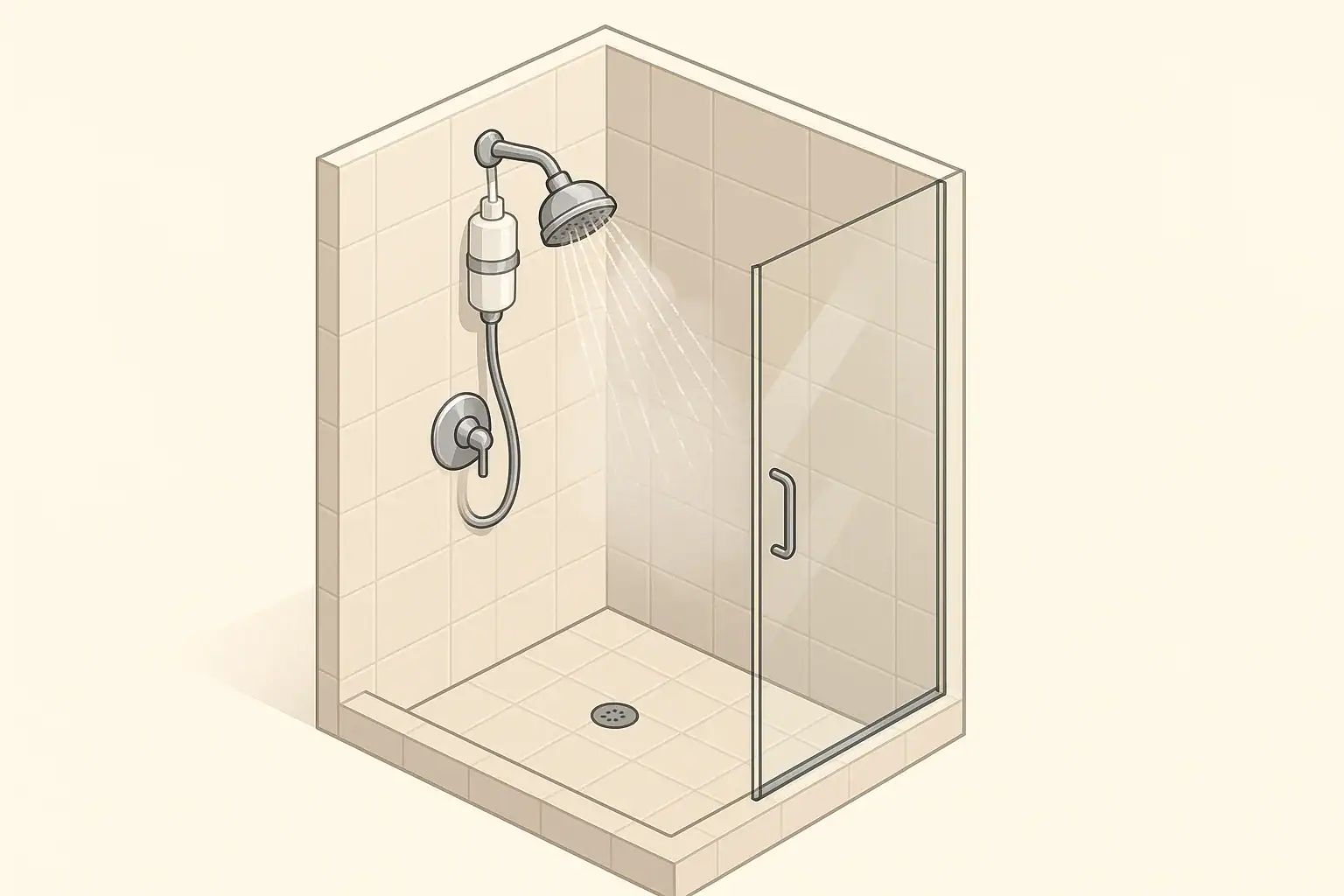
Shower filters are designed to reduce common tap water issues such as chlorine taste and odor, some sediment, and other unwanted substances before the water reaches your skin and hair. Over time, the filter cartridge fills up and becomes less effective. Knowing how often to replace shower filter cartridges helps you maintain consistent water quality, prevent clogs, and keep water flow comfortable.
Unlike whole-house or under-sink systems, shower filters usually have a relatively small cartridge. That means their useful life is limited by both time and the amount of water passing through. Waiting too long to change the cartridge can result in:
- Reduced flow and weaker shower pressure
- Water that smells or tastes more like untreated tap water
- Build-up of sediment inside the showerhead and plumbing
Manufacturers provide general replacement guidance, but real-world conditions in your home—such as water usage and local water quality—strongly affect how often you should change the cartridge.
Why Shower Filter Cartridge Replacement Matters
Typical Replacement Intervals for Shower Filter Cartridges
Most residential shower filter cartridges are rated for a certain number of months or gallons. These values are usually based on average household usage and typical municipal water quality. While specific numbers vary by design, some common guidelines include:
- Time-based guidance: Often every 3–6 months for a regularly used shower.
- Volume-based guidance: Often in the range of a few thousand gallons, as an illustrative example.
These are general example ranges. The actual recommendation for your cartridge should be printed on the packaging or user instructions. Some shower filter housings include a simple indicator ring you advance by month, or a basic reminder dial. Even with those, you should still pay attention to water quality changes and flow rate.
Factors that commonly shorten filter life include:
- Heavy usage: Large households taking frequent or long showers.
- High sediment levels: Visible particles, rust, or cloudiness in the water.
- High chlorine levels: Strong chlorine odor from municipal treatment.
If your usage or water quality is more demanding than the average conditions assumed by the rating, you may need to replace the cartridge more often than the maximum stated interval.
Example values for illustration.
| Approach | What You Track | Illustrative Guideline | Best For |
|---|---|---|---|
| Time-based only | Months since last change | Every 3–6 months (example) | Simple schedules, steady usage |
| Usage-based only | Estimated gallons used | Few thousand gallons (example) | Households with changing routines |
| Time + usage | Months and shower frequency | Earlier of time or heavy-use marker | Families and shared bathrooms |
| Time + water quality | Months and visible water changes | Replace when odor/cloudiness returns | Areas with variable tap water |
| Calendar reminders | Set dates in app or planner | Pre-scheduled change dates | Anyone wanting easy maintenance |
| Manual tracking | Notes on shower length and users | Adjust interval over time | People fine-tuning cost per gallon |
How Water Quality Affects Cartridge Lifespan
The same shower filter cartridge will last different lengths of time in different homes. Local water quality, plumbing conditions, and even seasonal changes can affect filter performance and capacity.
Chlorine and Chloramine Levels
Many municipal systems use chlorine or chloramine for disinfection. Cartridges that use activated carbon or similar media are designed to reduce chlorine taste and odor, but the filter media has a finite capacity. Higher levels of disinfectants usually mean the media becomes exhausted sooner.
If your water has a strong chlorine smell out of the tap, you may notice a clear improvement when the shower filter is new, followed by a gradual return of chlorine odor as the cartridge nears the end of its life. This is a practical cue that replacement is due, even if the calendar says you still have time left.
Sediment, Rust, and Turbidity
Some shower filters include a sediment stage to trap larger particles such as sand, rust, or other visible debris. In areas with higher turbidity (cloudiness) or older pipes that shed rust, this stage can clog quickly. The result is often:
- Noticeably weaker water flow
- Uneven spray patterns from the showerhead
- More frequent cleaning needed to remove buildup
In such cases, you may need to change cartridges more frequently than the maximum suggested interval. Adding a whole-house sediment filter upstream, if appropriate for your home, can help extend shower filter life by capturing heavier particles before they reach the bathroom.
Hardness and Scale
Some shower filter designs include media intended to help manage mineral scaling on fixtures. Water hardness comes from dissolved calcium and magnesium and is usually measured in grains per gallon or similar units. Hard water does not usually “clog” filter cartridges in the same way as sediment, but scale can still build on and around the showerhead.
Even if the cartridge itself is not full, severe hardness can make it feel as if the filter is underperforming because of scale on the showerhead nozzles. Regular cleaning of the showerhead, separate from cartridge replacement, is useful in hard water areas.
Estimating Replacement Time Based on Household Usage
To go beyond generic intervals, you can estimate a more personalized replacement schedule by thinking about how much water passes through your shower filter. This is not an exact calculation, but a rough estimate helps you decide whether you fall into light, average, or heavy usage.
Step 1: Approximate Shower Flow Rate
Most modern showerheads in the United States are designed for a flow rate of up to a few gallons per minute under typical household pressures. Your actual flow may be less, especially if you use a water-saving showerhead, have low water pressure, or if the filter itself adds some restriction.
You can do a quick home test:
- Place a container of known volume in the tub or shower.
- Run the shower at normal temperature and pressure for 30 seconds.
- Measure or estimate how much water you collected, then double it to estimate gallons per minute.
This simple test gives you a ballpark flow rate. You can then multiply this rate by shower length and frequency to estimate water used per month through that filter.
Step 2: Estimate Monthly Water Use Through the Filter
Once you have an approximate flow rate, consider:
- Average shower length (for example, 8–12 minutes)
- Number of showers per day using that filtered shower
- Whether guests or additional family members often use the same bathroom
Multiply flow rate by minutes per shower and by showers per month. This gives an estimated volume that you can compare with any example gallon rating given by the manufacturer. If your estimate is much higher than what the cartridge is suggested to handle in its maximum rated months, you might shorten the interval.
Step 3: Adjust Over Time
Use early cartridge changes to refine your estimate. If you notice taste and odor returning or flow dropping before your planned replacement date, note how long the cartridge actually lasted under your usage pattern. Over several cycles, you can settle on a realistic schedule that fits your home.
Visible and Practical Signs It Is Time to Replace
Even with careful planning, your best indicator for how often to replace shower filter cartridges is what you observe during normal use. Cartridges do not usually stop working suddenly; performance tends to decline gradually.
Changes in Water Flow
One of the most common signs is a noticeable decrease in flow. This can be caused by:
- Accumulated sediment in the filter media
- Debris trapped by a built-in pre-filter screen
- Scale or residue inside the showerhead itself
If cleaning the showerhead does not restore the original spray pattern or strength, the cartridge may be restricting flow and ready for replacement.
Return of Original Tap Water Smell or Taste
When a new cartridge is installed, many users notice a change in water smell, especially if the incoming water has a strong chlorine odor. Over time, as the media becomes saturated, the treated water may begin to smell more like the original tap again. This return of taste or odor is a useful signal that the cartridge is past its prime, even if the flow still seems acceptable.
Visible Discoloration or Debris
Some cartridges include a sediment stage that may darken as it traps particles. If the housing is clear or partially transparent, discoloration of the media or visible buildup can show that it is working hard and may be nearing capacity.
In showers without transparent housings, watch the water itself. New staining, tiny particles, or cloudy water that were previously reduced by the filter can suggest that the cartridge is no longer handling sediment as effectively as before.
NSF/ANSI Certifications and What They Mean for Lifespan
Some shower filter cartridges are tested against NSF/ANSI standards. These standards do not guarantee a specific replacement interval, but they do define how performance is evaluated under controlled conditions. Understanding the basics can help you interpret claims about capacity and performance.
Common Standards Relevant to Shower Filters
- NSF/ANSI 42: Focuses on aesthetic effects, such as reduction of chlorine taste and odor and particulate reduction.
- NSF/ANSI 53: Covers reduction of certain contaminants with potential health significance, such as some heavy metals and particulates, for applicable products.
- NSF/ANSI 401: Relates to certain emerging compounds, such as some pharmaceuticals and personal care products, in products designed and tested for that performance.
- NSF/ANSI 58: Applies mainly to reverse osmosis systems, usually not relevant for typical shower filters.
For shower filters, NSF/ANSI 42 is the most commonly referenced standard, especially for claims about chlorine taste and odor reduction. If a manufacturer indicates a certified capacity under one of these standards, it reflects performance testing up to a specified volume of water.
Verifying Claims and Matching Them to Expected Use
When looking at a cartridge, you can:
- Check whether the product documentation lists specific NSF/ANSI standards.
- Look for mention of tested capacity (for example, a number of gallons) associated with those standards.
- Compare that capacity with your estimated household usage to see if the suggested replacement interval seems realistic.
This approach does not replace following manufacturer instructions, but it gives you an analytical way to decide whether you are operating near the upper range of what the cartridge was tested to handle.
Example values for illustration.
| Standard | Applies To | Main Focus | What To Check |
|---|---|---|---|
| NSF/ANSI 42 | Many shower and point-of-use filters | Aesthetic effects (chlorine taste/odor, particulates) | Claimed chlorine reduction and example capacity |
| NSF/ANSI 53 | Point-of-use systems with specific contaminant claims | Certain contaminants with health significance | Whether the cartridge is listed for particular substances |
| NSF/ANSI 401 | Systems addressing select emerging compounds | Specified pharmaceuticals and similar compounds | If applicable, which compounds were tested |
| NSF/ANSI 58 | Reverse osmosis systems | RO performance and structural integrity | Usually not relevant for basic shower filters |
| General capacity notes | Certified filter cartridges | Performance up to a tested volume | Compare tested volume with your estimated usage |
Practical Tips for Tracking and Changing Shower Filter Cartridges
A simple system for tracking filter changes helps you avoid both premature replacement and letting cartridges run far past their useful life. You do not need special tools to stay on top of maintenance.
Use a Calendar or Reminder App
When you install a new cartridge, note the date on a piece of tape on the housing or on a bathroom cabinet. At the same time, set a reminder in your phone or digital calendar for the manufacturer’s suggested interval, minus a short “buffer” period if you know your usage is heavy.
For example, if the guidance suggests up to six months, you might set your reminder at four or five months so you can check flow and water quality and decide whether to replace immediately or extend slightly.
Keep a Simple Log
A short maintenance log—either in a notebook or as a note in your phone—can include:
- Date of installation and type of cartridge
- Any noticeable changes in water smell, taste, or clarity
- Approximate number of daily users
- Comments about flow (normal, slightly reduced, low)
Over time, this log becomes a personalized reference for how long cartridges tend to last in your specific conditions.
Follow Safe Replacement Practices
When it is time to replace the cartridge:
- Turn off the water at the shower valve.
- Open the filter housing according to the instructions.
- Have a towel or small container ready to catch any residual water.
- Install the new cartridge in the correct orientation, ensuring any gaskets or O-rings are clean and seated properly.
- Tighten the housing securely but avoid overtightening.
- Run water for a short time to flush any loose filter media fines before normal use, as recommended.
These steps help maintain performance and reduce the chance of leaks around the housing after a cartridge change.
Consider Whole-Home Water Conditions
If you find yourself changing shower cartridges very frequently because of sediment, rust, or strong taste and odor, it may be a sign of broader water quality or plumbing issues. Whole-house filtration, point-of-entry sediment filters, or consultation with a local water specialist may help address the underlying cause, extending the useful life of all downstream filters, including those on your shower.
By combining manufacturer guidance, observation of water quality, a basic understanding of household usage, and awareness of relevant certifications, you can set a realistic and repeatable schedule for how often to replace shower filter cartridges in your home.
Frequently asked questions
How often should I replace shower filter cartridges under typical household use?
Many shower filter manufacturers recommend replacing cartridges every 3–6 months or after a specified number of gallons, but actual timing depends on your water quality and usage. Use calendar reminders and monitor for reduced flow, return of chlorine odor, or visible discoloration to decide when to change the cartridge.
If my water has high chlorine or chloramine, will I need to replace cartridges more often?
Yes. Activated carbon and similar media are consumed faster with higher disinfectant levels, so cartridges in high-chlorine or chloramine areas can reach capacity sooner. A noticeable return of chlorine smell or taste is a practical cue that replacement is needed.
Can I rely on decreased water flow alone to indicate the cartridge needs replacing?
Not entirely. Decreased flow can result from sediment in the cartridge, a clogged pre-filter, or scale in the showerhead; cleaning the showerhead can help distinguish the cause. Combine flow observations with smell/taste changes and manufacturer guidance to make a replacement decision.
Does hard water shorten the life of a shower filter cartridge?
Hard water usually causes mineral scale on the showerhead rather than rapidly exhausting the filter media, so it may make the filter seem less effective even if the cartridge still has capacity. Regular descaling of the showerhead and considering whole-house treatments can improve perceived performance and reduce maintenance frequency.
How can I estimate how long a cartridge will last based on my household use?
Do a simple flow test with a container to estimate gallons per minute, multiply by average shower length and number of showers per month, and compare that volume with any gallon rating provided by the manufacturer. Keep a short log over a few cycles and adjust your schedule if you observe odor return or flow decline before the planned replacement date.
Recommended next:
- NSF/ANSI standards explained (42/53/401/58)
- Clear trade-offs: pitcher vs faucet vs under-sink vs RO
- Maintenance planning: cost per gallon and replacement cadence