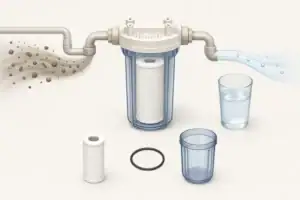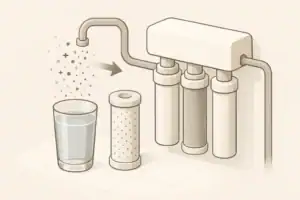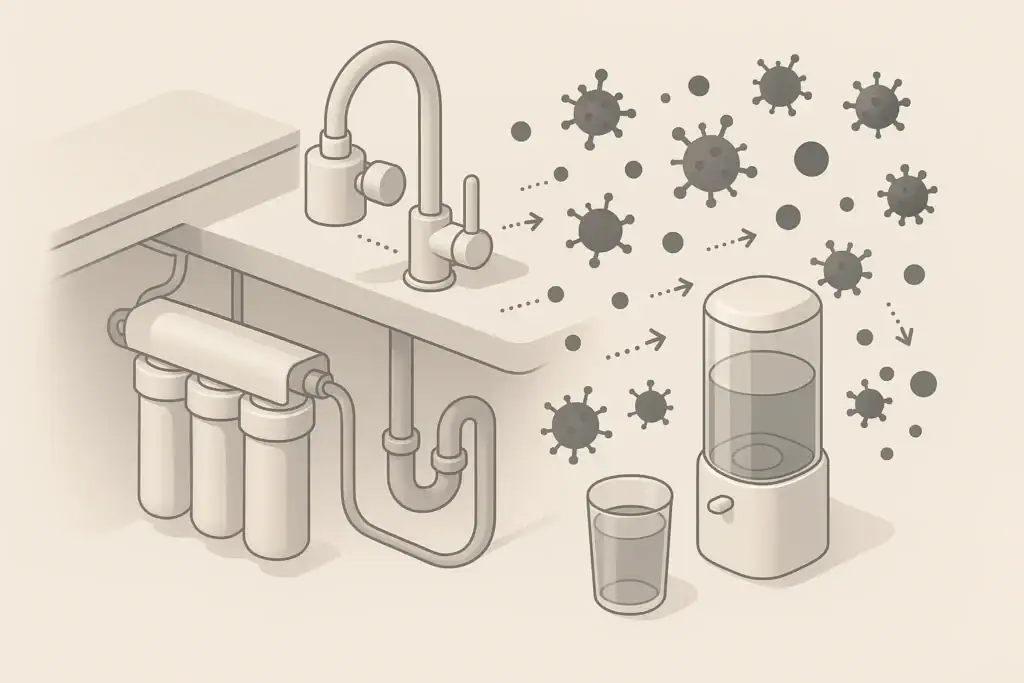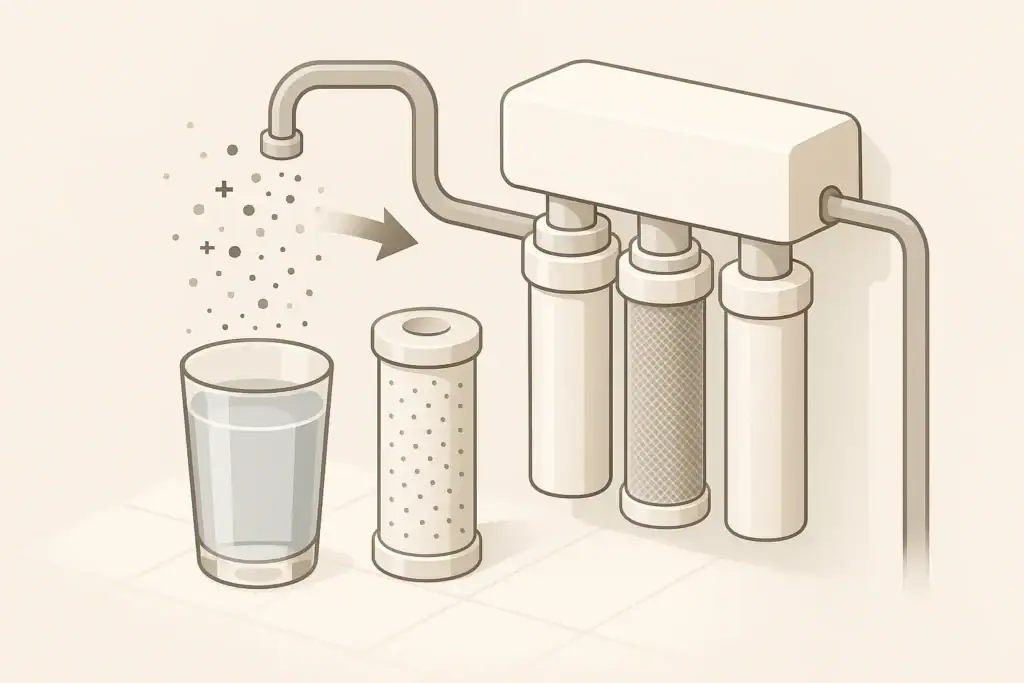
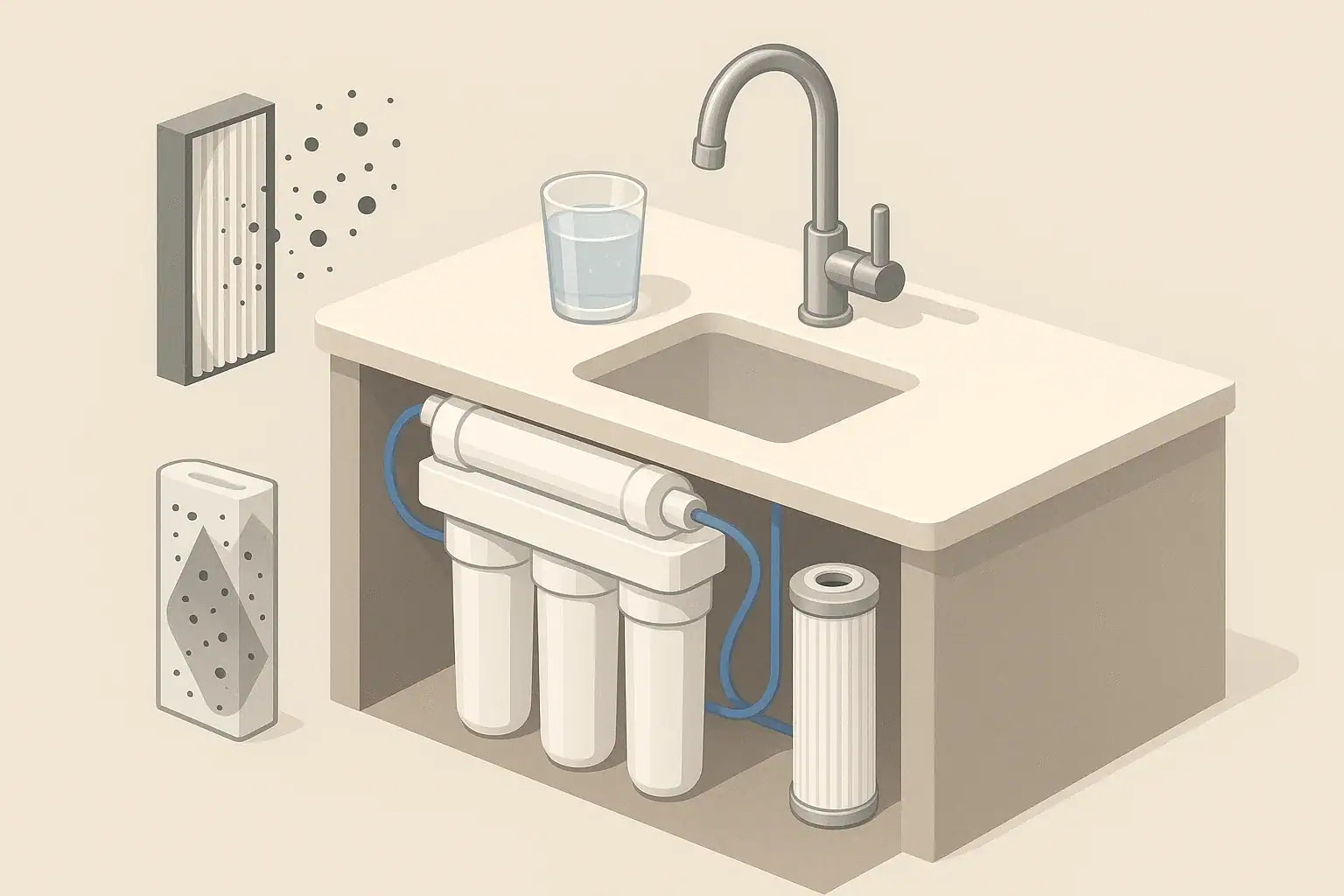
Black specks in filtered water are usually a sign to slow down and identify the source, not a reason to panic. In many homes, the specks are carbon fines released from a new or disturbed carbon filter. In other cases, they may be small pieces of plumbing debris, deteriorated rubber washers, mineral scale, or sediment that passed through or appeared after the filter.
The practical question is simple: are the particles coming from the filter media, the faucet or fixture, the water heater, or the plumbing upstream? The answer affects what you do next. A new carbon cartridge may only need proper flushing, while recurring gritty material may point to a fixture, pipe, or cartridge housing issue.
This article explains how to compare carbon fines versus plumbing debris, how to troubleshoot without unsafe plumbing changes, and when filter replacement, flushing, water testing, or professional service may be appropriate.
Why Black Specks Show Up in Filtered Water
Black specks can appear in a glass, an ice maker bin, a refrigerator dispenser tray, a faucet aerator, or the bottom of a pitcher. The particles may be powdery, flaky, rubbery, hard, or gritty. Their appearance, timing, and location provide useful clues.
Common sources include:
- Activated carbon fines from a carbon block, granular activated carbon cartridge, refrigerator filter, faucet filter, or pitcher filter.
- Rubber or gasket particles from washers, O-rings, flexible hoses, shutoff valves, or internal faucet components.
- Mineral scale from hard water, water heaters, or disturbed plumbing.
- Pipe or fixture debris loosened during plumbing work, filter changes, pressure changes, or shutoff valve operation.
- Sediment from private wells, old service lines, or municipal main work that reaches the point-of-use filter.
Filtered water does not mean every visible particle is impossible. Most home filters are designed for specific tasks, such as reducing chlorine taste, sediment, lead, certain organics, or other contaminants depending on the filter type and certification. A filter can also be the source of particles if carbon dust is not fully flushed out.
Carbon Fines: The Most Common Filter-Related Cause
Activated carbon is widely used in home water filtration because it improves taste and odor and can reduce certain chemicals depending on the filter design. Carbon filters may use granular activated carbon or compressed carbon block media. Both can release small black particles called carbon fines, especially when new.
Carbon fines often look like pepper, soot, or dark powder. They may smear if rubbed between fingers. They can settle at the bottom of a glass or appear briefly in the first water drawn after installation.
When Carbon Fines Are Most Likely
Carbon fines are more likely when:
- A new cartridge, pitcher filter, refrigerator filter, or faucet filter was just installed.
- The filter was not flushed for the recommended amount of water or time.
- The filter was shaken, dropped, stored on its side, or handled roughly.
- Water was shut off and turned back on, disturbing the media.
- The filter sat unused for several days and then was used again.
- The system experienced a pressure surge or sudden flow change.
Small amounts of carbon fines after a new filter change are common. The practical response is to follow the filter maker’s flushing instructions and discard the first water used for flushing. Do not assume that a filter is ready for drinking water use immediately after installation unless its instructions say so.
What Carbon Fines Usually Feel Like
Carbon fines are usually soft or powdery rather than sharp. If you collect a few specks on a clean white paper towel and rub them gently, they may leave a gray or black smudge. That does not prove the particles are carbon in every case, but it is one practical clue.
Carbon fines should reduce significantly after proper flushing. If black particles continue for days or weeks, appear in multiple locations, or return after every use, the source may not be normal startup carbon dust.
Example values for illustration.
| Observation | Carbon fines more likely | Plumbing debris more likely |
|---|---|---|
| Timing | Right after filter installation or replacement | After plumbing work, valve operation, or pressure changes |
| Texture | Soft, powdery, may smear | Gritty, flaky, rubbery, or hard |
| Color | Black to dark gray | Black, brown, rust-colored, white, or mixed |
| Location | Only from the filtered outlet | May appear at unfiltered faucets too |
| Duration | Often improves after flushing | May continue until fixture or plumbing issue is corrected |
| Common source | Carbon cartridge or filter media | Washers, hoses, scale, pipe sediment, aerator debris |
| First action | Flush according to instructions | Compare filtered and unfiltered taps and inspect aerators |
Plumbing Debris: When the Filter Is Not the Main Source
Not every black particle in filtered water comes from carbon. Plumbing systems contain washers, seals, flexible supply lines, shutoff valves, faucet cartridges, aerators, water heater components, and pipe surfaces. These parts can release small particles as they age or after being disturbed.
Rubber Washers, O-Rings, and Flexible Hoses
Black rubber-like flecks may come from deteriorating washers, O-rings, or flexible connector liners. They may feel elastic or form small flakes rather than powder. You may notice them more after turning an older shutoff valve, replacing a filter, or moving a faucet hose.
If particles appear only at one faucet, the fixture or its local supply connections deserve attention. Do not disassemble pressurized plumbing or remove safety devices while water is on. If a fixture needs internal service, shutoff, depressurization, and proper reassembly matter. When in doubt, use a qualified plumber.
Mineral Scale and Water Heater Sediment
Hard water can leave scale inside pipes, water heaters, fixtures, and appliances. Scale is often white, tan, or gray, but it can look darker when mixed with iron, manganese, rubber particles, or other debris. Water heater disturbance can release sediment into hot water lines.
A useful clue is temperature. If specks appear mainly in hot water, the water heater or hot-side plumbing may be involved. Most drinking water filters are installed only on the cold line, so hot-water-only particles generally point away from the drinking water filter.
Pipe Sediment and Recent Utility Work
Municipal water main repairs, hydrant flushing, nearby construction, or household plumbing work can temporarily disturb sediment. Private wells may also send periodic sediment if filtration is undersized, a well component is disturbed, or the well produces sand or fine solids.
Point-of-use filters can catch some particles, but they are not a substitute for an appropriate sediment filter if the incoming water regularly carries visible solids. Whole-house or point-of-entry sediment filtration may be considered when debris affects multiple fixtures.
How to Narrow Down the Source Safely
You can often troubleshoot black specks with simple observations. The goal is not to perform risky plumbing work, but to identify whether the issue is isolated, filter-related, or system-wide.
Compare Filtered and Unfiltered Water
Draw water from the filtered faucet and from a nearby unfiltered cold-water tap, such as a bathroom sink. Use clean, clear glasses. Let the water sit for several minutes and compare the bottom of each glass.
- If specks appear only in filtered water right after a cartridge change, carbon fines are likely.
- If specks appear in filtered and unfiltered cold water, the source may be upstream plumbing or incoming water.
- If specks appear only at one fixture, the faucet, aerator, supply line, or local valve may be involved.
- If specks appear mainly in hot water, look toward the water heater or hot-side plumbing rather than the cold drinking water filter.
Check the Faucet Aerator or Screen
Many faucets have aerators or small screens that collect debris. A clogged aerator can release particles into a glass or make the flow pattern irregular. If the aerator is designed to be removed by the user, inspect it carefully and clean it according to the faucet instructions. Avoid forcing parts, using excessive torque, or removing components that are not intended for routine access.
For refrigerator dispensers and built-in appliance filters, check the user-accessible drip tray, filter seating, and startup flushing procedure. Do not bypass appliance safety switches or modify water lines to test flow.
Use a White Towel Test
Pour the water through a clean white coffee filter or a white paper towel placed in a clean strainer. This can help you see particle color and texture. Carbon fines often leave a dark smudge. Hard minerals feel gritty. Rubber particles may look like tiny flexible flakes.
This test is only a screening tool. It does not identify contaminants or determine whether water meets any standard. If there are persistent visible particles, unusual odors, discoloration, or a known contamination concern, consider laboratory testing or professional evaluation.
Filter Flushing, Replacement, and Installation Issues
Many black speck complaints start after a filter change. That makes installation and flushing the first items to review.
Flush New Carbon Filters Fully
Carbon filters often require flushing before normal use. The needed amount varies by filter design. Some small filters may require a few minutes of flow. Larger under-sink or refrigerator cartridges may require several gallons. Follow the specific instructions for the filter you use. If your flow is also sluggish, it can help to review a low-pressure after installing a filter checklist while you flush.
During flushing, the first water may look gray or contain dark specks. That water should be discarded. Flow should generally become clear as loose fines are washed out. If the filter continues shedding visible material after the instructed flush, remove it from service according to the system instructions and contact the seller, manufacturer, or a plumbing professional for next steps.
Confirm the Cartridge Is Seated Correctly
A misaligned cartridge, damaged O-ring, loose housing, or incompatible replacement can allow water to bypass the media or disturb internal parts. Use only cartridges designed for the housing or appliance. Do not trim, drill, force, or modify cartridges to make them fit. For cartridge swaps, a cartridge change mistakes that cause leaks guide can help with the common failure points.
After installation, inspect for leaks, pressure changes, and unusual flow. A sudden high flow through a filter that normally flows slowly can suggest bypass or mis-seating. A very low flow can indicate clogging, trapped air, or a plugged screen.
Replace Filters on Schedule, Not Just by Taste
Old cartridges can clog, channel, lose performance, or release trapped material when flow changes. Taste and odor are useful clues, but they are not a complete maintenance plan. Time in service, rated capacity, household use, incoming water quality, and flow reduction all matter.
If black specks appear near the end of a filter’s expected life, replacement may be reasonable. If they appear immediately after replacement, flushing and installation checks are more relevant.
When to Test Water or Call a Professional
Visible particles are not automatically a serious health issue, but recurring debris should not be ignored. The right response depends on frequency, location, and accompanying signs.
Consider water testing or professional help when:
- Particles appear at multiple fixtures and do not clear after flushing.
- The water has unusual color, odor, or taste changes.
- There was recent plumbing work and debris continues afterward.
- A private well produces sand, black sediment, or recurring solids.
- There are known concerns such as lead service lines, older plumbing, industrial contamination, or flood impacts.
- The filter housing leaks, cracks, or cannot be sealed properly.
- Particles are sharp, metallic-looking, oily, or mixed with discoloration.
For city water, your water utility may provide information about recent main work, hydrant flushing, or water quality notices. For private wells, testing is the homeowner’s responsibility and may be especially useful after flooding, major repairs, changes in appearance, or long periods of non-use.
Laboratory testing should be selected based on the suspected issue. A basic mineral test will not answer every question, and a bacteria test will not identify carbon fines. If you are unsure what to test for, a local health department, certified laboratory, or qualified water treatment professional can help choose an appropriate panel.
Practical Troubleshooting Planner for Black Specks
The table below summarizes practical next steps. It is not a diagnostic guarantee, but it can help prioritize the most likely source and avoid jumping straight to an unnecessary system replacement.
Example values for illustration.
| Scenario | Likely direction | Practical next step |
|---|---|---|
| New carbon filter installed today | Carbon fines | Flush per instructions and discard flush water |
| Specks only from filtered faucet | Filter, cartridge seating, or filtered faucet | Check installation, cartridge fit, and user-accessible screens |
| Specks from several cold taps | Incoming water or household plumbing | Ask utility about recent work or consider sediment evaluation |
| Specks mainly in hot water | Water heater or hot-side plumbing | Review water heater maintenance needs with a qualified professional |
| Rubbery black flakes at one sink | Washer, O-ring, hose, or valve material | Inspect user-accessible parts or schedule fixture service |
| Gritty particles with low flow | Clogged aerator, sediment, or scale | Check aerator and compare other fixtures |
| Persistent particles after flushing | Defective, incompatible, or disturbed system | Stop using that outlet for drinking until evaluated |
| Well water with recurring sediment | Well or prefiltration issue | Consider testing and properly sized sediment filtration |
Frequently Asked Questions
Are black carbon fines the same as contamination?
Carbon fines are small particles of activated carbon media. They are not the same thing as a dissolved chemical contaminant. However, visible particles in drinking water are still something to address because they can be unpleasant and may indicate a filter that needs flushing, replacement, or inspection.
Should I keep drinking water with black specks in it?
If the specks appear during the required flushing of a new filter, that flush water should be discarded. If black specks continue after flushing, use a different drinking water source until you identify and correct the cause. This is a practical quality step, not a reason to assume the worst.
Can reverse osmosis water have black specks?
Yes, it can happen, especially if the system includes carbon prefilters or postfilters. Black specks after an RO filter change may be carbon fines from a postfilter. Specks can also come from the faucet, storage tank components, tubing, or local plumbing. Proper flushing and cartridge seating are important.
Do black specks mean my filter is removing contaminants?
Not necessarily. Visible black particles may be loosened filter media or plumbing debris. They do not prove that the filter is performing well or poorly for dissolved contaminants. Performance depends on filter design, condition, installation, water quality, and applicable testing or certification claims. If you are comparing filter types, a guide on what reverse osmosis removes can help set expectations.
How can I prevent black specks after the next filter change?
Store cartridges as directed, avoid shaking them unnecessarily, install them carefully, replace O-rings when recommended, and flush the system fully before drinking the water. Keep a simple maintenance record with installation dates and any changes in flow, taste, odor, or visible particles.
Related guides: Cartridge Change Mistakes That Cause Leaks • Low Pressure After Installing a Filter: 8 Things to Check • Air in the Line After a Filter Change: How to Purge It • Bad Taste After Installing a New Filter: Quick Fixes
Frequently asked questions
How do I tell carbon fines from plumbing debris?
Carbon fines are usually soft, dark, and powdery, and they often appear right after a filter change. Plumbing debris is more likely to look gritty, flaky, rubbery, or mixed in color and may show up after plumbing work or valve use.
Will flushing a new carbon filter remove black specks?
Usually, yes. Proper flushing is the first step for a new carbon filter. If dark particles continue after the recommended flush amount, the cartridge, housing, or installation should be checked.
Why do black specks only appear in one faucet?
That often points to a local issue such as the aerator, supply line, faucet cartridge, or nearby valve. If other faucets are clear, the problem is less likely to be the main water supply.
Can hot water cause black specks in drinking water?
Yes, especially if the water heater or hot-side plumbing is releasing sediment or scale. If the specks mostly show up in hot water, the cold drinking water filter is less likely to be the cause.
When should I replace the filter instead of flushing it again?
If the filter is near the end of its service life, has already been flushed properly, or continues to shed visible particles, replacement is a reasonable next step. Follow the manufacturer’s guidance for the system.
Is it worth testing the water if the specks keep coming back?
Yes. Recurrent particles in multiple fixtures, changes in taste or odor, or a private well with sediment are good reasons to test. Choose a test based on the likely source so the results are useful.
Recommended next:
- Why Your Filtered Water Flow Suddenly Dropped (Diagnostic Checklist)
- Low Pressure After Installing a Filter: 8 Things to Check
- Leaking Under the Sink: How to Identify the Source Fast
- Air in the Line After a Filter Change: How to Purge It
- Noisy RO System: Common Causes and Fixes
- Bad Taste After Installing a New Filter: Quick Fixes
- More in Troubleshooting →
- NSF/ANSI standards explained (42/53/401/58)
- Clear trade-offs: pitcher vs faucet vs under-sink vs RO
- Maintenance planning: cost per gallon and replacement cadence