
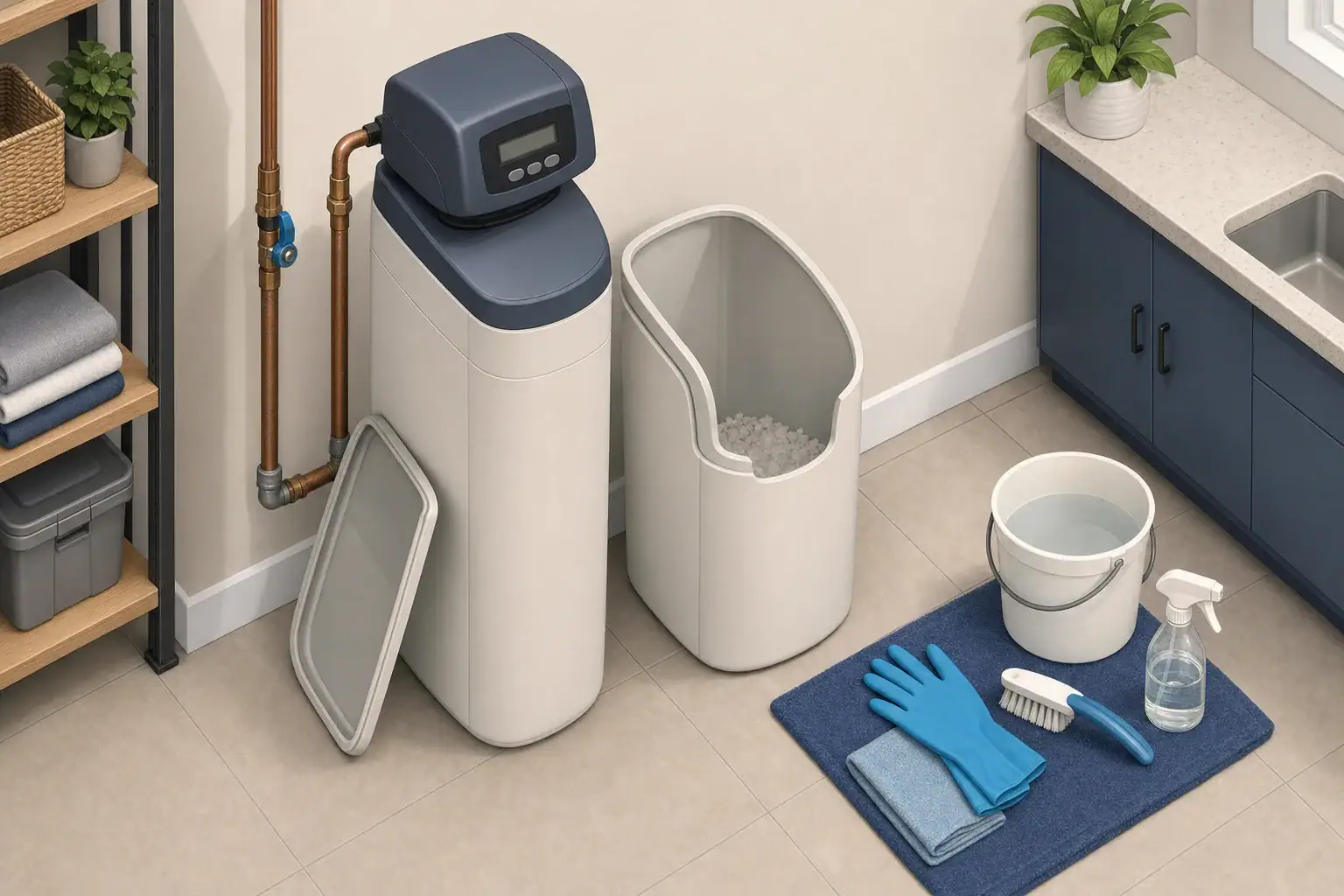
Quick answer: To clean a water softener brine tank, follow the owner’s manual to take it out of service, remove salt and residue, rinse approved parts, refill, and run the specified regeneration. Sanitize only with the model-approved product and procedure.
Before You Clean a Water Softener Brine Tank, Identify the Problem
A dirty-looking brine tank does not automatically need chemical sanitation, and cleaning cannot fix a malfunctioning valve, drain, or brine line. First determine whether you are seeing routine residue, soft compacted salt, a salt bridge, abnormal water behavior, or a possible contamination concern.
The U.S. Environmental Protection Agency recommends periodically checking softener salt and salt bridges and cleaning the brine tank once a year as general maintenance guidance. Your owner’s manual remains the controlling source for the correct procedure and maintenance interval for your model. EPA WaterSense home-maintenance guidance
Cleaning and sanitizing are different jobs
- Cleaning removes old salt, sediment, compacted material, and residue from the brine tank.
- Sanitizing uses a compatible treatment followed by the specified regeneration and rinse sequence. It may be appropriate after stagnation, flooding, a contaminated-water event, or certain service work, but it is not automatically needed whenever the tank is cleaned.
There is no universal sanitizer, dose, contact time, or regeneration sequence. The appropriate treatment depends on the softener design, media, and manufacturer instructions. The Water Quality Association notes that sanitizer compatibility can vary by treatment media and system type. WQA guidance for sanitizing residential water treatment systems
What Brine-Tank Residue Can Mean
A thin layer of sediment at the tank bottom can come from impurities in softener salt. Michigan guidance for well disinfection notes that sand and other salt impurities can accumulate as sludge as salt dissolves. That does not mean dark or discolored material is mold or another microbial contaminant; appearance alone cannot identify it. Michigan Water Well Disinfection Manual
Soft, compacted material at the bottom is often called salt mush. It can interfere with brine formation or movement, but removing it will not repair a clogged injector, restricted drain, failed control valve, or other mechanical problem.
| Observation | Likely category | Appropriate response |
|---|---|---|
| Thin sediment or bottom sludge; the softener otherwise operates normally | Routine residue | Plan a cleaning when the salt level is low, and confirm the approved salt type in the manual. |
| Soft, compacted salt at the bottom | Salt mush | Remove the compacted material during cleaning. Do not assume this repairs a brine-draw or valve problem. |
| Hard salt crust with an empty space underneath | Salt bridge | Use the manual’s bridge-breaking procedure. Do not strike, puncture, or force the tank wall. |
| Water keeps rising, reaches the overflow, or does not drop as expected during regeneration | Possible valve, brine-draw, tubing, or drain fault | Stop treating it as routine cleaning. Use model-specific troubleshooting instructions or arrange service. |
| Odor after prolonged stagnation, flooding, or a known supply event | Possible contamination concern | Follow any utility or health-authority notice and the manufacturer’s sanitation procedure. |
| Odor returns after the correct sanitation procedure | Possible source-water or system-wide issue | Seek appropriate water testing and qualified diagnosis rather than repeatedly adding chemicals. |
How to Clean a Water Softener Brine Tank Safely
Softener configurations differ. Some have removable brine wells or salt grids, while other designs should not be disassembled by a homeowner. Some models require water to be added after cleaning; others refill during a regeneration cycle. Use this manufacturer-first framework rather than a generic recipe.
- Identify the exact unit. Record the make, model, serial number, current settings, and any displayed error code. Find the matching owner’s manual.
- Wait for a low salt level when practical. This reduces lifting and waste. Do not delay action to use up salt if there is an active leak, overflow, or known contamination event.
- Read the shutdown and bypass instructions. Confirm the correct bypass position, electrical instructions, pressure precautions, and whether the controller must remain powered. Do not improvise the sequence.
- Plan for salt and brine removal. Follow local requirements for disposal. Do not reuse material that may have been contaminated.
- Empty only as the manual permits. Remove salt, liquid, and homeowner-serviceable components through approved steps. Do not disconnect tubing, alter a float setting, or remove a salt grid unless the manual specifically directs it.
- Remove loose residue. Use nonabrasive tools and only cleaning materials approved for the tank. Avoid acids, solvents, fragranced products, and improvised chemical combinations.
- Rinse and inspect accessible parts. Rinse as directed, then look for obvious damage or obstruction around accessible brine-well, float, tubing, and overflow components without changing adjustments.
- Reassemble and refill. Return approved removable parts to their documented positions. Add the specified softener salt. Add initial water only if the manual provides an amount or controller procedure.
- Return the softener to service. Restore the bypass and power as directed, then run the prescribed regeneration or recharge cycle. Check connections, the overflow route, and the surrounding floor for leaks.
When to Sanitize the Brine Tank
Sanitation may be warranted after extended stagnation, flooding around the equipment, a known contaminated-water event, particular repairs, or manufacturer-required startup procedures. Routine salt residue alone does not establish that sanitation is necessary.
Before using a sanitizer, verify the active ingredient, strength, media compatibility, application point, dose, contact time, required cycles, and rinse endpoint in the model documentation. If these details are unavailable, contact the manufacturer or a qualified water-treatment professional. Do not use a bleach, vinegar, or commercial-cleaner recipe written for a different softener, and never mix cleaners, sanitizers, or salt additives.
If a utility or local health authority has issued a boil-water, do-not-drink, or do-not-use notice, follow that notice first. Cleaning or sanitizing a softener does not show that the water supply is safe.
When Cleaning Is Not Enough
Normal brine depth and refill timing vary by design, so water in the tank is not, by itself, proof of a failure. Treat continuing water rise, overflow discharge, failure to draw brine during the specified cycle, a leaking valve, a restricted drain, an error code, or a recurring unexplained odor as troubleshooting concerns.
For example, the EcoPure EP100/EP200 owner’s manual lists a plugged nozzle or venturi, leaking valve seals, a restricted drain, and obstructions in the brine valve or tubing among possible causes of failed brine draw. Those details apply to that equipment family, but they illustrate why a persistent high water level may need diagnosis rather than another tank cleaning. EcoPure EP100/EP200 owner’s manual
Brine-Tank Manual Checklist
Before starting, find these details in the correct manual for your softener:
- Exact model number and manual revision
- Bypass and electrical shutdown procedure
- Expected brine level and refill timing
- Parts the homeowner may safely remove
- Approved salt type and prohibited additives
- Approved tank-cleaning materials
- Sanitizer type, strength, and media compatibility, if sanitation is needed
- Model-specific sanitation dose, contact time, and rinse endpoint
- Whether initial refill water must be added
- Required regeneration sequence
- Drain and overflow requirements
- Error-code meanings and service instructions
After the prescribed cycle, verify that the unit returns to normal operation, the water level behaves as the manual describes, and no connection or overflow point is leaking. If those checks fail, move to model-specific troubleshooting or professional service.
Frequently Asked Questions
How often should a water softener brine tank be cleaned?
EPA WaterSense recommends annual brine-tank cleaning as a general maintenance baseline. Clean sooner when substantial sediment or salt mush accumulates, but follow the maintenance interval and instructions for your specific softener.
Should I sanitize the brine tank every time I clean it?
No. Cleaning removes physical residue; sanitation is a separate, event-based procedure. Use sanitation only when the manufacturer directs it or when circumstances such as prolonged stagnation, flooding, a contaminated-water event, or relevant service work warrant it.
Does water in the brine tank mean the softener is broken?
Not necessarily. Brine level and refill timing vary by model. Water that continues to rise, overflows, or fails to drop as the manual describes during regeneration can indicate a mechanical or drain-related problem.
Related guides: Water softener salt pellets vs crystals • Can you use water while a water softener regenerates? • Water still hard after softening?
- NSF/ANSI standards explained (42/53/401/58)
- Clear trade-offs: pitcher vs faucet vs under-sink vs RO
- Maintenance planning: cost per gallon and replacement cadence