
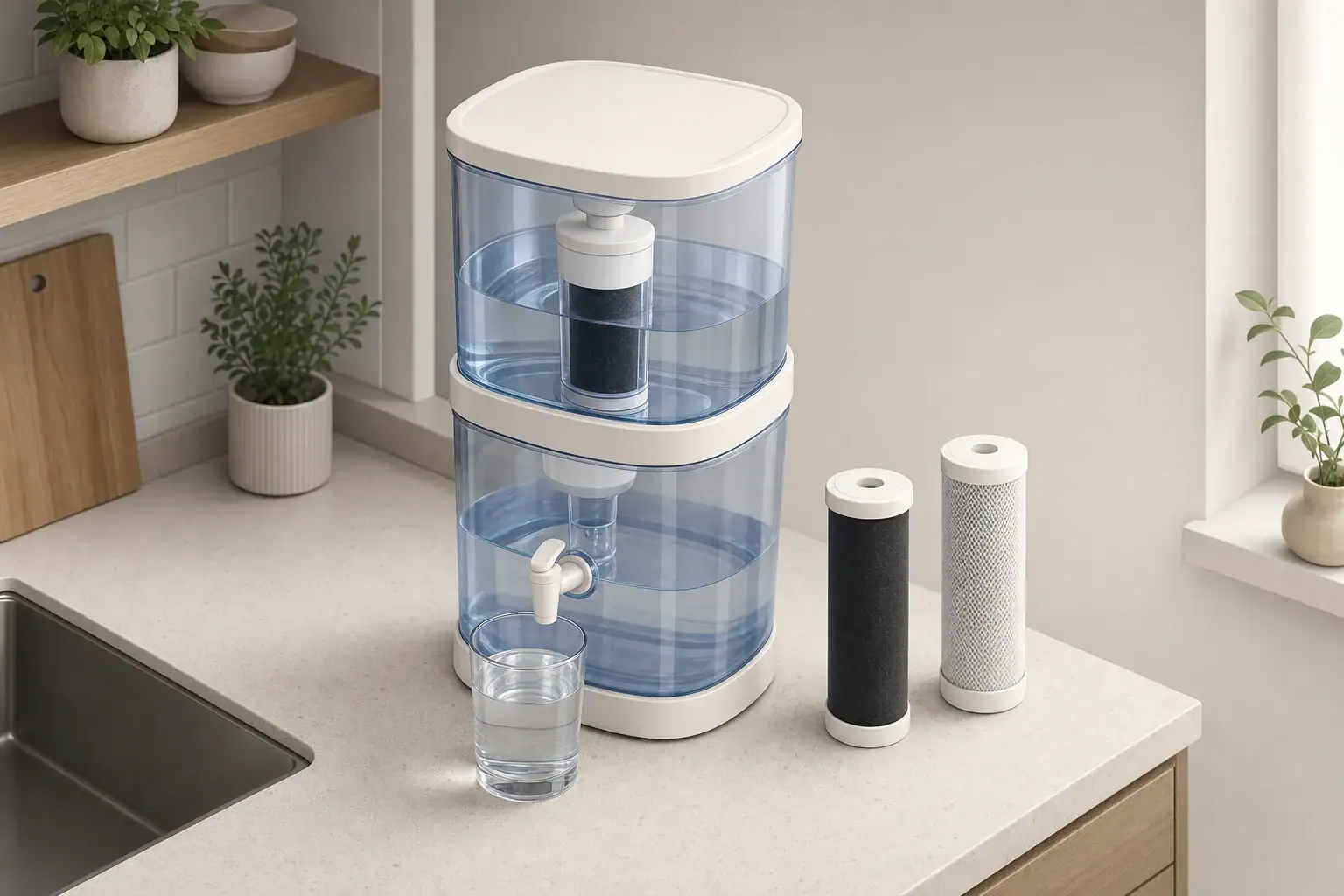
A countertop gravity water filter can make sense in an apartment when plumbing changes are not allowed, portability matters, and the household can tolerate slower filtration and manual refilling. It is often a practical middle ground between a small pitcher and a permanently installed under-sink system.
It is less suitable when counter space is scarce, daily water demand is high, or a specific contaminant must be reduced without a verified performance claim. The right decision depends on more than whether the unit physically fits: capacity, refill frequency, filtration evidence, maintenance, and total filled weight all matter.
What Makes a Gravity Filter Apartment-Friendly?
A countertop gravity system typically has an upper chamber for unfiltered water, one or more filter elements, and a lower chamber that stores treated water. Gravity moves water through the filters without electricity or a connection to the faucet.
That design offers several advantages for renters:
- No plumbing modification: The unit normally does not require drilling, faucet adapters, or changes beneath the sink.
- Portability: It can move to a new apartment without uninstalling water lines or leaving hardware behind.
- Flexible placement: It can sit on a counter, cart, or sturdy shelf as long as the dispenser remains accessible.
- Stored filtered water: The lower chamber provides water even while another batch is filtering, provided it has been refilled in advance.
- No operating pressure: It does not depend on apartment water pressure to push water through the filter.
These systems are different from faucet-connected countertop filters, which use a hose or diverter valve and filter water under line pressure. Renters comparing the two should confirm which design they are considering because installation, flow, and counter use differ substantially.
Apartment Situations Where Gravity Filtration Works Well
| Apartment need | Likely fit | Main consideration |
|---|---|---|
| No plumbing changes allowed | Good | Usually operates as a freestanding unit |
| One or two residents | Often good | Capacity may cover drinking water with regular refills |
| Very limited counter space | Mixed | Tall chambers need a stable footprint and overhead clearance |
| High cooking and drinking demand | Mixed to poor | Slow filtration can create refill bottlenecks |
| Frequent moves | Good | Portable, but some models are bulky when disassembled |
| Need to address a known contaminant | Depends | Requires a verified claim for the exact model and filter |
A small household wants filtered drinking water
For one person or a couple, a gravity unit may provide enough water for drinking and limited food preparation without constant refilling. It is generally easier to manage when demand is spread throughout the day rather than concentrated into a short period.
The lease restricts installation
A freestanding system avoids many concerns associated with altering a faucet, drain, cabinet, or supply line. Renters should still check lease rules if the unit will be placed on built-in shelving or anywhere that could be affected by its weight or occasional drips.
Portability matters more than fast flow
Gravity filters are useful for residents who expect to move and do not want to choose a system around the current apartment’s faucet or under-sink layout. The trade-off is that water is produced gradually rather than immediately on demand.
When a Gravity System May Be the Wrong Fit
Counter space is already tight
Gravity systems can have a modest footprint but considerable height. Enough vertical clearance is needed to remove the lid, fill the upper chamber, and lift out filter elements for cleaning. A cabinet directly above the intended location can make normal use awkward even if the unit technically fits.
The dispenser also needs to extend beyond the supporting surface or sit high enough for a glass to fit beneath it. Placing the system at the edge of a narrow counter can increase the chance of tipping or impact.
Filtered water demand is consistently high
Filtration speed varies with filter design, water temperature, filter condition, and the amount of water in the upper chamber. Flow commonly slows as filters collect material or as the water level drops.
A household that fills several large bottles each morning or uses filtered water for most cooking may consume stored water faster than the system can replace it. A larger chamber reduces refill frequency but also takes up more space and becomes heavier.
Immediate flow is important
Unlike an under-sink or faucet-connected filter, a gravity system does not deliver a continuous stream at the sink. Residents must plan ahead, keep the upper chamber filled appropriately, and wait for water to pass into the lower reservoir.
The goal is broad contaminant protection without checking claims
Gravity operation alone says nothing about what a filter reduces. Performance depends on the filter media and construction. Carbon may help with chlorine-related taste and odor, while other media may be designed for certain metals, chemicals, cysts, or sediment. Those capabilities should not be assumed from appearance or product type.
Capacity, Weight, and Refill Planning
Rated chamber capacity is not always the same as the amount available from the dispenser. Some water may remain below the outlet, and the upper chamber cannot necessarily be refilled whenever the lower chamber is full. Overfilling can cause water to rise between chambers or leak from the joint.
Estimate demand before choosing a size:
- Track how much water the household drinks on a typical day.
- Add any filtered water regularly used for coffee, tea, ice, pets, or cooking.
- Consider when that water is needed and whether there is enough time for refilling between uses.
- Compare that pattern with the unit’s usable storage and stated filtration rate.
For example, if an apartment household uses about 1.5 gallons of filtered water per day, a system with one gallon of practically accessible storage would require at least one refill during the day. This is an illustrative planning example, not a universal consumption target.
Weight also matters. Water weighs about 8.3 pounds per gallon, so two gallons alone weigh roughly 16.6 pounds before adding the chambers, filters, lid, and hardware. The system should sit on a level, stable surface rated to support its filled weight. A lightweight folding table or unstable cart may not be appropriate.
How to Evaluate Filtration Claims
Start with the actual concern rather than a long list of possible contaminants. For municipally supplied water, the local utility’s water quality report can provide information about the source and regulated testing. Conditions inside an apartment building, including older service lines or plumbing materials, may also affect water by the time it reaches the tap.
If there is a specific concern such as lead, chlorine taste, a particular chemical, or microbial contamination, look for performance documentation that names that contaminant and applies to the exact system and replacement filter. A general statement that a filter is tested, advanced, or uses a certain type of media is not equivalent to third-party certification for a reduction claim.
NSF and the Water Quality Association maintain certification information for some filtration products. When certification is important, verify the model number, replacement element, contaminant claim, rated capacity, and required operating conditions in the certifying organization’s listing. Certification for one claim should not be interpreted as certification for every contaminant.
A standard household gravity filter also should not be assumed to make microbiologically unsafe water safe. During a boil-water advisory or other public notice, follow instructions from the local utility or public health authority. Do not substitute routine countertop filtration unless the relevant authority and the filter’s verified performance information support that use.
Maintenance in a Rental Kitchen
Gravity systems avoid plumbing maintenance, but they are not maintenance-free. Routine work may include:
- Refilling the upper chamber without exceeding the manufacturer’s limits
- Washing chambers and lids according to the care instructions
- Cleaning the dispenser and seals
- Priming or conditioning new filter elements when required
- Replacing filters by time, treated-water volume, or another specified indicator
- Checking for slow flow, damaged seals, corrosion, cracks, or leaks
Replacement timing should come from the manufacturer’s instructions and verified rated capacity rather than taste alone. A filter may continue to pass water after its stated service life, and a change in taste is not a reliable measure of every contaminant.
Clean hands and utensils are important when handling the inside of either chamber. Avoid placing cleaned components on dirty counters, and do not allow untreated water from the upper chamber to spill into the lower chamber. If the system will sit unused for an extended period, follow the storage and restart instructions for its filter media.
Common Apartment Setup Mistakes
- Measuring only the base: Include total height, lid removal space, and room to pour water into the top.
- Ignoring full weight: Confirm that the counter, cart, or shelf can support the system when both chambers contain water.
- Assuming advertised capacity is fully dispensable: Check chamber design and outlet position.
- Choosing by capacity alone: A large unit can still be inconvenient if the filter rate is too slow for peak demand.
- Buying before identifying the water concern: The filter needs a relevant, supportable reduction claim.
- Refilling a full lower chamber: Water continuing to pass from the upper chamber may cause overflow.
- Forgetting replacement access: Filter elements and seals should be reasonably available for as long as the system is expected to remain in use.
Related guides: Water filter setups for apartments • Countertop filters for small kitchens • Filter capacity calculator
A Practical Apartment Decision
A countertop gravity filter is most practical for renters who want a portable, installation-free source of filtered drinking water and can accommodate its footprint, weight, and refill routine. Before choosing one, measure the available space, estimate daily demand, identify the relevant water-quality concern, and verify that the exact filter has appropriate performance documentation. If fast on-demand flow or high daily output matters more than portability, another filtration format may fit the apartment better.
Frequently asked questions
Are countertop gravity water filters good for apartments?
They can be a good fit for renters because they normally require no plumbing changes and can move with the household. They work best when there is adequate counter space, a stable surface, and time for manual refilling.
How much counter space does a gravity water filter need?
Measure the base footprint as well as the full height, clearance needed to remove the lid, and room to fill the upper chamber. Also allow enough space to use the dispenser safely without placing the unit at a counter edge.
Can a gravity filter keep up with a household’s daily water use?
That depends on usable storage, filtration rate, and when water is needed. A small household may manage with regular refills, while high drinking or cooking demand can exceed the system’s available filtered-water supply.
Do gravity water filters remove lead or other specific contaminants?
Not necessarily. Check the exact system and replacement filter for documented, applicable performance claims for the contaminant of concern, rather than assuming capability from the filter type or media.
Can I use a countertop gravity filter during a boil-water advisory?
Do not assume a routine household gravity filter makes unsafe water safe. Follow directions from the local utility or public health authority unless verified performance information specifically supports the intended use.
How often do gravity filter elements need replacement?
Follow the manufacturer’s replacement schedule, rated capacity, and maintenance instructions. Taste alone is not a reliable indication that a filter is still performing as intended.
Recommended next:
- Pitcher vs Under-Sink vs RO: Which Fits Your Budget and Water?
- Whole House vs Under-Sink: Taste vs Whole-Home Protection
- Carbon Block vs GAC vs Ion Exchange: Quick Guide to Filter Media
- Best Water Filter Setup for Apartments (Renters, Space, No Drill)
- Best Filters for Hard Water Problems (Scale, Feel, Appliances)
- Best Filters for Chlorine Taste: Pitcher vs Faucet vs Under-Sink
- More in Comparisons & Buying Guides →
- NSF/ANSI standards explained (42/53/401/58)
- Clear trade-offs: pitcher vs faucet vs under-sink vs RO
- Maintenance planning: cost per gallon and replacement cadence