
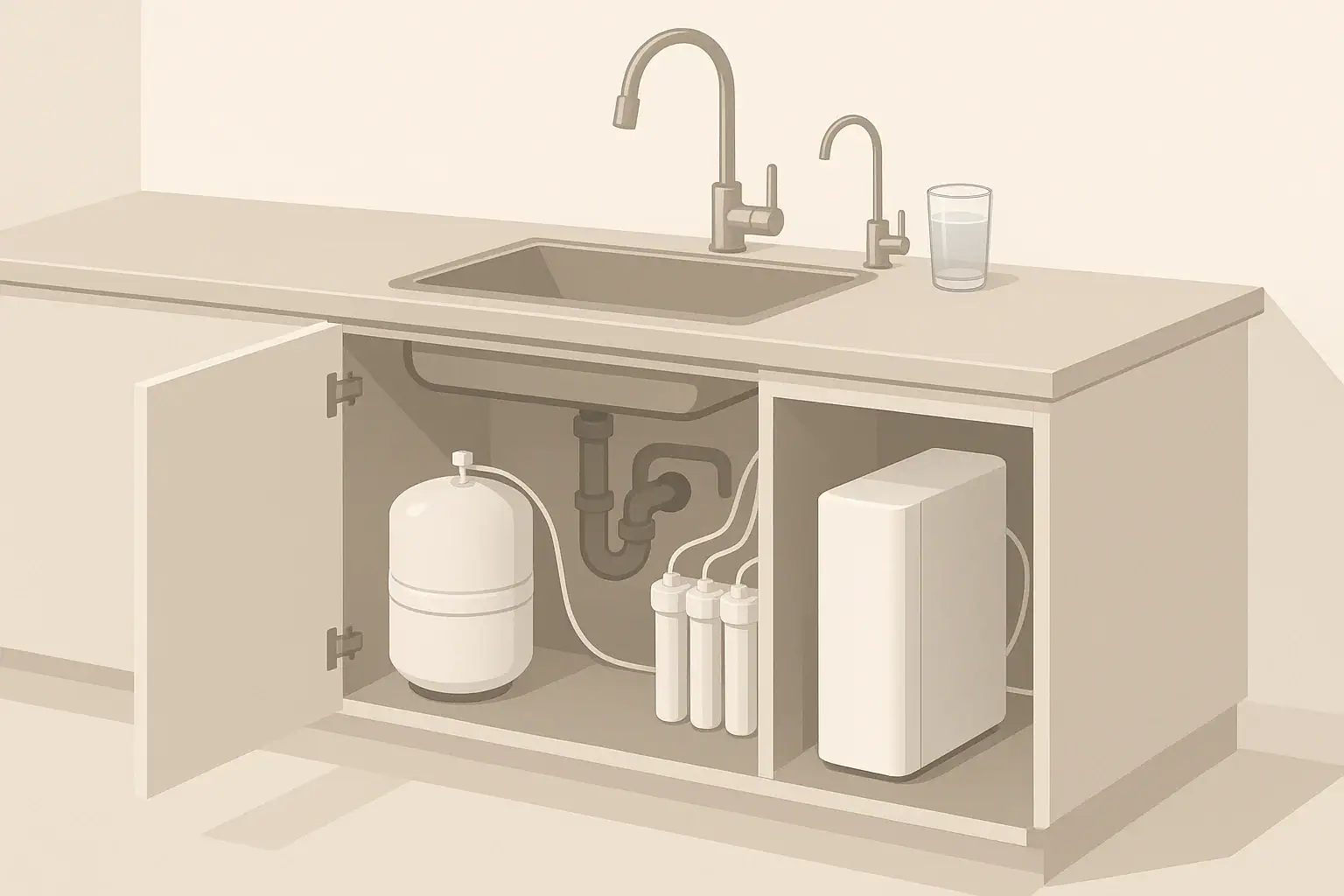
Choosing between a dedicated faucet filter setup and an inline under-sink filter is partly about water quality goals, but it is also about convenience. The simpler option is not the same for every kitchen. It depends on the sink layout, how comfortable you are with basic plumbing, whether you rent or own, and how you want filtered water to work day to day.
In general, an inline under-sink filter is often simpler to use because it sends filtered water through the existing cold-water faucet. A dedicated faucet setup can be simpler to manage if you want a separate drinking water outlet, a lower flow filtration system, or fewer compromises on the main kitchen faucet. Both designs can be practical when installed correctly and maintained on schedule.
What each setup is
A dedicated faucet setup uses a separate small faucet at the sink for filtered drinking water. The filter system sits under the sink and connects to that faucet only. This arrangement is common with many multi-stage under-sink filters and reverse osmosis systems, especially when the treatment process has a slower flow rate than a standard kitchen faucet.
An inline under-sink filter connects to the cold-water line feeding the existing kitchen faucet. When you turn on cold water, it passes through the filter before reaching the faucet. There is no separate drinking water tap, and the sink deck usually looks unchanged after installation.
Typical dedicated faucet parts
- Filter housing or cartridge system
- Separate drinking water faucet
- Tubing between the filter and faucet
- A connection to the cold-water supply
- For some systems, a storage tank or drain connection
Typical inline under-sink parts
- Filter housing or cartridge system
- Connection at the cold-water supply line
- Outlet line to the existing faucet
- Mounting bracket or under-sink placement
The important difference is not just the filter itself. It is where filtered water comes out. That affects installation, flow, maintenance, and how the kitchen feels in daily use.
Where the simplicity question really shows up
When people ask which setup is simpler, they may mean several different things. One person may want the easiest installation. Another may want the least visible hardware. Someone else may care most about fast cartridge changes or avoiding changes to a rental sink.
That is why the answer is usually conditional. A simple system for a homeowner with an unused sink hole may be inconvenient for a renter who cannot alter the countertop. A streamlined inline system may be perfect for city water taste and odor improvement, but less suitable for a treatment process that needs slower flow or a separate faucet.
It also helps to separate faucet type from filtration method. A dedicated faucet does not automatically mean reverse osmosis, and an inline filter does not automatically mean basic carbon only. However, many higher-restriction systems use a dedicated faucet because they are not intended to supply every cold-water demand at full kitchen faucet flow.
Example values for illustration.
| Factor | Dedicated faucet setup | Inline under-sink filter |
|---|---|---|
| Visible changes | Adds a separate drinking water faucet | Usually no visible sink change |
| Sink opening needed | Often needs an unused hole or approved installation point | Usually does not need a new sink hole |
| Daily operation | Use separate tap for filtered water | Use normal cold-water handle |
| Main faucet flow | Main faucet typically unaffected | May reduce cold-water flow depending on filter design |
| Best fit | Drinking and cooking water only | All cold water at the kitchen faucet |
| Common maintenance | Change cartridges and check faucet tubing | Change cartridges and check supply connections |
| Rental friendliness | Depends on sink and lease restrictions | Often easier to reverse if no permanent changes are made |
Installation: fewer parts versus fewer visible changes
For many households, installation is the biggest simplicity difference. An inline under-sink filter often has fewer visible changes because it uses the faucet already in place. The work is usually concentrated under the sink: connecting the filter between the cold-water shutoff valve and the faucet supply line, then securing the cartridge housing.
A dedicated faucet setup may involve more visible planning. The separate faucet needs a place to go. Some sinks have an unused accessory hole with a cover plate. Others have a soap dispenser, air gap, sprayer, or no available opening. If a new hole would be required, the job becomes less simple and should be handled according to the sink material, local plumbing expectations, and the product instructions. Avoid drilling or modifying a sink or countertop unless it is allowed and appropriate for the material.
Some dedicated faucet systems are still straightforward when the sink already has a suitable unused opening. In that case, the separate outlet can actually make the layout cleaner because the filter does not have to supply every cold-water use at the main faucet.
When inline installation may feel simpler
- You want no extra faucet on the sink deck.
- You have no available sink hole.
- You want filtered cold water from the main faucet.
- You prefer fewer visible components.
When a dedicated faucet may feel simpler
- You already have an unused sink opening.
- You want to keep unfiltered cold water available at full flow.
- You are installing a system that is not designed for whole-faucet flow.
- You want drinking water separated from general washing and rinsing.
Whichever setup you choose, installation should follow the manufacturer instructions and applicable plumbing codes. Do not bypass pressure controls, drain requirements, air gaps, backflow protections, or other safety features. If a connection does not match existing plumbing, using a qualified plumber is safer than improvising with incompatible parts.
Daily use: one handle or a separate drinking water tap
Inline under-sink filters are simple in daily use because there is no new behavior to learn. Turn on the cold-water side of the kitchen faucet and filtered water comes out. This can be convenient for filling pots, rinsing produce, making coffee, or using the faucet as usual.
The tradeoff is that every cold-water use at that faucet passes through the filter. That may include hand washing, rinsing dishes, or letting cold water run while cleaning. For some households, that is fine. For others, it may use filter capacity faster than expected.
A dedicated faucet adds one extra decision: use the small drinking water faucet when you want filtered water. The main faucet remains unchanged for general cleaning and high-flow kitchen tasks. This can help conserve cartridge life and reduce pressure-drop complaints at the main faucet.
Dedicated faucets typically have a lower flow than a full-size kitchen faucet. That is usually acceptable for drinking water, coffee, tea, ice trays, and cooking water in moderate amounts. It may feel slower if you often fill large pots through the dedicated tap.
Maintenance and leak awareness
Both setups need routine maintenance. Simplicity over time depends less on the faucet style and more on cartridge access, filter capacity, shutoff access, and whether the system is installed neatly under the sink.
Cartridge replacement intervals vary by filter type, water use, and source water quality. A carbon cartridge used for taste and odor improvement may have a different schedule than a sediment prefilter or reverse osmosis membrane. Treat manufacturer intervals as a planning baseline, not a guarantee that every home will get the same service life.
Inline maintenance considerations
- The main cold-water faucet may slow down as the cartridge loads with particles or scale-related buildup.
- Because all cold water passes through the filter, cartridge capacity may be used faster.
- A clogged filter can be more noticeable because it affects normal kitchen faucet use.
Dedicated faucet maintenance considerations
- The filtered water tap may be easier to isolate from general sink use.
- More tubing and faucet connections may mean more points to inspect.
- Systems with tanks or drains need additional checks, especially for tubing position and sanitation guidance.
Leak awareness is important for both. After installation or cartridge changes, check connections while the system is pressurized and again after normal use. Keep the cabinet area dry and uncluttered enough that slow drips are visible. Do not ignore pressure changes, unusual noises, or wet cabinet flooring.
Rentals, apartments, and sink compatibility
For renters, the simpler setup is usually the one that does not require permanent sink or countertop changes. An inline under-sink filter may be attractive because it can often be installed under the cabinet without adding a faucet. However, rental rules vary, and tenants should get permission before altering plumbing connections.
A dedicated faucet can be rental-friendly if there is already an unused sink hole and the landlord allows the installation. It is less practical if it would require drilling or replacing fixtures. In apartments, cabinet space can also be limited, especially if there is a garbage disposal, pull-out faucet hose, or storage items under the sink.
Sink compatibility matters for homeowners too. A pull-down faucet, sprayer hose, soap dispenser, dishwasher air gap, or large disposal can make the under-sink area crowded. Before buying any system, measure the cabinet and trace the current cold-water line. The simplest setup is one that fits without sharp tubing bends, stressed connections, or blocked access to shutoff valves.
A practical way to choose the simpler setup
Start with the job you want the filter to do. If the main goal is improving taste and odor from treated city water at the kitchen faucet, an inline carbon-based under-sink filter may be a simple fit. If the goal involves a multi-stage system, reverse osmosis, or a lower-flow drinking water process, a dedicated faucet may be more practical.
Then look at the sink. If you have an open accessory hole, a dedicated faucet becomes easier. If the sink has no available opening and you do not want visible changes, inline becomes easier. If you rent, the least permanent option is often the simplest in practice.
Finally, think about water use. A household that fills many large pots from the main faucet may prefer inline filtration if the system can support the desired flow. A household that mainly wants filtered water for drinking, coffee, tea, and ice may prefer a dedicated faucet because it keeps filter use targeted.
- Choose inline if you want the existing faucet to do everything.
- Choose a dedicated faucet if you want filtered water separated from general sink use.
- Check cabinet space before assuming either setup will fit.
- Consider cartridge cost and replacement access, not only installation.
- Use certified performance information where available, but match it to your actual water concern.
Example values for illustration.
| Situation | Simpler leaning | Why it may be easier |
|---|---|---|
| No unused sink hole | Inline under-sink filter | Avoids adding a separate faucet |
| Unused accessory hole available | Dedicated faucet setup | Separate tap can be added with less visible disruption |
| Filtering only drinking water | Dedicated faucet setup | Uses cartridge capacity for targeted water use |
| Filtering all kitchen cold water | Inline under-sink filter | Works through the existing faucet |
| Very limited cabinet space | Depends on system size | Measure housings, tubing, and replacement clearance |
| Rental with strict fixture rules | Inline under-sink filter | May avoid permanent sink-deck changes if allowed |
| Lower-flow multi-stage system | Dedicated faucet setup | Keeps treated water separate from high-flow tasks |
Related guides: Faucet-Mount vs Under-Sink Filters: Convenience vs Performance • Under-Sink Filter Installation: Tools, Parts, and Common Mistakes • No-Drill Under-Sink Filters for Renters: What’s Possible? • Under-Sink Filters for Apartments: Space-Saving Mounting Ideas • RO vs Carbon Under-Sink: Taste, TDS, and Maintenance Compared
Common questions
Is an inline under-sink filter always easier to install?
Not always. It can be easier when the existing cold-water line is accessible and the filter fits under the cabinet. It can become less simple if fittings are incompatible, the shutoff valve is old, or the cabinet is crowded. Any questionable plumbing connection should be handled carefully or by a qualified professional.
Does a dedicated faucet mean better filtration?
No. The faucet style does not determine performance by itself. Filtration performance depends on the filter media, system design, flow rate, cartridge condition, and any applicable testing or certification. A dedicated faucet is mainly a delivery choice.
Will an inline filter reduce water pressure?
It can reduce flow at the cold side of the kitchen faucet, especially as the cartridge loads with sediment or if the system has a restrictive design. The effect varies by plumbing pressure, cartridge type, and water use. Checking the rated flow and replacement interval helps set realistic expectations.
Which setup is simpler for reverse osmosis?
Reverse osmosis systems commonly use a dedicated faucet because the process is slower than a standard faucet and may involve a storage tank, drain connection, and multiple stages. Some designs vary, but the separate faucet approach is common for practical flow and separation from general sink use.
What is the simplest choice for most kitchens?
For minimal visible change, an inline under-sink filter is often simpler. For targeted drinking water, especially with multi-stage filtration or an available sink hole, a dedicated faucet may be simpler over time. The best choice is the one that fits your sink, water goals, and maintenance habits without awkward plumbing compromises.
Frequently asked questions
Can I install either setup without changing my sink?
Often yes, but it depends on the system and your sink layout. An inline filter usually avoids a new sink opening, while a dedicated faucet may need an existing unused hole.
Which option is better for a rental kitchen?
The simpler rental choice is usually the one that avoids permanent changes. An inline setup often fits that goal better, but you should still check lease rules before installing anything.
Does an inline filter use cartridge life faster?
It can, because all cold water from the kitchen faucet passes through the filter. If you use that faucet for lots of cleaning or rinsing, replacement may come sooner.
Is a dedicated faucet harder to maintain?
Not necessarily. It adds one more faucet and some extra tubing, but it also keeps filtered water use separate. Maintenance is usually about access and inspection, not just the number of parts.
Which setup is easier if I want filtered water only for drinking?
A dedicated faucet is often easier for that use case because it keeps filtration focused on drinking and cooking water instead of all cold-water tasks at the main faucet.
Recommended next:
- Under-Sink vs Pitcher: Which Is Better for Families?
- Best Under-Sink Filters for Chlorine Taste & Odor
- Under-Sink Filter Installation: Tools, Parts, and Common Mistakes
- No-Drill Under-Sink Filters for Renters: What’s Possible?
- Under-Sink Filters for Lead Reduction: What Certifications to Look For
- Under-Sink Filter Flow Rate Explained: Why GPM Matters
- More in Under-Sink Filters →
- NSF/ANSI standards explained (42/53/401/58)
- Clear trade-offs: pitcher vs faucet vs under-sink vs RO
- Maintenance planning: cost per gallon and replacement cadence