
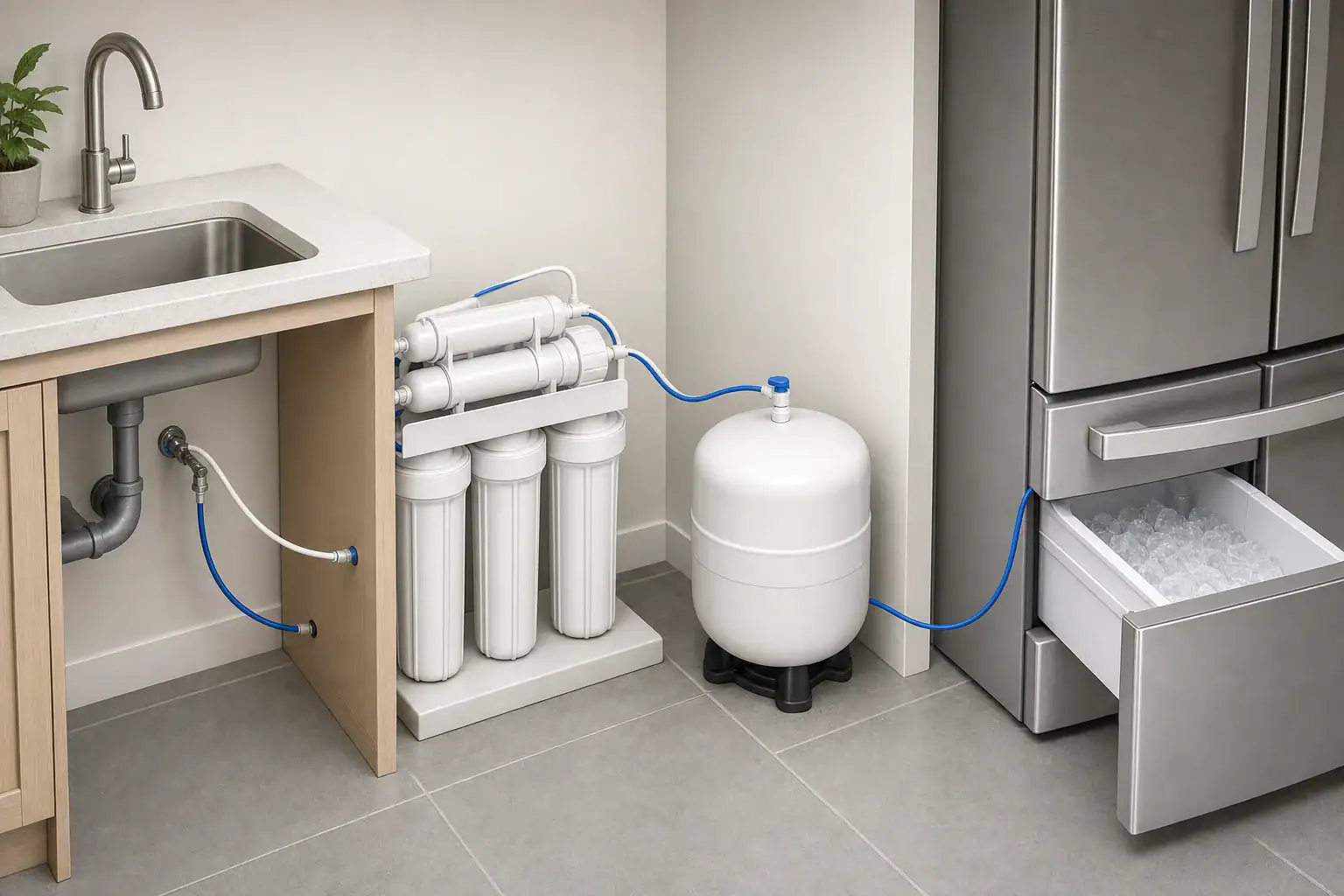
An RO system can usually supply a refrigerator dispenser and ice maker, but only if it provides enough pressure and flow at the refrigerator inlet. A properly sized storage tank, unrestricted tubing, and a compatible refrigerator filter arrangement are often as important as the RO membrane itself.
Before connecting the systems, check the minimum inlet pressure specified by the refrigerator manufacturer and the operating requirements of the reverse osmosis system. Refrigerator requirements vary, and adequate pressure at the RO faucet does not always mean adequate pressure at the appliance.
Why refrigerator performance can suffer on an RO line
A refrigerator normally receives water directly from a pressurized household cold-water line. A conventional under-sink RO system works differently: it produces purified water slowly, stores it in a pressurized tank, and then delivers it when a faucet or appliance opens.
Several pressure points affect performance:
- RO feed pressure: Incoming pressure drives water through the membrane and affects production rate.
- Tank pressure: The storage tank’s air charge pushes stored water toward the refrigerator.
- Delivery pressure: Tubing length, fittings, valves, and postfilters can reduce pressure between the tank and appliance.
- Refrigerator inlet requirement: The dispenser and ice maker valve need sufficient pressure while water is flowing, not merely when the line is idle.
Many refrigerators list a minimum water pressure in the owner’s manual. Some models have different requirements when connected to an RO system. Use the appliance’s stated specification rather than assuming a universal minimum.
Check pressure under actual flow conditions
Static pressure is measured when no water is moving. Dynamic pressure is the pressure available while the dispenser or another outlet is drawing water. A system can show acceptable static pressure but lose too much pressure when flow begins. See how water pressure and flow rate differ when diagnosing a slow line.
Signs of inadequate dynamic pressure include:
- A slow refrigerator dispenser despite normal flow elsewhere
- Small, hollow, or inconsistently formed ice cubes
- An ice tray that does not fill completely
- A refrigerator valve that chatters or takes unusually long to fill
- Good output immediately after the RO tank fills, followed by rapidly declining flow
Start by comparing flow at the dedicated RO faucet with flow at the refrigerator. If both are weak, investigate the RO system, feed pressure, filters, membrane, and tank. If only the refrigerator is weak, the restriction is more likely in the branch tubing, refrigerator filter, supply valve, or appliance inlet valve.
A compatible pressure gauge can provide a more reliable diagnosis than judging flow by sight. Follow the RO and refrigerator manufacturers’ service instructions, shut off the water before disconnecting fittings, and avoid working around an energized appliance water valve. A plumber or appliance technician can measure pressure at the appliance if the connection is not readily accessible.
Evaluate the RO storage tank
A storage tank provides the short burst of flow needed by a refrigerator. Its advertised or nominal volume is not the same as its usable water volume. The amount available depends on feed pressure, tank air charge, shutoff pressure, and the pressure remaining in the tank.
Tank capacity
A small tank may be adequate for occasional ice production but struggle when a dispenser, ice maker, and RO faucet are used close together. The issue is especially noticeable after several glasses of water or a large ice-making cycle.
If flow starts strong and then falls off quickly, allow the tank to refill fully and repeat the test. Consistently exhausting the tank suggests one of three problems:
- The tank does not hold enough usable water for peak demand.
- The RO system produces water too slowly to recover between uses.
- The tank’s air charge or internal bladder is faulty.
Installing a larger or additional tank may increase reserve capacity, but only if the RO system manufacturer permits that configuration. More storage does not correct low feed pressure, a clogged filter, or poor membrane production.
Empty-tank air charge
Conventional RO tanks contain an air chamber separated from the water by a flexible bladder. The air precharge must be measured with the water side completely empty. Many residential tanks use a relatively low empty-tank precharge, often in the general range of 5 to 8 psi, but the correct value is the one specified for the particular tank and RO system.
Too little air can produce weak delivery and leave water trapped in the tank. Too much air reduces the amount of water the tank can store.
To check it safely, close the RO feed valve and open the RO faucet until water stops flowing before using a low-pressure gauge on the tank’s air valve. Make adjustments only according to the manufacturer’s instructions, preferably with a hand pump that allows small changes. For more detail, see how to check and adjust RO tank pressure. If water comes out of the air valve, the bladder has likely failed and the tank generally needs replacement.
Tankless RO systems
A tankless system must produce enough real-time flow for the refrigerator without relying on stored water. Check whether the manufacturer permits a refrigerator connection and whether the system has startup delays, minimum flow behavior, or pressure requirements that could interfere with the ice maker’s short fill cycles. A small appliance pressure tank may be an approved option for some systems, but it should not be added unless the system is designed for it.
Inspect the tubing and refrigerator connection
A long run of narrow tubing can create a substantial pressure drop. Kinks, partially closed valves, excessive fittings, and clogged inline components make the problem worse.
Check the full route from the RO outlet to the refrigerator for:
- Kinked or sharply bent tubing
- A shutoff valve that is not fully open
- A restrictive or deteriorated piercing-type valve
- Debris in fittings after recent plumbing work
- Unnecessary inline filters
- Leaks or loose push-fit connections
- Tubing that is undersized for a long run
Some installations use larger tubing for most of a long refrigerator run and transition to the appliance connection near the refrigerator. Tubing size, materials, fittings, and routing must be compatible with both systems and local plumbing requirements. An accessible, code-appropriate shutoff valve also makes future servicing easier.
Decide how to handle the refrigerator filter
Sending RO water through the refrigerator’s internal filter can add resistance without providing a meaningful benefit for every installation. As the refrigerator cartridge loads with use, dispenser flow may decline further.
Some refrigerators allow the internal cartridge to be replaced with a manufacturer-approved bypass plug when the appliance receives filtered water. Other models require a filter or bypass component to seal and operate correctly. Do not simply remove the cartridge or alter the filter housing. Follow the refrigerator instructions and use only the specified configuration.
If the internal filter remains in place, replace it on the appliance manufacturer’s schedule or when a verified flow problem develops. An old refrigerator filter can be the restriction even when the RO system is working normally.
Separate RO problems from ice maker problems
Low water pressure is only one reason an ice maker may perform poorly. Confirm that the ice maker is switched on, the freezer is operating at its specified temperature, the fill tube is not frozen, and the refrigerator supply valve is open.
| Observed problem | Most useful first checks |
|---|---|
| RO faucet and refrigerator are both slow | RO feed pressure, prefilters, membrane production, tank charge, and tank refill |
| RO faucet is normal but refrigerator is slow | Branch tubing, shutoff valve, refrigerator filter, and appliance inlet valve |
| Flow starts strong and quickly fades | Usable tank capacity, tank precharge, and RO recovery rate |
| Dispenser works but ice is small or incomplete | Dynamic pressure, fill tube, freezer conditions, and ice maker fill cycle |
| Performance dropped after a filter change | Filter seating, approved bypass configuration, closed valves, and trapped air |
After plumbing service or a filter change, trapped air may cause sputtering temporarily. Flush the system according to both manufacturers’ instructions and allow the RO tank time to refill before evaluating ice production. Because an ice maker operates in cycles, the result may not be apparent immediately.
When additional pressure equipment may be appropriate
A feed-water booster pump and a delivery pump solve different problems. A booster pump raises pressure entering the RO membrane, which can improve production when household feed pressure is below the system’s required range. A delivery or demand pump raises pressure after the storage tank for a distant fixture or appliance.
Do not choose a pump until the restriction has been identified. Adding pressure will not fix a clogged refrigerator filter, damaged tank bladder, frozen fill tube, or undersized valve. Any pump must be approved for potable-water service, compatible with the RO system’s controls and pressure limits, and installed according to the manufacturer and applicable plumbing rules.
Related guides: Troubleshooting low RO flow • Fixing low flow from a refrigerator dispenser • Tank vs tankless RO
A practical connection checklist
- Confirm that both the RO system and refrigerator permit the connection.
- Compare the refrigerator’s required inlet pressure with pressure available while water is flowing.
- Verify that the RO tank fills, holds an adequate reserve, and has the correct empty-tank air charge.
- Inspect the complete tubing run for restrictions, leaks, and partially closed valves.
- Use the refrigerator’s approved filter or bypass arrangement.
- Check freezer operation, the fill tube, and the ice maker before blaming the RO system.
- Allow sufficient tank refill and ice-making time after making changes.
If pressure at the RO faucet is acceptable but remains low at the refrigerator after basic checks, measuring dynamic pressure at both points is the clearest next step. That comparison shows whether the solution belongs on the RO side, along the supply line, or inside the refrigerator.
Frequently asked questions
Can I connect a refrigerator ice maker to an RO system?
Usually, yes, if both manufacturers permit the connection and the RO system can provide the refrigerator’s required inlet pressure and flow during a fill cycle.
Why is my refrigerator water dispenser slow on RO water?
Check whether the RO faucet is also slow. If it is not, inspect the refrigerator branch line, shutoff valve, internal filter or approved bypass, and appliance inlet valve for restrictions.
What RO tank size is needed for a refrigerator?
The needed usable capacity depends on dispenser use, ice production, RO production rate, and refrigerator pressure requirements. A tank that delivers strong flow briefly but fades quickly may not provide enough reserve.
Should I remove the refrigerator water filter when using RO water?
Only use a manufacturer-approved bypass plug if the refrigerator instructions allow it. Some refrigerators require a filter or bypass component to operate and seal correctly.
Do I need a pump to run a refrigerator from RO water?
Not necessarily. First identify whether the issue is low RO feed pressure, limited tank capacity, a delivery-line restriction, or a refrigerator component. Use only a compatible pump when it addresses the confirmed problem.
Why are my ice cubes small after connecting a refrigerator to RO?
Small cubes can result from low dynamic pressure, a depleted RO tank, restricted tubing or filtration, a frozen fill tube, or an ice maker issue. Check both the water supply and freezer conditions.
- NSF/ANSI standards explained (42/53/401/58)
- Clear trade-offs: pitcher vs faucet vs under-sink vs RO
- Maintenance planning: cost per gallon and replacement cadence