
What a Refrigerator Filter Bypass Plug Does
A refrigerator filter bypass plug is a small part used in some refrigerators when the internal water filter is removed. Its job is not to filter water. Instead, it keeps water moving through the refrigerator’s dispenser and ice maker when the built-in cartridge is not installed.
In many refrigerator designs, the filter cartridge is also part of the water path. Removing it can leave an open port or interrupt the flow of water. A bypass plug fills that space and redirects water through the filter head so the refrigerator can still operate.
Not every refrigerator needs one. Some models have an automatic bypass built into the filter housing. In those units, removing the cartridge may allow water to continue flowing without a separate plug. Other models require a specific bypass plug that matches the refrigerator’s filter head. If your dispenser slows unexpectedly, check the refrigerator’s water path with a guide like Why Your Filtered Water Flow Suddenly Dropped.
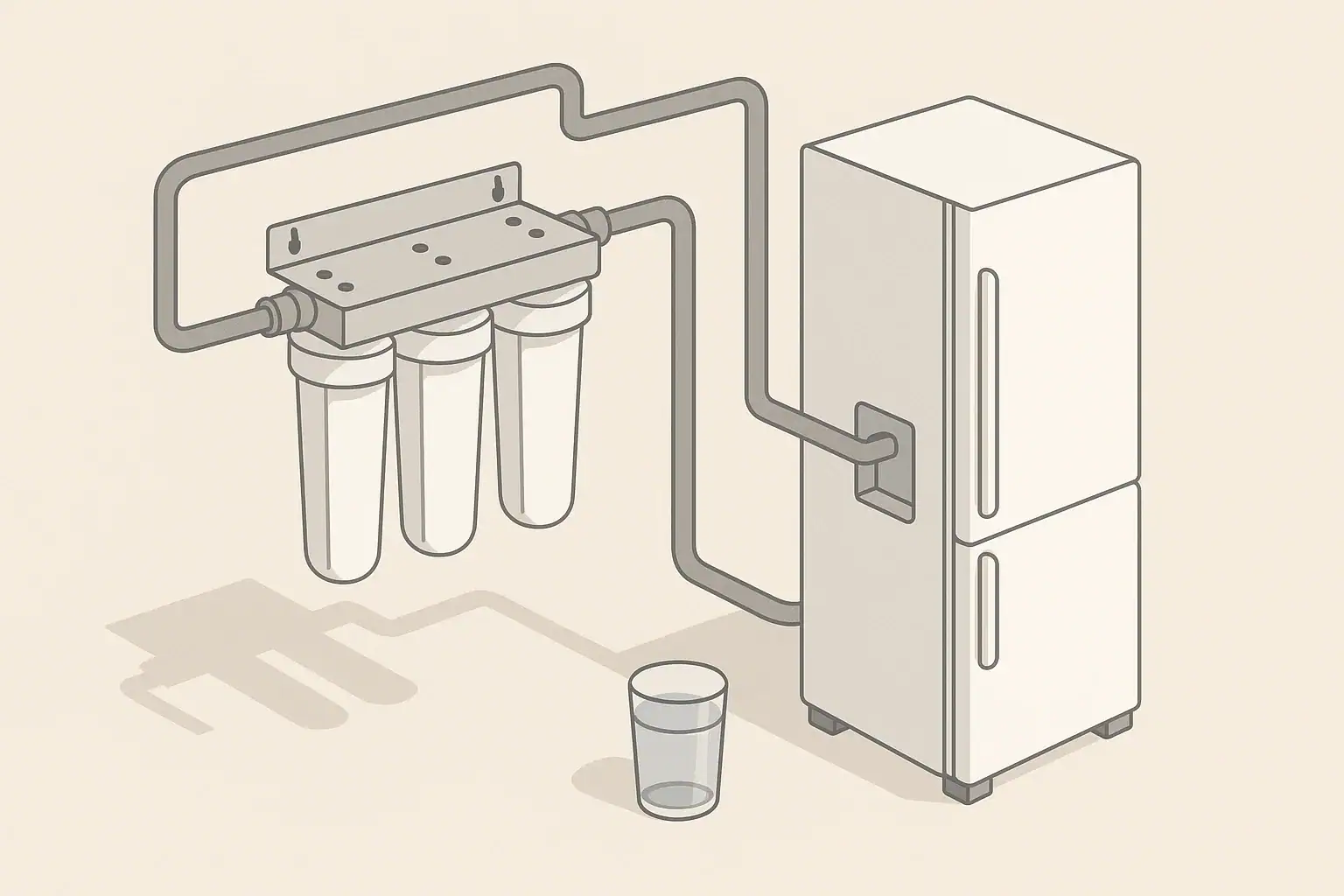
A bypass plug is most often used when the home already has another filtration system, such as an under-sink filter, reverse osmosis system, or whole-house filtration system. It may also be used temporarily while waiting for a replacement cartridge, if the refrigerator is designed for that use.
What it does not do
A bypass plug does not reduce chlorine, chloramine, sediment, lead, PFAS, volatile organic compounds, hardness minerals, or taste and odor issues. It is simply a water-routing component. Any water quality improvement must come from another treatment device upstream or from the refrigerator’s own installed filter cartridge.
When You Need a Bypass Plug
You may need a refrigerator filter bypass plug when your refrigerator will not dispense water or make ice after the internal filter has been removed. This usually means the filter housing needs either a cartridge or a matching bypass part to complete the water path.
A bypass plug can make sense when the refrigerator is connected to treated water from another system. For example, a home may have a whole-house carbon filter for taste and odor, a sediment filter on well water, or an under-sink filtration system feeding the refrigerator line. In those cases, using the refrigerator’s internal cartridge may be unnecessary or may reduce flow more than desired. If you are weighing upstream options, compare them in Whole House vs Under-Sink.
Some households also use bypass plugs because refrigerator filters are small and have limited contact time. If a separate filtration system is already sized for the home’s water quality and flow needs, the internal cartridge may add cost and maintenance without much practical benefit.
Common situations
- The refrigerator requires a plug for water flow when no cartridge is installed.
- A separate filtration system already treats water before it reaches the refrigerator.
- The refrigerator cartridge creates noticeable pressure drop or slow dispensing.
- The user wants to avoid redundant filtration stages.
- A replacement cartridge is delayed and a manufacturer-compatible bypass part is available.
Example values for illustration.
| Situation | Bypass plug typically makes sense? | Practical note |
|---|---|---|
| Refrigerator has automatic bypass | Usually no | The fridge may work with the cartridge removed. |
| Fridge stops dispensing without cartridge | Often yes | A matching plug may be needed to complete flow. |
| Whole-house filtration is installed | Sometimes | Depends on the water quality goals and system design. |
| Under-sink filter feeds refrigerator line | Often | Internal filtration may be redundant if the upstream system is maintained. |
| Untreated well water feeds the refrigerator | Use caution | Confirm sediment, iron, odor, and microbial control needs separately. |
| Water has known lead or PFAS concern | Use caution | Use a treatment method selected for the specific concern. |
| Temporary delay replacing a cartridge | Sometimes | Use only a compatible plug and monitor taste, odor, and flow. |
When You Should Not Use a Bypass Plug
A bypass plug is not a substitute for needed water treatment. If the refrigerator filter is the only filter treating the water, removing it changes what reaches the dispenser and ice maker. That may be acceptable in some homes, but it should be a deliberate decision rather than a convenience choice.
You should be cautious about bypassing the refrigerator filter if you rely on it for a specific contaminant reduction claim. Refrigerator filters vary widely, but some are designed for particular reductions under defined test conditions. A bypass plug removes that treatment step entirely. For example, if you are concerned about lead, review Lead in Tap Water before deciding to skip a certified filter stage.
For private well water, the decision needs extra care. Well water quality can vary by location, season, plumbing materials, and well construction. Sediment, iron, manganese, sulfur odors, hardness, and microbial concerns are usually addressed before water reaches appliances. A refrigerator bypass plug does not manage any of those issues. If you are trying to match treatment to a specific water issue, Whole House Filters for Sulfur Smell may help frame the broader approach.
Avoid unsafe modifications
Do not cut, drill, tape, or alter the refrigerator’s filter housing to create a bypass. Do not force an incompatible plug into the filter head. Do not defeat leak detection features or remove parts that are intended to protect the appliance. If the correct part is not available, use the refrigerator as designed or consult the appliance documentation or a qualified technician.
Also avoid using a bypass plug to compensate for a clogged line, failing valve, damaged filter head, or unknown leak. Those issues should be diagnosed directly. A bypass may change symptoms temporarily without addressing the cause.
How a Bypass Plug Affects Water Quality, Ice, and Flow
The main change from a bypass plug is that the refrigerator’s internal filter media is no longer in the water path. The water and ice quality will depend on the source water and any treatment installed before the refrigerator.
If the home has city water with a chlorine taste and no other filtration, bypassing the refrigerator filter may make the taste or odor more noticeable. If the home has a properly maintained upstream carbon filter, the difference may be minimal. If the home has reverse osmosis water feeding the refrigerator, the internal refrigerator cartridge may be unnecessary and could lower flow. For a deeper look at treatment tradeoffs, see Reverse Osmosis 101.
Flow rate and ice production
Many people consider a bypass plug because the dispenser is slow. A fresh refrigerator cartridge may reduce flow slightly, and a clogged cartridge can reduce it significantly. Removing that restriction may improve dispensing speed, but only if the filter was the main restriction. If the fridge still seems slow, Fixing Low Flow from a Refrigerator Dispenser can help isolate other causes.
Slow refrigerator water flow may also come from:
- A partially closed water shutoff valve
- A kinked refrigerator supply line
- Low household water pressure
- A clogged saddle valve or small supply connection
- Air trapped after a filter change
- A failing inlet valve inside the refrigerator
Ice production depends on both water flow and the refrigerator’s freezing cycle. A bypass plug may help if a clogged filter was limiting fill volume. It will not solve freezer temperature issues, mechanical problems, or water supply problems outside the filter housing.
Carbon filters, RO water, and mineral taste
Most refrigerator filters use activated carbon, often combined with other media. Carbon is commonly used to improve taste and odor associated with chlorine and some organic compounds. It does not soften water in the same way as an ion-exchange softener, and it does not remove dissolved minerals broadly like reverse osmosis.
If reverse osmosis water feeds the refrigerator, the water may taste different because the dissolved mineral content is lower. Some people prefer that taste, while others prefer water with more mineral character. A refrigerator bypass plug does not add minerals back; it simply allows the upstream water to pass through.
Choosing and Installing a Bypass Plug Safely
The most important rule is compatibility. Refrigerator bypass plugs are not universal. They must match the filter housing design, locking tabs, seals, and water path. A plug that looks similar may still fail to seal correctly.
Start by checking the refrigerator’s documentation for whether a bypass plug is required. Many manuals describe whether the appliance has an internal automatic bypass or needs a separate plug. If documentation is missing, the model information inside the refrigerator compartment can usually help identify the correct general type, but the part still needs to match the appliance.
Basic safe-use checklist
- Use only a bypass plug intended for the refrigerator’s filter housing.
- Inspect the plug and seals for damage before use.
- Do not lubricate, trim, or modify seals unless the appliance documentation specifically allows it.
- Follow the refrigerator’s normal filter removal and installation process.
- After installation, dispense water as recommended for normal filter changes to clear air from the line.
- Check around the filter housing, floor, and supply connection for leaks.
If the plug does not turn, click, seat, or seal normally, stop. Forcing a plug can damage the filter head. A damaged filter head can cause leaks inside the refrigerator compartment or behind the appliance, where water damage may go unnoticed.
Using a bypass plug with an external filter
If an external system feeds the refrigerator, make sure it is suitable for the refrigerator’s flow and pressure needs. Some fine filters and reverse osmosis systems can deliver water slowly, especially through long refrigerator supply lines. A pressurized storage tank or properly sized system is often used when an RO system supplies both a faucet and an ice maker.
External filters also need maintenance. Bypassing the refrigerator cartridge does not eliminate the need to replace refrigerator water filters or maintain upstream filtration, sanitize housings when appropriate, or monitor pressure drop. If the upstream system is neglected, the refrigerator may receive lower-quality water than expected.
Maintenance, Leak Awareness, and Troubleshooting
After installing a bypass plug, treat the refrigerator water system as an active plumbing connection. Small leaks can cause damage over time, especially behind the refrigerator or inside cabinets where supply lines run.
Check for leaks shortly after installation and again after normal refrigerator cycles. Look for drips around the filter housing, moisture under the refrigerator, water stains, or dispenser sputtering that does not clear after normal use. If you see water where it should not be, stop using the dispenser and address the leak source. If the issue appears to be around the filter area, review Refrigerator Filter Leaks for common causes.
Water taste and odor should also be monitored. A bypass plug may make a city water disinfectant taste more noticeable if no other carbon stage is present. On well water, changes in odor, sediment, or color should be evaluated at the source rather than treated as a refrigerator issue alone.
Example values for illustration.
| Observation | Likely area to check | Practical next step |
|---|---|---|
| Chlorine-like taste | Missing carbon treatment | Confirm whether upstream carbon filtration is present and maintained. |
| Slow dispenser flow | Supply line or pressure | Check for kinks, partially closed valves, or restrictions before the fridge. |
| Sputtering water | Air in line | Dispense water in short cycles until air clears, if no leak is present. |
| Cloudy ice | Air or dissolved minerals | Compare with tap water and upstream treated water. |
| Water near filter housing | Seal or fit issue | Stop use and verify plug compatibility and seating. |
| Earthy or sulfur odor | Source water or upstream filter | Evaluate well or plumbing conditions and maintain external treatment. |
| Ice maker not filling | Valve, line, or pressure | Confirm water supply and avoid forcing appliance components. |
Related guides: Refrigerator Filter Compatibility: How to Find the Right Replacement • Fixing Low Flow from a Refrigerator Dispenser • Refrigerator Filter Leaks: Common Causes and Quick Fixes • Inline Fridge Filters: When to Use an External Inline Filter
Key Takeaways Before You Bypass the Refrigerator Filter
A refrigerator filter bypass plug is useful when the appliance requires a cartridge-shaped part to keep water flowing and another filtration system is already handling the water quality task. It is a routing part, not a treatment device.
Before using one, confirm whether your refrigerator needs a plug or has an automatic bypass. Then consider what filtration, if any, remains upstream. If the refrigerator filter was your only treatment for taste, odor, or a specific water quality concern, bypassing it changes the water you drink and the ice you use.
The safest approach is to use a compatible plug, avoid modifications, monitor for leaks, and maintain any external filtration system on schedule. When the water source is a private well or when there are known contaminant concerns, make the bypass decision as part of a broader water treatment plan rather than as a simple appliance shortcut.
Frequently asked questions
Can I run my refrigerator without a filter or bypass plug?
Only if your refrigerator model is designed to do that. Some units have an automatic internal bypass, while others need a matching plug to keep water flowing.
Does a bypass plug improve water quality?
No. A bypass plug does not filter water. It only allows water to pass through the refrigerator when the cartridge is not installed.
Why is my refrigerator not dispensing water after I removed the filter?
Your model may require a bypass plug to complete the water path. Check the refrigerator manual or filter housing design to confirm the correct setup.
Will using a bypass plug make the water flow faster?
It can if the refrigerator filter was restricting flow, but it will not fix other causes of slow dispensing such as low pressure, kinks, or valve problems.
Is it safe to use a bypass plug with well water?
Use caution. A bypass plug does not address sediment, odor, hardness, or microbial concerns, so well water should be treated based on the specific water conditions.
Recommended next:
- Why Your Ice Tastes Bad (and How a Fridge Filter Helps)
- Refrigerator Filter Compatibility: How to Find the Right Replacement
- Inline Fridge Filters: When to Use an External Inline Filter
- How Often to Replace Refrigerator Water Filters (By Gallons & Usage)
- Fixing Low Flow from a Refrigerator Dispenser
- Do Refrigerator Filters Reduce Lead? How to Check Claims
- More in Refrigerator & Ice Filters →
- NSF/ANSI standards explained (42/53/401/58)
- Clear trade-offs: pitcher vs faucet vs under-sink vs RO
- Maintenance planning: cost per gallon and replacement cadence