
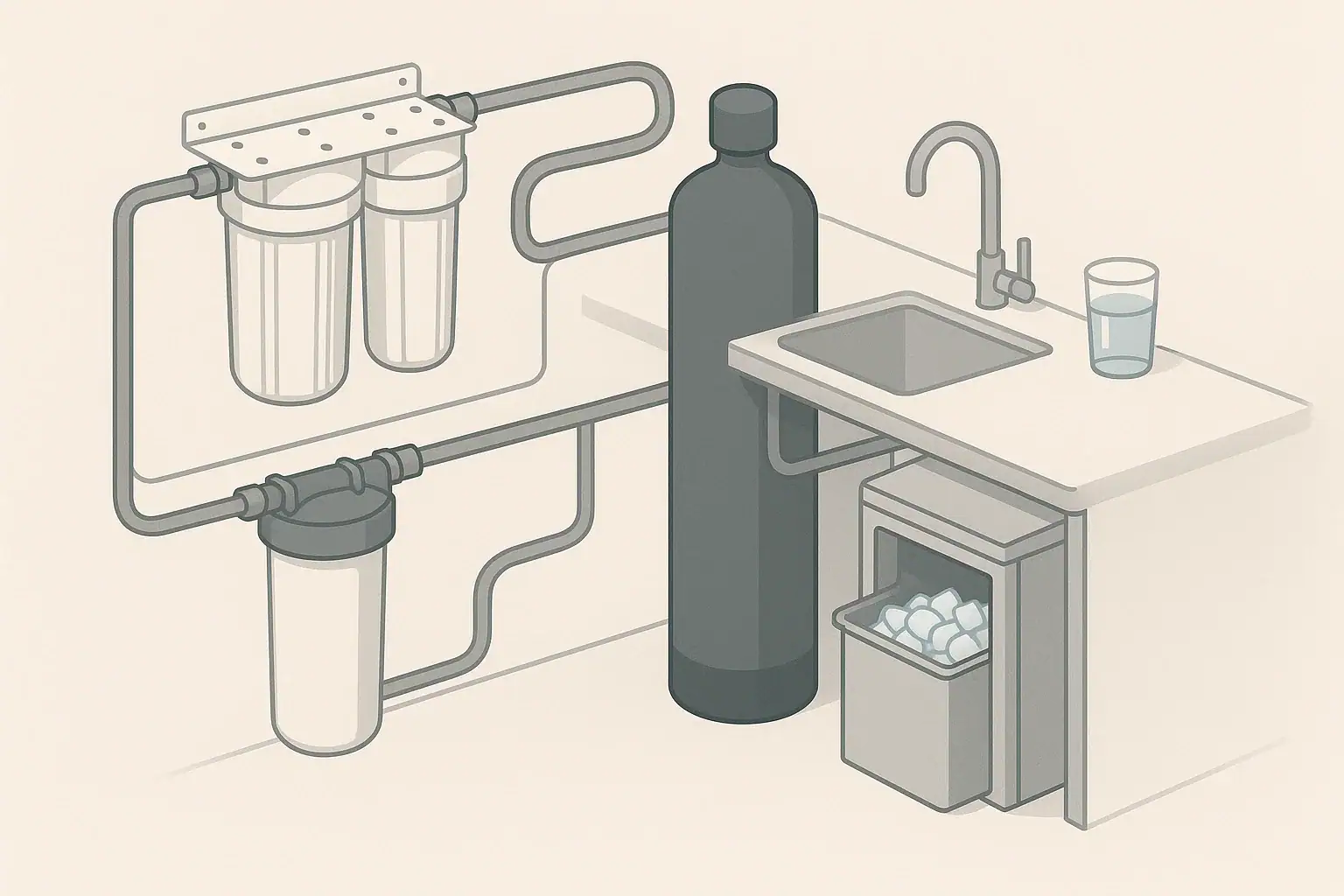
Ice maker scale buildup is usually a practical water chemistry problem, not a sign that the ice maker is defective. White crust, cloudy cubes, slow filling, odd noises, and small flakes in the ice bin often point to minerals left behind as water freezes, evaporates, or sits on cold surfaces.
The right fix depends on what is actually causing the deposits. A refrigerator filter may improve taste and reduce sediment, but it usually does not soften water. A softener can address hardness throughout the home, but it may not solve every ice quality complaint. Descaling removes existing deposits, but it does not change the water that created them.
This article compares the three common approaches: filtration, softening or scale control, and descaling. The goal is to help you choose a reasonable next step without overbuying equipment or ignoring basic maintenance.
Why Ice Makers Develop Scale
Scale forms when dissolved minerals come out of water and collect on surfaces. In many homes, the main contributors are calcium and magnesium, the minerals associated with hard water. These minerals can leave chalky white deposits inside ice maker molds, water lines, fill valves, and bins.
Ice makers can make the issue more noticeable because freezing separates water from some dissolved minerals. As ice forms, minerals may become concentrated in the remaining unfrozen water. Over time, that concentration can leave deposits on cold surfaces or create small white particles that appear in the bin or meltwater.
Scale is especially common where source water is naturally hard. This can affect both city water and well water. Private wells may also carry sediment, iron, manganese, or other constituents that can create staining, particles, or unusual taste. Those issues are not the same as hardness, so the fix may be different.
Common signs of scale around an ice maker
- White or gray crust around the fill cup, mold, or water inlet area
- Cloudy ice, white flakes, or mineral residue after ice melts
- Smaller cubes or incomplete harvest cycles
- Slower water flow to the ice maker or dispenser
- Grinding, buzzing, or straining sounds related to filling or harvesting
- Recurring need to clean the ice bin or ice chute
Some of these symptoms can also come from a clogged filter, low water pressure, a kinked supply line, or a mechanical issue. That is why diagnosis matters before choosing a treatment method.
How to Tell Whether You Need a Filter, Softener, or Descaling
Start by separating two questions: what is in the water, and what is already built up inside the appliance? A water treatment device addresses incoming water. Descaling addresses deposits that are already present. In many homes, the best result comes from doing both: clean the deposits, then treat the water if hardness or particles are recurring problems.
A basic hardness test can be useful if scale returns quickly after cleaning. Many home test kits report hardness in grains per gallon or parts per million as calcium carbonate. The exact number matters less than the pattern: if fixtures, coffee makers, shower doors, and the ice maker all show mineral residue, the issue is likely whole-home hardness rather than only an ice maker problem.
Also consider the type of residue. White chalky scale usually points to hardness. Brown, orange, or black staining may suggest iron, manganese, or sediment, especially on well water. Slimy buildup or odor can have other causes and may call for sanitation and water testing rather than only scale treatment.
Example values for illustration.
| Situation | Most likely need | Why it helps |
|---|---|---|
| White crust returns quickly after cleaning | Softener or scale control | Incoming water likely contains hardness minerals |
| Cloudy cubes with chlorine taste | Carbon filtration | Carbon can improve taste and odor, not hardness |
| Visible grit or particles in water | Sediment filtration | Captures particulate matter before small valves |
| Existing crust inside ice maker | Descaling | Removes deposits already attached to surfaces |
| Whole home has scale at faucets and appliances | Whole-house softening | Treats hardness before it reaches multiple fixtures |
| Well water has staining plus scale | Water testing first | Iron, manganese, sediment, and hardness need different treatment |
| Flow slows after a filter change interval | Filter replacement check | A loaded cartridge can restrict flow to the ice maker |
When a Filter Helps Ice Maker Scale Problems
A filter can help an ice maker, but the type of filter matters. Many refrigerator filters use activated carbon, sometimes combined with a fine particulate element. These filters are commonly used to improve taste and odor and to reduce certain particles, depending on design. They are not primarily hardness treatment devices.
If the complaint is chlorine taste, earthy odor, or small bits of sediment, a suitable filter may make a noticeable difference. If the complaint is hard white scale, a standard carbon filter alone is unlikely to stop it. Calcium and magnesium are dissolved minerals, and they generally pass through basic carbon filtration.
Carbon filters
Carbon filters are often useful for taste and odor issues. They may reduce chlorine taste in city water and can make ice smell and taste cleaner. However, carbon does not meaningfully soften water. If white residue is the main issue, carbon filtration may improve the eating experience of the ice but not prevent scale on internal parts.
Sediment filters
Sediment filters remove suspended particles such as sand, silt, or rust flakes. They can be especially important on well water or older plumbing where small particles may clog narrow appliance lines or valves. Sediment filtration does not remove dissolved hardness, but it can protect downstream filters and appliance components from grit.
Reverse osmosis for ice makers
Reverse osmosis systems can reduce many dissolved minerals, including those associated with hardness. In some homes, RO-treated water can reduce mineral residue in ice. However, using RO water for an ice maker requires careful planning.
RO systems have flow rate, storage, pressure, and drain water considerations. Some ice makers need adequate pressure to fill properly. Long tubing runs, small storage tanks, or low household pressure can affect performance. Always follow the ice maker and treatment system instructions, and use a qualified professional when a dedicated appliance connection is needed.
RO water may also produce different ice characteristics because mineral content is lower. That is not a problem by itself, but it is worth knowing that filtration changes water chemistry and sometimes taste.
When a Softener or Scale Control Device Makes More Sense
If scale appears throughout the home, a point-of-use ice maker filter is not addressing the root cause. A water softener or scale control device treats water before it reaches the refrigerator, coffee maker, dishwasher, and plumbing fixtures.
Traditional ion exchange softeners
A conventional water softener uses ion exchange to reduce calcium and magnesium hardness. In practical terms, it is one of the most direct ways to reduce hard-water scale. It is usually installed at the point where water enters the home, so it can protect multiple fixtures and appliances.
Softened water is not the same as filtered water. A softener is designed for hardness, not taste, odor, sediment, or every possible contaminant. Many homes use a softener for hardness and a separate carbon or sediment filter for other water quality goals.
Softeners also require maintenance, including salt or potassium chloride refills where applicable, periodic checks, and correct settings. The hardness setting should reflect actual water conditions. On private wells, iron or sediment may need to be addressed before a softener to reduce fouling and maintenance problems.
Scale control and conditioning
Some devices are marketed as scale control, scale inhibition, or conditioning rather than true softening. Their purpose is often to reduce how readily minerals attach to surfaces, not to remove hardness minerals from the water. Examples include certain media-based conditioners and chemical feed approaches used in specific applications.
These systems can be useful in some situations, but expectations should be realistic. If a water test shows high hardness and the home has heavy scale, true softening may provide more predictable reduction of hard scale. If the goal is to reduce deposits without adding a conventional softener, scale control may be considered, but performance depends on water chemistry, flow, temperature, and installation design.
Apartment and rental considerations
Renters often cannot install whole-house equipment. In that case, practical options may include replacing the refrigerator cartridge on schedule, using a countertop or under-sink drinking water system where allowed, and descaling the ice maker as recommended by the appliance manual. Avoid modifications that bypass shutoff valves, backflow protection, or lease restrictions.
Descaling and Maintenance: Removing What Is Already There
Descaling is the cleaning step. It removes mineral deposits from surfaces but does not prevent new minerals from entering with the next fill cycle. If deposits are already visible, treating the water alone may not immediately restore performance. The appliance may still need cleaning.
Always follow the ice maker or refrigerator manual for cleaning procedures and approved cleaning products. Some appliances have specific cleaning cycles. Others require shutting off the ice maker, removing ice, cleaning accessible parts, and rinsing thoroughly. Do not use harsh chemicals, abrasive tools, or improvised acids where the manual does not allow them.
Practical maintenance habits
- Replace refrigerator or inline filters according to capacity and time guidance.
- Clean the ice bin periodically, especially if ice sits unused.
- Inspect visible supply tubing for kinks, leaks, or discoloration.
- Check whether scale is also forming at faucets, showerheads, and appliances.
- Use water test results rather than guesswork when problems keep returning.
- Sanitize according to the appliance instructions if odor or biofilm is suspected.
A filter that is overdue for replacement can reduce water flow. Low flow may cause small cubes or incomplete fills, which can be mistaken for scale. On the other hand, a freshly replaced filter will not dissolve old scale from the ice maker mold or fill area. That is why maintenance and diagnosis work together.
For well water, maintenance planning should include the whole water system. Sediment filters may load faster after storms, plumbing work, or changes in well conditions. If staining, odor, or particles appear suddenly, testing and inspection are better than repeatedly replacing refrigerator filters.
Example values for illustration.
| Item | Typical check | Practical note |
|---|---|---|
| Refrigerator carbon filter | Every few months | Replace based on rated capacity, time, or flow drop |
| Inline sediment cartridge | Monthly visual check | Well water or old pipes may load cartridges faster |
| Ice bin cleaning | Every 1 to 3 months | More often if ice is used slowly or odors appear |
| Visible scale inspection | During filter changes | Look near fill cup, chute, and accessible surfaces |
| Softener salt level | Monthly | Keep enough salt for proper regeneration if used |
| Water hardness test | When scale returns | Retest after treatment changes or source changes |
| Professional service | When flow or leaks persist | Use qualified help for appliance or plumbing issues |
Related guides: Why Your Ice Tastes Bad (and How a Fridge Filter Helps) • Refrigerator Filter Compatibility: How to Find the Right Replacement • Whole House Filters vs Water Softeners: Different Jobs Explained • Best Filters for Hard Water Problems (Scale, Feel, Appliances) • TDS vs Hardness: What’s the Difference?
When to Test Water or Call a Professional
Testing is useful when scale is frequent, severe, or confusing. A basic hardness result can guide the filter-versus-softener decision. For private wells, broader testing may be appropriate because hardness can appear alongside iron, manganese, sediment, low pH, or other conditions that affect treatment choices.
Call a qualified professional if the ice maker has leaks, recurring valve problems, electrical symptoms, or persistent low flow after normal filter replacement. Also get help before adding an RO connection, moving appliance supply lines, or installing whole-house equipment. Safe plumbing work should preserve shutoff access, pressure requirements, backflow protection, and manufacturer instructions.
For most homes, the decision can be summarized simply: use filtration for taste, odor, and particles; use softening or scale control for recurring hard-water deposits; and use descaling to remove buildup that already exists. Matching the tool to the problem is the most reliable way to keep ice production steady without unnecessary equipment.
Frequently asked questions
Can a refrigerator filter stop ice maker scale buildup?
Usually not if the problem is hard water. A refrigerator filter can improve taste and reduce sediment, but it does not typically remove hardness minerals that cause scale.
When is a water softener better than descaling?
A softener is better when scale keeps coming back in multiple places around the home. Descaling removes existing buildup, while softening helps prevent new hardness deposits from forming.
How do I know if my ice maker problem is scale or a clogged filter?
If flow slows after the filter has been in service for a while, the filter may be restricted. If white crust or flaky residue keeps returning after cleaning, hardness scale is more likely.
Does reverse osmosis help with cloudy ice?
It can, because RO reduces many dissolved minerals. However, it needs enough pressure and proper setup for the ice maker to fill correctly.
How often should I descale an ice maker?
Follow the appliance manual, since cleaning intervals vary by model and water quality. Homes with hard water often need cleaning more often than homes with softer water.
Should I test my water before buying treatment equipment?
Yes. A basic hardness test, and broader testing on well water, can help you choose between filtration, softening, and descaling without guessing.
Recommended next:
- Why Your Ice Tastes Bad (and How a Fridge Filter Helps)
- Refrigerator Filter Compatibility: How to Find the Right Replacement
- Inline Fridge Filters: When to Use an External Inline Filter
- How Often to Replace Refrigerator Water Filters (By Gallons & Usage)
- Fixing Low Flow from a Refrigerator Dispenser
- Do Refrigerator Filters Reduce Lead? How to Check Claims
- More in Refrigerator & Ice Filters →
- NSF/ANSI standards explained (42/53/401/58)
- Clear trade-offs: pitcher vs faucet vs under-sink vs RO
- Maintenance planning: cost per gallon and replacement cadence