
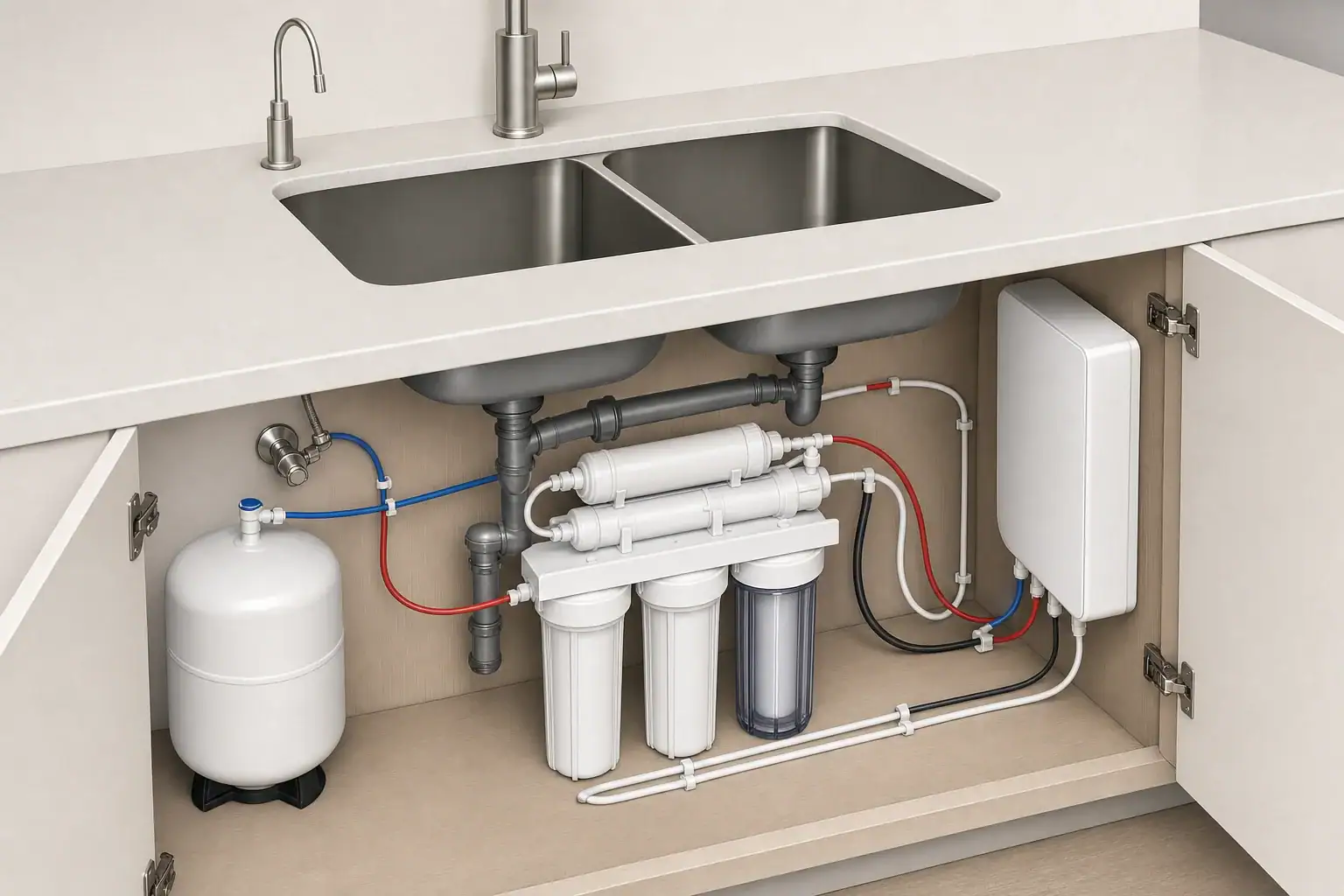
A new banging or knocking sound after installing an under-sink water filter usually comes from tubing or pipes moving when water flow stops suddenly. High supply pressure, a fast-closing faucet or solenoid, trapped air, and an incorrectly configured reverse osmosis system can also contribute.
Start by checking for leaks and identifying exactly when the noise occurs. Loose tubing and initial air can often be addressed without changing the plumbing design. Repeated sharp bangs, pressure fluctuations, or noise from inside a filter assembly may require a plumber or the system installer.
Is the Noise Actually Water Hammer?
True water hammer is a pressure surge caused by flowing water stopping or changing direction abruptly. It commonly sounds like a single, sharp bang immediately after a faucet or automatic valve closes.
Not every post-installation noise is water hammer:
- Sputtering at the faucet: Usually indicates air being displaced from new cartridges, housings, or tubing.
- Rapid clicking or chattering: May come from a check valve, reverse osmosis automatic shutoff valve, pressure pump, or tankless system solenoid.
- Rattling inside the cabinet: Often results from flexible tubing striking a cabinet wall, drainpipe, filter housing, or stored item.
- Whistling: Can indicate a partly closed supply valve, restricted tubing, or water moving through a narrow fitting.
- A low thump during use: May be a pipe shifting in an unsupported opening rather than a pressure surge.
The timing of the sound is one of the most useful clues. A bang when the filtered-water faucet closes points toward sudden flow stoppage. Noise while an RO storage tank is filling or when a tankless unit cycles points more toward a system valve, pump, or tubing issue.
| When the noise happens | Likely area to inspect |
|---|---|
| Immediately after closing the filter faucet | Loose tubing, high pressure, fast valve closure |
| Only during the first few uses | Air in new housings and tubing |
| While an RO tank is filling | Automatic shutoff valve, check valve, drain connection, or moving tubing |
| When a tankless system starts or stops | Solenoid, pump cycle, supply pressure, or unsupported tubing |
| After any faucet or appliance closes | Household pressure or unsecured building piping |
Common Causes After a Filter Installation
Loose Filter Tubing
Under-sink filters add flexible tubing that can move when pressure changes. Even a small movement can produce a loud knock if the tubing touches a cabinet panel, drainpipe, supply line, or filter bracket.
The tubing may also transfer movement to a rigid pipe. This can make the noise seem as though it is coming from inside the wall when the actual contact point is beneath the sink.
Air in New Cartridges and Housings
New filters contain air in the line that must be displaced during startup. Air commonly causes spurting, irregular flow, gurgling, and temporary tubing movement. These symptoms should generally diminish as the system is flushed according to its instructions.
Persistent sharp banging after a complete startup and flush is less likely to be explained by air alone.
Fast-Closing Faucets or Automatic Valves
A quarter-turn faucet can stop flow more abruptly than an older multi-turn faucet. Tankless RO systems and some pump-assisted systems also use solenoid valves that open and close quickly. The installation may reveal a pressure-surge problem that was not noticeable with the previous plumbing arrangement.
High or Unstable Supply Pressure
Higher pressure increases the force created when flow stops. A filter does not normally correct excessive household pressure, and the small shutoff valve under the sink should not be used as a substitute for proper pressure regulation.
Pressure that rises while no fixtures are operating can indicate a pressure-control or thermal-expansion issue elsewhere in the plumbing system. That is not usually solved by adjusting the filter.
Reverse Osmosis Valve or Tank Cycling
A tank-based reverse osmosis system typically includes a check valve and an automatic shutoff mechanism. If pressure repeatedly rises and falls near the shutoff point, a worn, incorrectly installed, or incompatible component may chatter.
Incorrect storage-tank air pressure can also affect system behavior. Tank precharge should only be checked and adjusted using the system manufacturer’s procedure, which commonly requires the water side of the tank to be empty. Guessing at the pressure while the tank contains water can lead to an inaccurate adjustment.
Installation Restrictions or Incorrect Connections
Kinked tubing, a partly opened feed valve, reversed connections, an incorrectly seated cartridge, or a misplaced flow-control component can create unusual pressure changes. Reverse osmosis systems are especially sensitive to correct routing because their check valves, flow restrictors, drains, tanks, and shutoff devices work together.
Do not remove a check valve, flow restrictor, leak shutoff, or other control component to silence the system. Doing so can interfere with normal operation or wastewater control.
A Safe Troubleshooting Sequence
1. Check for Leaks and Visible Damage
Inspect the feed connection, tubing, filter heads, housings, faucet connection, storage tank valve, and drain connection. Look for dripping, moisture, bulging tubing, stressed fittings, or a filter assembly pulling away from its mount.
Shut off the filter’s water supply and arrange service if a fitting is leaking, a housing is damaged, or tubing will not remain securely seated. Water near an electrical outlet, pump, or tankless unit also warrants immediate attention under the product’s shutdown instructions.
2. Reproduce the Noise Carefully
Clear stored items from the cabinet, then operate the filtered-water faucet while observing the exposed tubing. Note whether the noise occurs when the faucet opens, while water flows, when it closes, or several seconds later.
Also determine whether other fixtures trigger the same bang. If a dishwasher, washing machine, toilet valve, or regular kitchen faucet causes it, the issue may involve household plumbing rather than the filter alone.
3. Complete the Required Startup Flush
Follow the filter’s startup and flushing instructions. Open valves gradually where the instructions allow, and flush each stage for the specified process rather than assuming a brief flow is sufficient. Reverse osmosis systems may require filling and discarding initial tank water as directed by the manufacturer.
If sputtering and noise steadily decline, air was probably a major factor. If the same sharp bang continues after flushing, proceed to the mechanical and pressure checks.
4. Prevent Tubing From Striking Surfaces
Route tubing so it does not rest against cabinet panels, drainpipes, rigid water lines, or loose objects. Use plumbing-compatible clips or supports where appropriate, while retaining enough slack for cartridge service.
Do not kink, flatten, tightly pinch, or sharply bend the tubing. Avoid fastening tubing directly to removable filter housings, which need clearance for maintenance.
5. Confirm Valve and Tubing Configuration
Verify the tubing path, connection ports, cartridge order, and valve positions against the system instructions. A normal isolation or feed valve is generally intended to be fully open during operation unless the instructions state otherwise. Leaving it partly closed can cause noise and restriction without reliably controlling pressure.
6. Have Supply Pressure Evaluated
If the bang is strong, affects several fixtures, or returns after tubing is secured, supply pressure should be measured with an appropriate gauge. The result needs to be compared with the filter’s operating range and local plumbing requirements.
Excessive or unstable household pressure may call for service to a pressure-reducing valve or another plumbing correction. In a closed plumbing system, a plumber may also need to assess thermal expansion. Throttling the under-sink stop valve is not an equivalent fix.
7. Consider a Water Hammer Arrestor
A properly selected water hammer arrestor can absorb the pressure surge from a quick-closing valve. It is most effective when installed in the correct location near the valve creating the surge.
The arrestor must be suitable for potable-water plumbing and compatible with the line size, pressure, installation orientation, and local code. Because adding one involves modifying the supply plumbing, professional installation may be appropriate. An arrestor should not be used to conceal excessive pressure, failing valves, or unsupported pipes.
When the Filter Itself Needs Service
Contact the installer, system manufacturer, or a qualified plumber if the sound appears to come from an internal valve, pump, or sealed filter head. Service is also appropriate when:
- The system repeatedly starts and stops despite no filtered water being used.
- An RO automatic shutoff valve or check valve chatters during tank filling.
- A tankless unit cycles rapidly or displays a fault condition.
- Filtered flow has fallen sharply since installation.
- The noise continues after flushing and securing the tubing.
- Pressure changes affect multiple fixtures throughout the home.
- Pipes move inside a wall or another inaccessible area.
Provide the technician with the timing of the noise, which fixtures trigger it, whether the system has a storage tank or pump, and whether the problem began immediately after installation. Those details can narrow the diagnosis without unnecessary component changes.
Related guides: Under-sink filter installation mistakes • Noisy RO system causes and fixes • Water pressure vs. flow rate
Preventing the Noise From Returning
Check tubing placement whenever cartridges are replaced because service can shift lines back against the cabinet or drain. Restore all clips and supports, confirm that valves are returned to their correct operating positions, and complete the required flushing procedure after maintenance.
A brief period of air-related sputtering after a cartridge change can be normal. A recurring hard bang, persistent valve chatter, or worsening pressure fluctuation is a reason to investigate rather than wait for the noise to disappear.
Frequently asked questions
Is water hammer normal after installing an under-sink filter?
Brief sputtering or movement from trapped air can be normal during startup, but a repeated sharp bang is not something to ignore. Check tubing placement, complete the required flush, and investigate persistent noise.
Why does my under-sink filter make a bang when I turn off the faucet?
A bang immediately after the faucet closes can result from flexible tubing striking a surface, a fast-closing valve, or a pressure surge. Secure exposed tubing and have supply pressure evaluated if the problem continues.
Can trapped air in a new water filter cause knocking?
Yes. Air in new cartridges, housings, and tubing can cause sputtering, gurgling, and temporary movement. These symptoms should lessen after the manufacturer’s startup flushing procedure is completed.
Should I partially close the under-sink shutoff valve to stop water hammer?
No. A feed or isolation valve is generally meant to be fully open during normal operation unless the system instructions say otherwise. Partly closing it can restrict flow and create noise without properly controlling pressure.
When should I call a plumber for water hammer after filter installation?
Call for service if the bang is strong, affects multiple fixtures, continues after flushing and securing tubing, or is accompanied by leaks, pressure fluctuations, valve chatter, or pipes moving inside walls.
Will a water hammer arrestor fix noise from an under-sink filter?
An appropriately selected arrestor may help when a quick-closing valve is causing a pressure surge. It should be installed near the source of the surge and should not be used instead of correcting excessive pressure, failing valves, or unsupported pipes.
- NSF/ANSI standards explained (42/53/401/58)
- Clear trade-offs: pitcher vs faucet vs under-sink vs RO
- Maintenance planning: cost per gallon and replacement cadence