
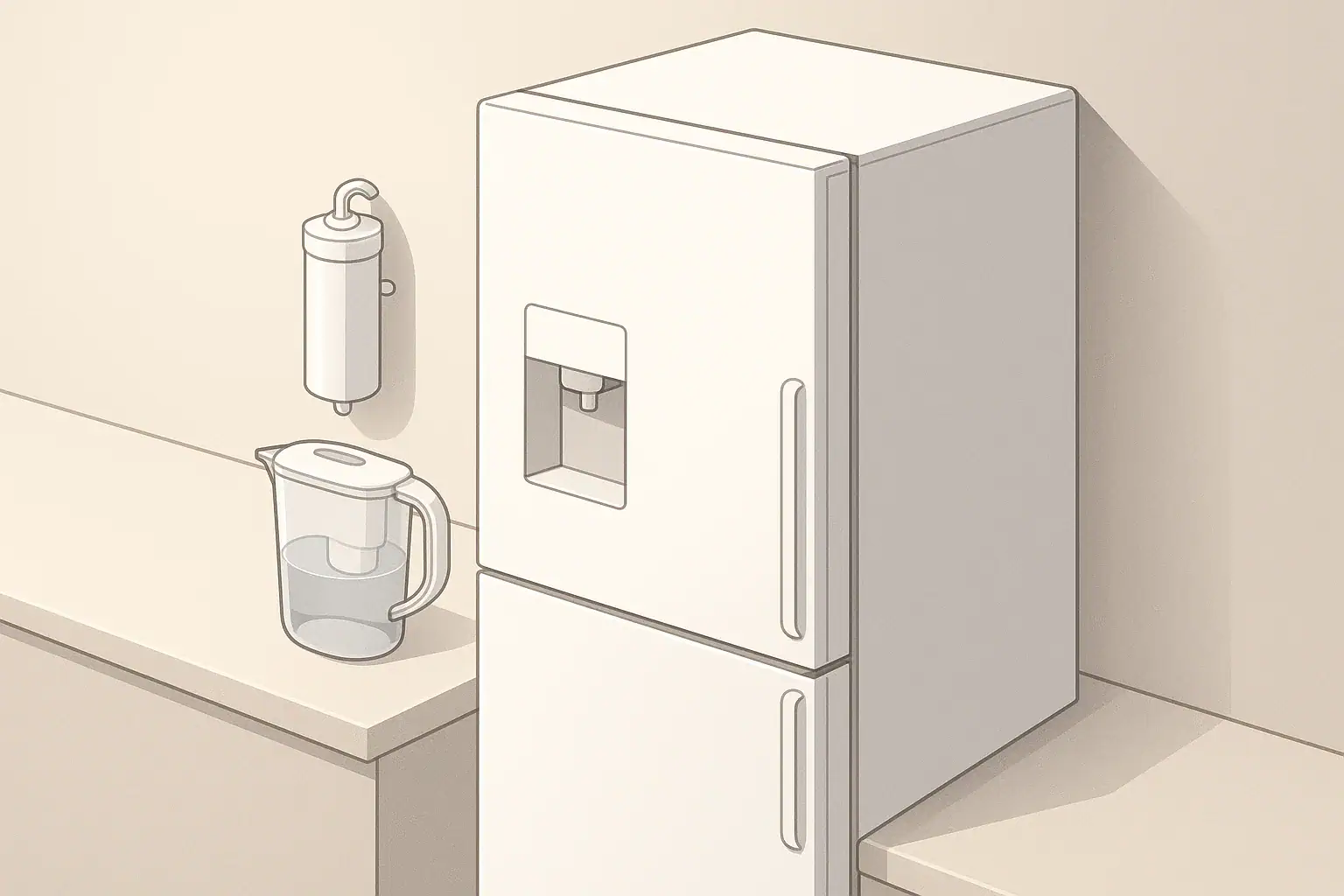
Refrigerator and pitcher filters both aim to make tap water taste and smell better, but they do it in slightly different ways. Understanding how each type works helps explain why your water might taste different from one to the other.
Basic filtration mechanisms
Most fridge and pitcher filters are based on similar core technologies:
- Activated carbon: Highly porous material that adsorbs many taste- and odor-causing compounds, especially chlorine and some organic chemicals.
- Mechanical screening: Fine pores or mesh that trap larger particles like sediment, rust, and visible debris that can affect clarity and mouthfeel.
- Optional media layers: Some designs add ion-exchange resins or additional media to address hardness minerals or specific metals, which can subtly influence taste.
Because both fridge and pitcher filters usually rely on activated carbon, they are often similar in how they handle basic taste issues like chlorine odor or slight discoloration. Differences in taste usually come from water contact time, flow, and how consistently filters are maintained.
How Fridge and Pitcher Filters Improve Taste
What “better taste” usually means
For most households, better-tasting water means:
- Less chlorine or “swimming pool” smell
- Cleaner, less metallic or chemical taste
- Improved clarity (no visible particles or cloudiness related to sediment)
- More “neutral” flavor that does not distract from beverages like coffee or tea
Both fridge and pitcher filters can improve these aspects when properly sized for your water quality and replaced on schedule.
Fridge Filter vs Pitcher: Key Taste Differences
From a user’s perspective, taste differences between fridge and pitcher filters come down to how water moves through the filter, where it is stored, and how consistently the water is kept cold and fresh.
Fridge filters: in-line convenience and stable temperature
Refrigerator filters are usually installed either internally (inside the fresh food compartment) or externally (in-line on the water supply tube). Taste-related points:
- Consistent cold temperature: Chilled water often tastes crisper and can mask minor off-flavors, especially slight chlorine notes.
- Pressurized flow: Household water pressure pushes water through the filter. Contact time with the carbon bed is determined by filter design and your flow rate.
- Direct-to-glass delivery: Water moves from supply line → filter → short length of tubing → your glass, reducing chances for recontamination or stale taste if the system is used regularly.
- Ice taste: The same filter often serves the ice maker, affecting how ice cubes taste and how they influence beverages.
Fridge filters can deliver very consistent taste when the filter is not clogged and the fridge’s internal water lines are clean and used frequently.
Pitcher filters: gravity flow and longer contact time
Pitcher filters sit on the counter or in the fridge and rely on gravity to pull water through the cartridge into a lower reservoir. Taste-related points:
- Longer contact time: Because water drips slowly through the carbon, it can have relatively extended contact time with the filter media, which may enhance removal of some taste- and odor-causing substances.
- Manual batching: Water is filtered in batches, so taste can vary slightly depending on how fresh the batch is and how long it sits in the pitcher.
- Adjustable chilling: You choose whether to keep the pitcher in the fridge or on the counter. Colder storage usually improves perceived taste.
- More exposed storage: Stored water may pick up minor fridge odors if not covered well, or develop a flat taste if it sits for many days.
Pitcher filters can produce very clean-tasting water when refilled regularly, cartridges are changed on time, and the pitcher itself is kept clean to prevent stale or musty notes.
Example values for illustration.
| Factor | Fridge Filter | Pitcher Filter |
|---|---|---|
| Water temperature during use | Usually cold from dispenser | Room temp or chilled, user choice |
| Contact time with filter media | Short to moderate, pressure-driven | Longer, gravity-driven |
| Taste consistency over the day | High if used regularly | Can vary as pitcher empties/sits |
| Impact on ice taste | Yes, typically same filter feeds ice | No direct effect on freezer ice |
| Risk of stale flavor from storage | Low, minimal stored volume in lines | Moderate if water sits for days |
| Perceived “crispness” | Often higher due to chilling | Depends on storage temperature |
Which One Usually Improves Taste More?
For many households with typical municipal tap water in the United States, both fridge and pitcher filters can significantly improve taste compared with unfiltered tap water, especially by reducing chlorine smell and some organic compounds. Whether one tastes “better” is often subjective and depends on how you use each system.
Situations where fridge filters often win on taste
You may notice better-tasting water from a fridge filter when:
- You prefer very cold water: Chilled, filtered water can taste more refreshing even if the underlying filtration is similar.
- You use the dispenser frequently: Regular use keeps water in the internal lines from sitting too long, so you get fresher-tasting water.
- Ice flavor matters: If you are sensitive to how ice affects drinks, a well-maintained fridge filter can reduce off-flavors from ice cubes.
- Your pitcher sits too long: If your household rarely refills the pitcher, water may taste flat or slightly stale compared to freshly dispensed fridge water.
Situations where pitcher filters may taste better
Pitcher-filtered water may taste better in scenarios such as:
- Slow, thorough gravity filtration: Some people notice a cleaner taste that they attribute to the slower flow and longer contact with the carbon media.
- Dedicated pitcher cleaning routine: If the pitcher is washed regularly and water is rotated daily, it can taste extremely fresh and neutral.
- You prefer room-temperature water: Room-temperature filtered water is easier with a counter or pantry-stored pitcher.
- You want to separate water from fridge odors: If your refrigerator tends to carry food smells, a tightly covered pitcher stored elsewhere may avoid subtle odor transfer.
Role of your incoming water quality
Local tap water quality strongly affects which option feels better:
- Heavily chlorinated municipal water: Both systems can help, but some pitcher media designs with slightly more contact time may be perceived as more effective.
- Water with mild sediment or rust: Either option can improve appearance and mouthfeel when cartridges include appropriate particulate reduction stages.
- Very hard water: Basic fridge and pitcher filters are not designed to fully soften water. Taste differences here may be modest unless ion-exchange media is part of the design.
For issues beyond basic chlorine taste and minor particulates—such as concerns about specific metals, PFAS, or other contaminants—taste alone is not a reliable indicator of performance. In those cases, testing and certifications become more important than flavor impressions.
Understanding Certifications and What They Mean for Taste
While you may be choosing mainly based on taste, independent certifications offer a way to compare how different filters handle common tap water issues. For home filters in the United States, you will frequently see NSF/ANSI standards referenced in manuals and product literature.
Key NSF/ANSI standards related to taste
These standards are especially relevant when you care about taste and basic quality:
- NSF/ANSI 42: Focuses on aesthetic effects such as chlorine taste and odor, and sometimes particulates that can influence clarity.
- NSF/ANSI 53: Covers certain health-related contaminants like lead and some volatile organic compounds (VOCs). While aimed at safety, reducing these can also affect flavor.
- NSF/ANSI 401: Addresses selected emerging compounds such as some pharmaceuticals and chemicals. Some of these can impart off-flavors or odors, even at low levels.
Reverse osmosis systems may also reference NSF/ANSI 58, but most basic fridge and pitcher filters rely on standards 42 and sometimes 53 or 401, depending on the design.
How to use certifications as a taste guide
When comparing a fridge-compatible filter cartridge and a pitcher cartridge, consider:
- Which standards are claimed: A certification to NSF/ANSI 42 for chlorine taste and odor is a useful baseline when taste is your primary concern.
- Verification details: Look for model-specific claims in product documentation rather than generic statements about “NSF tested” with no standard numbers.
- Scope of claims: Even with similar certifications, actual media formulations and capacities can differ, so user experience may still vary.
Because many fridge and pitcher filters can hold similar certifications, taste differences often come down more to maintenance habits and how water is stored than to the certification itself.
Example values for illustration.
| Standard | Primary Focus | What to Verify on Documentation |
|---|---|---|
| NSF/ANSI 42 | Aesthetic effects (chlorine taste & odor, particulates) | Specific mention of “chlorine taste and odor” and the filter model number |
| NSF/ANSI 53 | Selected health-related contaminants (e.g., some metals, VOCs) | Which contaminants are addressed and any conditions of use |
| NSF/ANSI 401 | Selected emerging compounds (some pharmaceuticals & chemicals) | List of specific compounds the filter is certified to reduce |
| NSF/ANSI 58 | Reverse osmosis systems (beyond basic fridge/pitcher filters) | Applies mainly if you are evaluating RO systems, not basic carbon filters |
| General labeling | Model-specific claims | Exact filter model, replacement interval, and standard numbers together |
| Independent verification | Third-party testing | Whether an independent body is named as the certifier |
Maintenance Habits That Directly Affect Taste
Regardless of whether you choose a fridge filter or a pitcher, taste quality depends heavily on how the system is maintained. A high-quality filter that is overdue for replacement or installed in a dirty housing can make water taste worse instead of better.
Filter replacement timing
Replacement intervals vary by model and use, but many fridge filters and pitcher cartridges are rated for a few months or a specified number of gallons. Factors such as household water use, incoming water quality, and noticeable taste or flow changes should prompt earlier replacement. If you notice any of the following, your filter may be due for replacement sooner than expected:
- Chlorine smell or other tap-like odor reappearing
- Water flavor becoming flat, musty, or inconsistent
- Visible particles when there were none previously
Cleaning the system itself
Good-tasting water also depends on clean components around the filter:
- Pitcher filters: Regularly wash the reservoir, lid, and spout. Avoid letting water sit for extended periods without use.
- Fridge filters: Wipe down dispenser nozzles, and if the system allows, follow any recommended procedures for flushing lines when changing cartridges.
Cold, filtered water can still pick up unpleasant notes if the storage container or dispenser surface harbors residue or biofilm. Simple periodic cleaning is often enough to keep taste consistent.
Flow rate can subtly influence perceived taste:
Flow rate can subtly influence perceived taste:
- Very fast flow: May slightly reduce contact time in pressure-driven systems, but most certified filters are designed to perform within a rated flow range.
- Very slow flow: Can signal a clogged or exhausted filter. Stagnant zones and reduced flushing may allow off-flavors to develop.
If flow has slowed noticeably compared with when the filter was new, and you are also noticing taste changes, it is usually a sign to replace the cartridge and flush according to the manual.
Putting it all together for taste
In everyday use, many people find that:
- A well-maintained fridge filter offers consistently crisp-tasting, cold water and ice, especially when the dispenser is used frequently.
- A carefully cleaned and regularly refilled pitcher can yield very neutral-tasting water, particularly if you prefer to control storage temperature and batch size.
Instead of relying on filter type alone, pay attention to your own tap water characteristics, how quickly your household consumes water, and how diligent you can be with cleaning and replacements. Those practical details often determine which option truly “improves taste more” in day-to-day life.
Frequently asked questions
How often should I replace a fridge filter compared with a pitcher filter?
Replacement intervals vary by model and use, but many fridge filters and pitcher cartridges are rated for a few months or a specified number of gallons. Factors such as household water use, incoming water quality, and noticeable taste or flow changes should prompt earlier replacement. Follow the manufacturer’s model-specific guidance and replace sooner if you detect chlorine smell, off-tastes, or reduced flow.
Can fridge or pitcher filters remove lead or PFAS from tap water?
Basic activated carbon fridge and pitcher filters commonly reduce chlorine taste and some organic compounds, and some cartridges are designed to reduce lead if certified to NSF/ANSI 53 for lead reduction. Removal of PFAS or other emerging contaminants requires media that has been specifically tested and certified for those compounds, which is less common in standard consumer cartridges. Always check the product’s model-specific certification documents to verify which contaminants are reduced.
Does the temperature of stored water change how the filtered water tastes?
Yes. Colder water often tastes crisper and can mask minor off-flavors, while room-temperature water may reveal more subtle tastes. Where you store filtered water (in the fridge vs on the counter) and whether it sits for days will influence perceived freshness and flavor.
Which option is better for improving the taste of ice?
Ice cubes from the fridge often taste better when the fridge filter is well maintained, since fridge filters commonly feed the ice maker and can reduce off-flavors in ice that affect drinks. Pitcher filters do not normally affect freezer ice unless you freeze filtered water from the pitcher manually.
How should I decide between a fridge filter and a pitcher for my household?
Consider your priorities: if you want consistently cold water and ice with low maintenance, a fridge filter may be preferable; if you value slower contact time and control over batch freshness, a pitcher may suit you. Also factor in incoming water quality, replacement costs, certification claims for specific contaminants, and how reliably you will perform cleaning and cartridge changes.
Recommended next:
- Why Your Ice Tastes Bad (and How a Fridge Filter Helps)
- Refrigerator Filter Compatibility: How to Find the Right Replacement
- Inline Fridge Filters: When to Use an External Inline Filter
- How Often to Replace Refrigerator Water Filters (By Gallons & Usage)
- Fixing Low Flow from a Refrigerator Dispenser
- Do Refrigerator Filters Reduce Lead? How to Check Claims
- More in Refrigerator & Ice Filters →
- NSF/ANSI standards explained (42/53/401/58)
- Clear trade-offs: pitcher vs faucet vs under-sink vs RO
- Maintenance planning: cost per gallon and replacement cadence