
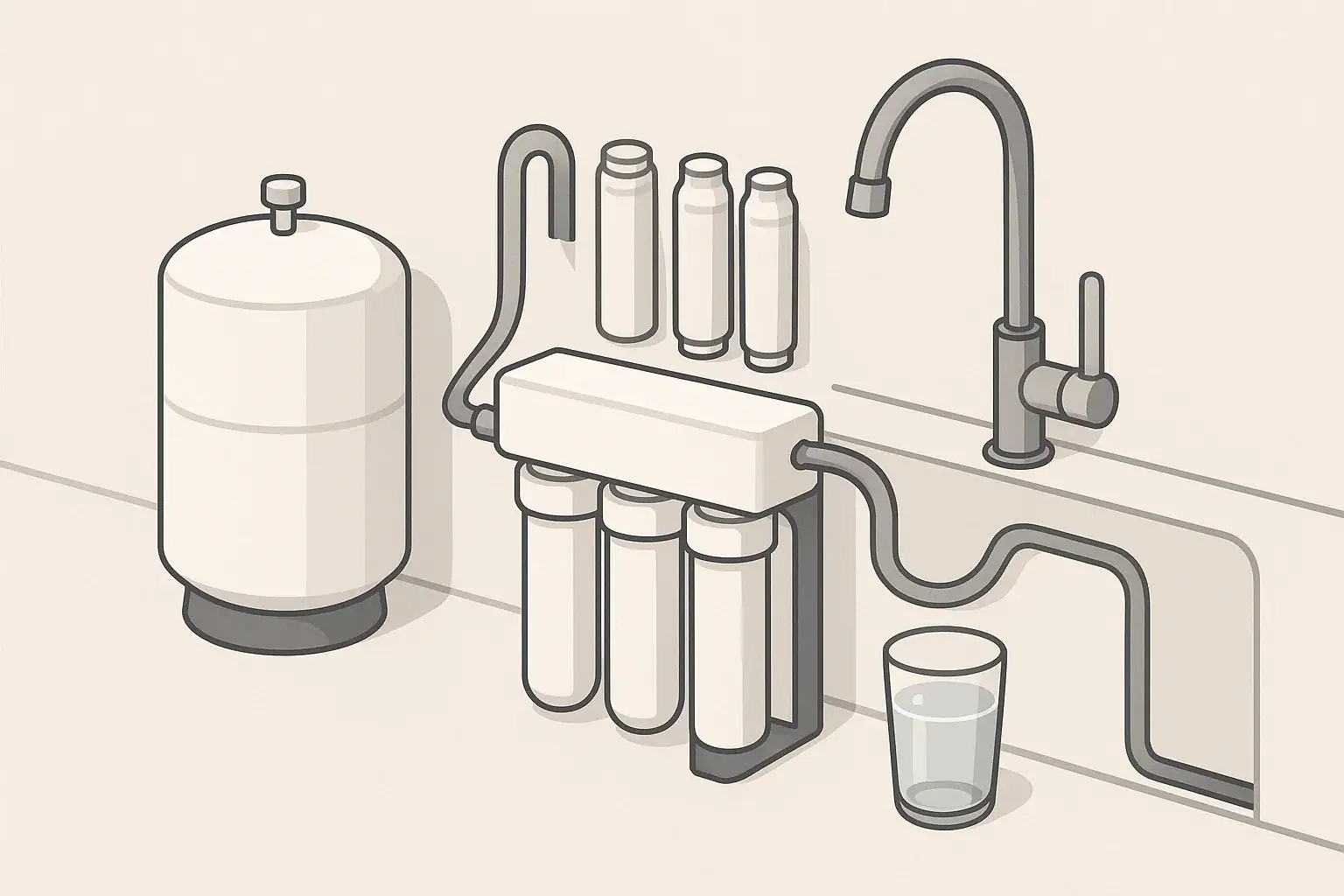
Why the Housing Style Matters Under the Sink
Under-sink filter housings are the containers or connection bodies that hold replaceable filter cartridges. They may look like a small detail, but the housing style affects long-term cost, replacement availability, installation layout, and how easy the system is to maintain.
Two common approaches are standard 10-inch housings and proprietary cartridge systems. A standard housing usually accepts a broad category of cartridges with the same general size. A proprietary system uses cartridges designed for a specific head, manifold, or locking mechanism.
Neither approach is automatically better. A standard housing can offer flexibility and lower replacement cost. A proprietary cartridge can be compact, quick to change, and designed as part of a matched system. The practical question is which tradeoffs fit your water quality goals, available space, maintenance habits, and budget.
This article focuses on typical under-sink point-of-use filters for drinking and cooking water. It does not cover whole-house housings in detail, although some concepts overlap.
How Standard 10-Inch Under-Sink Housings Work
A standard 10-inch housing is usually a cylindrical sump with a screw-on body and a separate filter cartridge inside. The cartridge commonly measures about 10 inches long and is designed to fit inside a housing with compatible diameter and end style. The most common sizes are often described as slim-line or larger-diameter housings.
The housing itself is reused. At replacement time, the sump is opened, the spent cartridge is removed, and a new cartridge is installed. Depending on the system design, the housing may hold a sediment filter, carbon block cartridge, granular activated carbon cartridge, specialty media cartridge, or another cartridge type.
Common Cartridge Options
Standard housings are popular because they can accept many cartridge types when the dimensions and flow direction match the housing. Common examples include:
- Sediment cartridges for visible particles, rust flakes, or grit
- Carbon block cartridges for chlorine taste and odor reduction
- Granular carbon cartridges for general taste and odor improvement
- Specialty cartridges intended for targeted reduction, depending on the media and testing
- Pre-filters for some reverse osmosis systems
Performance depends on the cartridge, not just the housing. The same standard housing can hold a basic sediment cartridge or a dense carbon block with different flow, pressure drop, and replacement needs.
What Standard Does and Does Not Mean
Standard does not mean universal in every detail. Cartridge length, diameter, gasket style, housing type, temperature rating, pressure rating, and port size still matter. A cartridge that physically fits is not always appropriate for the flow rate, water conditions, or intended contaminant reduction.
It is also important to distinguish general size compatibility from independent performance testing. A cartridge may be described by size, but reduction claims should be evaluated based on the cartridge’s own documentation and applicable standards language, not the housing size alone.
Example values for illustration.
| Factor | Standard 10-Inch Housing | Proprietary Cartridge |
|---|---|---|
| Cartridge availability | Often broad, if size and type match | Limited to compatible cartridges |
| Replacement cost | Can be lower, varies by media | Often higher, varies by design |
| Change-out process | May require opening a sump | Often twist-in or snap-in |
| Space use | Can be bulkier under the sink | Often compact and integrated |
| Customization | High, with compatible cartridge choices | Moderate to low, depending on system |
| Leak points | Sump seal must be handled carefully | Fewer user-opened seals in many designs |
| Best fit | Users who want flexibility | Users who prioritize convenience |
How Proprietary Cartridges Differ
Proprietary cartridges are made to work with a specific filter head, bracket, manifold, or enclosed system. Instead of dropping a loose cartridge into a reusable sump, the entire cartridge body often locks into place as a sealed unit.
Many proprietary systems use quarter-turn or push-in designs. Some include built-in valves that reduce drips when the cartridge is removed. Others are designed for compact multi-stage systems, including under-sink carbon filters and some reverse osmosis systems.
Why Manufacturers Use Proprietary Designs
Proprietary cartridge systems can simplify design. The filter head, flow path, seals, and cartridge media can be engineered as one package. This may support a smaller footprint, easier installation, and a more predictable user experience.
For homeowners and renters, the main appeal is often convenience. A cartridge that twists off without opening a sump can make replacement less messy. This can be useful in tight sink cabinets where bowls, towels, cleaning supplies, and plumbing already compete for space.
The Main Limitation: Lock-In
The tradeoff is replacement dependency. If a system only accepts one cartridge shape or connection, you must continue using compatible replacements. If those cartridges become hard to find, change in price, or do not include the media type you want later, your options may be limited.
This does not mean proprietary cartridges are poor choices. It means the replacement path should be considered before purchase. A filter is not just a one-time equipment decision; it is a recurring maintenance item.
Performance Depends More on the Cartridge Than the Housing
Housing style affects convenience and compatibility, but water treatment performance comes mainly from cartridge design, media, contact time, flow rate, and testing. A standard 10-inch housing with a weak cartridge may perform poorly. A proprietary cartridge with appropriate media and documentation may perform well for its intended purpose.
Flow Rate and Contact Time
Carbon filters need enough contact time for effective taste and odor reduction. Dense carbon blocks may reduce flow more than loose granular carbon, especially as they load with sediment. A larger housing or more open cartridge may flow faster, but faster is not always better if the water does not spend enough time in the media.
For kitchen sink use, many under-sink drinking water filters are designed for moderate flow rather than whole-house demand. If you expect rapid filling of large pots, consider how the cartridge’s rated service flow compares with the way you use the faucet.
Pressure Drop
Every cartridge creates some pressure drop. Sediment loading, small-pore carbon blocks, and multiple stages can reduce faucet flow. Standard housings make it easier to choose a different compatible cartridge if pressure drop becomes a problem. Proprietary systems may offer fewer alternatives, though some are designed to balance flow and performance from the start.
Filter Claims and Standards Language
When comparing cartridges, look for clear performance documentation. General terms such as “clean water” or “advanced filtration” are less useful than specific reduction claims, tested capacities, flow rates, and applicable certification or testing references.
Standards-related language should be read carefully. A component may be tested for material safety, structural integrity, or contaminant reduction, and those are not the same thing. The relevant point is whether the particular cartridge or system has documented performance for the issue you are trying to address.
Cost, Availability, and Long-Term Ownership
The purchase price of the housing is only part of the cost. Under-sink filters require cartridge replacements, and those replacements continue for as long as the system remains in use.
Standard Housing Cost Patterns
Standard 10-inch housings often have a moderate up-front cost and a wide range of cartridge prices. Basic sediment cartridges are usually inexpensive. More specialized carbon blocks or targeted media cartridges cost more. The flexibility can be helpful if your needs change, such as adding a sediment pre-filter before a carbon stage.
However, standard housings also require attention during service. The sump seal must be clean and seated correctly, and the housing should be checked for leaks after replacement. O-rings may need periodic replacement according to the equipment instructions.
Proprietary Cartridge Cost Patterns
Proprietary systems may have convenient replacement cartridges, but the cartridges are often the main recurring cost. Some users accept this because the change-out is faster and cleaner. Others prefer standard housings because they want more control over cartridge selection and replacement price.
Availability is a practical concern. Before buying any proprietary system, check whether replacement cartridges are easy to obtain from multiple normal retail channels and whether the cartridge line includes the functions you need.
Storage and Shelf Planning
It is reasonable to keep one replacement cartridge on hand, especially if your filter is used daily for drinking water or coffee and tea. Avoid stocking many years of cartridges unless the manufacturer’s storage guidance supports it. Filter media, seals, and packaging can age, and cartridges should be stored clean, dry, and unopened until use.
Related guides: Under-Sink Filter Installation: Tools, Parts, and Common Mistakes • Under-Sink Filter Replacement Schedule: Estimate by Gallons Used • Fixing Under-Sink Filter Leaks: 7 Quick Checks
Choosing Between Standard and Proprietary Under-Sink Filters
The best choice depends on your priorities. A household that values low replacement cost and cartridge flexibility may prefer standard 10-inch housings. A household that wants compact design and quick cartridge changes may prefer a proprietary system.
When a Standard 10-Inch Housing May Make Sense
- You want flexibility to choose sediment, carbon, or specialty cartridges.
- You are comfortable with a slightly more hands-on cartridge change.
- You have enough cabinet space for the housing and service clearance.
- You want to compare replacement cartridges from several sources.
- You may change treatment goals later, such as adding a pre-filter.
When a Proprietary Cartridge May Make Sense
- You want a compact, tidy under-sink installation.
- You prefer a fast cartridge change with less contact with wet filter parts.
- You are comfortable using the system’s compatible replacement cartridges.
- You have reviewed the replacement cost and availability.
- The cartridge documentation matches your water quality goals.
Special Note for Reverse Osmosis Systems
Reverse osmosis systems often use multiple stages, such as sediment pre-filtration, carbon pre-filtration, an RO membrane, post-carbon polishing, and sometimes remineralization. Some RO systems use standard-style pre-filter housings, while others use proprietary cartridges.
For RO, cartridge style affects maintenance, but membrane support, pressure requirements, drain flow, storage tank or tankless design, and installation space are also important. A convenient cartridge format does not remove the need to follow the system’s service schedule and sanitation guidance.
Example values for illustration.
| Filter Part | Typical Planning Factor | What to Watch |
|---|---|---|
| Sediment cartridge | Water clarity and pressure drop | Slower flow or visible loading |
| Carbon cartridge | Rated capacity and taste changes | Return of chlorine taste or odor |
| RO pre-filter | System schedule and feed water quality | Reduced flow or membrane protection needs |
| RO membrane | System performance over time | Lower production or changed TDS trend |
| Post-filter | Polishing stage schedule | Stale taste after storage tank use |
| Housing seals | Condition during service | Flattening, cracking, or drips |
Related guides: Under-Sink Filter Flow Rate Explained: Why GPM Matters • Under-Sink Filters for Lead Reduction: What Certifications to Look For • Reverse Osmosis 101: What RO Removes (and What It Doesn’t)
Pre-Purchase Checks Before You Decide
Before choosing between a standard 10-inch housing and a proprietary cartridge system, review the whole ownership picture. The right system should fit your cabinet, match your water quality goals, and be realistic to maintain.
- Measure under-sink space, including room to remove a housing sump or cartridge.
- Check cartridge replacement cost and normal availability.
- Review flow rate expectations for your drinking water faucet.
- Match cartridge documentation to the issue you want to address, such as sediment, chlorine taste and odor, or specific tested reductions.
- Confirm compatibility with your plumbing setup without unsafe modifications.
- Follow installation instructions, leak checks, flushing steps, and replacement schedules.
Standard 10-inch under-sink filter housings offer flexibility and broad cartridge choice. Proprietary cartridges offer convenience and compact design. The better option is the one that you can install safely, service consistently, and support with replacement cartridges over time.
Frequently asked questions
Are standard 10-inch under-sink housings interchangeable?
Not always. The cartridge may be same-size, but diameter, end style, gasket fit, and port connections still need to match the specific housing.
Do proprietary cartridges filter better than standard cartridges?
Not by default. Filtration performance depends on the cartridge media, flow rate, and testing, not simply on whether the system is proprietary.
Which type usually costs less over time?
Standard housings often have lower-cost replacement options, but the total cost depends on the cartridge type, replacement frequency, and how easy it is to source replacements.
Is a standard housing harder to maintain?
It can be a bit more hands-on because you open the sump to change the cartridge. With correct sealing and leak checks, though, maintenance is straightforward.
When does a proprietary system make the most sense?
It is often a good fit when cabinet space is tight, you want quick cartridge changes, and replacement cartridges are easy to buy consistently.
Recommended next:
- Under-Sink vs Pitcher: Which Is Better for Families?
- Best Under-Sink Filters for Chlorine Taste & Odor
- Under-Sink Filter Installation: Tools, Parts, and Common Mistakes
- No-Drill Under-Sink Filters for Renters: What’s Possible?
- Under-Sink Filters for Lead Reduction: What Certifications to Look For
- Under-Sink Filter Flow Rate Explained: Why GPM Matters
- More in Under-Sink Filters →
- NSF/ANSI standards explained (42/53/401/58)
- Clear trade-offs: pitcher vs faucet vs under-sink vs RO
- Maintenance planning: cost per gallon and replacement cadence