
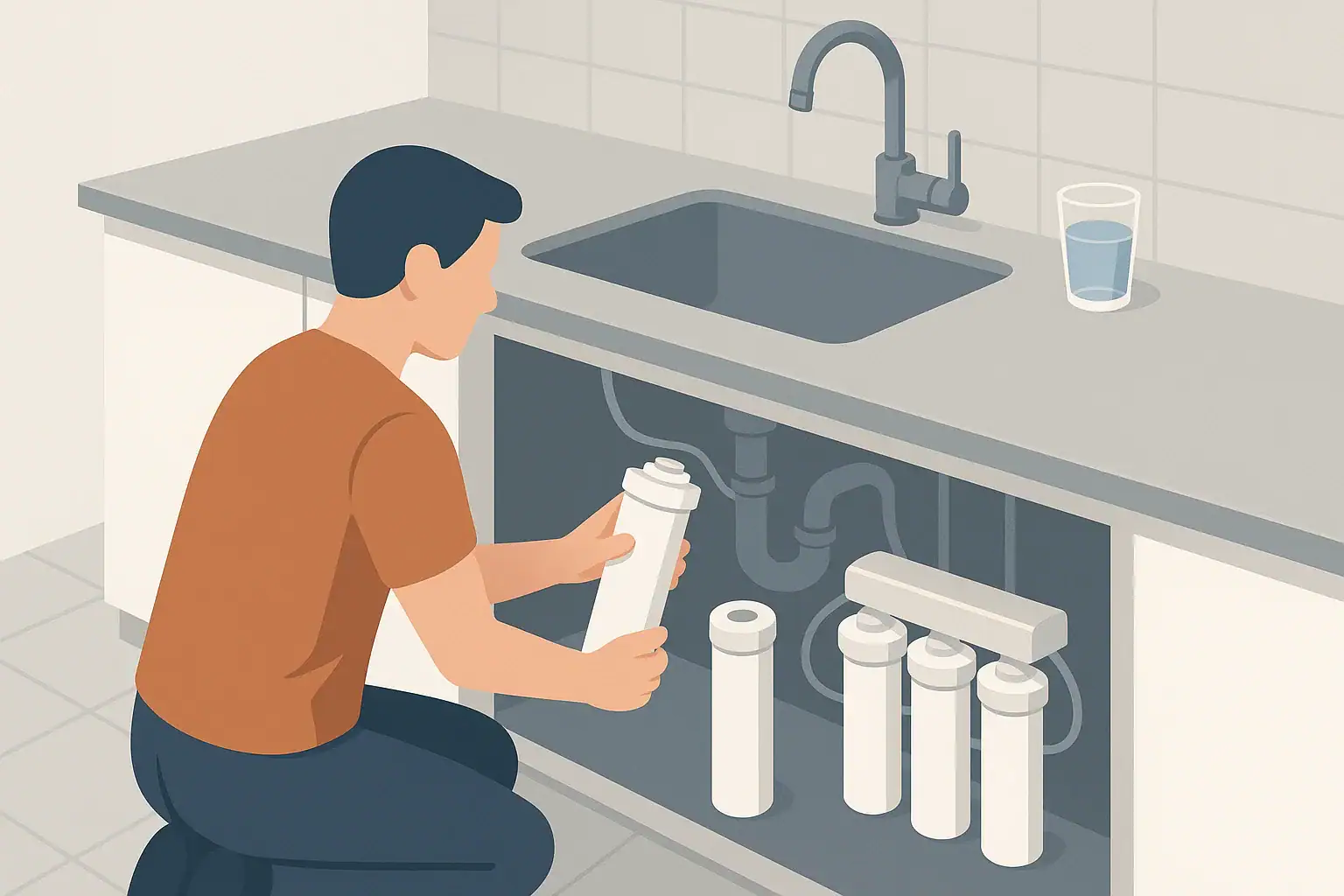
Why Pesticides and Herbicides Show Up in Drinking Water
Pesticides and herbicides are widely used in agriculture, landscaping, and some residential settings. After application, rainfall and irrigation can wash these chemicals into soil and surface water. From there, they can make their way into:
- Shallow groundwater used for private wells
- Rivers and reservoirs that supply municipal water
- Stormwater runoff that eventually reaches larger water bodies
Public water systems are regulated and usually monitor for certain pesticide-related compounds. Utilities may treat water to reduce these substances before it reaches homes. However, some compounds can still be present at low levels, and private wells are generally the homeowner’s responsibility.
At the home level, treatment typically focuses on a broad group of contaminants called synthetic organic chemicals (SOCs), which include many pesticides and herbicides. No single filter can address every possible compound, but several technologies are commonly used to reduce this group.
Key Filter Technologies for Pesticide and Herbicide Reduction
Most home filters that help reduce pesticides and herbicides rely on one or more of the following technologies. For comparisons of treatment approaches for persistent organics, see PFAS Removal Options: RO vs Carbon vs Whole House.
Activated Carbon (Granular and Block)
Activated carbon is one of the most common choices for reducing many pesticides and herbicides. It works mainly through adsorption, where molecules cling to the surface of the carbon.
Common forms include:
- Granular activated carbon (GAC): Loose carbon granules used in whole-house systems, under-sink cartridges, and some refrigerator filters.
- Carbon block: Carbon particles pressed into a solid block, often found in higher-performance under-sink and countertop filters.
Factors that influence pesticide and herbicide reduction with carbon include:
- Contact time between water and carbon
- Carbon type and pore structure
- Filter size and flow rate
- How often the cartridge is replaced
In general, well-designed carbon filters with sufficient contact time can reduce many common pesticide and herbicide residues to lower levels.
Reverse Osmosis (RO)
Reverse osmosis systems force water through a semipermeable membrane that rejects a wide range of dissolved substances. For many organic compounds, including some pesticides and herbicides, RO can provide an additional barrier beyond carbon.
Typical under-sink RO units combine:
- Sediment prefilter
- Carbon prefilter (often two stages)
- RO membrane
- Post-carbon polishing filter
In these systems, much of the pesticide and herbicide reduction may come from the carbon stages, with the membrane adding another layer of protection for certain compounds, depending on their size and properties.
Sediment Filtration
Sediment filters (spun polypropylene, pleated cartridges, etc.) remove particles such as sand, rust, and silt. They do not reliably remove dissolved pesticides and herbicides on their own.
However, sediment filters are often used as a pre-treatment step to:
- Protect carbon and RO filters from clogging
- Improve overall system performance and lifespan
They are a supporting component rather than the main barrier for pesticide and herbicide reduction.
Other Technologies (What They Typically Do Not Do)
Several other common water treatment options are often misunderstood with respect to pesticides and herbicides:
- UV disinfection: Designed to inactivate microorganisms. It does not remove pesticide or herbicide molecules.
- Water softeners (ion exchange for hardness): Target calcium and magnesium. They are not designed for pesticides or herbicides.
- Distillation: Can reduce many contaminants by boiling and condensing water, though some volatile compounds may require additional carbon treatment to be effectively reduced.
Example values for illustration.
| Technology | Main Role | Typical Use Point | Helps Reduce Many Pesticides/Herbicides? |
|---|---|---|---|
| Granular activated carbon (GAC) | Adsorbs organic chemicals | Whole house, under-sink, fridge | Often yes, when properly sized and maintained |
| Carbon block | Higher-contact carbon filtration | Under-sink, countertop, faucet | Often yes, especially with longer contact time |
| Reverse osmosis (with carbon stages) | Membrane plus carbon pre/post filters | Under-sink point-of-use | Often yes, multi-barrier approach |
| Sediment filter | Removes particles | Whole house, prefilter | No, mainly for physical debris |
| UV disinfection | Targets microbes | Whole house or under-sink | No, does not remove chemicals |
| Water softener | Reduces hardness minerals | Whole house | No, not designed for organic chemicals |
| Distillation (with carbon post-filter) | Boils and condenses water | Countertop or batch system | Can help, often paired with carbon |
This table summarizes common roles and does not guarantee performance for specific compounds.
How Pesticide and Herbicide Reduction Works in Filters
Understanding how filters interact with pesticides and herbicides can help you choose and use them more effectively; learn more about how carbon filters work.
Adsorption on Activated Carbon
Activated carbon has a very large internal surface area with many pores. Many pesticide and herbicide molecules are attracted to this surface and become trapped. The process depends on:
- Carbon quality and type: Different raw materials and activation methods create different pore structures.
- Contact time: Slower flow and larger cartridges usually allow more adsorption.
- Competing substances: Natural organic matter and other chemicals can occupy adsorption sites.
Over time, the carbon becomes saturated. Once this happens, it is less effective, and timely cartridge replacement becomes important.
Size Exclusion and Diffusion in RO Membranes
Reverse osmosis membranes primarily work by size exclusion and diffusion through the membrane material. Many ions and larger organic molecules are rejected to some degree and flushed to drain.
For pesticides and herbicides, performance depends on:
- Molecular size and structure
- Charge and polarity
- Membrane condition and pressure
Because under-sink RO units almost always include carbon stages before and after the membrane, the system’s pesticide and herbicide reduction is usually a combination of membrane rejection and carbon adsorption.
Role of Multi-Stage Systems
Many modern filters combine several stages to target different contaminant groups. A typical configuration for pesticide and herbicide concerns might include:
- Sediment filter to remove particles
- One or more carbon stages for organic chemicals
- Optional RO membrane for additional dissolved contaminant reduction
- Final polishing carbon stage for taste and odor
This multi-barrier approach helps distribute the work across stages and can improve overall performance and cartridge life when properly designed.
Point-of-Use vs. Whole-House Treatment
Deciding where to place filtration is a practical step in planning for pesticide and herbicide reduction.
Point-of-Use (POU) Filters
Point-of-use filters treat water at a specific tap or appliance, such as:
- Under-sink systems (dedicated drinking water faucet)
- Countertop filters
- Faucet-mounted filters
- Pitcher or dispenser filters
Advantages for pesticide and herbicide concerns include:
- Higher-contact carbon designs are easier to implement at a single tap.
- RO systems are typically installed as point-of-use for drinking and cooking.
- Filter cartridges can focus on water you actually ingest.
For many households, a point-of-use system at the kitchen sink is a practical starting point for reducing pesticide and herbicide exposure through drinking and cooking water.
Whole-House (Point-of-Entry) Filters
Whole-house systems treat water where it enters the home. They can help provide filtered water to:
- Showers and baths
- Laundry
- All interior faucets
For pesticide and herbicide concerns, whole-house systems often use large GAC tanks or big carbon cartridges. Practical considerations include:
- Need for sufficient contact time at higher household flow rates
- More frequent media replacement for high-use homes
- Upfront cost and installation requirements
Some homeowners use a combination: a whole-house carbon filter for broad chemical reduction plus a dedicated point-of-use filter for drinking and cooking water.
Matching Filter Types to Your Water Situation
The best filter approach depends on your water source, goals, and budget. A few typical scenarios can help frame the decision.
Municipal (City) Water
If you are on a public water supply, your utility may already be managing certain pesticide and herbicide risks. To understand your situation, you can learn how to read your city’s Consumer Confidence Report (CCR) and:
- Review the annual water quality report provided by your utility.
- Look for sections on synthetic organic chemicals or similar groups.
Typical home options for city water include:
- Under-sink carbon block filter: A practical starting point for drinking and cooking water.
- RO system with carbon stages: For those who want a multi-barrier approach for a single tap.
- Pitcher or faucet filter with carbon: Useful when installation options are limited, though capacity and contact time may be lower than larger under-sink systems.
Private Wells Near Agricultural or Lawn Treatment Areas
Private wells can be influenced by nearby agricultural fields, orchards, golf courses, or frequent yard treatments. Because private wells are typically unregulated, testing is important.
Depending on test results and risk tolerance, households may consider:
- Whole-house GAC system: For broad organic chemical reduction throughout the home.
- Under-sink RO with carbon: As a focused solution for drinking and cooking water.
- Periodic retesting: To track changes over time, especially after land-use or seasonal changes.
Rentals and Apartments
If you cannot modify plumbing, non-permanent solutions can still provide pesticide and herbicide reduction:
- Countertop filters that connect to the faucet with an adapter
- Carbon-based faucet-mounted filters
- Pitcher and dispenser filters using activated carbon
Here, paying attention to cartridge replacement schedules and verified contaminant reduction claims can help you choose among different designs.
Interpreting Certifications and Performance Claims
Filter packaging and product literature often reference standards and testing for organic chemical reduction.
General Ideas Around Standards
Without naming specific organizations, some general concepts are useful:
- Some standards focus on aesthetic improvements such as taste and odor.
- Other standards address reduction of specified contaminants, including some organic chemicals.
- Performance claims are usually tied to particular test conditions and contaminants.
When you evaluate a filter for pesticide and herbicide concerns, look for:
- Clear statements about which contaminant groups the filter was tested against.
- Any mention of specific pesticide or herbicide compounds, when available.
- Details on capacity (for example, gallons treated before recommended replacement) at specified conditions.
Why One Filter Cannot Cover Every Chemical
Pesticides and herbicides include many different compounds with varied properties. No filter can realistically be tested for every possible molecule or guarantee complete removal in all conditions.
Because of this, many systems are designed to target broad classes of contaminants (such as many synthetic organic chemicals) rather than every individual compound. Multi-stage arrangements, especially those combining carbon and RO, are commonly used to build in redundancy across several contaminant groups.
Maintenance Habits That Matter for Pesticide and Herbicide Reduction
Even a well-designed filter can become less effective if it is not maintained. For pesticide and herbicide reduction, a few habits are particularly important.
Replacing Cartridges on Time
Activated carbon has a finite capacity. After a certain volume of water, its ability to adsorb new contaminants diminishes. Similarly, RO membranes gradually foul and lose performance.
To keep reduction performance more consistent:
- Follow the manufacturer’s recommended replacement intervals, which may be based on time, volume, or both.
- Adjust more frequently if your household uses significantly more water than the example household in the documentation.
- Do not rely solely on taste and odor changes to decide when to replace carbon cartridges.
Watching Flow Rate and Pressure Changes
Clogging in sediment or carbon stages can reduce flow. A significant drop in flow from a faucet filter, pitcher, or under-sink system can be a sign that filters need attention.
In multi-stage systems, prefilters protect later stages. Replacing clogged prefilters on time helps maintain flow and may extend the useful life of carbon and RO components.
System Sanitation and Leak Awareness
While pesticide and herbicide concerns focus on chemicals, overall system hygiene still matters:
- Some systems include recommended periodic sanitization steps during cartridge changes.
- Checking for drips, dampness, or corrosion around fittings can prevent water damage.
- Avoid modifying safety features or bypass valves in ways not intended by the manufacturer.
Example values for illustration.
| Filter Stage | Typical Location | Example Replacement Interval | Why It Matters for Pesticides/Herbicides |
|---|---|---|---|
| Sediment prefilter | Whole house or pre-RO | About every 3–6 months | Prevents clogging and supports downstream carbon and RO |
| GAC whole-house media | Point-of-entry tank or cartridge | About every 6–36 months, depending on size and usage | Maintains adsorption capacity for organic chemicals |
| Carbon block under-sink | Point-of-use drinking tap | About every 6–12 months | Helps sustain pesticide and herbicide reduction at the tap |
| RO membrane | Under-sink RO system | About every 2–5 years | Supports overall dissolved contaminant reduction |
| Post-carbon polishing filter | After RO tank or final stage | About every 12 months | Improves taste and provides a final adsorption step |
| Pitcher or faucet filter cartridge | Countertop or tap-mounted | Every few weeks to a few months | Smaller cartridges fill faster; timely changes are important |
Actual intervals depend on water quality, filter size, and usage; always follow product-specific guidance.
Related guides: PFAS Removal Options: RO vs Carbon vs Whole House • Lead in Tap Water: Practical Steps Before Buying a Filter • VOCs in Water: How Carbon Filters Work
Practical Steps to Get Started
If you are concerned about pesticides and herbicides in your drinking water, a step-by-step approach can keep decisions practical and manageable:
- Clarify your source: Determine whether you are on city water or a private well.
- Review available water quality information: Use your utility’s report or consider lab testing for wells, focusing on relevant contaminant groups.
- Decide on treatment location: Start with point-of-use at the kitchen sink if you are mainly concerned about drinking and cooking water.
- Choose an appropriate technology: Look for carbon-based systems, with or without RO, that are designed and tested for organic chemical reduction.
- Plan for maintenance: Set reminders for cartridge changes and periodic checks of flow and fittings.
By combining informed filter selection with consistent maintenance, many households can meaningfully reduce pesticide and herbicide levels in the water they use for drinking and cooking, while keeping expectations realistic and grounded in how the technologies actually work.
Frequently asked questions
Can home carbon filters remove all pesticides and herbicides?
No. Activated carbon can reduce many common pesticide and herbicide compounds, but effectiveness varies by the specific chemical, contact time, carbon type, and cartridge condition. No single filter reliably removes every compound.
Should I test my water for pesticides or herbicides?
Testing is recommended for private wells and useful if you suspect contamination (for example, nearby agricultural application). For municipal users, review the utility’s water quality report to see which groups are monitored. Testing helps match treatment to actual risks.
Is reverse osmosis better than carbon alone for these contaminants?
RO adds a membrane barrier that can reject many dissolved substances and is often installed with carbon pre/post stages. For some compounds, the combination is more protective than carbon alone, but carbon stages remain important for many organic chemicals.
How often should I replace filters to maintain pesticide and herbicide reduction?
Follow manufacturer recommendations. Typical example intervals in this article include sediment filters every 3–6 months, carbon block cartridges every 6–12 months, GAC media 6–36 months depending on size and use, and RO membranes every 2–5 years. Increase frequency if usage or water quality requires it.
Recommended next:
- NSF/ANSI standards explained (42/53/401/58)
- Clear trade-offs: pitcher vs faucet vs under-sink vs RO
- Maintenance planning: cost per gallon and replacement cadence