
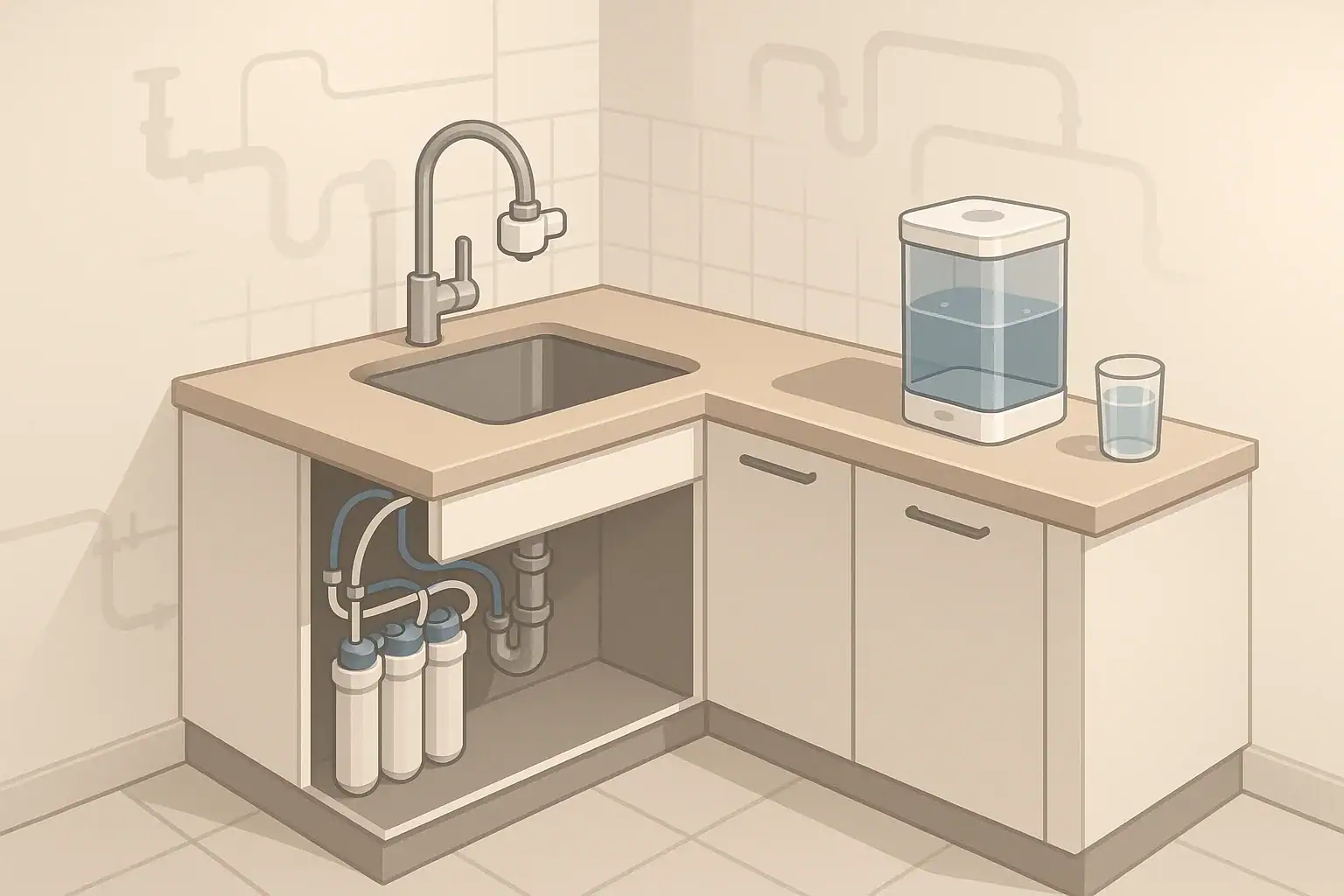
What Makes an Apartment-Friendly Water Filter?
Renters face some specific limits when improving tap water. The goal is usually better taste and reduced common contaminants, without drilling holes, changing landlord plumbing, or taking up too much space.
When choosing a water filter setup for an apartment, it helps to think about four main constraints:
- Installation rules: Many leases restrict permanent changes such as drilling in sinks or counters.
- Plumbing access: Some apartments have hard-to-reach shutoff valves, unusual faucets, or limited cabinet space.
- Counter and under-sink space: Small kitchens and shared spaces favor compact or multi-use solutions.
- Easy removal when moving: You may want a system that can be packed and taken to your next home.
Most apartment-friendly setups rely on simple connections at the faucet, under-sink cold-water line, or fully non-plumbed designs like pitchers and gravity filters. The best approach for you depends on how much water you need, how involved you want installation to be, and what you are trying to reduce.
Common Apartment Water Concerns (City vs. Older Buildings)
In many U.S. apartments, the water source is treated city water, but the building plumbing can be decades old. That combination can affect both taste and potential contaminants between the water plant and your tap.
Typical issues renters want to address include:
- Chlorine and chloramine: Used for disinfection; can cause taste and odor issues.
- Musty or metallic taste: Sometimes related to older pipes or stagnant water in building lines.
- Visible particles or cloudiness: Sediment from plumbing work, rust, or mineral particles.
- Lead from older plumbing components: More likely in older buildings with legacy materials.
- Concerns about emerging contaminants: Such as some volatile organic compounds (VOCs) and PFAS families.
Most apartment setups focus on point-of-use filtration at one sink rather than whole-building solutions, which are outside renter control. You can still make a practical and meaningful improvement by matching filter type to your main concerns.
Example values for illustration.
| Filter type | Install difficulty | Space impact | Good for | Less ideal when |
|---|---|---|---|---|
| Pitcher / Dispenser | Very low | Uses fridge or counter space | Basic taste, chlorine, some metals | You need high daily volume |
| Faucet-mounted filter | Low | Minimal, at faucet | On-demand drinking water | Faucet is non-standard or fragile |
| Countertop faucet-connected | Low to moderate | Uses some counter space | Higher volume, flexible apartment use | Very limited counter clearance |
| Non-plumbed countertop (gravity) | Very low | Moderate counter or cart space | No faucet changes, portable | You dislike filling the upper reservoir |
| Quick-connect under-sink carbon | Moderate (tools needed) | Uses under-sink cabinet space | Cleaner look, faster dispense | Access to shutoff valves is difficult |
| Compact under-sink RO (no drill) | Moderate | More under-sink space needed | Lower TDS for cooking and drinks | Very low water pressure or tiny cabinets |
Overview of Renter-Friendly Filter Types
Most apartment setups use one or a combination of the following options. Each can be apartment-safe when installed according to its instructions and lease requirements.
Pitcher and Dispenser Filters
Pitcher filters are often the first step for renters.
How they work: Water passes through a small replaceable cartridge, usually with activated carbon and sometimes simple ion exchange media.
Pros:
- No plumbing changes or tools.
- Portable between apartments.
- Fits in most refrigerators for chilled water.
Limitations:
- Limited flow and volume; may not keep up with larger households.
- Cartridges are small and may need frequent replacement.
- Only filters the water you pour into it, not directly from the tap.
Pitchers are best for small households that primarily want better taste, odor reduction, and basic contaminant reduction without any installation.
Faucet-Mounted Filters
These attach directly to the end of a standard kitchen faucet using a threaded adapter. Many have a small lever to switch between filtered and unfiltered water. If you’re unsure whether your fixture will accept an adapter, see our guide to faucet-mount filter compatibility.
Pros:
- On-demand filtered water without filling a container.
- Usually tool-free installation and removal.
- Compact and inexpensive.
Limitations:
- Do not fit all faucet styles, especially pull-down sprayers or some designer faucets.
- Can reduce flow rate through the filter mode.
- Adds weight to the faucet spout.
Faucet-mounted filters are well-suited to renters with compatible faucets who want continuous access to filtered water for drinking and light cooking.
Countertop Faucet-Connected Systems
These sit on the counter and connect to the faucet via a small hose and adapter. Some use carbon-only filtration; others use multi-stage or reverse osmosis (RO) designs.
Pros:
- No drilling; connects to existing faucet with an adapter.
- Often higher capacity and faster flow than pitchers.
- Easy to disconnect when not in use or when moving.
Limitations:
- Uses counter space and can crowd a small sink.
- Still depends on faucet thread compatibility.
- Hoses should be routed to avoid kinks and tripping hazards.
These systems work well in apartments where under-sink access is limited or leases discourage any under-cabinet modifications.
Non-Plumbed Countertop (Gravity) Filters
Gravity systems have an upper reservoir you fill manually. Water passes through one or more filters into a lower chamber with a spigot.
Pros:
- Do not connect to plumbing or require tools.
- Portable and can be used during temporary water shutoffs.
- Can serve multiple people once the lower reservoir is full.
Limitations:
- Relies on manual filling; slower overall throughput.
- Needs stable counter or cart space.
- Heavier when full; moving it while full is not practical.
These options suit renters who cannot modify faucets at all, or who want a solution that also works away from the kitchen, such as in a shared living area.
Under-Sink Carbon Filters with No-Drill Install
Some under-sink systems are designed for renters and do not require drilling a new hole in the sink or counter. Instead, they route filtered water through the existing cold-water line or a conversion kit that sends all cold water through the filter.
Pros:
- Hidden under the sink; preserves counter space.
- Higher capacity and faster flow than many countertop setups.
- Convenient for cooking and dish rinsing with filtered water.
Limitations:
- Requires access to shutoff valves and basic plumbing steps.
- May not be permitted in all leases; check your agreement.
- Cartridges are larger and may cost more per change.
These systems are good for long-term renters comfortable with simple, reversible plumbing work who want filtered water from the main kitchen faucet without new holes.
Compact Under-Sink RO Systems for Renters
Under-sink reverse osmosis systems use multiple stages, typically including sediment and carbon pre-filters, an RO membrane, and sometimes a final polishing filter. Some can connect without drilling if they send RO water to a special adapter or an existing faucet designed for mixed use. For guidance on handling the RO drain and efficiency, see our RO waste water ratio guide.
Pros:
- Can significantly reduce total dissolved solids (TDS) compared with simple carbon filtration.
- Helpful for improving taste when source water has high mineral content or certain dissolved substances.
- Suitable for people who cook frequently and want consistent water quality.
Limitations:
- Needs adequate water pressure and space for filters and possibly a storage tank.
- Produces a waste-water stream that must be routed to the drain using approved methods.
- Installation complexity is higher; some landlords may require a professional plumber.
RO systems are more common in long-term rentals, especially where local water is very hard or has a noticeably high TDS. They should always be installed according to instructions, without bypassing safety devices or drain connections.
Matching Filter Type to Apartment Constraints
Choosing the best water filter setup for an apartment means balancing your water goals with your physical space and lease terms.
If You Cannot Change Plumbing at All
When your landlord or property rules prohibit attaching anything to plumbing fixtures, focus on:
- Pitchers or dispensers for simple, low-cost filtration.
- Gravity countertop units if you need more volume or multi-stage filtration without faucet contact.
Try to store these devices where they are easy to refill and clean; for many, that means a small section of counter next to the sink or a sturdy rolling cart.
If You Can Use the Faucet Thread Only
Some buildings allow attachments at the faucet as long as they do not alter permanent plumbing. In that case:
- Faucet-mounted filters are the fastest to install and remove.
- Countertop faucet-connected systems work well if you have more filtration stages or volume in mind.
Always confirm the faucet type before buying. Pull-down or integrated-spray faucets often do not support standard adapters.
If You Have Permission for Under-Sink Changes
Where leases permit simple under-sink connections and you can shut off water at the valves:
- Under-sink carbon units provide a clean look and convenient daily use.
- Compact RO systems can be considered when lower TDS water is a priority.
All work should be reversible. Keep original parts (such as hoses and fittings) in a labeled bag so you can restore the plumbing when you move out, ideally using a qualified professional if required.
Space Planning: Small Kitchens and Shared Apartments
Space is often the limiting factor in apartments. Before deciding on a system, measure or at least estimate key dimensions:
- Clearance behind and above the faucet.
- Open counter area near the sink.
- Cabinet depth and height under the sink.
- Available shelf space in the refrigerator for pitchers or dispensers.
Tips for Tight Counter Space
- Use a slim pitcher that fits in the fridge door instead of a wide dispenser.
- Choose a compact faucet-mounted unit instead of a large countertop box.
- Consider a rolling cart near the kitchen to hold a gravity filter or larger unit.
Under-Sink Layout Considerations
Under-sink areas often hold trash bins, cleaning supplies, or a disposal. For under-sink filters, try to:
- Keep filters mounted in a way that leaves floor space for essentials.
- Route tubing neatly to minimize snagging when you use the cabinet.
- Ensure valves, P-trap, and disposal remain accessible for service.
Basic Filter Technology for Renters
Even in an apartment, it helps to understand what is actually inside the filter housing. Common technologies include:
- Sediment filters: Capture larger particles such as rust, sand, and silt. Often used as a first stage.
- Activated carbon: Helps reduce chlorine taste and odor and can reduce many organic compounds.
- Carbon block vs. granular carbon: Block filters are denser and can allow more contact time; granular carbon is looser, often used where higher flow is needed.
- Ion exchange resins: Sometimes included to reduce certain metals or adjust hardness in small systems.
- Reverse osmosis membranes: Semi-permeable membranes that significantly reduce dissolved solids; require pre-filtration and a drain connection.
For most renters, a multi-stage carbon-based system or a compact RO setup will cover common apartment concerns. The right choice depends on your local water quality report, your tolerance for taste, and how much installation effort you are willing to accept.
Maintenance and Filter Life in an Apartment Setting
Apartment life often involves sharing the kitchen and varying daily routines. A filter that fits your schedule and habits is more likely to be maintained correctly.
Typical Cartridge Lifespans (Examples)
Manufacturers usually specify capacity and time limits such as “up to X gallons or Y months.” Actual life varies with usage and water quality, but typical ranges include:
- Pitcher filters: about 1–3 months.
- Faucet-mounted cartridges: about 2–4 months.
- Countertop and under-sink carbon stages: about 6–12 months.
- RO pre-filters: about 6–12 months.
- RO membranes: often 2–3 years under typical use, depending on feed water.
These are example ranges only; always follow the specific instructions and replace sooner if flow drops noticeably or taste changes.
Maintenance Tips for Renters
- Track dates: Use calendar reminders for filter changes, especially in shared apartments where no one “owns” the task.
- Keep manuals: Store manuals and part numbers in a folder or digital note so you can reorder cartridges easily.
- Watch for leaks: Check under-sink areas and connection points occasionally, especially after cartridge changes or plumbing work in the building.
- Flush new filters: Most filters require a flushing period to rinse fine particles and air; run water as directed before drinking.
- Move-out plan: If you installed under-sink equipment, leave time to remove it carefully and restore original hardware.
Example values for illustration.
| Setup type | Key component | Example time interval | Usage notes |
|---|---|---|---|
| Pitcher / Dispenser | Carbon cartridge | Every 1–2 months | More frequent for high daily use |
| Faucet-mounted filter | Cartridge | Every 2–4 months | Replace sooner if flow slows noticeably |
| Countertop faucet-connected | Carbon block | Every 6–12 months | Check manufacturer gallon rating |
| Under-sink carbon | Main cartridge | Every 6–12 months | Shorter interval in older buildings |
| Under-sink RO system | Sediment & carbon pre-filters | Every 6–12 months | Helps protect RO membrane |
| Under-sink RO system | RO membrane | Every 2–3 years | Depends on feed water TDS and use |
Related guides: Pitcher vs Under-Sink vs RO: Which Fits Your Budget and Water? • Whole House vs Under-Sink: Taste vs Whole-Home Protection • Carbon Block vs GAC vs Ion Exchange: Quick Guide to Filter Media
Safety, Lease Considerations, and When to Get Help
Any modification in a rental should respect building rules and basic plumbing safety.
Before You Install
- Review your lease for clauses on plumbing and fixtures.
- If unclear, ask your landlord in writing about faucet, under-sink, or no-drill RO systems.
- Confirm you can access shutoff valves safely; stuck or corroded valves may warrant a professional visit.
Installation Boundaries
- Do not drill new holes in sinks, countertops, or walls unless explicitly permitted.
- Do not remove or bypass safety devices such as vacuum breakers or backflow preventers.
- Ensure any drain connections for RO waste water use approved fittings and follow local codes.
When to Involve a Professional
- If valves will not shut off fully or show signs of damage.
- If you are unsure how to reconnect original plumbing when moving out.
- If your building’s plumbing is complex, such as shared manifolds or unusual materials.
With reasonable planning and respect for these limits, renters can usually find a water filter setup that improves everyday use while remaining reversible, compact, and compatible with apartment living.
Frequently asked questions
Can I install a water filter in an apartment without drilling?
Yes. Pitchers, gravity dispensers, faucet-mounted filters, and countertop faucet-connected systems require no drilling. Some under-sink units offer no-drill connection options that use the existing cold-water line, but always check your lease and ensure you can access shutoff valves before proceeding.
Which filter type is best for very limited counter or under-sink space?
Use slim pitchers that fit in the fridge, compact faucet-mounted units, or small countertop systems. If you have some cabinet room, a compact under-sink carbon unit can keep counters clear. Measure available space before selecting a system.
How often should I replace filters in an apartment setting?
Replacement depends on filter type and usage: pitcher cartridges often last 1–3 months, faucet cartridges 2–4 months, carbon stages 6–12 months, and RO membranes 2–3 years. Follow the product guidance and replace sooner if flow or taste worsens.
Will a faucet-mounted or countertop system fit my faucet?
Not always. Many adapters fit standard threaded faucets, but pull-down sprayers and some designer faucets may be incompatible. Verify your faucet type and adapter compatibility before buying, or choose a non-plumbed option if unsure.
Recommended next:
- NSF/ANSI standards explained (42/53/401/58)
- Clear trade-offs: pitcher vs faucet vs under-sink vs RO
- Maintenance planning: cost per gallon and replacement cadence