
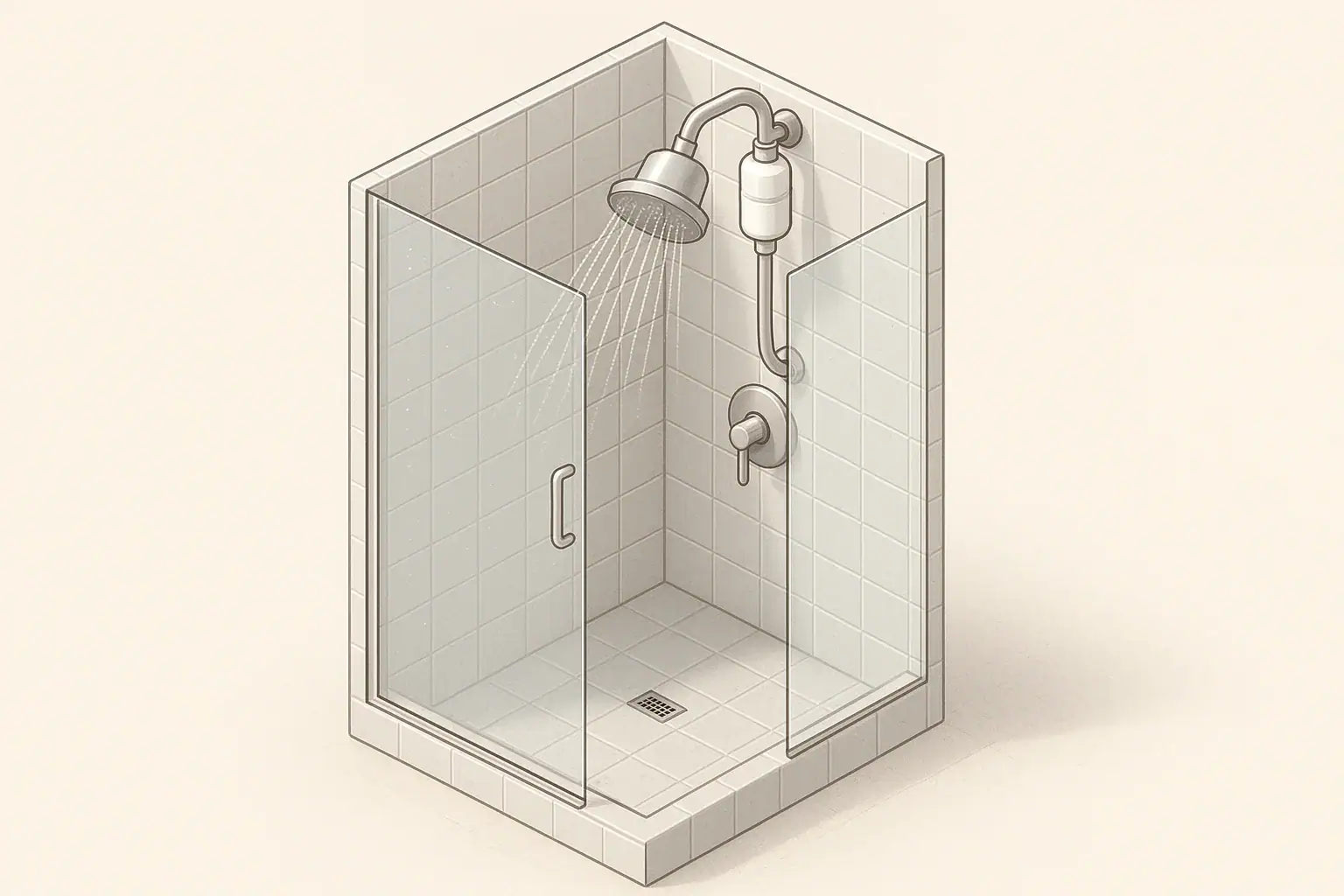
This article covers practical steps to reduce mineral residue and scale buildup in showers caused by hard water. It explains how hardness forms, how to recognize common signs on glass, tile, and fixtures, and which simple daily habits help slow accumulation. The piece also outlines shower-specific and whole-home treatment options, plus guidance for descaling existing deposits and for choosing and maintaining filters or softeners. Finally, you’ll find notes on relevant water-quality metrics and certification standards to consider when comparing systems, along with planning tips to coordinate cleaning and equipment upkeep. Use this information to set realistic expectations for what local and whole-house options can achieve and to build a maintenance plan that fits your home and budget.
What Is Hard Water and Why Showers Scale Up So Quickly
Hard water is water with elevated levels of dissolved minerals, mainly calcium and magnesium. These minerals are not usually removed by basic disinfection or simple sediment filtration, so they are common in municipal and well water across the United States.
When hard water is heated or dries on a surface, the dissolved minerals convert into solid deposits. In the shower, this shows up as white or off-white crust on fixtures, hazy film on glass, and rough spots on tile and grout. Soap and shampoo can also react with hardness minerals to form soap scum, which sticks to surfaces and makes them harder to clean.
Key reasons showers are especially prone to scale buildup include:
- Frequent use: Multiple daily showers mean repeated wetting and drying cycles.
- Warm water: Heating water encourages minerals to precipitate out as scale.
- Large surface area: Walls, doors, and floors provide many places for minerals to settle.
- Fine spray: Mist from showerheads dries quickly, leaving mineral residue behind.
Understanding how hardness behaves in water sets the stage for realistic expectations: you can significantly reduce residue and cleaning effort, but you may not eliminate scale completely without broader water treatment.
How to Tell If You Have Hard Water in the Shower
Shower scale often appears gradually, so it helps to know what to look for and how to confirm water hardness with simple checks. Many of these steps do not require specialized testing equipment.
Visual Signs on Surfaces and Fixtures
Common visual indicators of hard water residue in the shower include:
- White or chalky spots on glass doors, walls, and metal fixtures.
- Cloudy film on shower doors that does not fully rinse off with water alone.
- Crust around showerheads and at the base of faucets or diverters.
- Rough-feeling tile that was once smooth, especially in the spray zone.
Behavior of Soap and Shampoo
Hardness can affect how cleaning and personal care products behave. Indicators include:
- Soap that does not lather well and requires more product for the same effect.
- Persistent soap scum that forms a ring or film on tubs and walls.
- Slippery, difficult-to-rinse feeling on skin or hair, even after thorough rinsing.
Simple Home Tests for Hardness
If you want a clearer sense of your water hardness level, you can try:
- Hardness test strips: Dip-and-read strips provide a rough hardness range in grains per gallon (gpg) or milligrams per liter (mg/L).
- Small liquid test kits: Some kits use a drop-count method to estimate hardness more precisely.
- Utility water reports: Many municipal suppliers publish typical hardness ranges in their annual water quality reports.
While exact numbers are not always necessary for shower maintenance, knowing whether your water is considered soft, moderately hard, or very hard can help you choose between localized solutions (like shower filters) and broader home treatment options.
Example values for illustration.
| Observed shower condition | Likely hardness level (example) | Typical response to consider |
|---|---|---|
| Minimal spotting, glass stays mostly clear | Soft to mildly hard (0–3 gpg) | Focus on routine cleaning and squeegeeing; filtration optional |
| Light white spots after a few days | Moderately hard (3–7 gpg) | Use daily wipe-down plus occasional vinegar cleaning; consider basic shower filter |
| Noticeable film and crust in 1–2 weeks | Hard (7–10 gpg) | Combine mechanical cleaning, low-residue cleaners, and targeted shower filtration |
| Heavy scale, clogged spray nozzles, dull fixtures | Very hard (>10 gpg) | Evaluate whole-house or point-of-entry treatment in addition to shower measures |
| Soap scum buildup even with frequent cleaning | Moderate to very hard (example range) | Adjust cleaning products and consider hardness-focused treatment |
| Scale visible on other fixtures (sinks, appliances) | Consistently hard water | Assess home-wide solutions and long-term maintenance planning |
Daily Habits to Reduce Hard Water Residue in the Shower
Simple daily steps can slow scale formation and make deeper cleaning faster and less frequent. These approaches are low cost and do not require plumbing changes.
Remove Standing Water Quickly
The less time water sits and dries on surfaces, the less mineral residue is left behind. Helpful habits include:
- Use a squeegee: Run a small squeegee over glass doors and smooth tile immediately after showering.
- Wipe fixtures: Quickly towel-dry metal fixtures and shelves to prevent spotting.
- Angle showerhead thoughtfully: Aim the spray to minimize direct contact with glass doors when possible.
Improve Ventilation and Drying
Humidity and slow drying extend the time minerals have to settle and harden. To speed drying:
- Use a bathroom exhaust fan during and after showers.
- Open the shower door or curtain fully once you finish to let air circulate.
- Consider a small, safe fan outside the shower area to increase airflow if ventilation is limited.
Choose Cleaning Products Strategically
For routine wipe-downs, many households use mild cleaners or diluted vinegar solutions on scale-prone surfaces. In general:
- Use non-abrasive tools (soft cloths or non-scratch pads) on glass and polished fixtures.
- Test any cleaner on a small, inconspicuous area to ensure it does not damage finishes.
- Avoid mixing cleaners; rinse thoroughly between different chemicals.
These day-to-day habits cannot remove minerals from the water itself, but they significantly reduce visible residue and slow scale buildup over time.
Shower-Specific Water Treatment Options
If daily habits are not enough to control buildup, adding treatment at or near the shower can help. These solutions focus on the water feeding a single fixture instead of the entire home.
Inline Shower Filters
Inline shower filters typically install between the shower arm and the showerhead, or in an integrated housing. Many are designed primarily to reduce chlorine, sediment, and some odor-causing compounds, but certain designs also target hardness-related issues indirectly.
Key aspects to understand:
- Main purpose: Most shower filters target chlorine reduction, taste and odor improvement, and particulate removal.
- Hardness effect: Many do not remove hardness minerals directly, but some may include media that can help condition water or reduce scaling tendencies.
- Flow and pressure: Any filter adds some resistance to flow. Check that the unit is rated for typical shower flow rates so pressure remains acceptable.
- Maintenance: Cartridges require periodic replacement based on rated capacity, time-in-service, or noticeable changes in flow or appearance.
Point-of-Use Water Softeners and Conditioners
Some point-of-use devices are designed specifically for hardness management at a single fixture.
Cartridge-based conditioners: These may use media that interact with hardness minerals to reduce their tendency to form hard scale. They do not always remove minerals from the water, but can change how they behave on surfaces.
- Cartridge-based conditioners: These may use media that interact with hardness minerals to reduce their tendency to form hard scale. They do not always remove minerals from the water, but can change how they behave on surfaces.
- Compact softening cartridges: Some systems use ion exchange media similar to traditional softeners but sized for one bathroom or fixture. They generally require periodic recharging or replacement.
Because designs and capabilities vary, it is useful to review manufacturer documents to understand whether a shower device is intended mainly for chlorine, sediment, or hardness conditioning. Look for transparent claims that specify what the unit is and is not designed to address.
Limitations of Localized Shower Treatment
Shower-only treatment has practical boundaries:
- Scale may still form on other fixtures and appliances, such as faucets, dishwashers, and water heaters.
- Some devices condition rather than remove hardness, so you may still see some spotting, though it may be easier to clean.
- There is typically no impact on hot water equipment upstream of the shower, where scale can also accumulate.
For households with very hard water and widespread scale problems, shower-level solutions are often most effective when combined with broader home treatment.
Whole-Home Approaches to Reducing Scale Buildup
Whole-home or point-of-entry systems treat water as it enters the building, before it reaches showers, sinks, and appliances. These systems can greatly influence how aggressively scale forms throughout the home.
Traditional Water Softeners (Ion Exchange)
Traditional softeners use ion exchange media to reduce calcium and magnesium. In many cases, this significantly reduces classic hard scale in showers and inside plumbing.
Points to consider include:
- Chemistry: Calcium and magnesium ions are swapped with other ions in the resin bed.
- Coverage: All connected fixtures, including showers and appliances, receive softened water.
- Maintenance: Systems require periodic regeneration, monitoring of media performance, and basic upkeep according to manufacturer guidance.
- Cost per gallon: Initial equipment plus ongoing media and regeneration costs can be estimated over expected service life to understand long-term expense.
Conditioners and Alternative Scale-Reduction Technologies
Some point-of-entry devices are marketed as scale reducers or conditioners rather than classic softeners. They may use different media or physical processes to influence how minerals deposit on surfaces.
- Scale-reducing media: These can encourage minerals to form crystals that are less likely to adhere to surfaces.
- Physical conditioning: Some systems use physical methods to change the way minerals behave in water, often emphasizing reduced adhesion rather than actual removal.
- Expectations: These technologies may reduce hard crust and make residue easier to clean but may not eliminate spotting entirely.
Integration With Other Filtration
Hardness management is often combined with other whole-house filtration strategies:
- Pre-filtration: Sediment filters can protect softening or conditioning media from clogging with particulate matter.
- Taste and odor treatment: Carbon-based filters may reduce chlorine and some organic compounds for the whole home.
- Reverse osmosis systems: These are usually installed under sinks for drinking water, not for showers, due to flow and capacity demands, but can complement a home’s overall water quality approach.
Before installing any whole-home system, it is helpful to characterize your water (hardness, sediment, disinfectant type, and other key metrics) so the solution matches your specific conditions.
Cleaning and Descaling Existing Shower Buildup
Even with better habits and filtration, most showers need periodic descaling. The goal is to dissolve or loosen existing scale without damaging surfaces or fixtures.
Descaling Showerheads
Mineral deposits can block spray nozzles, reducing flow uniformity and coverage. To descale a showerhead:
- Remove if possible: Unscrew the showerhead and soak it in a descaling solution suitable for its material.
- Soak in a mild acid solution: Many households use diluted vinegar or other mild, commercially available descalers compatible with plumbing fixtures.
- Rinse thoroughly: Flush the showerhead with clean water before reinstalling.
- For fixed heads: Fill a plastic bag with solution, place it around the head, and secure it so the nozzles are submerged, then rinse afterward.
Addressing Scale on Glass and Tile
Hard water residue on glass and tile can be stubborn, especially if it has built up over months or years. Helpful approaches include:
- Softening the scale first: Apply a descaling solution and allow time for it to react, following product instructions.
- Non-scratch tools: Use plastic scrapers, soft pads, or microfiber cloths to reduce the risk of scratches.
- Rinse and dry: After cleaning, rinse surfaces well and dry them to slow new residue formation.
Because finishes can vary widely, always confirm that the chosen cleaner and method are compatible with your specific tile, stone, or glass.
Understanding Water Metrics, Certifications, and Maintenance
Managing hard water in the shower fits into a broader picture of home water quality. Knowing key metrics and how to verify system performance supports better long-term decisions.
Key Water Metrics Relevant to Shower Scale
When considering filtration or softening options, pay attention to:
- Hardness: Often measured in grains per gallon (gpg) or mg/L as calcium carbonate; directly related to scale potential.
- Total dissolved solids (TDS): An overall measure of dissolved material, though it does not specify which minerals are present.
- pH: Influences how minerals dissolve and deposit, and can affect cleaning performance.
- Turbidity and sediment: Particles can contribute to surface soiling and protect scale from being easily removed.
- Flow rate and pressure: Affects shower comfort and how filters or softeners can be sized and selected.
- Capacity: How much water a system can treat before maintenance or media replacement is needed.
NSF/ANSI Standards for Related Filtration Systems
For filtration systems used elsewhere in the home, such as whole-house filters or under-sink units for drinking water, independent certifications can provide added confidence about specific performance claims. While these standards focus on defined contaminant reductions rather than cosmetic scale alone, they are part of the overall water quality context.
Commonly referenced NSF/ANSI standards include:
- NSF/ANSI 42: Covers systems that can reduce aesthetic concerns such as chlorine taste and odor, and particulates.
- NSF/ANSI 53: Addresses systems designed for reduction of certain substances with health-related limits, such as some metals or organic compounds.
- NSF/ANSI 401: Applies to systems tested for reduction of certain emerging or incidental compounds.
- NSF/ANSI 58: Focuses on reverse osmosis systems and related performance criteria.
For shower-only devices, fewer units are certified under these standards, but the same principle applies: documented, independently verified performance can be more informative than broad, unverified claims.
Example values for illustration.
| Standard | Primary focus | What a homeowner might verify |
|---|---|---|
| NSF/ANSI 42 | Aesthetic effects (taste, odor, particulates) | Claims about chlorine taste and odor reduction and particulate reduction classes |
| NSF/ANSI 53 | Reduction of specified substances with health-related limits | Which specific contaminants the system is certified to reduce and under what conditions |
| NSF/ANSI 401 | Reduction of selected emerging or incidental compounds | Whether any compounds of local interest are included in the certification listing |
| NSF/ANSI 58 | Reverse osmosis system performance | Production rate, recovery, and which contaminants have verified reduction claims |
| System documentation | Installation and maintenance instructions | Specified filter change intervals, operating pressure and temperature ranges |
| Independent listings | Third-party verification | That the system and model number appear in an independent certifier’s database |
Planning Long-Term Maintenance and Cost Control
Reducing hard water residue in the shower is not a one-time project. It depends on consistent habits, periodic cleaning, and timely upkeep of any treatment devices you install.
Coordinating Cleaning and Filter Changes
To keep scale manageable over time:
- Set a schedule: Align shower descaling with other household tasks, such as monthly bathroom deep cleaning.
- Track filter lifespans: Note installation dates and estimated capacities for shower filters or softening cartridges.
- Watch for cues: Reduced flow, visible residue, or changes in odor can signal that media is nearing end of life.
Estimating Cost per Gallon
For any filtration or conditioning device, cost per gallon is a practical way to compare options:
- Total cost: Include equipment, cartridges or media, and any routine service items over a given period.
- Estimated treated volume: Use typical daily household use and rated capacity to approximate treated gallons.
- Divide cost by volume: This provides a rough cost per gallon that can be compared across different technologies.
By combining daily drying habits, appropriate cleaners, and well-maintained filtration or softening solutions, you can substantially reduce scale buildup in the shower and keep surfaces easier to maintain over the long term.
Frequently asked questions
How can I quickly remove light hard water spots from shower glass and tile?
For light hard water residue in the shower, use a squeegee after each use and wipe glass or tile with a mild acidic cleaner like diluted white vinegar to soften deposits, then rinse and dry. Use non-abrasive cloths or pads to avoid scratches and test on a small area before wider use.
Will an inline shower filter stop scale buildup by removing hardness minerals?
Most inline shower filters are designed to reduce chlorine, sediment, and some odors rather than remove calcium and magnesium that cause scale. Some shower-level conditioners can change how minerals behave and make scale easier to clean, but true removal of hardness usually requires an ion-exchange softener or equivalent point-of-entry treatment.
How often should I descale showerheads and deep-clean shower surfaces?
Frequency depends on your water hardness and shower usage—descale showerheads every 1–3 months if you see reduced flow or visible deposits, and deep-clean glass and tile monthly to quarterly. Use lighter, regular maintenance like squeegeeing or wiping to minimize the need for intensive descaling.
Are there safe DIY descaling methods for different shower surfaces?
Diluted white vinegar or commercially formulated mild descalers are effective for glass, tile, and many fixtures, but avoid acidic cleaners on natural stone and some specialty finishes. Always test cleaners on an inconspicuous spot, use non-scratch tools, and rinse and dry thoroughly after cleaning.
How do I decide between shower-level treatment and a whole-home water softener?
Check your measured hardness and the extent of scale: if only the shower shows minor spotting, a shower filter or conditioner may help; if multiple fixtures and appliances show heavy scale or hardness exceeds about 7–10 gpg, a whole-home softener is typically more effective. Factor in installation cost, maintenance (regeneration or cartridge changes), and whether you want softened water throughout the house when choosing a solution.
Recommended next:
- Shower Filters for Chlorine: What They Can (and Can’t) Do
- Hard Water Feel in the Shower: Filter vs Softener vs Nothing
- KDF Media Explained: Why It’s Common in Shower Filters
- Installing a Shower Filter Tool-Free: Avoiding Leaks
- How Often to Replace Shower Filter Cartridges
- Shower Filter Bad Smell? Cleaning & Sanitizing Tips
- More in Shower Filters →
- NSF/ANSI standards explained (42/53/401/58)
- Clear trade-offs: pitcher vs faucet vs under-sink vs RO
- Maintenance planning: cost per gallon and replacement cadence