Why manganese shows up in household water
Manganese is a naturally occurring mineral found in soil, rock, and groundwater. It can enter private wells as water moves through mineral-bearing formations. It can also appear in some public water systems, especially when source water chemistry changes or when deposits in mains are disturbed.
For homeowners, manganese is usually noticed as a nuisance problem before anything else. It can leave black or dark brown stains, create dark particles, discolor laundry, and contribute to stained fixtures. The challenge is that manganese symptoms can overlap with iron, sediment, sulfur odors, and plumbing corrosion, so guessing based on color alone can lead to the wrong treatment choice.
Manganese can be present in more than one form. Dissolved manganese may look clear when water first comes out of the tap, then darken after exposure to air or oxidizing chemicals. Particulate manganese may appear as visible specks or dark sediment. Some waters contain both forms, and the treatment plan depends on knowing which conditions are present.
Water chemistry also matters. pH, dissolved oxygen, alkalinity, iron, hardness, organic matter, and disinfectant residuals can all affect how manganese behaves. A filter that works well in one house may clog quickly or perform poorly in another if the chemistry is different.
Black stains and odor clues to watch for
The most common clue is black or very dark brown staining. Manganese stains often appear around toilet bowls, sink drains, dishwasher interiors, shower corners, and on light-colored laundry. The stains may look oily or sooty, even though manganese itself is not an oil.
Dark staining is not proof of manganese by itself. Iron can create orange, red, or brown stains, and mixed iron-manganese water can produce darker deposits. Sediment from aging pipes, water heater debris, or well disturbance can also create dark particles. For side-by-side clue checking, a guide on sediment vs. rust particles can help separate mineral staining from plumbing debris.
Odor is a clue, but not a manganese test
Manganese is not usually the primary cause of a strong rotten-egg odor. That smell more often points toward hydrogen sulfide, certain bacteria-related conditions, or reactions inside a water heater. A metallic or earthy taste can occur with dissolved metals, but taste is not a reliable way to separate manganese from iron or other water quality issues.
Odor patterns can still help you organize the investigation. For example, an odor only from hot water suggests checking the water heater and hot-water plumbing. An odor from both hot and cold water suggests looking at the source water or well system. A smell that is strongest after water sits overnight may point to stagnant plumbing, pressure tank conditions, or bacterial activity in the system.
Common places manganese symptoms appear
- Black rings or streaks in toilet bowls
- Dark staining at faucet aerators and drains
- Gray or brown discoloration on laundry
- Dark residue in dishwasher corners
- Specks in a glass after water sits
- Staining that returns quickly after cleaning
Example values for illustration.
| Clue at home | Possible cause | Useful test or check |
|---|---|---|
| Black toilet or sink stains | Manganese, sometimes with iron | Lab test for dissolved and total manganese plus iron |
| Orange-brown stains | Iron more likely, but mixtures vary | Iron, manganese, pH, hardness |
| Rotten-egg odor | Hydrogen sulfide or water heater reaction | Source water odor check, hot versus cold comparison |
| Dark gritty particles | Particulate manganese, sediment, or pipe debris | Sediment observation and total metals test |
| Clear water that darkens later | Dissolved metals oxidizing after exposure | Filtered and unfiltered sample comparison |
| Rapid filter clogging | Iron, manganese, sediment, or biofilm load | Particle load, iron, manganese, and well inspection |
| Odor only in hot water | Water heater or hot-water plumbing issue | Hot and cold sampling comparison |
Testing first: what to measure before buying equipment
Testing is the most important first step because manganese treatment is chemistry-dependent. A basic visual inspection can tell you where symptoms appear, but a water test tells you what is actually in the water and how difficult it may be to treat. If you are also comparing broader home treatment options, whole house filters vs water softeners can help clarify which system does what.
For private wells, testing should be done on raw water before treatment. If a home already has filters, softeners, or chemical feed equipment, it is helpful to test both before and after the system when practical. That shows whether existing equipment is helping, exhausted, or being asked to handle the wrong problem.
Ask for dissolved and total metals when possible
Total manganese includes both dissolved and particulate forms in the sample. Dissolved manganese refers to the portion passing through a fine filter during laboratory preparation. The difference matters because dissolved manganese often requires oxidation before filtration, while particulate manganese may be captured by appropriate sediment or media filtration.
Many homeowners only test for one number, then wonder why a filter underperforms. If the water contains a significant dissolved fraction, a simple sediment cartridge alone may not be enough. If the water contains mostly particles, prefiltration and maintenance planning become more important.
Water chemistry results that affect treatment
A useful test panel for manganese decisions often includes:
- Manganese, preferably total and dissolved if available
- Iron, because it often appears with manganese
- pH, which affects oxidation and media performance
- Hardness and alkalinity, which affect scaling and softener planning
- Total dissolved solids, as a general water chemistry reference
- Hydrogen sulfide or sulfur-related screening when odor is present
- Turbidity or sediment indicators if particles are visible
- Bacteria testing for private wells, especially if odor or slime is present
Use a qualified drinking water laboratory when results will guide equipment choices. Home test strips may be useful for quick screening of some parameters, but they are not a substitute for a full well-water analysis when black staining is persistent.
Sample location matters
Where you collect the sample can change the result. A kitchen tap after a softener, carbon filter, or refrigerator filter may not represent raw well water. A sample taken after water has been sitting in pipes may include deposits from plumbing. Follow the lab’s sampling instructions and note whether the sample is raw, treated, hot, cold, first draw, or flushed.
If odor is part of the complaint, describe when it occurs. A written note such as “cold water only,” “hot water only,” “after sitting overnight,” or “after heavy rain” can help a water professional interpret the results more accurately.
Treatment options depend on manganese form and water chemistry
There is no single best filter for every manganese problem. The appropriate approach depends on the concentration, whether manganese is dissolved or particulate, the presence of iron or sulfur, water pH, household flow rate, and maintenance expectations.
Sediment filtration
Sediment cartridges or backwashing sediment filters may help when manganese is already in particulate form. They can also protect downstream equipment from grit and oxidized particles. However, a sediment filter generally will not remove dissolved manganese that is still clear in the water. Whole house sediment filters are most useful when the particle load is part of the problem, not when metals remain dissolved.
Cartridge filters are simple, but they can clog quickly if the particle load is high. A pressure drop at fixtures, shorter filter life, or dark coating on cartridges can indicate that more robust pretreatment may be needed.
Oxidation followed by filtration
Dissolved manganese often needs to be oxidized into a filterable form. Oxidation can happen through aeration, chlorine, peroxide, ozone, or specialized media depending on the system design. After oxidation, a filter bed or cartridge captures the particles.
This type of treatment is sensitive to pH, contact time, oxidant dose, and flow rate. If contact time is too short, manganese may pass through. If oxidation is too aggressive or poorly controlled, it can create maintenance problems, taste issues, or excess particles. Chemical feed systems should be installed and maintained according to code, manufacturer instructions, and applicable safety practices.
Backwashing media filters
Backwashing filters use a tank of media that periodically cleans itself by reversing flow and sending captured particles to a drain. These systems can be appropriate for some iron and manganese problems, but they must be sized for both service flow and backwash flow. If the home’s pump cannot provide the needed backwash rate, the media may foul over time. For a broader look at how these systems work, see backwashing filters explained.
Backwashing systems also need a suitable drain connection and enough space for service. They are common in well-water treatment because they can handle higher particle loads than small cartridges when sized correctly.
Water softeners
A softener may reduce some dissolved manganese under certain conditions, especially when levels are low and the water chemistry is favorable. But relying on a softener alone can be risky if manganese levels are higher, if iron is also present, or if the resin becomes fouled. Fouled resin may lead to staining, poor softening performance, or more frequent cleaning needs.
If a softener is considered, test results should guide the decision. Many homes with manganese need oxidation and filtration before a softener, not after.
Point-of-use filters
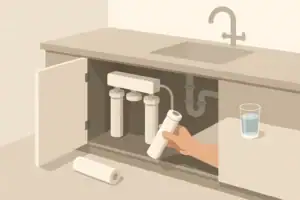
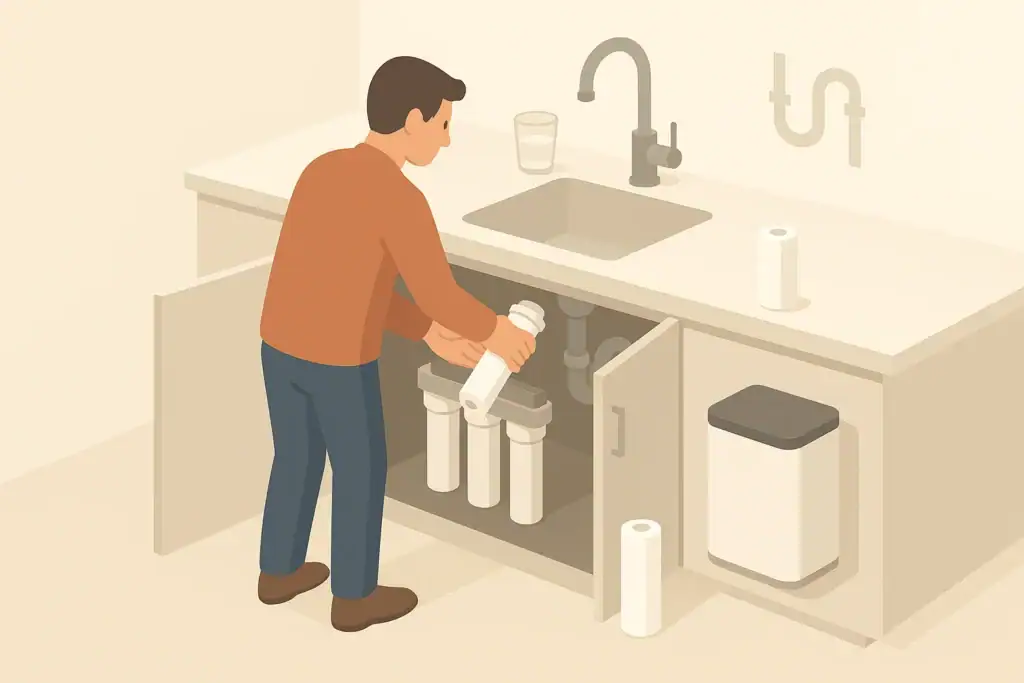
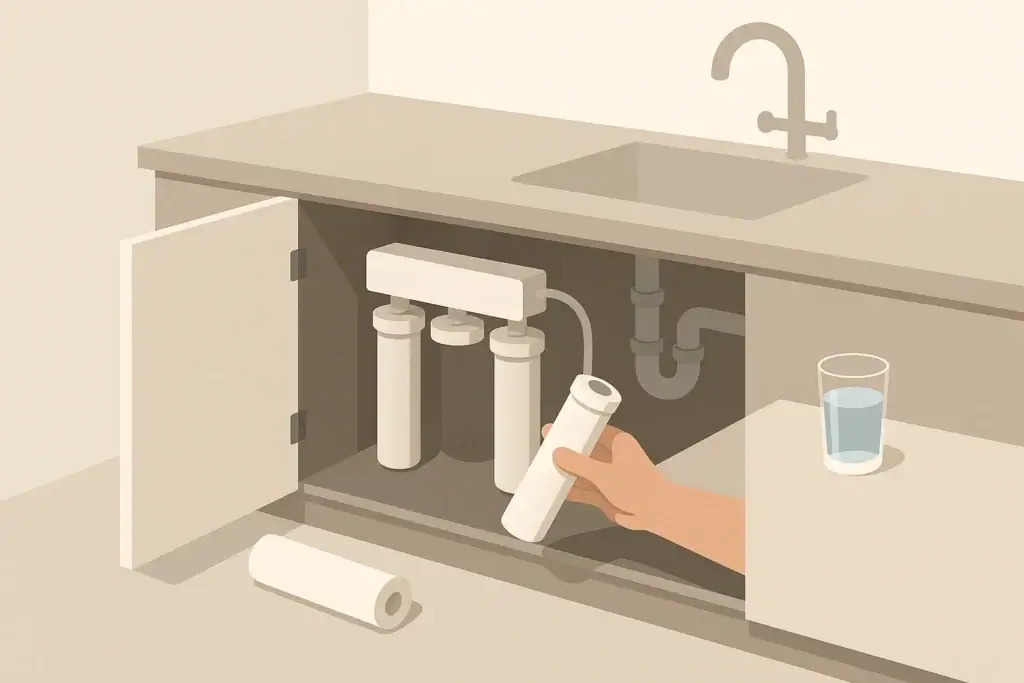
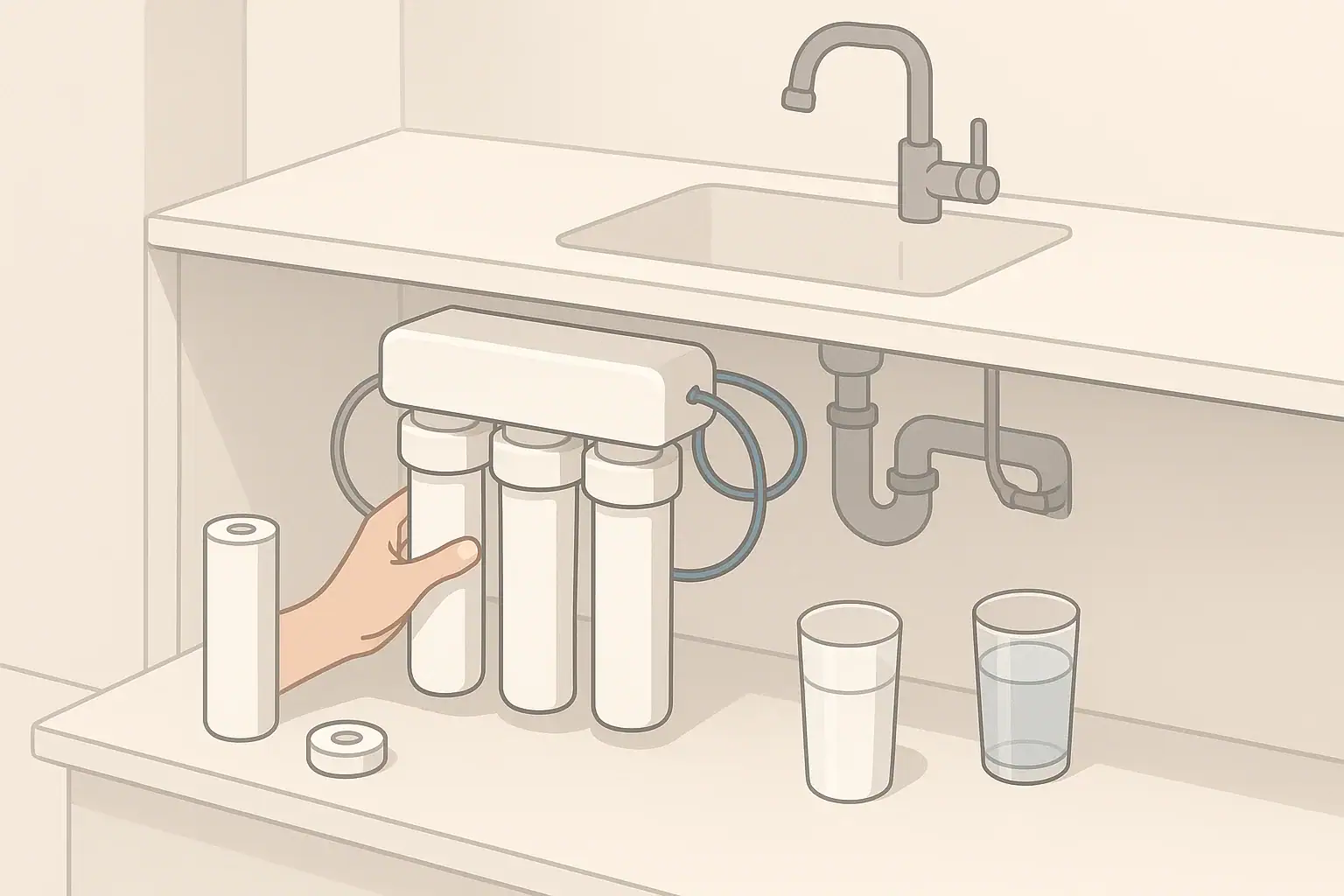
Under-sink systems, faucet filters, and refrigerator filters are usually not the primary solution for whole-house manganese staining. They may improve taste or polish water at one tap, but they do not protect toilets, showers, laundry, dishwashers, or water heaters. If the main complaint is black staining throughout the home, treatment near the point where water enters the house is often more practical. For drinking-water-only treatment, reverse osmosis can help with many dissolved substances at one tap, though it is still not a whole-house answer.
Reverse osmosis can reduce many dissolved substances at a single drinking-water tap, but it is not a whole-house stain control strategy. It also requires pretreatment and maintenance if source water contains iron, manganese, sediment, or sulfur that could foul the system.
Example values for illustration.
| Observation after treatment | Likely area to check | Practical action |
|---|---|---|
| Stains return quickly | Raw water level or insufficient oxidation | Retest raw and treated water |
| Flow at fixtures is lower | Clogged cartridge or fouled media | Check pressure drop and service interval |
| Rotten-egg odor remains | Sulfur source or water heater | Compare hot and cold water |
| Dark particles after service | Loose deposits or media fines | Flush according to equipment instructions |
| Staining only at one fixture | Local plumbing, aerator, or fixture deposits | Clean aerator and compare other taps |
| Short cartridge life | High sediment or oxidized metal load | Consider larger or backwashing pretreatment |
| Good cold water, stained hot water | Water heater sediment or hot-side deposits | Evaluate heater maintenance and hot plumbing |
Related guides: Iron in Water: Staining, Taste, and Filtration Options • Sediment vs Rust Particles: Diagnosing Brown Water • Whole House Filters vs Water Softeners: Different Jobs Explained • Backwashing Filters Explained: Pros, Cons, and Maintenance • Reverse Osmosis 101: What RO Removes (and What It Doesn’t)
Maintenance and practical next steps
Manganese treatment is not a one-time decision. Any system that captures oxidized metals will need maintenance. Cartridges must be replaced, backwashing filters need proper programming, chemical feed systems need solution refills and safe handling, and media may eventually need cleaning or replacement.
Track staining, odor, pressure, and service dates. A simple log can show whether a problem is seasonal, related to heavy water use, or tied to a missed maintenance interval. For well systems, changes after flooding, drought, pump work, pressure tank replacement, or nearby construction are also worth noting.
When to retest
Retesting is useful after installing or adjusting treatment, after major plumbing or well work, and whenever symptoms change. For private wells, periodic testing is a normal ownership task because groundwater chemistry can shift over time.
If test results show manganese along with bacteria indicators, strong sulfur odors, unusual slime, or rapid fouling, consider working with a qualified water treatment professional or local health department. The goal is not to overbuild a system, but to match treatment to the actual water conditions.
A calm order of operations
- Document where black stains, particles, taste, or odor occur.
- Compare hot and cold water if odor is present.
- Test raw water before choosing equipment.
- Include manganese, iron, pH, hardness, and odor-related indicators.
- Choose treatment based on dissolved versus particulate form.
- Size equipment for household flow and maintenance access.
- Retest treated water to confirm performance.
Black stains can be frustrating, but they are also useful clues. With testing first and a practical look at water chemistry, manganese problems can usually be narrowed down without guesswork or unnecessary equipment.
Frequently asked questions
Can manganese in water be seen without testing?
Sometimes, but not always. Black stains or dark particles can be a clue, yet manganese may be present at levels that are not obvious by sight alone. Testing is the best way to confirm it.
Is manganese the same as iron in water?
No. They are different metals, but they often occur together and can cause similar staining. Iron more often leaves orange or red stains, while manganese is more likely to cause black or dark brown residue.
Does a rotten-egg smell mean manganese is present?
Not necessarily. Rotten-egg odors usually point to hydrogen sulfide, bacteria-related conditions, or a water heater issue. Odor can help narrow the problem, but it does not confirm manganese.
Will a standard sediment filter remove manganese?
It may remove particulate manganese, but it usually will not remove dissolved manganese. If the metal is still dissolved in clear water, oxidation and a proper filtration step are often needed.
Should I test hot water, cold water, or both?
Test raw cold water first if possible, and compare hot and cold water when odor or staining seems worse on one side. Hot-water problems can sometimes point to the water heater rather than the source water.
What should I test before buying treatment equipment?
At minimum, test manganese, iron, pH, and hardness. If odor, slime, or visible particles are present, add hydrogen sulfide, turbidity or sediment indicators, and bacteria testing for private wells.
Recommended next:
- Lead in Tap Water: Practical Steps Before Buying a Filter
- PFAS Removal Options: RO vs Carbon vs Whole House
- VOCs in Water: How Carbon Filters Work
- Pesticides & Herbicides: What Filters Can Reduce Them?
- Nitrates in Well Water: What Filtration Works Best?
- Arsenic Filtration Basics: What to Look For
- More in Contaminants & Removal →
- NSF/ANSI standards explained (42/53/401/58)
- Clear trade-offs: pitcher vs faucet vs under-sink vs RO
- Maintenance planning: cost per gallon and replacement cadence