
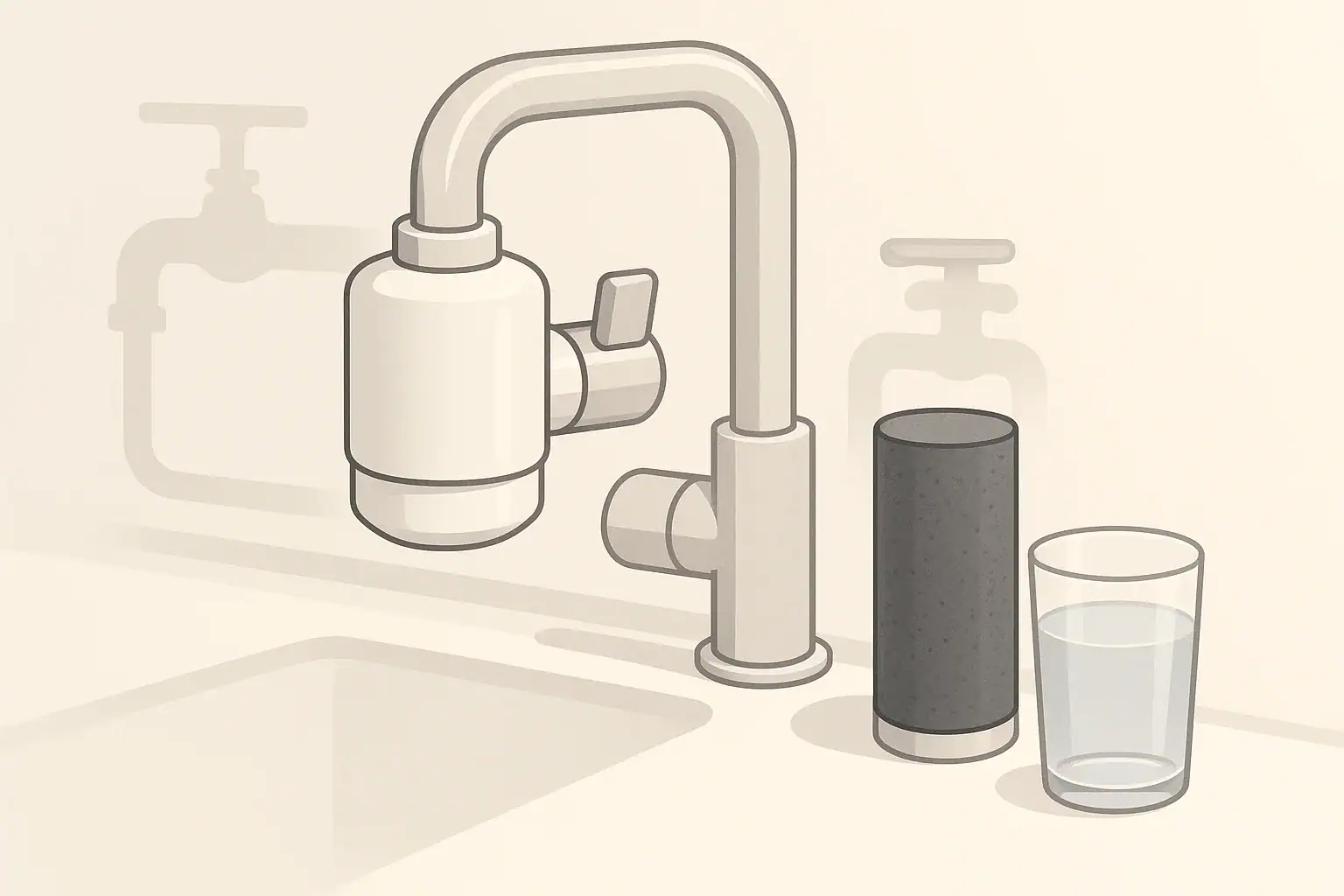
A faucet-mounted water filter is simple in concept: turn the selector one way for regular tap water and the other way for filtered water. When the switch valve starts leaking in both filtered and unfiltered modes, the problem can feel more confusing than a normal drip.
Most of these leaks come from shared parts inside the diverter assembly, worn seals, mineral buildup, thread fit issues, or pressure changes caused by a cartridge. The goal is not to modify the faucet or bypass safety features. The goal is to identify where the water is escaping, understand what the symptom means, and decide whether cleaning, a seal check, cartridge replacement, or replacing the unit is the practical next step.
How a Faucet Filter Switch Valve Works
Most faucet filters use a diverter valve attached to the end of the kitchen faucet. The diverter connects where the aerator normally sits. A small lever, knob, or slide redirects water either straight out of the faucet opening or through the filter cartridge. If your setup has never fit quite right, it may be worth checking faucet-mount filter compatibility before assuming the valve itself is the only problem.
Common parts in the assembly
Although designs vary, many faucet-mounted filters include the same basic components:
- A threaded adapter that connects to the faucet spout
- A rubber washer or gasket that seals the connection
- A diverter valve body with an internal passage
- A selector lever or switch
- One or more O-rings around moving or removable parts
- A filter housing and cartridge, often using activated carbon media
- A filtered-water outlet separate from the regular faucet outlet
Because the filtered and unfiltered paths share some of these parts, a worn washer or internal seal can affect both modes. A leak in both positions does not always mean both water paths failed separately. It often means a shared sealing surface is no longer doing its job.
Normal operation versus leakage
In normal operation, the switch should direct most water to only one path at a time. A few leftover drops after switching modes can be normal because water remains in the spout or filter outlet. A continuing stream, spray, or drip from the wrong location is different. That points to a sealing, pressure, fit, or blockage issue.
Why Filtered and Unfiltered Modes Can Both Leak
Leaks in both modes usually happen because the issue is upstream of the mode selection, inside the valve body, or at a connection that is used no matter which mode is selected. The leak may look different depending on water pressure and the position of the switch, but the underlying cause may be the same.
Shared seals can wear or shift
The washer at the faucet connection, small O-rings in the valve body, and seals around the cartridge housing are common leak points. Rubber and flexible seals can flatten, harden, twist, or become coated with mineral scale over time. Once a seal no longer compresses evenly, water can escape in either mode.
Backpressure can expose weak spots
Filtered mode usually creates more resistance than unfiltered mode because water has to pass through the cartridge. If the cartridge is clogged, incorrectly seated, or past its useful service life, pressure can build inside the diverter and housing. That pressure may push water out around threads, the selector lever, or a housing seam. For a deeper look at this symptom, see troubleshooting a faucet-mount filter with slow flow.
Mineral buildup can prevent full valve movement
Hard water minerals, sediment, and debris from plumbing work can collect around small passages and moving parts. If the switch cannot fully seat in either position, water may partially enter both paths. This can create dripping from the filtered outlet during unfiltered use, or dripping from the regular faucet outlet during filtered use. Cleaning scale early can also help prevent issues, as described in how to install a faucet-mount filter without leaks.
Example values for illustration.
| Leak symptom | Likely area to check | Practical meaning |
|---|---|---|
| Water sprays at faucet connection | Adapter threads or washer | The diverter may not be sealed evenly to the faucet spout. |
| Drip around selector lever | Internal O-ring or valve stem | A moving seal may be worn, dirty, or out of position. |
| Filtered outlet drips in unfiltered mode | Diverter seat | The valve may not be fully closing the filtered path. |
| Regular outlet drips in filtered mode | Diverter seat or cartridge backpressure | Water may be bypassing the intended filtered path. |
| Leak at cartridge cover | Housing seal or cartridge seating | The cartridge or cover may not be aligned correctly. |
| Leak worsens only at high flow | Pressure-sensitive seal | A weak seal may hold at low pressure but fail at higher flow. |
| Leak starts after cartridge change | Cartridge position or housing gasket | A seal may have shifted during replacement. |
Step-by-Step Troubleshooting by Leak Location
Start by observing the leak with the faucet running at a moderate flow. Avoid using maximum force, and do not disassemble pressurized parts while water is running. If water is spraying unpredictably, turn off the faucet before inspecting the unit.
Leak at the faucet connection
A leak where the filter attaches to the faucet is often related to the adapter, threads, or flat washer. This connection is used in both filtered and unfiltered modes, so it can leak no matter which path is selected.
Check whether the diverter sits squarely on the faucet spout. Cross-threading can happen easily with small adapters. A tilted connection may tighten enough to feel secure but still leave a gap for water. Also inspect the washer. A missing, doubled, cracked, or flattened washer can cause spraying or dripping.
Hand-tightening is usually the safe approach for plastic filter housings and many small adapters. Over-tightening can distort a washer or crack a plastic fitting. If the connection cannot seal with the correct adapter and washer, forcing it is unlikely to be a lasting fix.
Leak around the selector lever
Water around the lever usually points to the internal valve stem or its O-ring. This seal moves each time the mode is changed, so it can wear faster than a static washer. Mineral residue can also make the lever feel stiff or gritty.
If the lever no longer clicks or rests cleanly in each position, the valve may not be seating fully. Some designs allow limited cleaning of the exterior and filter outlet, while other designs do not expose the internal valve safely. If the valve body is sealed and the lever leak continues, replacement of the faucet filter assembly is often more practical than trying to rebuild it.
Filtered outlet drips during unfiltered mode
A few drops after switching away from filtered mode can simply be water draining from the filter outlet. Continuous dripping or a thin stream is different. It suggests the diverter is allowing some water into the filtered path even when it should be closed.
Possible causes include scale on the valve seat, debris in the diverter, a damaged internal seal, or a selector that is not fully engaged. If the cartridge is very clogged, pressure changes inside the housing can also make small leaks more noticeable. If flow has dropped sharply, this diagnostic checklist may help you narrow down the cause.
Unfiltered outlet drips during filtered mode
If water comes from the standard faucet outlet while filtered mode is selected, the valve may be bypassing. This is not the same as saying the water is unsafe; it means the filter is not receiving all of the flow intended for filtered mode.
For uses where filtered water quality matters for taste, odor reduction, or consistency, bypassing makes the filter less predictable. It may also make the filtered flow seem faster than normal because some water is not actually passing through the cartridge.
Leak around the cartridge housing
Leaks at the cartridge cover, cap, or seam often appear after a cartridge change. The cartridge may be misaligned, the housing cover may not be seated evenly, or a gasket may have shifted. A small piece of old gasket material or debris can also prevent the cap from sealing.
Turn off the faucet before opening any filter housing. Check that the cartridge is the correct type for the unit and that it sits in the intended orientation. If a housing cap feels unusually hard to install, stop and recheck alignment rather than forcing it.
Practical Fixes That Are Usually Safe to Try
Many faucet filter leaks can be addressed with simple inspection and maintenance. Keep the work limited to normal user-serviceable parts. Do not drill, glue, bypass, or permanently alter a faucet filter, especially if it connects to potable water.
Clean the connection and outlet screens
Remove visible grit, old plumber residue, or mineral flakes from the faucet threads, adapter, and screen areas. A soft brush or cloth is usually enough. If the faucet aerator was recently removed, check that no old washer remained stuck inside the spout.
Mineral buildup can make parts look properly installed even when they are not mating evenly. Cleaning the seating surfaces often helps the washer compress as intended.
Inspect washers and O-rings
A washer should be flexible, clean, and correctly sized for the adapter. An O-ring should not be cut, flattened, swollen, or twisted. If the product documentation identifies a user-replaceable seal, replacing that seal with the correct size can solve a leak. If the seal is not meant to be serviced, avoid improvising with random parts that may not be suitable for drinking water contact.
Replace an overdue cartridge
A clogged carbon cartridge can reduce flow and increase resistance. That does not automatically cause every leak, but it can expose weak seals. If the filter has been in service longer than the stated interval, or if filtered flow has slowed sharply, cartridge replacement is a reasonable troubleshooting step. A faucet-mount cartridge change is often the safest maintenance task to try first.
Cartridge life depends on water quality, household use, and the filter design. Homes with more sediment, higher chlorine demand, or heavy use may see shorter intervals than the label estimate.
Use moderate faucet flow
Faucet-mounted filters are not designed for unlimited pressure or high-volume use. Running the faucet fully open may increase stress on a small diverter valve, especially in filtered mode. A moderate stream can reduce splashing and may help the valve operate within a more comfortable range.
If the unit only leaks at very high flow, the immediate workaround may be to reduce flow. However, a persistent pressure-sensitive leak still points to a seal or fit problem that may worsen over time.
Check faucet compatibility
Some faucets do not work well with faucet-mounted filters. Pull-out sprayers, unusual thread patterns, very shallow spouts, damaged threads, or nonstandard aerators may prevent a reliable seal. Adapters help in many cases, but they cannot fix every spout shape. If you are still unsure whether your faucet type is the issue, review faucet adapter compatibility problems.
If the filter never sat squarely from the beginning, the issue may be compatibility rather than wear. In that case, another filtration format, such as a countertop unit or under-sink system, may be more stable.
When Replacement or a Different Setup Makes More Sense
There is a point where repeated troubleshooting is less useful than replacing the filter assembly. Small faucet-mounted units are compact and convenient, but their valves, housings, and adapters experience frequent movement and pressure changes.
Replacement is usually more reasonable when the valve body is cracked, the selector lever leaks continuously, the housing seam leaks after proper cartridge seating, or the faucet connection cannot seal with the correct adapter and washer. A cracked plastic pressure-bearing part should not be patched for continued use on a drinking water line.
It may also be time to reconsider the setup if the household regularly needs higher filtered-water volume. Faucet filters can be practical for apartments, rentals, and light kitchen use, but they are not always ideal for filling large containers, cooking frequently, or supplying multiple fixtures.
An under-sink carbon filter may provide a cleaner countertop, a dedicated filtered-water faucet, and less weight hanging from the main faucet spout. A pitcher or dispenser may be simpler for renters who cannot get a reliable faucet fit. The best choice depends on sink design, space, budget, maintenance preference, and desired flow.
Example values for illustration.
| Item to check | Example timing | Why it matters |
|---|---|---|
| Faucet adapter washer | At installation and during cartridge changes | A flat or missing washer can leak in both modes. |
| Cartridge service life | Every few months or as specified | A loaded cartridge can reduce flow and increase resistance. |
| Filtered outlet | Monthly visual check | Mineral deposits can cause drips or uneven flow. |
| Selector movement | When switching modes | Stiff movement may indicate scale or internal wear. |
| Housing cap or cover | After each cartridge replacement | Misalignment can cause seam leaks. |
| Faucet threads and adapter fit | When removing or reinstalling | Cross-threading can create persistent leaks. |
Related guides: Faucet-Mount Filters for Renters • Faucet-Mount vs Under-Sink Filters • Best Faucet-Mount Filters for Chlorine Taste • Troubleshooting a Faucet-Mount Filter with Slow Flow
Frequently Asked Questions About Faucet Filter Switch Valve Leaks
Is a small drip after switching modes normal?
A few leftover drops can be normal because water remains inside the filtered outlet or faucet spout. A steady drip, spray, or stream that continues while the faucet is running points to a sealing or diverter problem.
Can a bad cartridge make the switch valve leak?
It can contribute. A clogged or incorrectly seated cartridge can increase resistance in filtered mode. That added resistance may reveal a weak seal at the housing, lever, or faucet connection. It is not the only possible cause, but it is worth checking if flow has slowed.
Why does the leak happen in both filtered and unfiltered settings?
Both settings share parts, including the faucet connection, adapter washer, and portions of the diverter valve. If one of those shared parts fails to seal, water can leak regardless of which mode is selected.
Should tape, glue, or sealant be used to stop the leak?
Do not use glue or permanent sealants on user-serviceable drinking water filter parts. Thread tape is not a universal fix and may interfere with small plastic fittings or washers that are designed to seal by compression. Follow the product instructions and use the correct washer, adapter, or replacement part.
When should the faucet filter be replaced instead of repaired?
Replacement is usually the practical option if the valve body is cracked, the selector leaks continuously, the unit cannot seal to a compatible faucet, or leaks return after correct cartridge and washer checks. Small faucet filter valves are often not designed for extensive rebuilding.
Frequently asked questions
How can I tell whether the leak is coming from the faucet connection or the switch valve?
Watch where the water first appears. A leak at the threaded connection or washer usually shows up where the filter attaches to the faucet, while a switch valve leak often appears around the lever, housing seam, or outlet paths.
Is it safe to keep using a faucet filter that leaks in both modes?
If the leak is minor and external, the filter may still be usable temporarily, but continued leaking usually means a seal or fit problem that should be corrected soon. Stop using it if water is spraying, the housing is cracked, or the unit feels unstable.
Will cleaning mineral buildup usually fix the problem?
It can help when scale is keeping the valve from seating fully or making the lever stiff. Cleaning is most useful when the leak started gradually and the rest of the unit is in good condition.
Do I need to replace the whole filter if only the gasket is worn?
Not always. If the gasket or washer is a user-replaceable part and the correct size is available, replacing that seal may solve the leak. If the seal is built into a sealed valve body, replacement of the assembly is often the practical choice.
Recommended next:
- Best Faucet-Mount Filters for Chlorine Taste (High Flow Picks)
- Faucet-Mount Filter Compatibility: How to Check Your Faucet Type
- Faucet-Mount vs Under-Sink Filters: Convenience vs Performance
- How to Install a Faucet-Mount Filter Without Leaks
- Faucet-Mount Filters for Renters: No-Drill Setup Guide
- Troubleshooting a Faucet-Mount Filter with Slow Flow
- More in Faucet-Mount Filters →
- NSF/ANSI standards explained (42/53/401/58)
- Clear trade-offs: pitcher vs faucet vs under-sink vs RO
- Maintenance planning: cost per gallon and replacement cadence